Advertisement
)
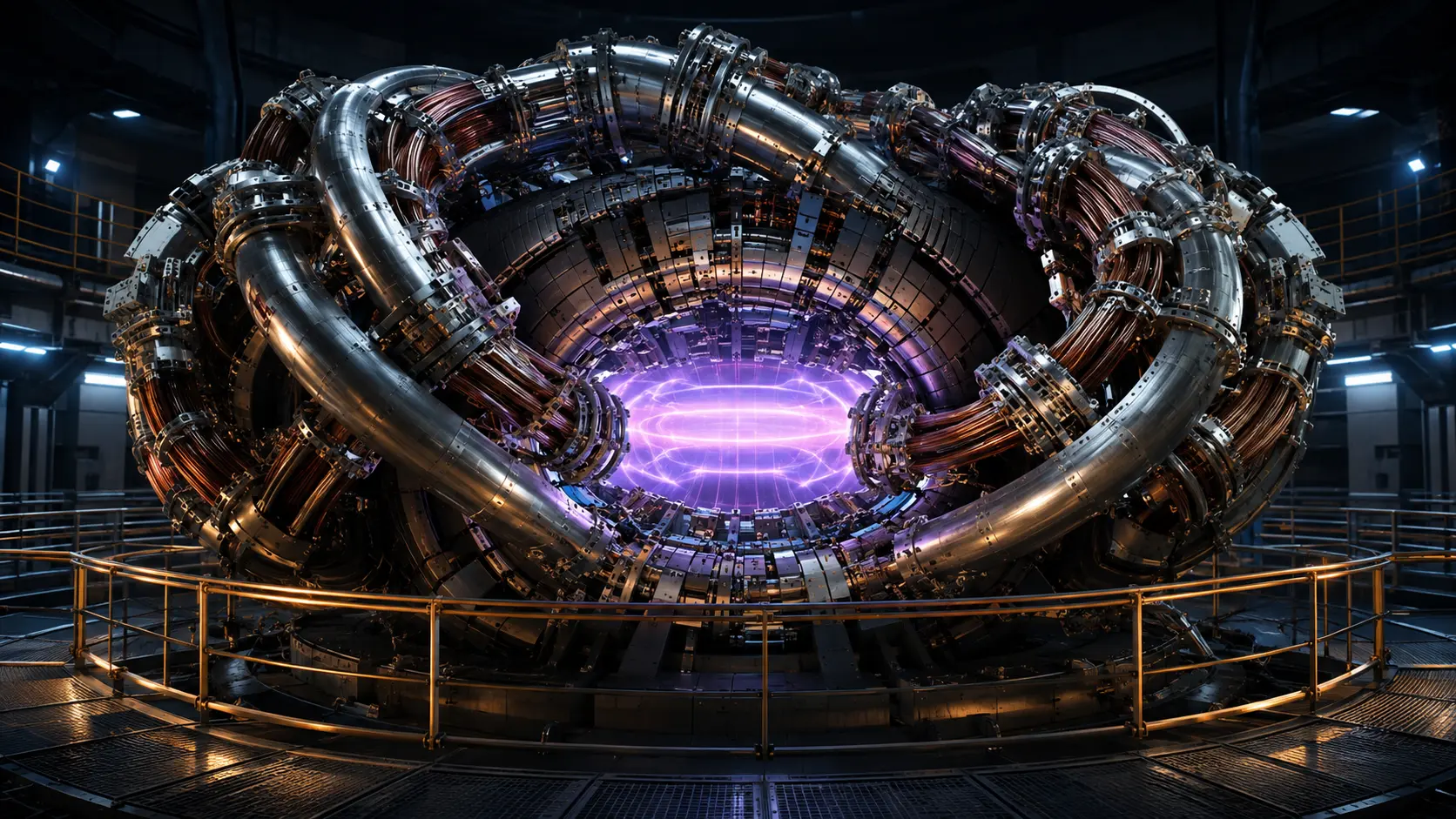

For decades, the pursuit of nuclear fusion has been dominated by a fatal flaw: the plasma keeps tearing itself apart. The world’s leading reactor design, the Tokamak, relies on blasting a massive electrical current directly through superheated plasma to hold it in place. However, this internal current is inherently unstable. Without warning, the plasma can kink, collapse, and unleash a violent “disruption” that instantly halts the reaction and physically damages the reactor walls. You cannot power a modern electrical grid with a machine that sporadically turns itself off.
To solve this, physicists abandoned the symmetrical, donut-shaped Tokamak and turned to a radically different architecture: a twisted, chaotic-looking cage of asymmetric metal coils. This design removes the volatile internal current entirely, promising a limitless, disruption-free reaction. For over fifty years, this machine was considered mathematically impossible to build because the geometry of the coils was too complex for human engineers to calculate. Today, advanced artificial intelligence and supercomputers have finally solved the math. Welcome to the era of the stellarator, the definitive blueprint for commercializing the power of the stars.
What is a Stellarator Fusion Reactor?
A stellarator fusion reactor is a highly advanced nuclear energy device that confines superheated plasma using a complex, asymmetric cage of external magnetic coils. Unlike tokamaks, stellarators do not rely on an internal electrical current to hold the plasma, allowing them to operate continuously without violent, reactor-damaging disruptions.
At a Glance
- Concept: Controlling 100-million-degree plasma using a twisted 3D magnetic field generated entirely by external, superconducting coils.
- Why it matters: The electrical grid requires steady, continuous baseload power. Tokamaks naturally operate in short “pulses” and suffer from severe disruptions. Stellarators run in a true “steady state,” making them vastly superior for commercial power generation.
- Who uses it: Elite public research hubs (Max Planck Institute’s Wendelstein 7-X) and a new wave of heavily funded private fusion startups (Proxima Fusion, Type One Energy, Renaissance Fusion).
- Biggest takeaway: The stellarator is a triumph of software over hardware. It took the advent of modern machine learning and generative AI to mathematically optimize the microscopic tolerances required for the twisted magnetic fields to trap particles effectively.
In Simple Words
To build a star on Earth, you have to heat hydrogen gas until it becomes a plasma that is ten times hotter than the core of the sun. Because no physical material can hold something that hot without melting, you have to hold the plasma inside a “cage” made of invisible magnetic fields.
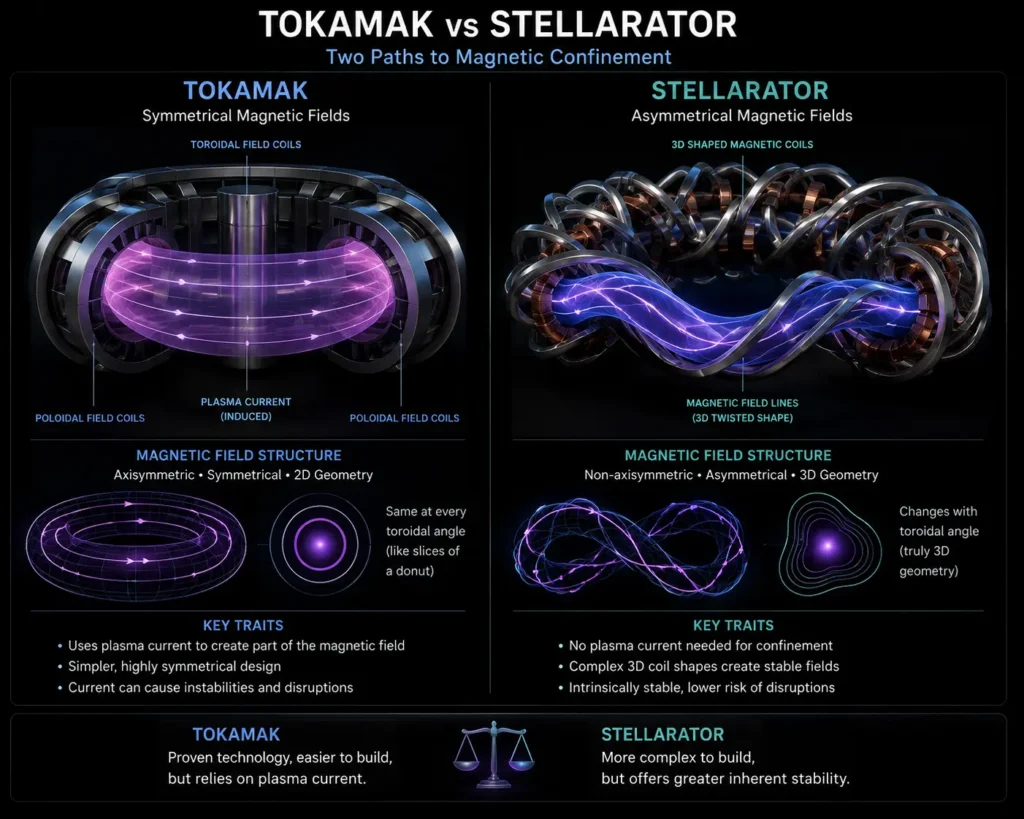
In a traditional Tokamak reactor, scientists create part of that magnetic cage by running a massive lightning bolt (an electrical current) straight through the plasma itself. The problem is that plasma behaves like a wild, writhing fluid. If the current hiccups, the magnetic cage breaks, and the 100-million-degree plasma crashes into the walls.
A Stellarator takes a smarter approach. It removes the lightning bolt completely. Instead, it builds the entire magnetic cage using giant, twisted metal magnets placed on the outside of the machine. Because the plasma is no longer doing the work of holding itself together, the machine is perfectly stable. You can turn it on, leave it running for hours or days, and it will never suddenly collapse, making it the perfect engine to plug into the global power grid.
Why This Matters
The global venture capital market poured billions into fusion during the early 2020s, heavily favoring the simpler Tokamak design. However, as those companies approach the challenge of building commercial power plants, the harsh reality of plasma disruptions and the high “recirculating power” (the energy required to drive the internal plasma current) is crippling their economic models.
Stellarators inherently solve these commercialization bottlenecks. Because they operate in a continuous steady state with minimal recirculating power, their Levelized Cost of Energy (LCOE) models project a much more competitive power plant. The recent integration of Artificial Intelligence into coil design has suddenly accelerated the stellarator timeline, rapidly shifting investor sentiment. Mastering the stellarator is no longer just a physics experiment; it is a race to claim the foundational intellectual property for the ultimate zero-carbon baseload energy source.
The Shift from Tokamaks to Stellarator Fusion Reactors
We are entering the “Commercial Translation” phase of stellarator development.
The foundational physics were proven by the Wendelstein 7-X (W7-X) in Germany, which confirmed that a computational stellarator design translates perfectly into physical hardware with error margins tighter than 1:100,000.
Now, the industry is merging stellarator physics with two parallel technology booms: High-Temperature Superconducting (HTS) tape and Artificial Intelligence. HTS magnets allow the reactors to be built significantly smaller and cheaper, while AI platforms like Princeton Plasma Physics Laboratory’s STELLAR-AI (launched in 2026) are generating and evaluating hundreds of novel coil geometries in hours rather than years. This convergence has allowed startups to leapfrog decades of legacy engineering.
How Stellarators Work: 3D Magnetic Confinement
Trapping a subatomic particle moving at relativistic speeds requires bending space and electromagnetism to your will. Here is the first-principles breakdown.
1. The Fundamental Problem: Particle Drift
When you place plasma in a simple magnetic donut (a torus), the magnetic field is stronger on the inside curve than the outside curve. This gradient causes the positively charged ions and negatively charged electrons to naturally drift apart, hit the walls, and kill the fusion reaction.
2. The Insufficiency of Tokamaks
To stop this drift, the magnetic field must be twisted into a helix (like a mobius strip) so the particles spiral safely around the donut. Tokamaks create this twist by inducing a massive electrical current inside the plasma. But this internal current triggers magnetohydrodynamic (MHD) instabilities. The plasma develops “kinks” and “tears,” leading to catastrophic disruptions that damage the reactor.
3. The Core Mechanism: External 3D Coils
The stellarator forces the magnetic twist entirely from the outside. Engineers design a series of deeply asymmetric, uniquely shaped electromagnetic coils. When placed in a ring, the combined magnetic field of these twisted coils perfectly forms the required 3D helical cage. The plasma is passively trapped inside; it simply flows along the predefined, stable magnetic tracks without needing to generate its own current.
4. Technical Depth: Neoclassical Optimization
Historically, stellarators leaked heat faster than tokamaks due to “neoclassical transport”—particles getting trapped in localized magnetic ripples caused by the bumpy 3D coils. Modern stellarators (like the Quasi-Isodynamic design) solve this through “Neoclassical Optimization.” By using supercomputers to warp and optimize the exact shape of the coils down to the millimeter, engineers can mathematically align the magnetic field lines so that particle drift is canceled out, perfectly retaining the heat.
5. Real-World Consequences: The Island Divertor
Because a stellarator runs continuously, it needs an “exhaust pipe” to constantly remove the helium ash created by the fusion reaction without stopping the machine. Stellarators use an “Island Divertor.” The optimized magnetic field naturally forms resonant magnetic “islands” at the edge of the plasma. These islands act as exit ramps, gently guiding the hot exhaust particles directly onto hardened, actively cooled strike plates, allowing the reactor to run indefinitely without poisoning the core plasma.
Commercializing Stellarators: Proxima Fusion and W7-X
The stellarator landscape of 2026 is defined by record-breaking public science and aggressive private commercialization.
The Wendelstein 7-X (W7-X) World Record: In May 2025, the Max Planck Institute’s W7-X achieved a historic milestone. Using a continuous injection of frozen hydrogen pellets and microwave heating, the reactor sustained a plasma at 20–30 million degrees Celsius for 43 seconds, establishing a new world record for the “triple product” (density × temperature × time) in a long-duration plasma. This proved unequivocally that stellarators can achieve the prolonged, steady-state performance required for a power grid.
Proxima Fusion’s Alpha Power Plant: Spun out of the Max Planck Institute, Proxima Fusion raised a staggering €130 million Series A in mid-2025, pushing its valuation past €2.4 billion in 2026. Utilizing AI-assisted design, Proxima is building a Quasi-Isodynamic (QI) stellarator. Armed with this capital, they are constructing the Stellarator Model Coil (SMC) by 2027 to de-risk their high-temperature superconducting (HTS) tech, targeting their “Alpha” demonstration plant to achieve net energy gain (Q>1) by 2031.
Princeton’s STELLAR-AI Platform: In early 2026, the U.S. Department of Energy (via PPPL) launched STELLAR-AI. This platform utilizes machine learning to automate the multi-objective optimization of stellarator coils. One sub-project, StellFoundry, sifts through millions of data points to generate perfect 3D configurations in days, fully digitizing the engineering pipeline and transitioning stellarator design from a manual physics problem to an automated software output.
Economic & Strategic Impact
The emergence of commercial stellarators heavily de-risks the fusion supply chain for institutional investors.
In a tokamak, a major plasma disruption can generate electromagnetic forces strong enough to rip multi-ton components off their mounts and vaporize the expensive tungsten wall cladding. Consequently, tokamak power plants must over-engineer their entire architecture to survive these violent, unpredictable events, vastly driving up the Capital Expenditure (CapEx).
Stellarators remove this engineering penalty. Because they are immune to disruptions, commercial stellarators can be built with thinner containment vessels, longer-lasting divertor components, and simpler control systems. While the initial manufacturing of the 3D twisted coils is complex, the operational expenditure (OpEx) and maintenance downtime of a mature stellarator plant are projected to be significantly lower, offering utility companies a far more predictable and bankable asset.
Advantages
- Zero Plasma Disruptions: Immune to the catastrophic magnetohydrodynamic instabilities that tear tokamak plasmas apart, guaranteeing safe, continuous operation.
- True Steady-State: Does not require pulsed operation or massive amounts of energy injected into the plasma to drive an internal current (low recirculating power).
- Lower Peak Heat Loads: The 3D magnetic geometry naturally spreads the exhaust heat over a wider surface area on the divertor, preventing the localized melting that plagues traditional reactor exhausts.
Limitations
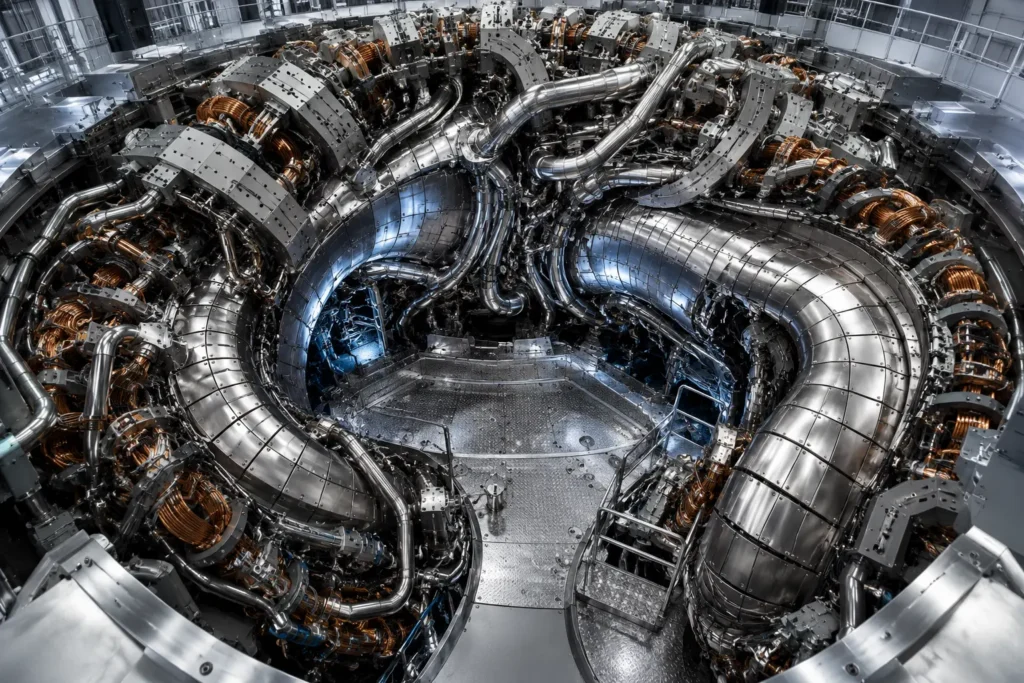
- Extreme Manufacturing Complexity: The coils are asymmetrical, twisted, and bent in 3D space. Winding brittle High-Temperature Superconducting (HTS) tape into these pretzel-like shapes with millimeter precision is an immense metallurgical challenge.
- Tritium Breeding Geometry: A commercial fusion plant must “breed” its own tritium fuel by wrapping a lithium blanket around the reactor. Designing a functional 3D blanket that flawlessly wraps around the jagged, twisted shape of a stellarator is structurally and economically unproven.
- Alpha Particle Losses: While neoclassical optimization traps the base plasma well, highly energetic “alpha particles” (the byproduct of the fusion reaction) can sometimes escape the complex magnetic field early, slightly reducing the internal heating efficiency of the reactor.
Common Misconceptions
Misconception: The stellarator is a brand new, unproven invention.
Reality: The stellarator was actually invented by Lyman Spitzer at Princeton in 1951—years before the Tokamak. However, 1950s computers were too weak to calculate the complex 3D magnetic fields, causing the design to be abandoned for decades until modern supercomputers caught up.
Misconception: Fusion reactors can melt down or explode.
Reality: Unlike nuclear fission (which relies on a fragile, self-sustaining chain reaction of heavy uranium), fusion relies on an incredibly delicate balance of heat and magnets. If a stellarator loses power or a magnet fails, the plasma instantly cools and vanishes in milliseconds. A meltdown is physically impossible.
Misconception: Stellarators use more power than they create.
Reality: Currently, yes (as do all magnetic fusion machines). However, because stellarators do not need to constantly burn energy to “push” an electrical current through the plasma, their path to commercial net-positive energy (Q > 1) requires less gross electrical input than a similarly sized steady-state tokamak.
What Most People Miss
The revolution of Standardized Permanent Magnets.
One of the great criticisms of stellarators is that the twisted, unique 3D electromagnetic coils are too expensive to mass-produce. What most people miss is that AI is solving this hardware problem.
Recent breakthroughs from PPPL propose replacing the impossibly complex, custom-wound 3D electromagnets with standardized, identical, cube-shaped permanent magnets (similar to the magnets on a refrigerator, but vastly stronger). By using AI algorithms to arrange thousands of cheap, identical magnetic blocks into highly specific geometric patterns around the vacuum vessel, engineers can artificially sculpt the required 3D stellarator field. This transition from “custom 3D coils” to “LEGO-like permanent magnet blocks” could shatter the engineering barrier and mass-manufacture stellarators at a fraction of the traditional cost.
Comparison Table
| Feature | Tokamak | Stellarator |
| Magnetic Confinement | Symmetrical external coils + Internal plasma current | 100% External, asymmetric 3D coils |
| Plasma Disruptions | High Risk (Current-driven instabilities) | Zero Risk (Inherently stable) |
| Operational Mode | Inherently Pulsed (Requires complex current drive) | True Steady-State (Continuous) |
| Engineering Complexity | Moderate (Symmetrical design) | Extreme (Asymmetrical 3D design) |
| AI Design Dependency | Moderate | Absolute (Requires supercomputing optimization) |
Case Study
Situation: The Max Planck Institute for Plasma Physics (IPP) built the Wendelstein 7-X to prove that neoclassical optimization could prevent a stellarator from leaking heat. They succeeded in proving the physics, but the global fusion community questioned if a stellarator could ever be commercialized into a functional, investable power plant.
Challenge: Academic machines like W7-X are massive, expensive science experiments. To commercialize the technology, the reactor needed to be shrunk using HTS magnets, and the engineering timelines needed to be aggressively accelerated to meet the 2030s climate-tech window.
Solution (The Proxima Fusion Spin-out): In 2023, elite researchers from the W7-X project spun out to form Proxima Fusion. They combined the verified physics data of W7-X with an entirely new, AI-assisted engineering pipeline. By applying automated multi-objective optimization algorithms, they bypassed years of manual iteration to design a compact, Quasi-Isodynamic (QI) commercial reactor.
Outcome: The financial markets immediately recognized the value of disruption-free plasma. Proxima Fusion closed a €130 million Series A in 2025, elevating their valuation past €2.4 billion in mid-2026. This capital secured the manufacturing of their Stellarator Model Coil (SMC) by 2027 and fast-tracked the 2031 deployment of the “Alpha” demonstration plant.
Lessons Learned: The case study proves that when pure physics is paired with generative AI and HTS materials, legacy constraints evaporate. The W7-X provided the structural proof, but Proxima Fusion proved that the stellarator architecture is highly investable, shifting the European fusion strategy directly toward a commercial, steady-state power plant.
Future Outlook
Next 12–24 Months
The era of the HTS Model Coils. Following the massive influx of capital in 2025, startups like Proxima Fusion and Type One Energy will physically manufacture and test their first High-Temperature Superconducting (HTS) twisted coils. Demonstrating that brittle REBCO (rare-earth barium copper oxide) tapes can be wound into tight, non-planar 3D geometries without fracturing is the final major mechanical hurdle. Success here will immediately unlock subsequent funding rounds for full-scale demonstrator plants.
Next 3–5 Years
The deployment of AI-Driven Digital Twins. Supported by initiatives like the U.S. Genesis Mission and the STELLAR-AI platform, researchers will transition from physical trial-and-error to flawless virtual experimentation. Digital twins of existing machines (like NSTX-U and W7-X) will allow AIs to instantly model how a plasma reacts to micro-adjustments in the magnetic field. This closed-loop software ecosystem will dramatically reduce the time it takes to optimize the exhaustive island divertor parameters required for commercial heat exhaust.
Next 10 Years
The Net-Gain Demonstration (Q > 1). By the mid-2030s, the first commercial stellarator demonstrators (such as Proxima’s “Alpha” plant) will reach full operations. These facilities will prove “engineering breakeven,” demonstrating not just a sustained, steady-state plasma, but the ability to extract high-grade heat and run a commercial steam turbine to generate net-positive electricity for the local grid, officially inaugurating the commercial fusion era.
Most Likely Scenario
Tokamaks will likely achieve the first raw “breakeven” fusion ignition due to their historical funding head start (e.g., ITER, Commonwealth Fusion Systems). However, because stellarators are immune to disruptions and require significantly less recirculating power, they will ultimately win the commercial race. By 2040, utilities will demand the steady-state reliability of the stellarator, rendering pulsed tokamaks as stepping-stone technologies on the path to the AI-optimized fusion grid.
Key Takeaways
- A stellarator is a fusion reactor that traps 100-million-degree plasma using a twisted, asymmetric 3D cage of external magnetic coils, entirely removing the need for a volatile internal plasma current.
- Because it lacks an internal current, the stellarator is inherently immune to violent plasma disruptions and can run in a true “steady state” (continuously), making it ideal for the commercial power grid.
- In 2025, the Wendelstein 7-X stellarator shattered world records by sustaining high-performance plasma for 43 seconds.
- Stellarators were historically impossible to design due to mathematical complexity. Today, AI platforms like STELLAR-AI automatically generate optimal magnetic coil geometries in hours.
- Private startups are aggressively commercializing the technology. Proxima Fusion raised a €130M Series A in 2025 to build a compact, HTS-powered stellarator demonstrator by 2031.
- The primary remaining engineering hurdle is the physical manufacturing of a complex, 3D “breeding blanket” to capture neutrons and regenerate tritium fuel at a commercial scale.
Glossary
Disruption: A catastrophic event in a tokamak where the plasma’s internal magnetic structure breaks down, causing the plasma to crash into the reactor walls and halt the reaction.
High-Temperature Superconductors (HTS): Advanced materials (like REBCO tape) that conduct electricity with zero resistance at temperatures higher than traditional superconductors, allowing for smaller, much more powerful magnets.
Island Divertor: The “exhaust pipe” of a stellarator. It uses resonant magnetic islands at the edge of the plasma to safely guide hot helium ash out of the reactor without stopping the continuous fusion reaction.
Neoclassical Optimization: The use of supercomputers to meticulously design the bumpy, asymmetric 3D magnetic field of a stellarator so that particle drifts cancel each other out, preventing heat loss.
Plasma: The fourth state of matter. A superheated, electrically charged gas consisting of free electrons and positive ions, required for nuclear fusion to occur.
Triple Product: The ultimate metric of fusion success, calculated by multiplying the plasma’s density, temperature, and energy confinement time.
Frequently Asked Questions
Is a stellarator better than a tokamak?
For commercial power generation, yes. Tokamaks are easier to build, but they operate in short pulses and suffer from violent plasma disruptions. Stellarators are much harder to build, but once built, they run continuously and safely without disruptions, which is exactly what a utility grid requires.
Why do stellarators look so weird and twisted?
If you put plasma in a simple donut-shaped magnet, the particles drift to the outside and escape. You have to twist the magnetic field to keep the particles trapped in the center. A stellarator forces this twist by bending the physical magnets themselves into highly complex, pretzel-like shapes.
How does AI help build a stellarator?
Calculating the exact 3D twist required to perfectly trap plasma involves evaluating millions of variables. Humans and traditional software take years to do this. AI models and machine learning can instantly recognize patterns and mathematically generate the perfect, optimized coil shapes in days.
When will we get electricity from a stellarator?
While experimental reactors like W7-X have proven the physics, commercial power requires net-positive energy. Startups like Proxima Fusion are targeting the early 2030s for their demonstration plants, meaning widespread grid connection is likely a late-2030s to 2040s reality.
Are there radioactive wastes like in a traditional nuclear plant?
No. Traditional nuclear fission uses heavy uranium and leaves behind long-lived radioactive waste. Fusion uses light hydrogen. The byproduct is harmless helium gas. The reactor walls become slightly radioactive from neutron bombardment, but this material is safe to handle and recycle within 100 years, eliminating the need for deep-geological waste dumps.
Sources
[1] PatSnap Eureka: Stellarator Fusion Reactor Technology Landscape 2026 (April 2026)
[2] Max Planck Institute for Plasma Physics: Wendelstein 7-X sets new fusion performance records (2025/2026)
[3] Proxima Fusion: Proxima Fusion raises €130M Series A to build world’s first stellarator-based fusion power plant in the 2030s (June 2025)
[4] Princeton Plasma Physics Laboratory (PPPL): PPPL launches STELLAR-AI platform to accelerate fusion energy research (January 2026)
[5] EUROfusion: Wendelstein 7-X sets World record for long plasma triple product (June 2025)