Advertisement
)

AT A GLANCE
- Concept: Ring 0 Execution: eBPF runs in the most privileged layer of the operating system, bypassing software abstraction delays.
- Concept: The Verifier: A strict mathematical algorithm checks every piece of code to ensure it cannot crash the kernel.
- Concept: Event Triggers: Programs attach to specific system calls, executing instantly when a file opens or network packets arrive.
- Concept: Kernel Bypass: Security teams gain absolute visibility into containerized applications without modifying the actual application code.
HOW eBPF WORKS
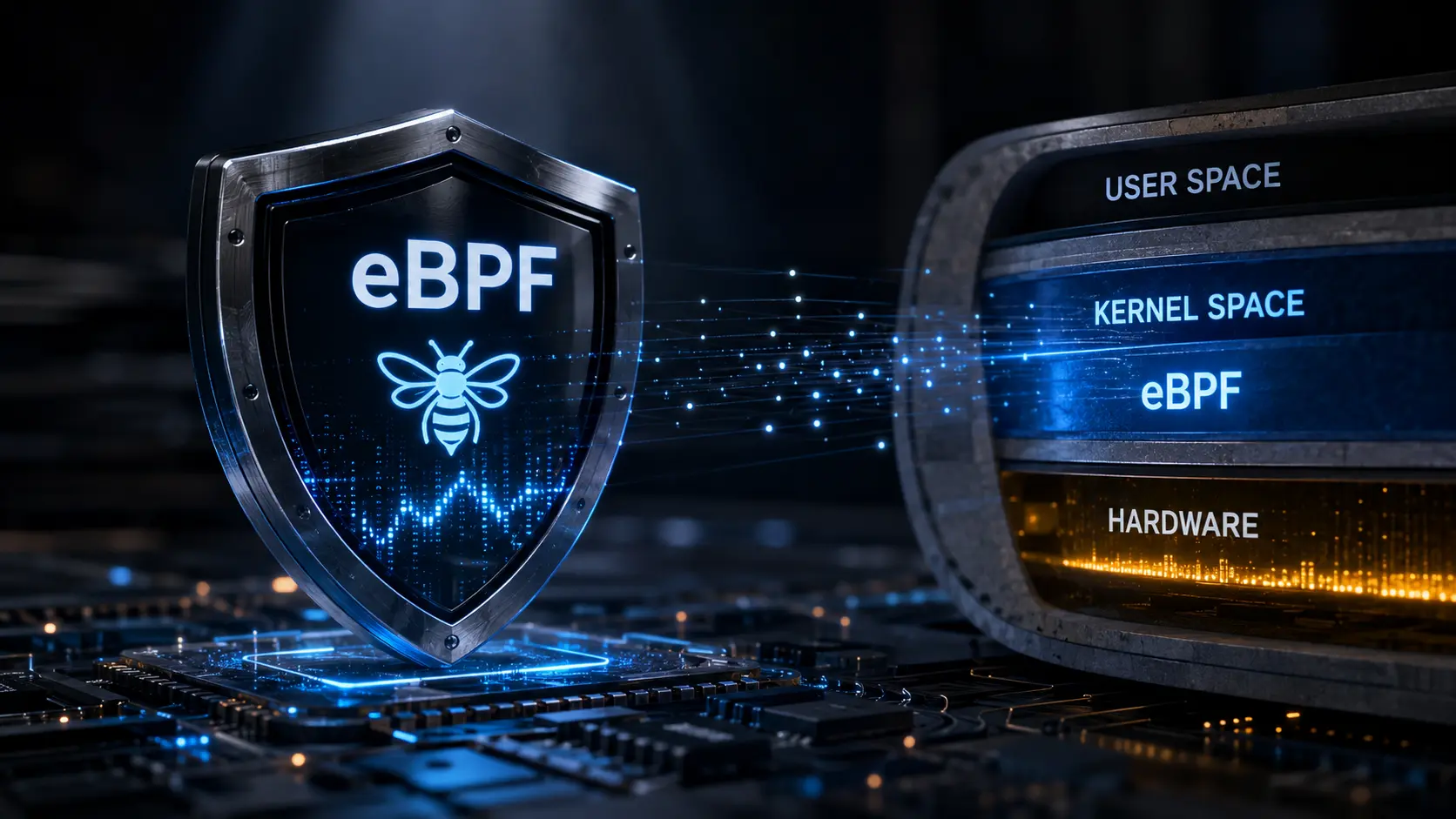
Modern operating systems physically divide computing memory into two strict domains. Standard applications run in “user space,” a restricted zone with zero direct access to the underlying hardware. When an application needs to send a network packet or read a hard drive, it must cross a boundary to ask the “kernel space” to execute the task on its behalf.
Historically, monitoring these deep kernel interactions required software engineers to write custom kernel modules. This architecture carried extreme operational risk. If a developer deployed a kernel module containing a single memory bug, the entire operating system would suffer a catastrophic “kernel panic,” instantly taking down the physical server.
eBPF solves this systemic fragility by introducing a secure, in-kernel virtual machine. Developers write a monitoring program in a standard language like C, compile it into specialized bytecode, and send it directly to the kernel.
Before the operating system executes the code, it forces the bytecode through the eBPF Verifier. This software algorithm mathematically proves that the program will not loop infinitely, access illegal memory addresses, or crash the system. Once the verifier approves the code, a Just-In-Time (JIT) compiler translates the bytecode into native machine instructions, allowing the probe to attach to specific kernel hooks and capture line-rate data instantly.
WHY IT MATTERS NOW
Modern cloud-native infrastructure relies heavily on Kubernetes, which packs thousands of ephemeral software containers onto a single physical server. These containers frequently spin up, execute a task, and terminate in less than a second. Traditional security agents operating in user space cannot track these microscopic lifespans, creating massive blind spots across the enterprise.
To capture data, legacy agents utilize “sidecar” proxy architectures. They physically copy network packets from the kernel up to the user space for inspection. This constant data duplication burns massive amounts of central processing overhead, artificially throttling the computational speed of highly dense cloud environments.
eBPF eliminates this architectural bottleneck entirely. Because the security logic lives directly inside the kernel, it intercepts hostile network traffic or malicious file executions the exact microsecond they hit the operating system. It observes every container equally, requiring zero modifications to the actual applications running above it.
Companies heavily commercialized this mechanic to build zero-trust cloud architectures. Platforms like Cilium utilize eBPF to enforce strict, identity-based network microsegmentation across multi-cloud clusters. They evaluate and drop malicious packets directly at the network interface card level, halting ransomware propagation at native hardware speeds before the hostile data ever reaches the target application.
WHAT MOST PEOPLE MISS
Cloud architects frequently view eBPF solely as a passive observability tool used to draw network topology maps. They entirely miss its capability as an active, real-time enforcement engine capable of autonomously mutating data structures on the fly.
Because an eBPF program intercepts system calls directly at the kernel boundary, it can quietly overwrite the arguments of a command before the operating system actually executes it. This allows a security probe to actively block a compromised container from opening a sensitive file, neutralizing a data breach while the malicious process remains completely unaware it was denied access.
THE TRAJECTORY
Next 12–36 Months: The integration of eBPF natively into Windows server architectures. Software conglomerates will aggressively expand eBPF compatibility across operating systems, creating a unified, cross-platform telemetry standard that eliminates the need to deploy OS-specific security agents.
Next Five Years: The death of the user-space sidecar proxy. Service meshes will migrate entirely into the kernel via eBPF. The operating system itself will natively handle encryption, routing, and load balancing, reclaiming massive amounts of cloud compute capacity for revenue-generating workloads.
Next Ten Years: Hardware offloading to specialized silicon. Cloud providers will push the eBPF execution environment down from the main central processor directly onto SmartNICs and Data Processing Units (DPUs). This shift will achieve zero-overhead, wire-rate security enforcement at the absolute physical edge of the server chassis.
What Could Go Wrong: The weaponization of the execution environment by sophisticated threat actors. If a hacker successfully gains root access and manages to bypass the verifier algorithm, they can inject malicious eBPF rootkits directly into the kernel. This creates invisible malware that intercepts and falsifies the exact telemetry data security teams use to hunt threats.
Most Likely Outcome: eBPF will become the absolute fundamental layer of modern operating systems. It will function as the universal translation layer between application intentions and hardware execution, permanently rendering legacy monitoring architectures obsolete.
KEY TERMS
- Extended Berkeley Packet Filter (eBPF): A kernel technology that allows custom programs to run in a sandboxed environment directly within the operating system.
- Kernel Space: The strictly reserved, highly privileged memory area where the core operating system and hardware drivers execute.
- eBPF Verifier: A strict software algorithm that analyzes bytecode before execution to guarantee it will not crash or compromise the kernel.
- User Space: The restricted memory area where standard applications and user programs run, requiring explicit permission to access underlying hardware.
- Sidecar Proxy: A legacy cloud architecture pattern where a separate monitoring application runs alongside the primary application, duplicating network traffic and consuming excess resources.
SOURCES
- Linux Foundation — The eBPF Documentation and Kernel Runtime Specifications
- Cloud Native Computing Foundation (CNCF) — Cilium and eBPF-Based Networking Architecture
- SANS Institute — Defending the Cloud: Exploitation and Weaponization of eBPF
- Netflix Technology Blog — How Netflix Uses eBPF Flow Logs at Scale for Cloud Network Observability