

AT A GLANCE
- Concept: Massive ships carrying iron ore and coal dictate the primary index volatility.
- Concept: A strict formula calculates daily net profit after subtracting bunker fuel costs.
- Concept: Fleet operators artificially reduce vessel speeds to constrain global cargo capacity.
- Concept: Emission regulations create massive pricing disparities between scrubber-equipped and standard vessels.
HOW IT WORKS (THE MECHANISM)
The Baltic Exchange operates out of London. It does not own ships. It functions purely as an information clearinghouse.
Every day, independent brokers submit their confidential assessments of current shipping rates. The index weighs three specific vessel classes: Capesize, Panamax, and Supramax.
Capesize vessels carry the heaviest weighting. They move raw iron ore and coal. To standardize the market, the exchange calculates the Time Charter Equivalent (TCE). This formula translates wildly different voyage routes into a single daily dollar rate.
The math is ruthless. Brokers take the total gross revenue of a specific cargo route. They subtract the voyage costs, which consist entirely of bunker fuel and port tolls.
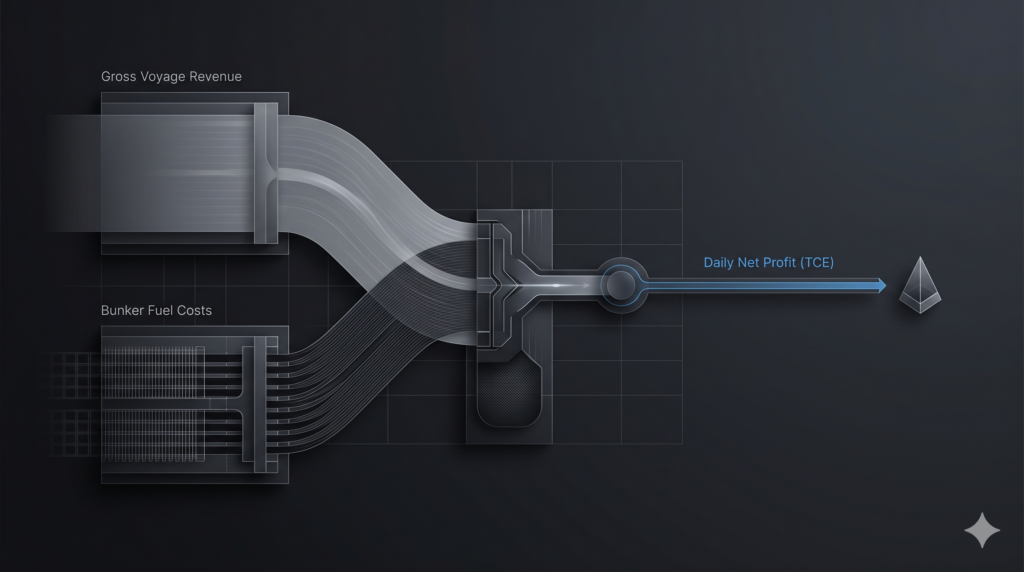
They divide the remainder by the total duration of the trip in days. This final daily rate determines whether a shipping magnate makes a profit or bleeds cash. Fuel efficiency directly dictates the TCE outcome.
WHY IT MATTERS NOW (THE HUMAN IMPACT)
The Baltic Dry Index acts as a pure leading economic indicator. It measures the demand for the raw materials that build future infrastructure. Finished goods travel in containers, but raw civilization travels in bulk.
When China plans massive steel production, Capesize rates spike weeks before the first concrete pours. Conversely, when the index collapses, it signals an immediate halt in global industrial expansion.
This index dictates the cost structure of heavy industry. In late 2021, Capesize rates surged past eighty thousand dollars per day due to massive port congestion in Asia. Steel mills in Europe immediately absorbed this cost, passing it directly into global construction projects.
The index also serves as a massive derivatives casino. Hedge funds trade Forward Freight Agreements based entirely on the Baltic calculations. These paper contracts allow speculators to bet on the future cost of shipping without ever touching a physical hull.
This paper market frequently eclipses the physical market. A hedge fund can engineer a short squeeze on specific Capesize routes. This forces industrial buyers to pay extreme premiums simply to secure a physical vessel.
WHAT MOST PEOPLE MISS
Basic economic models assume the index reflects pure supply and demand. They ignore the cartelized nature of global shipping pools. Fleet owners actively manipulate the available supply through a mechanical tactic called slow steaming.
When rates drop, major shipping pools order their captains to reduce engine speed. This physically extends the duration of every voyage. It artificially removes active tonnage from the market, creating a synthetic shortage that forces the index back upward.
Furthermore, environmental regulations provide a hidden arbitrage mechanism. The International Maritime Organization mandates low-sulfur fuel. Ships equipped with physical exhaust scrubbers can legally burn cheap, high-sulfur sludge. Owners use opaque bunker adjustment formulas to pocket this massive spread, achieving a highly profitable Time Charter Equivalent while their competitors burn cash.
THE TRAJECTORY (12–36 MONTHS)
Over the next thirty-six months, incoming Carbon Intensity Indicator regulations will permanently fracture the bulk shipping market. Ships will receive a strict energy efficiency rating from A to E.
Vessels graded D or E will face immediate operational restrictions. Charterers will refuse to hire them to meet strict corporate environmental mandates. This dynamic will strand hundreds of older vessels, instantly deleting millions of tons of cargo capacity from the global fleet.
As this physical capacity vanishes, the Baltic Dry Index will decouple from pure commodity demand. Structural supply shortages will cause unprecedented spikes in Capesize rates. Shipping pools will exploit these artificial bottlenecks, dictating premium pricing for top-tier eco-vessels while the broader global supply chain absorbs the shock.
KEY TERMS
- Time Charter Equivalent (TCE): A standard shipping industry metric calculating the average daily revenue performance of a vessel.
- Capesize: A massive cargo ship too large to transit the Panama or Suez canals, forcing it to sail around the Cape of Good Hope.
- Forward Freight Agreement (FFA): A financial derivative contract allowing participants to hedge against future volatility in freight rates.
- Slow Steaming: The deliberate reduction of a ship’s operating speed to cut bunker fuel consumption and artificially constrain fleet capacity.
- Bunker Fuel: The thick, heavy hydrocarbon oil burned by massive two-stroke marine diesel engines.
SOURCES
- The Baltic Exchange — The Baltic Dry Index Methodology
- International Maritime Organization — Sulphur 2020: Cutting Sulphur Oxide Emissions
- United Nations Conference on Trade and Development — Review of Maritime Transport
- S&P Global Commodity Insights — Capesize Freight Assessments and TCE Calculations