
AT A GLANCE
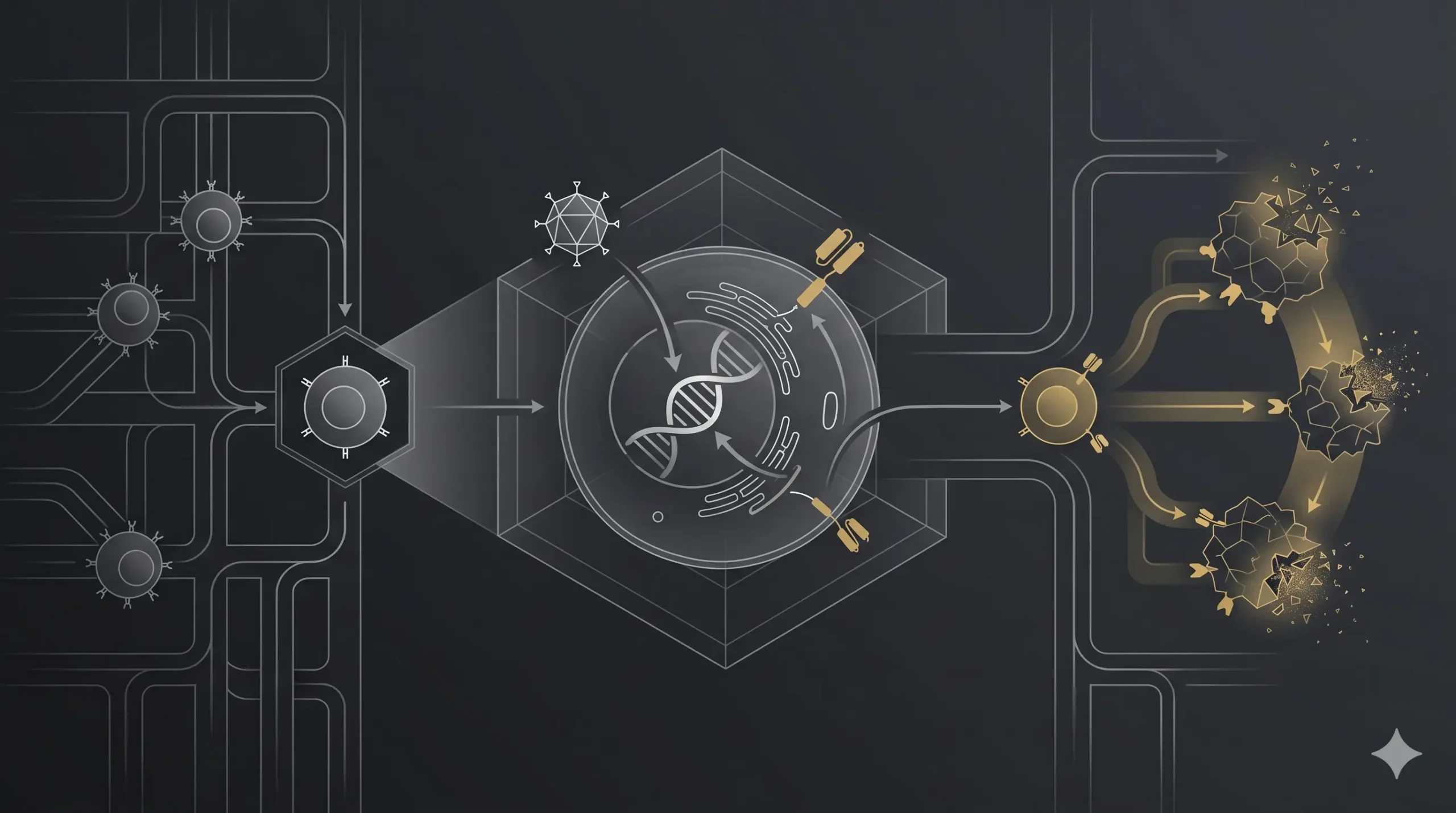
- Concept: Leukapheresis: Centrifuge machines filter white blood cells directly out of the patient’s circulating blood.
- Concept: Viral Transduction: Inactivated retroviruses insert synthetic DNA code directly into the T-cell genome.
- Concept: Co-Stimulatory Domains: Synthetic internal protein chains force the cell into hyper-aggressive multiplication.
- Concept: Antigen Escape: Tumors aggressively mutate their surface proteins to become physically invisible to synthetic receptors.
HOW IT WORKS
Human T-cells naturally patrol the bloodstream, searching for abnormal proteins called antigens. Cancer cells survive by masking these antigens, rendering themselves biologically invisible to the human immune system.
To break this camouflage, engineers physically rewrite the T-cell’s genetic code. They extract the patient’s blood and isolate the T-cells in a specialized biomanufacturing facility.
Technicians use a modified, harmless retrovirus as a biological delivery vehicle. The virus injects synthetic DNA directly into the T-cell nucleus. This forces the cell to grow a Chimeric Antigen Receptor (CAR) on its outer membrane.

This synthetic receptor acts as a biological homing beacon. The external claw locks onto a specific protein, such as CD19, found exclusively on the surface of leukemia and lymphoma cells.
The true engineering lies inside the cell. Modern constructs include synthetic co-stimulatory domains attached to the receptor’s internal tail. When the external claw grabs a cancer cell, these internal domains trigger a massive biochemical cascade. They force the T-cell to multiply exponentially and release toxic perforin proteins that physically shatter the tumor cell wall.
CAR-T Cytokine & Suicide Switch Simulator
Balance CAR-T dosage against tumor burden. Activate the synthetic kill-switch to halt fatal systemic inflammation.
WHY IT MATTERS NOW
This genomic reprogramming represents the first true curative therapy for late-stage blood cancers. Patients with terminal B-cell lymphomas who exhaust all traditional chemotherapy options routinely achieve complete remission following a single infusion of Novartis’s Kymriah or Bristol Myers Squibb’s Breyanzi.
However, this biological precision creates severe economic friction. Manufacturing a bespoke living drug takes three to six weeks. During this biomanufacturing window, aggressively mutating cancers often kill the patient before the engineered cells leave the laboratory.
The infrastructure required dictates the ultimate cost. A single treatment prices between $400,000 and $500,000. This figure excludes the massive intensive care costs required to manage the brutal side effects of the therapy.
When millions of engineered T-cells simultaneously attack a tumor, they trigger Cytokine Release Syndrome (CRS). The dying cancer cells release massive amounts of inflammatory proteins, causing the patient’s immune system to overreact violently. Without immediate intervention, CRS induces rapid organ failure and fatal neurological toxicity.
WHAT MOST PEOPLE MISS
Mainstream medical journalism hypes CAR-T as a universal cure for all oncology. They ignore the brutal mechanical reality of the tumor microenvironment. CAR-T excels at hunting liquid blood cancers because the engineered cells circulate freely to find their targets.
Solid tumors, like pancreatic or lung cancers, build physical and chemical fortresses. They surround themselves with a dense extracellular matrix that physically blocks T-cells from entering. More critically, solid tumors deploy antigen escape. If a CAR-T cell is programmed to hunt a specific protein, the solid tumor simply stops expressing that protein on its surface, rendering the multi-million-dollar therapy completely useless in a matter of days.
THE TRAJECTORY
Next 12–36 Months: Fourth-generation CAR-T constructs, known as TRUCKs, will enter late-stage clinical trials. These cells feature engineered suicide gene switches. If a patient experiences fatal cytokine toxicity, doctors administer a specific oral drug that activates the suicide gene, instantly destroying the synthetic T-cells and shutting off the immune response.
Next Five Years: The industry will pivot away from autologous, patient-derived manufacturing toward allogeneic, off-the-shelf therapies. Using CRISPR-Cas9, foundries will delete the rejection markers from healthy donor T-cells, creating universal CAR-T banks that can be injected immediately upon diagnosis without waiting weeks for manufacturing.
Next Ten Years: Dual-targeting CAR-T cells will utilize Boolean logic gates encoded directly into their DNA. The cell will only fire its toxic payload if it detects protein A AND protein B, but NOT protein C. This genetic circuitry allows the cell to differentiate perfectly between a malignant solid tumor and healthy organ tissue.
What Could Go Wrong: Allogeneic, off-the-shelf T-cells risk triggering Graft-versus-Host Disease. If the CRISPR gene editing fails to completely silence the donor’s native immune receptors, the injected CAR-T cells will identify the patient’s own body as a foreign pathogen and systematically attack their healthy organs.
Most Likely Outcome: CAR-T will remain highly specialized and localized to tier-one academic medical centers. The extreme logistical complexity of cold-chain cell transport and intensive care monitoring will prevent genomic oncotherapy from scaling rapidly across emerging markets.
KEY TERMS
- Cytokine Release Syndrome (CRS): A potentially fatal systemic inflammatory response triggered when engineered T-cells simultaneously destroy large masses of cancer cells.
- Retroviral Vector: An engineered, harmless virus used as a delivery mechanism to insert synthetic genetic code into the DNA of a host cell.
- Co-Stimulatory Domain: An intracellular protein sequence added to synthetic receptors to amplify T-cell multiplication and survival upon encountering a tumor.
- Antigen Escape: An evolutionary survival mechanism where cancer cells mutate and stop displaying the specific surface proteins targeted by engineered immune cells.
- Allogeneic Therapy: A medical treatment utilizing cells or tissues harvested from a healthy, genetically distinct human donor rather than the patient themselves.
SOURCES
- Food and Drug Administration (FDA) — Cellular & Gene Therapy Products
- Nature Reviews Clinical Oncology — CAR T-cell therapy for solid tumours
- The New England Journal of Medicine — Chimeric Antigen Receptor T Cells in Hematologic Malignancies
- Novartis — Kymriah (tisagenlecleucel) Prescribing Information