Advertisement
)


AT A GLANCE
- Concept: The Bandgap: The exact amount of energy an electron needs to break free and generate electricity.
- Concept: Thermalization Loss: Traditional silicon turns high-energy blue sunlight into wasted heat instead of electrical current.
- Concept: The Tandem Stack: Layering two different photovoltaic materials allows the panel to harvest distinct segments of the light spectrum.
- Concept: The Shockley-Queisser Limit: The absolute physical ceiling of 29.4 percent efficiency for any single-material solar cell.
HOW A PEROVSKITE-SILICON TANDEM WORKS
Solar panels generate electricity when incoming photons strike electrons, giving them enough energy to jump across a material’s atomic bandgap. Traditional solar panels rely entirely on a single layer of crystalline silicon, which possesses a narrow bandgap of roughly 1.1 electron volts (eV).
This narrow bandgap creates a severe physics problem called thermalization. Silicon absorbs low-energy red and infrared light perfectly. However, when a high-energy blue photon strikes the silicon, the electron absorbs the required 1.1 eV and immediately bleeds off the excess energy as wasted thermodynamic heat, physically degrading the panel’s efficiency.
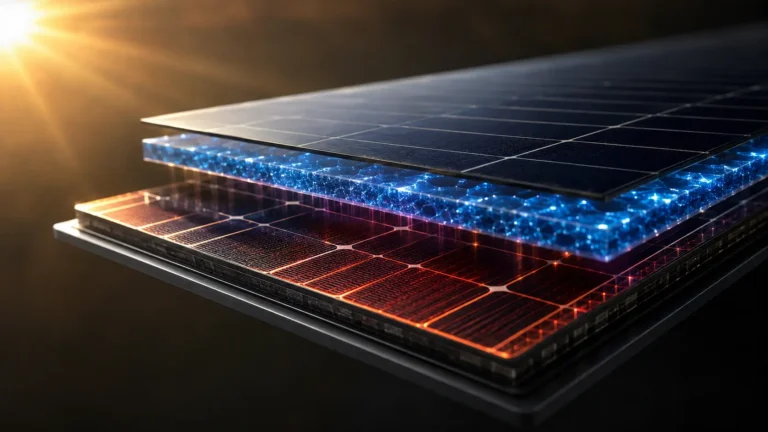
A tandem heterojunction solves this by stacking two different materials with complementary bandgaps. Engineers physically print a micro-thin layer of synthetic perovskite crystal directly on top of the silicon base. Perovskite features a wide, highly tunable bandgap tuned precisely to 1.7 eV.
When sunlight hits this tandem architecture, the top perovskite layer instantly captures the high-energy blue photons, converting them efficiently into electricity without generating excess heat. The crystal is highly transparent to lower-energy wavelengths, allowing the red and infrared photons to pass straight through to the bottom silicon layer. By splitting the solar spectrum, the stack harvests the entire light wave simultaneously.
WHY IT MATTERS NOW
The global transition to electrified economies faces a strict geographic constraint. Solar developers are running out of cheap, flat land near existing high-voltage transmission lines. Maximizing the exact power output of every single square meter of deployed glass now dictates the profitability of modern renewable infrastructure.
For decades, the fundamental physics of single-junction silicon capped commercial solar panel efficiency around 22 percent. Tandem heterojunctions shatter this ceiling, pushing laboratory efficiencies past 33 percent. This mechanical leap permanently rewrites the Levelized Cost of Energy (LCOE) for utility-scale solar farms.
By increasing the energy yield of a panel by thirty percent without increasing its physical footprint, developers require fewer steel mounting racks, less copper wiring, and significantly less land to hit their megawatt targets. Advanced material companies like Oxford PV are currently commercializing these cells, shifting them from laboratory novelties to mass-manufactured assets rolling off European production lines.
This density increase also physically unlocks the urban solar market. Commercial real estate holds minimal roof space. Equipping a massive high-rise data center with standard silicon panels barely offsets its cooling load, but deploying highly dense tandem perovskites allows corporate consumers to generate a structurally significant fraction of their baseload power directly on-site to bypass congested grid pricing.
WHAT MOST PEOPLE MISS
Renewable energy analysts often assume perovskite is merely a cheaper replacement for silicon. They completely miss the electrochemical fragility that prevents perovskite from surviving independently in the field. Pure perovskite crystals degrade violently when exposed to ambient moisture, oxygen, or extreme ultraviolet radiation.
The true engineering moat of a tandem cell lies in its atomic passivation layers. Manufacturers must deposit microscopic barriers between the perovskite and the silicon to prevent chemical reactions that would destroy both materials. The commercial winner of the tandem race will not be the company that achieves the highest laboratory efficiency, but the company that engineers a transparent encapsulation layer capable of keeping the perovskite chemically stable for a twenty-five-year outdoor warranty cycle.
THE TRAJECTORY
Next 12–36 Months: Commercial deployment of the first utility-scale tandem panels in harsh-weather testing sites. Early adopters will accept higher degradation risks in exchange for extreme power density, establishing baseline durability metrics for the infrastructure insurance industry.
Next Five Years: The standardization of slot-die coating in silicon gigafactories. Traditional panel manufacturers will avoid building entirely new supply chains, instead retrofitting existing silicon production lines with specialized printing nozzles that coat the wet perovskite ink directly onto standard silicon wafers at industrial speeds.
Next Ten Years: The transition to all-perovskite multi-junction cells. Material scientists will entirely phase out the rigid, expensive silicon bottom layer. They will stack distinct, flexible perovskite layers tuned to different bandgaps on cheap plastic substrates, enabling ultra-lightweight, high-efficiency solar films that can wrap entirely around moving electric vehicles and aircraft.
What Could Go Wrong: Severe heavy metal toxicity during a catastrophic weather event. High-efficiency perovskite crystals currently require microscopic amounts of water-soluble lead to maintain their atomic structure. If a massive hailstorm shatters a utility-scale tandem array, rain could theoretically leach these heavy metals directly into the local groundwater, triggering devastating environmental lawsuits.
Most Likely Outcome: Perovskite-silicon tandems will become the absolute standard for premium commercial and utility solar. The geometric physics of stacking bandgaps is the only viable mechanism to bypass the Shockley-Queisser limit and continue driving down the cost of global energy generation.
KEY TERMS
- Bandgap: The precise amount of energy required to free an electron from a solid material, allowing it to move freely and generate an electrical current.
- Thermalization: The physical process where a solar cell absorbs a photon with too much energy, bleeding the excess off as unusable heat instead of electricity.
- Heterojunction: An interface that occurs between two different semiconductor materials possessing unequal bandgaps, designed to manipulate electron flows.
- Shockley-Queisser Limit: The calculated maximum theoretical efficiency of a solar cell made from a single specific material, historically capping silicon at roughly 29.4 percent.
- Passivation: The application of a micro-thin protective coating to a semiconductor surface to prevent unwanted chemical reactions and stop electron leakage.
SOURCES
- National Renewable Energy Laboratory (NREL) — Best Research-Cell Efficiency Chart and Perovskite Tandem Architectures
- Nature — Monolithic Perovskite/Silicon Tandem Solar Cells with >30% Efficiency
- Massachusetts Institute of Technology (MIT) Energy Initiative — The Future of Solar Energy and Spectral Splitting
- Science — Carrier Dynamics and Passivation Strategies in Metal Halide Perovskite Photovoltaics