Advertisement
)

AT A GLANCE
- Concept: Optical Attenuation: Light loses physical intensity as it travels through thousands of miles of silica glass.
- Concept: O-E-O Bottleneck: Legacy systems forced light to turn into electricity for boosting, causing severe data gridlock.
- Concept: Erbium Doping: Engineers embed rare-earth erbium ions directly into a short segment of the actual glass fiber.
- Concept: The 980nm Pump Laser: A secondary laser excites the erbium, passing its energy directly into the fading 1550nm internet signal.
HOW AN ERBIUM-DOPED FIBER AMPLIFIER WORKS
Fiber optic cables carry the internet as pulses of light tuned precisely to the 1550 nm wavelength. However, even ultra-pure silica glass absorbs photons over distance. After roughly 100 kilometers, the physical signal becomes too weak for a receiving station to read.
Legacy telecommunications companies solved this attenuation using optical-to-electrical-to-optical (O-E-O) repeaters. They caught the weak light, converted it into electrical voltage, amplified it mechanically, and fired a new laser. This physical conversion process is sluggish and severely limits the total data throughput of the cable.
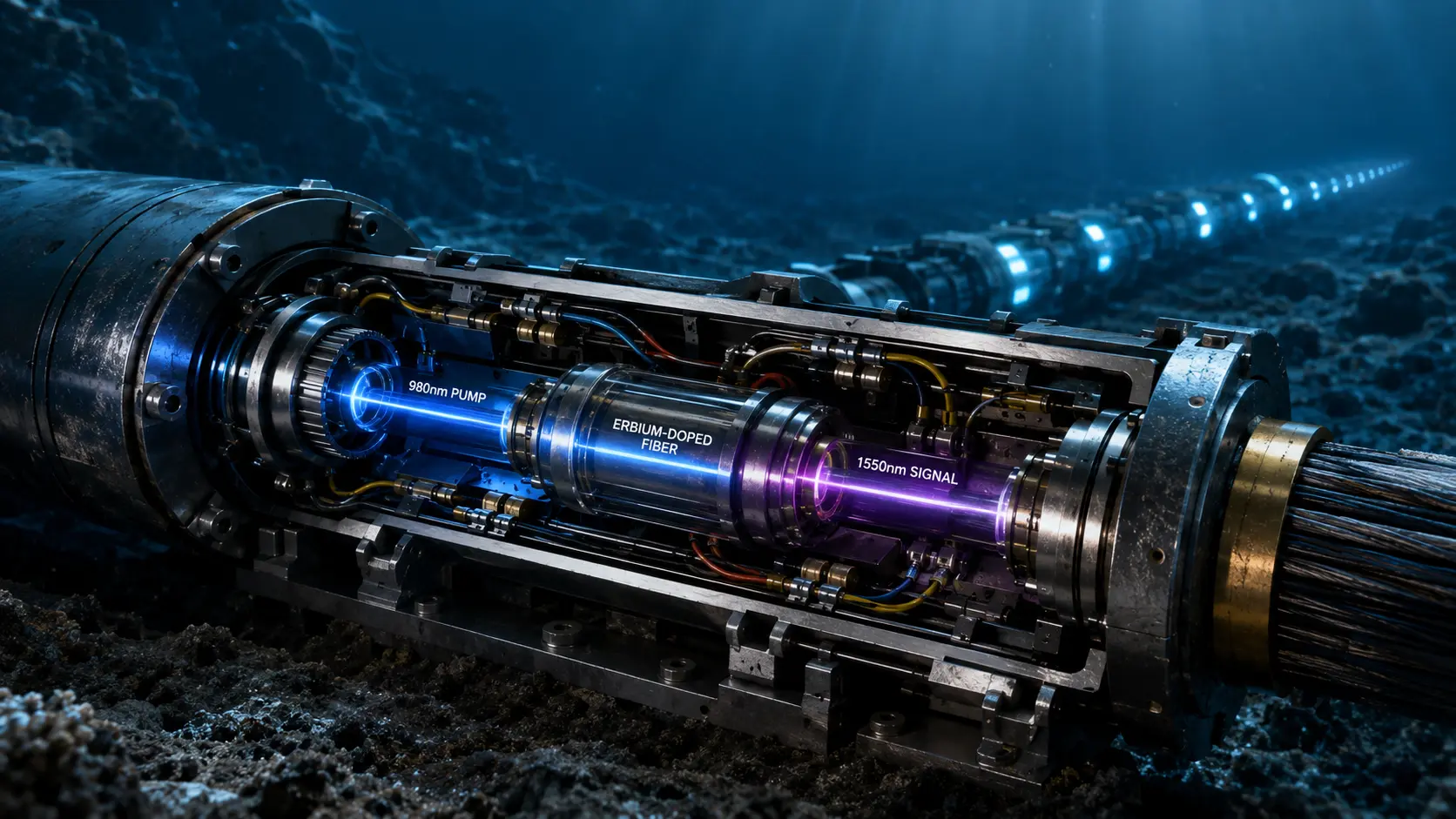
The Erbium-Doped Fiber Amplifier (EDFA) completely eliminates this electrical bottleneck. Engineers splice a short section of specialized fiber, chemically doped with the rare-earth element erbium, directly into the transoceanic cable.
Alongside the main data fiber, a secondary “pump” laser fires a continuous beam of light at exactly 980 nm. This pump laser strikes the erbium ions, exciting their electrons into a high-energy quantum state.
When the fading 1550 nm internet signal enters this highly charged erbium section, it triggers stimulated emission. The excited erbium electrons collapse back to their resting state, releasing their stored energy as exact physical clones of the incoming signal photons, multiplying the internet signal’s intensity purely through optical physics.
WHY IT MATTERS NOW
The EDFA dictated the modern structure of the global internet by enabling Wavelength Division Multiplexing (WDM). Because an EDFA amplifies light purely through photon emission, it does not care what data the light actually carries. It blindly amplifies everything operating in the 1550 nm band simultaneously.
Telecom operators exploit this blind amplification by transmitting dozens of different colors of light through a single glass strand. Each color acts as an independent, massive data channel. A single EDFA unit boosts all 80 distinct channels at once, saving operators billions of dollars in redundant subsea infrastructure costs.
Hyperscale cloud providers like Google and Meta now construct their own transoceanic cables to support massive artificial intelligence dataset synchronization. These companies demand continuous, multi-terabit bandwidth across continents. If they relied on legacy O-E-O electrical repeaters, the inherent latency and massive physical heat generation would render global AI training loops mathematically impossible.
Maintaining EDFA repeaters at the bottom of the Mariana Trench requires extreme hardware reliability. The 980 nm pump lasers must operate flawlessly under immense atmospheric pressure for a continuous twenty-five-year lifespan. Command over the rare-earth erbium supply chain and the highly specialized laser diode manufacturing base now constitutes a hard physical constraint on national digital sovereignty.
WHAT MOST PEOPLE MISS
Tech commentators frequently assume optical amplification is a perfect, infinite loop that can carry data forever. They entirely miss the mechanical degradation caused by Amplified Spontaneous Emission (ASE) noise.
When erbium ions sit in an excited state waiting for a signal photon, some inevitably decay randomly, firing rogue, unaligned photons down the glass cable. These rogue photons act as heavy optical static.
Every successive EDFA repeater in the chain amplifies the actual internet signal, but it also heavily amplifies the accumulated static from the previous amplifiers. This physical noise floor compounds rapidly, dictating the absolute maximum length of a transoceanic cable before the original signal becomes unreadable garbage.
THE TRAJECTORY
Next 12–36 Months: The massive deployment of Spatial Division Multiplexing (SDM). Cable operators will transition to multi-core fibers where a single glass strand contains multiple parallel light channels. To power these without drawing massive electrical current from the shore, operators will use shared EDFA pump lasers that optically split their 980 nm beams across multiple cores simultaneously.
Next Five Years: The integration of distributed Raman amplification. To combat the severe EDFA noise floor over ultra-long distances, subsea networks will deploy hybrid Raman-EDFA systems. Raman amplification uses the standard silica fiber itself as the gain medium, providing a distributed optical boost that dramatically suppresses compounding static.
Next Ten Years: The transition to hollow-core fiber optics. As solid glass approaches its absolute nonlinear Shannon limit, the industry will pivot to hollow-core cables where light travels through a pure vacuum. Because hollow cores physically cannot support erbium doping, engineers will be forced to entirely reinvent inline optical amplification using localized, highly pressurized gas cells.
What Could Go Wrong: Pump laser diode cascading failure. The entire transoceanic link relies on the continuous operation of the microscopic 980 nm pump diodes. If a generic manufacturing defect causes a batch of these semiconductor lasers to burn out prematurely, a $400 million cable instantly goes dark, requiring a multi-month deployment of specialized repair ships to physically haul the repeater up from the abyssal plain.
Most Likely Outcome: The EDFA will remain the absolute bedrock of global telecommunications. The ability to manipulate photons purely through rare-earth quantum states represents the most physically efficient data scaling mechanism in the history of human infrastructure.
KEY TERMS
- Wavelength Division Multiplexing (WDM): A technology that multiplexes multiple optical carrier signals onto a single optical fiber by using slightly different colors of laser light.
- Optical-to-Electrical-to-Optical (O-E-O): A legacy signal regeneration method that mechanically converts photons into electrons for amplification before turning them back into photons.
- Stimulated Emission: The quantum mechanics process where an incoming photon forces an excited electron to drop to a lower energy state, releasing a perfect clone photon.
- Amplified Spontaneous Emission (ASE): Random, unwanted light generated by excited erbium ions decaying naturally, creating compounding static noise across long distances.
- Pump Laser: A continuous, secondary laser beam operating at a specific frequency designed exclusively to transfer raw energy into a gain medium.
SOURCES
- Bell Labs — The Evolution of Erbium-Doped Fiber Amplifiers in Transoceanic Networks
- Institute of Electrical and Electronics Engineers (IEEE) — Quantum Optics and Noise Figures in Submarine Repeater Systems
- International Telecommunication Union (ITU) — Submarine Cable Network Architecture and Optical Amplification Standards
- Optica — Spatial Division Multiplexing and the Scaling Limits of EDFA