Advertisement
)

AT A GLANCE
- Concept: Vector Embeddings: Algorithms translate text into coordinates, searching for information based entirely on mathematical proximity.
- Concept: Multi-Hop Queries: Questions requiring the AI to connect several distinct, separate pieces of information sequentially.
- Concept: Graph Nodes and Edges: A database architecture storing information as explicit entities connected by defined relationships.
- Concept: GraphRAG: The AI traverses rigid relational pathways before generating text, forcing strict adherence to factual context.
HOW A KNOWLEDGE GRAPH VECTOR INDEX WORKS
Standard Retrieval-Augmented Generation (RAG) relies exclusively on flat vector databases. When an enterprise uploads thousands of PDF documents into an AI system, an embedding model mathematically translates every paragraph into a list of numbers, plotting them as coordinates in high-dimensional space. When a user asks a question, the AI converts the prompt into a coordinate and retrieves the paragraphs physically sitting closest to it.
This vector-only architecture excels at simple similarity searches, but it catastrophically fails at multi-hop reasoning. If a user asks, “Which supplier manufactures the microchips used by the subsidiary of Company X?”, a flat vector search pulls paragraphs containing the words “supplier” and “Company X.” It physically lacks the structural logic to jump from Company X, to the subsidiary, and finally to the specific supplier.
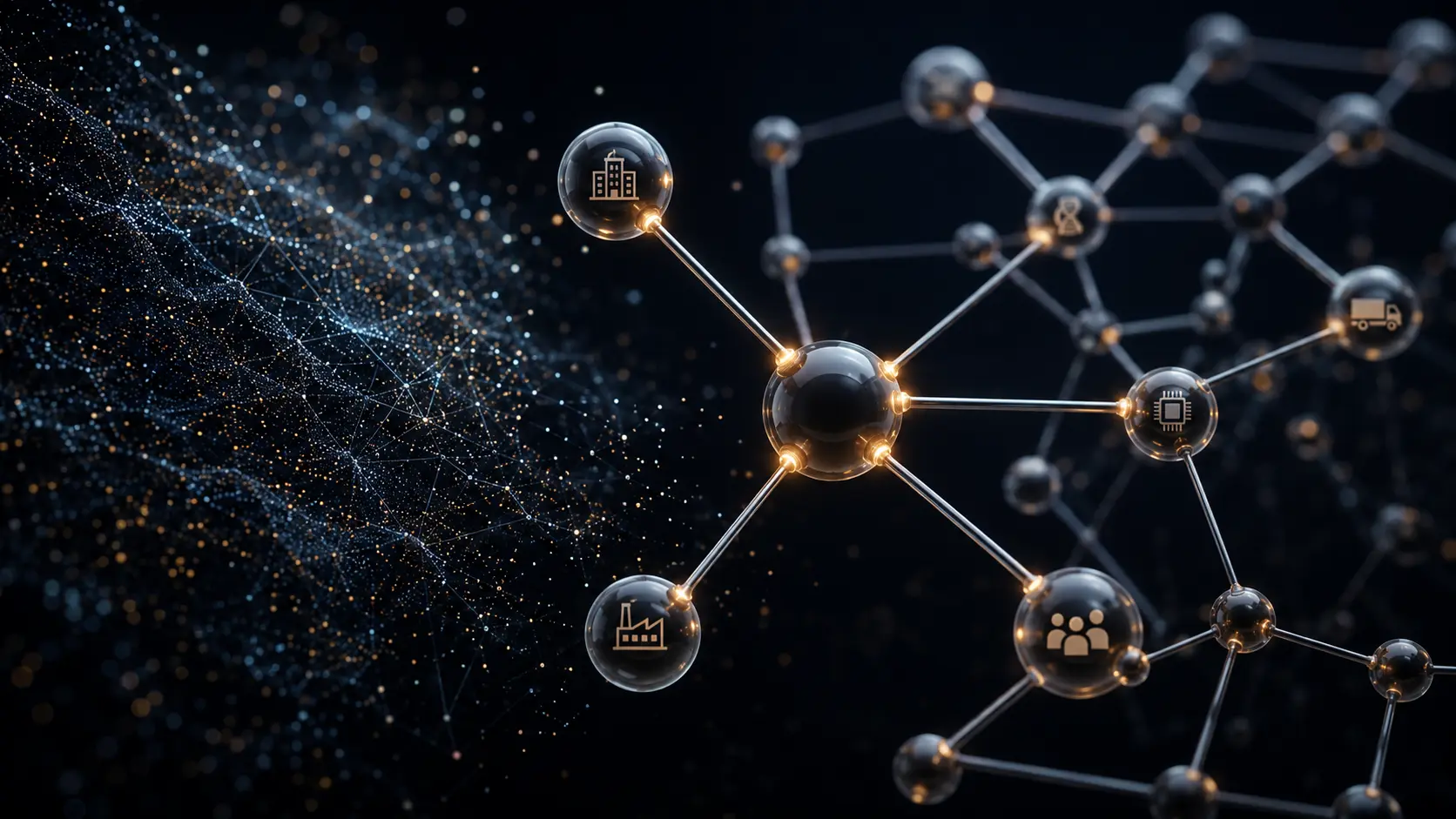
To solve this, engineers deploy a Knowledge Graph Vector Index. During the initial data ingestion, large language models scan the unstructured text and actively extract distinct entities, such as people, organizations, or products. The system defines these entities as nodes and explicitly maps the relationships between them as connecting lines, known as edges.
This hybrid architecture executes a two-step retrieval process. First, the AI uses standard vector similarity to locate the exact starting node within the massive graph. Once anchored to that entity, the search algorithm physically travels along the pre-mapped edges, traversing the factual chain from parent company, to subsidiary, to supplier before generating a final response.
WHY IT MATTERS NOW
The global artificial intelligence industry currently faces a severe enterprise adoption wall. Chief Information Officers realize that standard language models randomly hallucinate facts when querying proprietary corporate datasets. A financial institution cannot legally deploy an autonomous agent to summarize client portfolios if the underlying vector search randomly misattributes a multi-million-dollar transaction.
Graph-relational extraction instantly translates a stochastic text generator into a deterministic query engine. By forcing the language model to ground its responses exclusively in the rigid relationships of a knowledge graph, enterprises achieve near-perfect factual accuracy. The AI can no longer invent relationships; it can only report the edges that physically exist within the database.
This architectural shift completely redefines the economic value of unstructured corporate data. Legacy organizations possess decades of disorganized contracts, supply chain manifests, and engineering logs. GraphRAG allows these companies to algorithmically compile this dark data into an interactive, machine-readable map of their entire corporate existence.
Software giants and database providers aggressively commercialize this specific hybrid index. They recognize that the ultimate enterprise moat is not owning the smartest generative model. The true monopoly lies in owning the underlying graph architecture that feeds the model perfect, contextually accurate data.
WHAT MOST PEOPLE MISS
Tech media widely assumes that feeding a language model a larger context window solves the multi-hop reasoning problem. They completely miss the physical reality of the needle-in-a-haystack degradation metric. When forced to read a million-token document, the AI’s attention mechanism mathematically dilutes, causing it to randomly ignore specific relationships buried deep within the text.
GraphRAG actively bypasses the context window limitation entirely. Instead of forcing the GPU to re-read thousands of pages of raw text for every prompt, the system passes the model a highly compressed, explicit list of verified facts extracted directly from the graph. This mathematical compression drastically reduces the computational cost of the query while simultaneously guaranteeing absolute structural accuracy.
THE TRAJECTORY
Next 12–36 Months: The mass automation of ontology creation. Currently, building a knowledge graph requires human data engineers to manually define the relationship rules. New pipelines will deploy specialized AI agents that autonomously define and construct the entire graph schema directly from raw data dumps.
Next Five Years: Real-time dynamic graph mutation. As streaming data hits the enterprise, the knowledge graph will continuously update its nodes and edges in milliseconds. AI agents will monitor these shifting relationships, automatically executing financial trades or supply chain reroutes the exact moment a specific edge changes state.
Next Ten Years: Civilization-scale graph federation. Sovereign governments and multinational consortiums will link their isolated knowledge graphs into encrypted, federated networks. This will allow an AI to trace the origin of a single component through a multi-hop global supply chain across dozens of independent corporate databases simultaneously.
What Could Go Wrong: Malicious graph poisoning. If a threat actor manages to inject a subtle, false relational edge into the master database—such as secretly linking a legitimate vendor to a sanctioned entity—every AI agent relying on that graph will instantly and permanently hallucinate the exact same lie at scale.
Most Likely Outcome: The hybrid knowledge graph vector index will become the mandatory baseline architecture for all enterprise AI deployments. Flat vector search will operate strictly within consumer chatbots, while any system making financial, legal, or medical decisions will require explicit graph verification.
KEY TERMS
- Vector Embedding: A mathematical representation of text translated into a high-dimensional coordinate, allowing algorithms to calculate semantic similarity.
- Knowledge Graph: A specialized database that stores information inherently as a network of distinct entities and their explicit logical relationships.
- Node: A fundamental unit within a graph database representing a specific, unique entity such as a person, company, or concept.
- Edge: The defined, directional connection between two nodes in a graph that explicitly describes the physical or logical relationship between them.
- GraphRAG: An advanced retrieval architecture that combines graph database traversal with language models to guarantee accurate multi-hop reasoning.
SOURCES
- Microsoft Research — GraphRAG: Enterprise LLM Discovery on Narrative Private Data
- Neo4j — The Architecture of Hybrid Vector and Graph Indexes for Generative AI
- Institute of Electrical and Electronics Engineers (IEEE) — Multi-Hop Question Answering in Large-Scale Knowledge Graphs
- Stanford University Artificial Intelligence Laboratory — Mitigating Hallucinations through Graph-Relational Extraction