Advertisement
)

AT A GLANCE
- Concept: Pulse Power: Kinetic flywheels capture raw nuclear reactor energy and release it in explosive micro-bursts.
- Concept: Linear Induction: Instead of rotating a circular shaft, the motor unrolls geometrically to pull a shuttle straight forward.
- Concept: Dynamic Tuning: Software algorithms adjust the magnetic wave microsecond by microsecond to prevent airframe stress.
- Concept: Weight Spectrum: The system scales power instantly to launch heavy bombers and lightweight autonomous drones consecutively.
HOW THE ELECTROMAGNETIC AIRCRAFT LAUNCH SYSTEM WORKS
Legacy aircraft carriers rely on mechanical steam catapults. These systems divert high-pressure steam directly from the ship’s nuclear reactor into a massive physical piston. This creates a violent, uncontrollable explosive force that physically degrades the structural integrity of naval aircraft over time.
The Electromagnetic Aircraft Launch System (EMALS) replaces this steam architecture with a pure solid-state electrical grid. However, the ship’s nuclear reactor cannot generate the instantaneous electrical spike required to accelerate a massive fighter jet from zero to 160 knots in three seconds.
To solve this energy deficit, engineers deploy specialized Energy Storage Groups. The ship feeds steady electrical current into massive kinetic flywheels, spinning heavily shielded steel rotors up to 6,400 revolutions per minute. This physical mechanism stores the electricity as pure rotational momentum.
When the flight deck operator triggers the launch sequence, specialized alternators instantly extract this kinetic energy. They convert the rotational momentum into a massive 121-megajoule electrical pulse, routing the current directly into a Linear Induction Motor (LIM) embedded inside the flight deck.
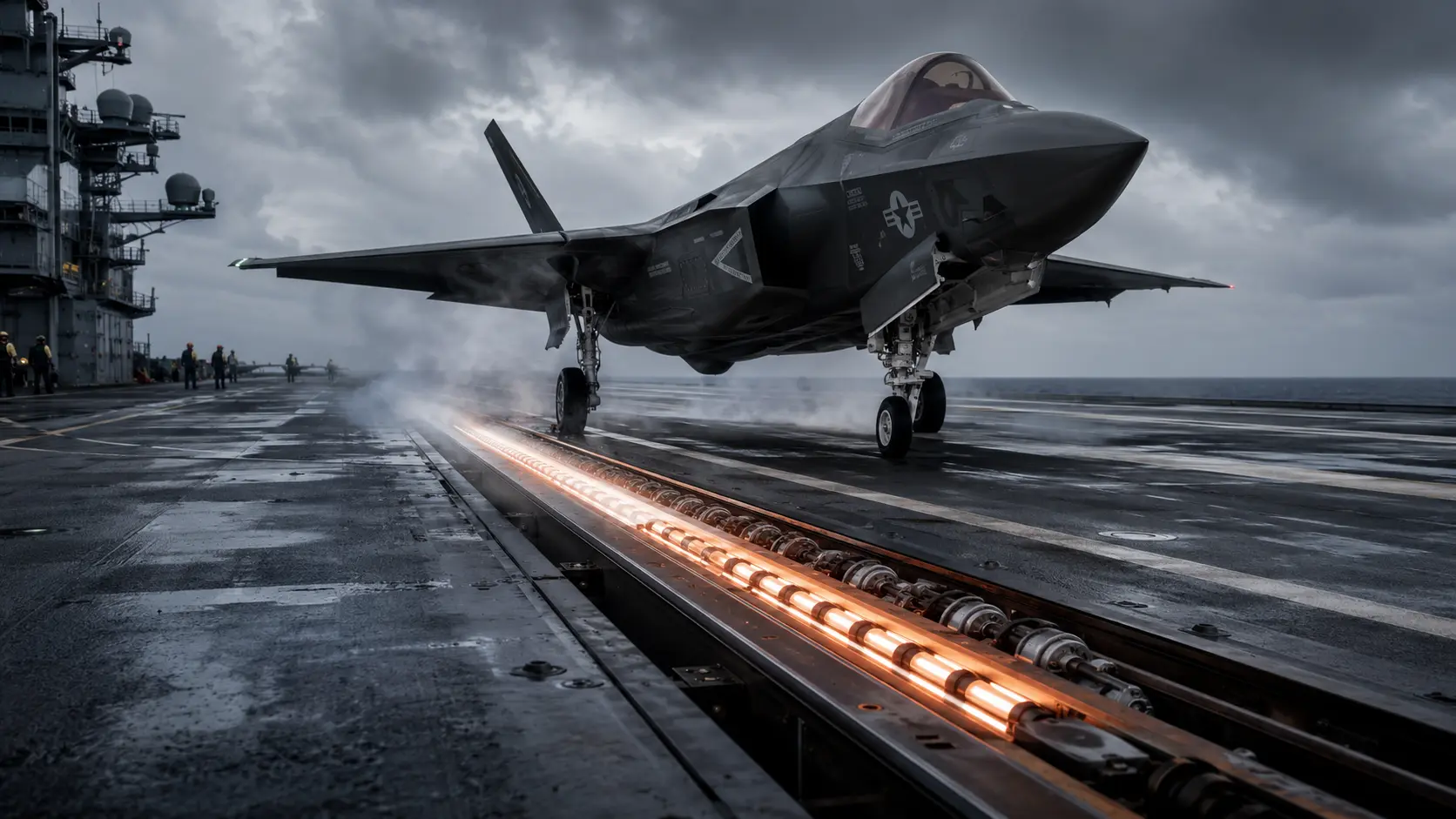
A standard electric motor uses magnetic fields to spin a circular rotor. A linear induction motor mathematically unrolls that circle into a flat, 300-foot track.
As the pulse-power hits the stator coils embedded in the deck, it generates a traveling magnetic wave. This invisible electromagnetic force grabs the aircraft shuttle and pulls it linearly down the track, converting raw electricity into extreme forward acceleration.
WHY IT MATTERS NOW
The transition from steam to electromagnetics dictates the future composition of naval carrier air wings. Steam catapults possess a rigid minimum operational threshold; they physically cannot launch anything lighter than a manned fighter jet without ripping the airframe apart.
EMALS software solves this mechanical limitation by precisely modulating the acceleration curve. A deck operator can launch a fully loaded, 100,000-pound F-35C Lightning II, and sixty seconds later, dial the magnetic wave down to gently launch a 3,000-pound autonomous surveillance drone.
This mechanical flexibility enables the integration of the MQ-25 Stingray unmanned aerial refueler. By launching drone tankers off the deck, the United States Navy massively extends the physical strike radius of its carrier strike groups. This capability allows the multi-billion-dollar ship to remain safely outside the range of Chinese hypersonic anti-ship missiles while still projecting offensive force.
Furthermore, the electromagnetic architecture strips massive amounts of weight and maintenance complexity out of the ship’s hull. Removing miles of high-pressure steam piping reclaims critical physical space below deck. Engineers utilize this reclaimed volume to install larger magazines for precision-guided munitions or massive battery banks for future directed-energy laser weapons.
The ultimate strategic consequence is sustained sortie generation. The Ford-class aircraft carrier, utilizing EMALS, is mathematically modeled to execute 160 sorties per day. This represents a 33 percent increase over the legacy Nimitz-class, directly amplifying the kinetic output of American maritime supremacy during a sustained conflict.
WHAT MOST PEOPLE MISS
Naval commentators frequently assume EMALS is purely a mechanical upgrade to push heavier planes. They completely miss the diagnostic telemetry loop embedded inside the track architecture.
The linear induction motor acts as a massive digital sensor. As the magnetic wave pulls the shuttle down the deck, the system continuously measures the physical resistance of the aircraft in microseconds. It automatically adjusts the electrical current mid-launch to compensate for unexpected headwinds or landing gear friction, guaranteeing the aircraft hits the exact velocity required for flight.
THE TRAJECTORY
Next 12–36 Months: Global allied navies, including France, will finalize procurement of EMALS for their next-generation carriers. This standardization will ensure complete interoperability, allowing American and European jets to cross-deck seamlessly during joint maritime operations.
Next Five Years: The miniaturization of pulse-power architecture. Defense contractors will adapt the flywheel and linear motor technology into compact, land-based expeditionary launch systems. This will allow military forces to launch heavy payload drones from short, austere jungle airstrips without requiring a physical runway.
Next Ten Years: The convergence of EMALS with railgun technology. The immense pulse-power generation capacity engineered for aircraft launches will be repurposed to fire kinetic projectiles at extreme velocities. This energy architecture will permanently shift naval warfare away from chemical propellants.
What Could Go Wrong: Saltwater intrusion into the stator coils. If the micro-tolerances of the flight deck seals fail, corrosive ocean water will short-circuit the linear induction track. This environmental failure could render a thirteen-billion-dollar aircraft carrier entirely incapable of launching its air wing in a combat zone.
Most Likely Outcome: The linear induction architecture will permanently replace steam in all future capital ships. The demand for launching lightweight, autonomous drone swarms makes the absolute precision of electromagnetic acceleration structurally mandatory for the next century of naval aviation.
KEY TERMS
- Electromagnetic Aircraft Launch System (EMALS): A complete pulse-power architecture that accelerates naval aircraft using a traveling magnetic wave instead of high-pressure steam.
- Linear Induction Motor (LIM): An electric motor that has had its stator and rotor physically unrolled into a flat plane, generating linear force along a track.
- Kinetic Flywheel: A heavy mechanical rotor that spins at high speeds to physically store electrical energy as pure rotational momentum.
- Pulse Power: The scientific discipline of accumulating energy over a long period and releasing it in an instantaneous, massive burst.
- Sortie Generation Rate: The absolute mathematical metric defining how many individual aircraft flights a carrier can execute within a 24-hour period.
SOURCES
- United States Navy Naval Air Systems Command (NAVAIR) — EMALS Architecture and Flight Deck Integration
- General Atomics Electromagnetic Systems — Linear Induction Motor Design and Pulse Power Specifications
- Institute of Electrical and Electronics Engineers (IEEE) — Energy Storage and Flywheel Dynamics in High-Power Pulsed Systems
- Congressional Research Service (CRS) — Navy Ford-Class Aircraft Carrier Program: Background and Issues