Advertisement
)

AT A GLANCE
- Concept: Spectrum Slicing: Lasers compress multiple distinct colors of light into a single physical glass fiber.
- Concept: Dielectric Layers: Engineers coat microscopic glass substrates with dozens of alternating, sub-micron chemical films.
- Concept: Constructive Interference: The specific thickness of each film forces only one exact wavelength to pass through.
- Concept: Wavelength Isolation: The filter mathematically blocks all other light waves, preventing data cross-talk and corruption.
HOW DENSE WAVELENGTH DIVISION MULTIPLEXING WORKS
Optical fiber cables possess physical bandwidth limits. If an infrastructure provider relies on a single laser to send data down a glass tube, that physical cable hits maximum capacity almost instantly. Dense Wavelength Division Multiplexing (DWDM) solves this by packing up to 128 different colors, or wavelengths, of laser light into the exact same fiber.
This creates a dense, composite beam of light carrying terabits of data simultaneously. When this massive beam reaches a receiving data center, the hardware must perfectly separate these 128 colors back into individual streams without corrupting the payload.
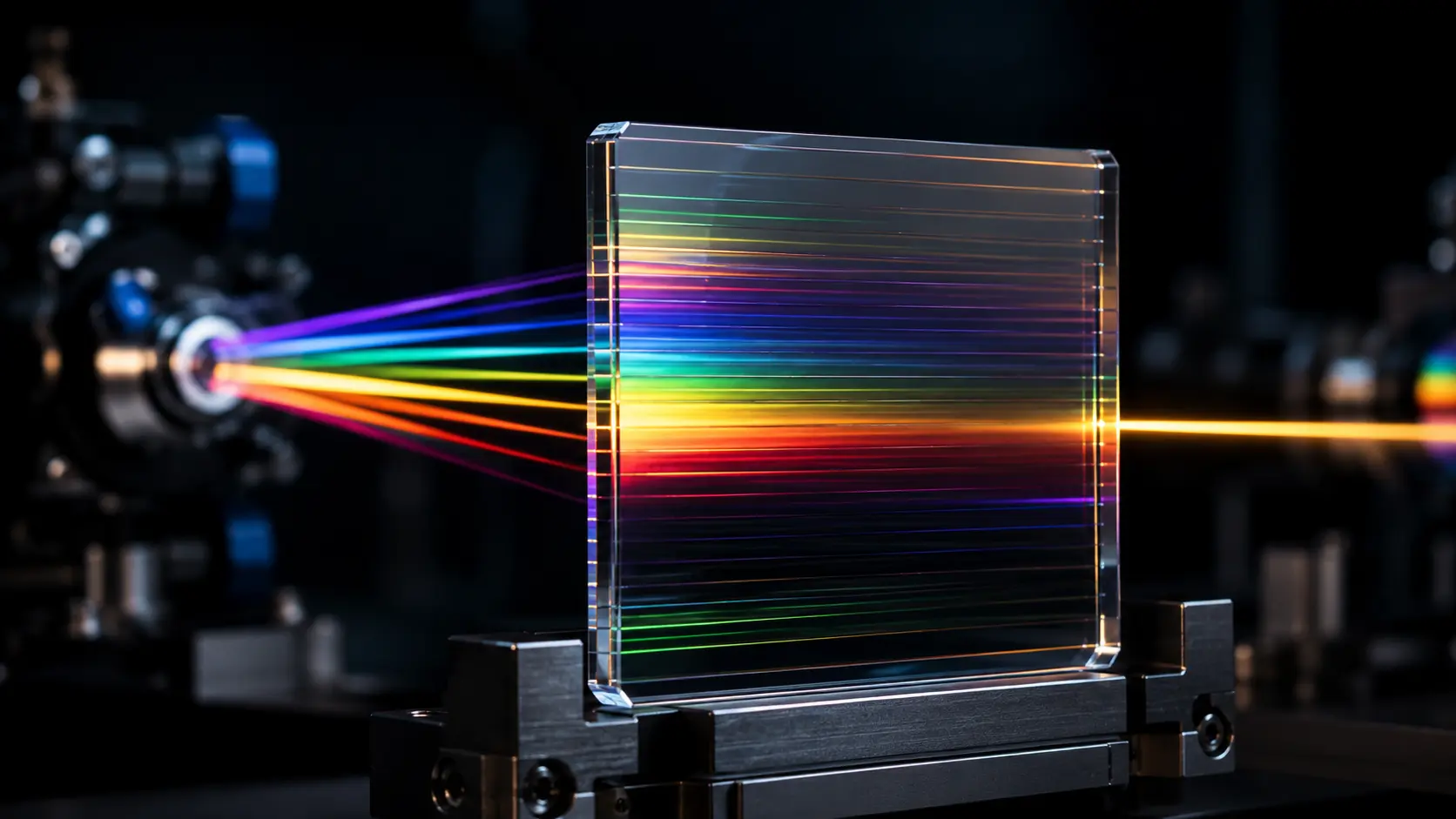
To achieve this separation, engineers rely on Thin-Film Filters (TFF). A thin-film filter is a microscopic piece of glass coated with alternating layers of dielectric materials, such as titanium dioxide and silicon dioxide. Manufacturers deposit these films at the atomic scale in strict vacuum chambers.
The exact thickness of each alternating layer directly corresponds to the physical length of the specific light wave it intends to manipulate. When the composite light beam strikes this layered mirror, wave physics takes over.
The alternating dielectric layers create constructive interference for one exact wavelength, allowing it to pass straight through the glass substrate. The structure simultaneously creates destructive interference for all other 127 wavelengths, reflecting them perfectly toward the next filter in the sequence to be isolated.
WHY IT MATTERS NOW
The artificial intelligence boom requires hyperscale data centers to synchronize multi-terabyte datasets across vast geographic distances. Laying new fiber optic cables across oceans or under congested urban centers costs billions of dollars and takes decades to permit.
DWDM architecture allows global telecom operators to continuously multiply the capacity of their existing glass networks purely by upgrading the optical filters at either end of the pipe. Companies like Lumentum and Coherent manufacture these sub-micron filters to feed the voracious bandwidth appetites of Amazon Web Services and Microsoft Azure.
By narrowing the physical spacing between each wavelength from 100 gigahertz down to 50 gigahertz, these filters double the total data channels a legacy cable can support. This physical layer manipulation acts as the silent economic engine of the modern cloud.
The manufacturing precision required to build these components creates a severe global supply chain bottleneck. A 50-gigahertz DWDM filter requires over one hundred distinct dielectric layers deposited with absolute uniformity. A single stray atom in the coating chamber ruins the interference pattern, rendering the filter useless and exposing the entire telecommunications supply chain to extreme supplier concentration risk.
This architecture also directly dictates the limits of digital financial markets. High-frequency trading firms pay premium leases to access specific DWDM wavelengths on transatlantic fiber routes. The hardware guarantees that a specific trading algorithm possesses an isolated, unshared physical path of light to execute arbitrage, ensuring absolute microsecond latency predictability independent of general internet traffic.
WHAT MOST PEOPLE MISS
Networking analysts frequently evaluate data center bandwidth by focusing exclusively on the silicon switching chips inside the server racks. They completely ignore the thermodynamic reality that silicon cannot efficiently route light. Every time a router needs to read a DWDM signal, it must mechanically convert the photons into electrons, consuming massive amounts of electricity and generating intense physical heat.
The true systemic value of advanced thin-film filters is their ability to execute purely optical routing. By deploying Reconfigurable Optical Add-Drop Multiplexers (ROADMs) built with specialized filters, grid operators physically bend and redirect specific colors of light to different cities without ever converting the signal to electricity. This bypasses the silicon bottleneck entirely, saving megawatts of power while instantly rerouting global internet traffic around severed cables.
THE TRAJECTORY
Next 12–36 Months: Hyperscalers will aggressively deploy extended C-band and L-band DWDM filters. By pushing into entirely new segments of the infrared spectrum, telecom operators will extract an additional 50 percent capacity from existing long-haul dark fiber networks without laying new glass.
Next Five Years: The commercialization of integrated silicon photonics. Manufacturers will move away from discrete, physical glass filters and etch the wave-splitting interferometers directly into the silicon of the receiving microchip. This will drastically shrink the physical footprint of optical transceivers, allowing switches to handle petabits of data in a single rack unit.
Next Ten Years: The transition to spatial division multiplexing. As the physical limit of wavelength packing approaches, engineers will deploy multi-core fibers. DWDM filters will evolve into complex 3D holographic structures designed to split hundreds of wavelengths across multiple distinct physical glass cores simultaneously.
What Could Go Wrong: Severe thermal drift in extreme environments. Thin-film filters rely on exact physical geometry to block adjacent wavelengths. If a localized data center fire or cooling failure causes the glass substrate to physically expand, the interference layers will shift. This will cause the filters to misroute the light, instantly cross-contaminating financial data with commercial video traffic across the entire backbone.
Most Likely Outcome: Thin-film dielectric filtering will remain the mandatory gatekeeper of global data transmission. The mathematical certainty of wave interference provides the only scalable, zero-power mechanism to dissect light accurately enough to sustain civilization’s compounding bandwidth demands.
KEY TERMS
- Dense Wavelength Division Multiplexing (DWDM): An optical fiber technology that multiplexes multiple data signals onto a single strand of glass using different colors of laser light.
- Thin-Film Filter (TFF): A microscopic component built from alternating layers of chemical coatings that uses wave interference to isolate specific optical frequencies.
- Constructive Interference: A physical phenomenon where multiple light waves perfectly align their peaks and troughs to amplify a specific wavelength.
- Dielectric Coating: An insulating material applied at the atomic level to manipulate the reflective and transmissive properties of an optical surface.
- Reconfigurable Optical Add-Drop Multiplexer (ROADM): A piece of network hardware that uses filters to remotely switch traffic at the wavelength layer without electrical conversion.
SOURCES
- Optica — Thin-Film Optical Filters for Dense Wavelength Division Multiplexing Networks
- Institute of Electrical and Electronics Engineers (IEEE) — Physical Layer Tolerances in 50-GHz DWDM Architectures
- Lumentum — ROADM Architecture and Advanced Wavelength Selective Switching
- International Telecommunication Union (ITU) — Spectral Grids for WDM Applications and DWDM Frequency Spacing