Advertisement
)

AT A GLANCE
- Concept: Hypervisor Threat: The foundational software managing a cloud server physically controls all memory, making it a catastrophic attack vector.
- Concept: Memory Encryption: The processor scrambles the data inside the physical RAM chips to hide it from unauthorized observers.
- Concept: Secure Nested Paging: A hardware mechanism that validates the structural integrity of memory assignments before allowing access.
- Concept: Reverse Map Table: A strict silicon ledger that tracks ownership of every memory page, blocking unauthorized reassignment.
HOW THE REVERSE MAP TABLE WORKS
Traditional cloud computing relies on a hypervisor. This master software layer divides a single physical server into multiple isolated virtual machines for different customers. The hypervisor possesses absolute control over the physical memory hardware, mapping virtual addresses to physical RAM locations.
This architecture creates a severe trust vulnerability. If a hostile actor compromises the hypervisor, they inherit ultimate administrative privilege. They can physically read the raw memory of any virtual machine on the server, extracting unencrypted passwords, cryptographic keys, and proprietary algorithms directly from the RAM.
In legacy environments, securing data relies entirely on external firewalls and network perimeters. Once the data reaches the physical memory of the server to be actively processed, it exists in plaintext, fully exposed to the underlying hypervisor.
To neutralize this threat, hardware manufacturers developed Secure Encrypted Virtualization with Secure Nested Paging (SEV-SNP). This architecture physically removes the hypervisor from the circle of trust. When a secure virtual machine boots up, the processor generates a unique cryptographic key locked entirely inside the silicon chip.
The CPU encrypts all data before sending it out to the physical RAM, ensuring the hypervisor only sees scrambled ciphertext. However, simple encryption cannot stop a hypervisor from rearranging the encrypted memory blocks. To prevent this, SEV-SNP introduces the Reverse Map Table (RMT).
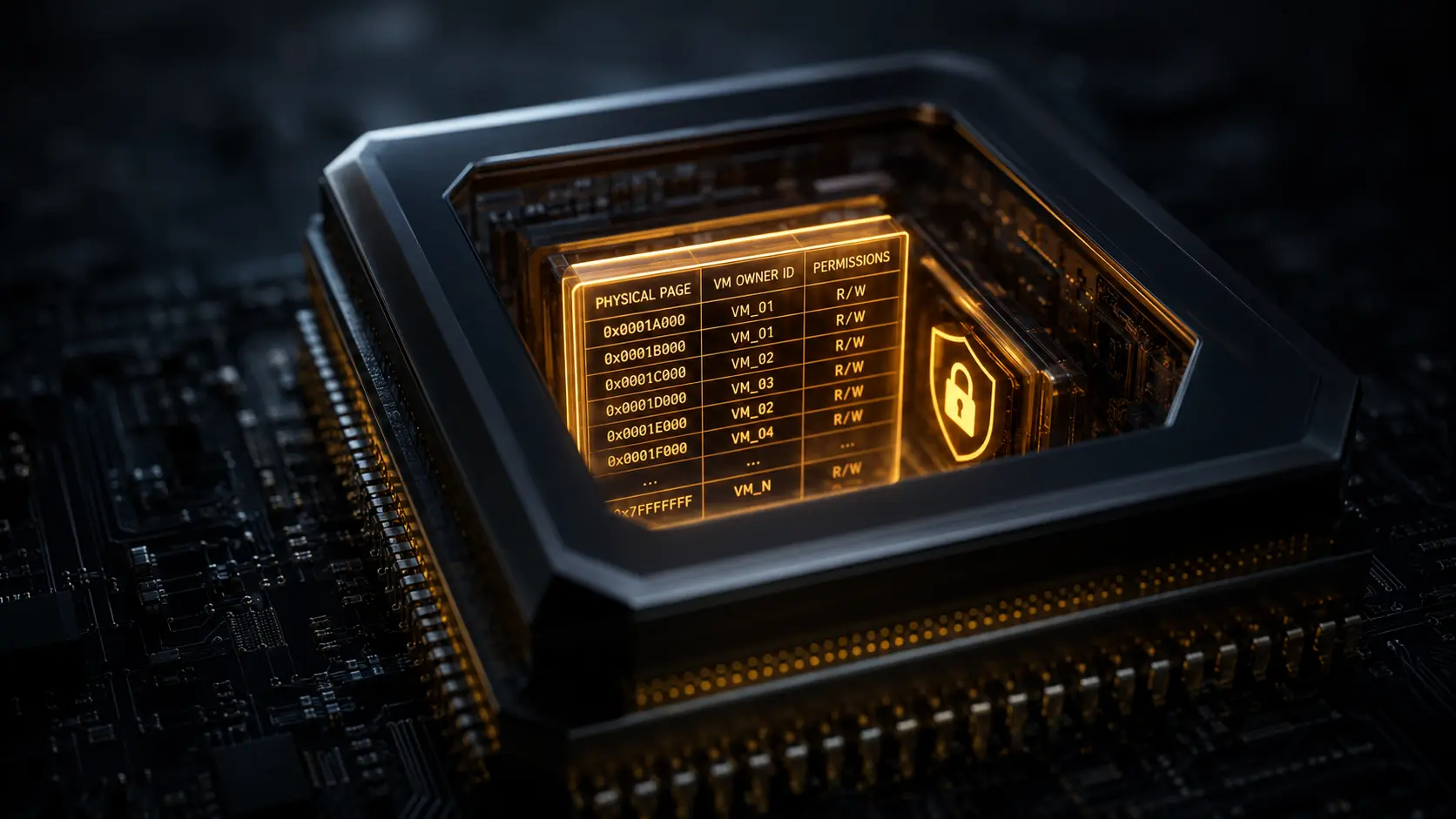
The RMT is a hardware-enforced ledger that explicitly records the exact owner of every physical memory page on the server.
When the hypervisor attempts to map a physical memory page to a virtual machine, the processor checks the RMT. The silicon verifies that the physical page actually belongs to the requesting virtual machine. If a compromised hypervisor attempts to map a page belonging to one tenant into the memory space of another, the CPU hardware instantly detects the ownership mismatch and violently terminates the operation.
WHY IT MATTERS NOW
The artificial intelligence boom forces enterprise organizations to upload their most valuable, highly sensitive datasets into public cloud infrastructure. Banks training fraud detection models cannot legally expose raw customer financial records to third-party cloud administrators. Confidential computing solves this data sovereignty crisis directly at the hardware level.
By utilizing AMD SEV-SNP, a corporation essentially builds a cryptographic fortress inside someone else’s data center. The cloud provider supplies the electricity, cooling, and physical hardware, but they possess absolutely no mathematical capability to access the data being processed. This allows highly regulated entities, such as military intelligence agencies and healthcare conglomerates, to abandon expensive on-premises servers safely.
This hardware isolation fundamentally alters cloud provider liability. Amazon Web Services, Google Cloud, and Microsoft Azure aggressively deploy confidential computing nodes to shield themselves from legal exposure. If a rogue cloud engineer or a nation-state hacker compromises the central hypervisor, the RMT ensures they cannot physically siphon data from the encrypted tenant enclaves.
The technology completely severs the historical link between infrastructure ownership and data access. Organizations can securely execute proprietary workloads on unverified or even actively hostile hardware in foreign jurisdictions. This mechanic shifts the foundation of cybersecurity away from perimeter defense and places it entirely inside the immutable physics of the processor silicon.
WHAT MOST PEOPLE MISS
Cloud architects frequently assume that simply encrypting memory prevents all data manipulation. They entirely miss the mechanics of memory aliasing attacks. A compromised hypervisor does not need to decrypt data to destroy a system; it can simply take an encrypted block of data from an old transaction and secretly overwrite a current memory page with it, forcing the virtual machine to process outdated, corrupted instructions.
The Reverse Map Table actively neutralizes this specific ciphertext manipulation. Because the RMT strictly enforces a one-to-one mapping between virtual addresses and physical pages, the hypervisor physically cannot assign two different virtual addresses to the same physical page. The hardware actively prevents the hypervisor from injecting malicious ciphertext or replaying old memory states, guaranteeing absolute memory integrity without ever needing to decrypt the data.
THE TRAJECTORY
Next 12–36 Months: Cloud providers will establish SEV-SNP and equivalent confidential computing architectures as the mandatory default for all high-performance enterprise instances. Major financial institutions will migrate their core banking ledgers directly into these hardware-encrypted enclaves.
Next Five Years: The integration of confidential computing with heterogeneous accelerators. Hardware manufacturers will extend the RMT architecture beyond the central processor, establishing secure encrypted memory links directly into graphics processing units (GPUs) to protect massive artificial intelligence training runs from hypervisor interception.
Next Ten Years: The realization of verifiable multi-party computation at a civilization scale. Distinct global organizations will pool highly classified datasets inside shared confidential enclaves. They will train collective intelligence models on the aggregated data without ever exposing their individual raw data to the other participants or the host provider.
What Could Go Wrong: A severe microcode vulnerability. The entire SEV-SNP architecture relies on the absolute perfection of the processor’s internal firmware. If researchers discover a flaw in how the silicon updates the Reverse Map Table, hackers could exploit the microcode to silently bypass the hardware checks, completely shattering the confidential computing trust model.
Most Likely Outcome: Hardware-enforced memory isolation will become the absolute baseline of global computing. Operating an enterprise application without a silicon-level reverse map table will eventually carry the same negligence liability as transmitting passwords in plain text.
KEY TERMS
- Confidential Computing: A security paradigm that protects data in use by performing computations exclusively within a hardware-based trusted execution environment.
- Hypervisor: The foundational software layer that creates and runs virtual machines by dynamically allocating physical server resources.
- Reverse Map Table (RMT): A hardware-enforced data structure that tracks the exact virtual machine ownership of every physical memory page.
- Secure Nested Paging (SNP): An AMD architectural feature that enforces strict memory integrity by preventing hypervisors from maliciously remapping memory pages.
- Ciphertext: Raw data that has been scrambled by a mathematical encryption algorithm, rendering it completely unreadable without the correct cryptographic key.
SOURCES
- AMD — SEV-SNP Architecture: Strengthening VM Isolation with Integrity Protection
- Institute of Electrical and Electronics Engineers (IEEE) — Hardware-Enforced Memory Protection and Reverse Map Tables
- Google Cloud Architecture Center — Confidential Computing and the Mechanics of Secure Encrypted Virtualization
- Microsoft Research — Hypervisor Threat Models and the Evolution of Secure Nested Paging