Advertisement
)

AT A GLANCE
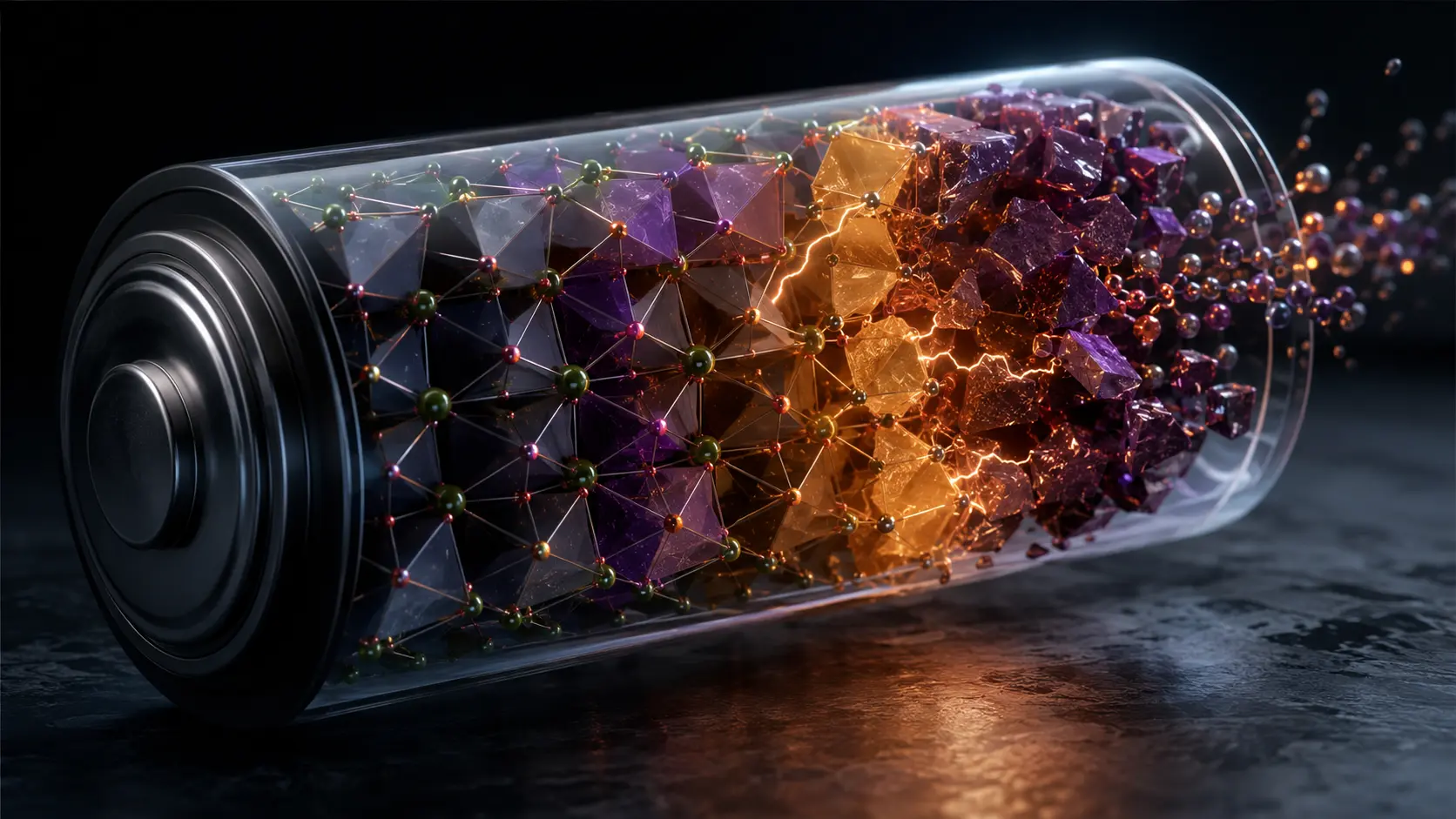
- Concept: The Olivine Lattice: A rigid atomic structure that traps and releases lithium ions without collapsing.
- Concept: Manganese Substitution: Replacing iron atoms with manganese raises the battery cell voltage to 4.1 volts.
- Concept: Jahn-Teller Effect: A severe physical distortion where manganese ions mechanically warp the surrounding crystal lattice.
- Concept: Transition Metal Dissolution: Distorted manganese escapes the crystal, poisoning the battery fluid and destroying charge capacity.
HOW THE LMFP BATTERY WORKS
Traditional Lithium Iron Phosphate (LFP) batteries dominate the budget electric vehicle market. They utilize a highly stable olivine crystal lattice. This rigid atomic structure moves lithium ions safely, but its chemical chemistry inherently limits the cell’s output to a low 3.2 volts.
Voltage dictates total energy density. To increase the driving range of an LFP cell without increasing its physical size, chemists must force the olivine lattice to operate at a higher electrical potential. They achieve this by systematically replacing up to sixty percent of the iron atoms with manganese.
This substitution creates Lithium Manganese Iron Phosphate (LMFP). Manganese possesses a higher oxidation potential than iron. When the battery discharges, the lithium ions interact with the manganese sites first, discharging energy at a sustained plateau of 4.1 volts before stepping down to the lower iron plateau.
This higher voltage output mathematically increases the total energy density of the battery pack by up to twenty percent. The substitution utilizes only cheap, globally abundant manganese, bypassing the fragile geopolitical supply chains associated with nickel and cobalt completely.
WHY IT MATTERS NOW
The electric vehicle price war centers entirely on battery chemistry economics. Automakers physically cannot build a profitable, long-range mass-market vehicle using expensive nickel-manganese-cobalt (NMC) cells. Standard LFP solves the cost equation but sacrifices too much vehicle range.
LMFP acts as the structural bridge between budget cost and premium performance. By increasing the energy density of the cheap olivine lattice, automakers can reduce the total physical weight of the battery pack. A lighter vehicle requires less kinetic energy to move, creating a compounding efficiency loop that extends highway driving ranges.
Major Chinese battery conglomerates dictate the timeline for this deployment. Companies like CATL are currently commercializing proprietary LMFP architectures, installing these high-voltage cells into mid-tier passenger vehicles to immediately obsolete legacy western LFP designs.
This chemical shift rewrites global mineral demand. As the world transitions toward LMFP, the commodity market for high-purity manganese sulfate will experience massive structural deficits. Institutional investors and mining consortiums are aggressively acquiring manganese deposits in Africa and Australia to feed the impending gigafactory supply chain.
WHAT MOST PEOPLE MISS
Battery enthusiasts assume that mixing two stable metals naturally creates a stable hybrid. They entirely miss the mechanical violence of the Jahn-Teller effect. When an LMFP cell charges to its 4.1-volt maximum, the manganese ions transition to a highly reactive oxidation state that physically distorts their electron clouds and mechanically stretches the atomic bonds of the olivine crystal.
This continuous microscopic stretching acts exactly like metal fatigue in an airplane wing. The lattice eventually fractures, allowing the manganese atoms to dissolve directly into the liquid electrolyte. These dissolved metals migrate across the battery and poison the anode, rapidly degrading the cell’s capacity to hold a charge and rendering raw LMFP commercially useless without highly advanced carbon coatings to lock the structure in place.
THE TRAJECTORY
Next 12–36 Months: Global automakers will launch their first generation of LMFP-powered vehicles. Early iterations will physically blend the LMFP powder with a small percentage of premium NMC material to act as a structural buffer, stabilizing the internal voltage and minimizing early degradation.
Next Five Years: The commercialization of advanced lattice doping. Material scientists will inject trace amounts of magnesium and titanium directly into the olivine structure. These microscopic structural pillars will lock the crystal lattice in place, entirely neutralizing the Jahn-Teller distortion and extending cycle life past one million miles.
Next Ten Years: The total monopolization of the mid-market electric grid. High-voltage LMFP will completely push nickel-based batteries out of passenger cars and grid-scale storage. Nickel and cobalt will survive strictly in niche applications requiring extreme power-to-weight ratios, such as electric aviation and specialized military drones.
What Could Go Wrong: Severe voltage suppression under fast-charging loads. Manganese mathematically possesses a much lower electronic conductivity than iron. If drivers consistently force high-amperage direct current into the battery during extreme fast-charging sessions, the internal electrical resistance could generate localized heat spikes, physically melting the protective carbon coatings.
Most Likely Outcome: LMFP will become the absolute default battery chemistry for terrestrial transportation. The geometric stability of a doped olivine lattice combined with cheap, abundant manganese offers an unbeatable mathematical advantage in global infrastructure economics.
KEY TERMS
- Olivine Lattice: A rigidly structured, naturally occurring crystal framework that safely houses and transports lithium ions within a battery cathode.
- Jahn-Teller Effect: A geometric distortion occurring in specific molecules and ions where asymmetrical electron clouds physically warp the surrounding atomic bonds.
- Oxidation Potential: The exact mathematical tendency of a chemical species to lose electrons and acquire a higher operational voltage during a chemical reaction.
- Transition Metal Dissolution: The structural failure where active metal atoms break free from the cathode lattice and permanently contaminate the liquid battery fluid.
- Morphological Doping: The deliberate insertion of trace foreign atoms into a crystal lattice to artificially reinforce its physical and electrical stability.
SOURCES
- Nature Energy — Jahn-Teller Distortion and Phase Transitions in Lithium Manganese Iron Phosphate
- Journal of The Electrochemical Society — Mitigating Manganese Dissolution in High-Voltage Olivine Cathodes
- Argonne National Laboratory — Structural Degradation Kinetics in Mixed Transition Metal Phosphates
- Department of Energy (DOE) — The Economic Scaling of LMFP Architectures in Electric Vehicle Supply Chains