Advertisement
)

AT A GLANCE
- Concept: RDMA Queue Pair: Paired memory buffers that allow direct hardware-to-hardware communication across a network.
- Concept: Kernel Bypass: Skipping the operating system CPU overhead entirely to prevent computational data bottlenecks.
- Concept: NVMe-over-Fabrics (NVMe-oF): A protocol translating high-speed internal storage commands into transmittable network packets.
- Concept: Line-Rate Storage: Moving data across a network at the exact maximum physical speed of the fiber optic cable.
HOW NVMe-oF AND RDMA WORK
Legacy network storage architectures force every piece of data through the central operating system. When a server requests a file, the network interface card (NIC) interrupts the central processing unit (CPU). The CPU must wake up, copy the incoming data from the hardware buffer into the operating system kernel, and then copy it a second time into the application’s memory.
This double-copy process creates massive computational friction. In a hyperscale data center moving petabytes of data, this operating system overhead consumes up to thirty percent of the server’s total processing power. The CPU spends its time managing administrative network traffic instead of executing profitable calculations.
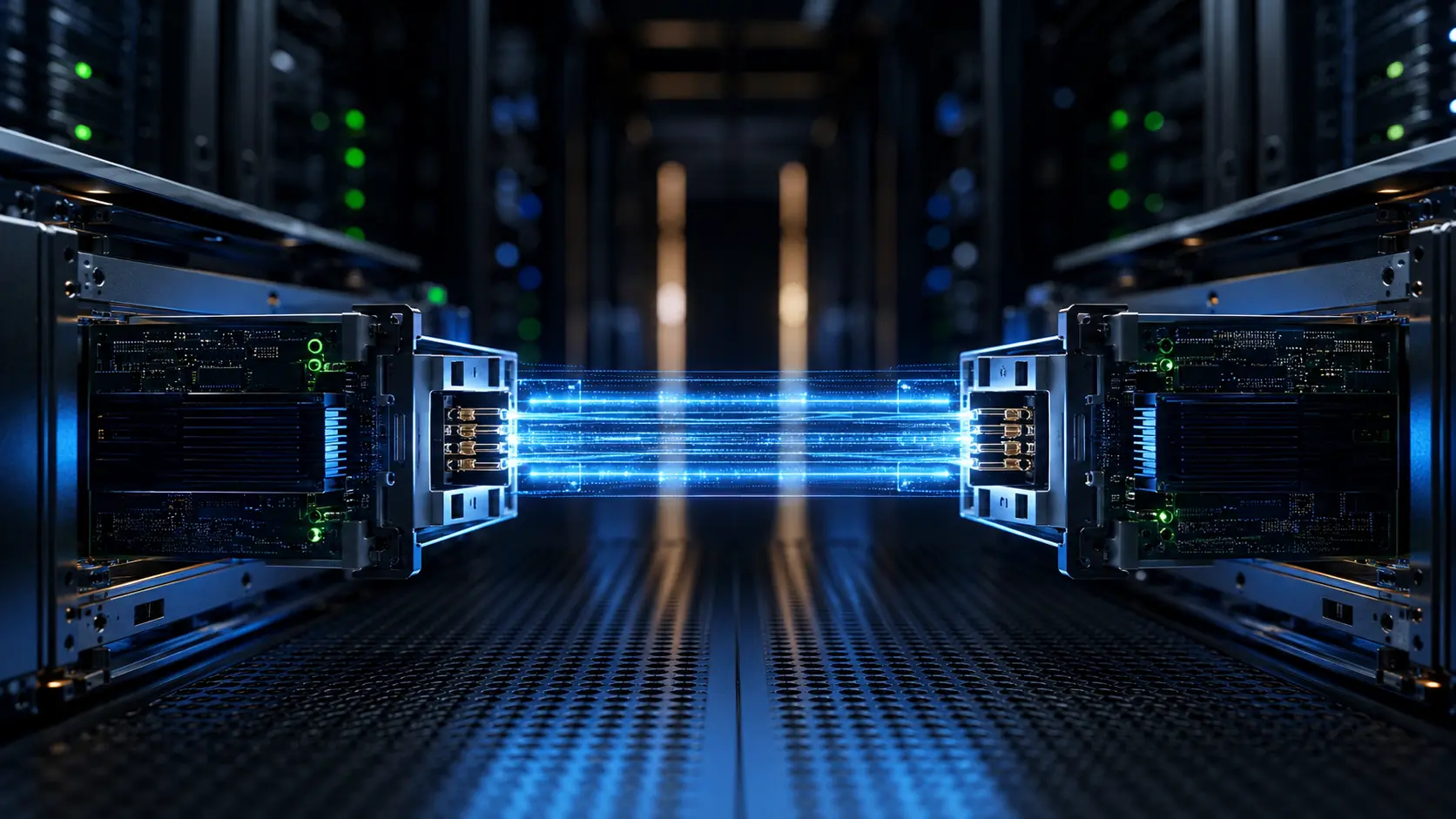
Remote Direct Memory Access (RDMA) solves this through a mechanism called the queue pair. The operating system sets up a Send Queue and a Receive Queue directly in the physical RAM of both the client server and the storage server.
Once these queue pairs link up, the operating system steps completely out of the way. When the application requests data, the command drops straight into the hardware queue. The local NIC reads the command, reaches across the network fabric, and writes the requested storage data directly into the remote server’s physical memory in microseconds.
WHY IT MATTERS NOW
Artificial intelligence completely broke legacy storage architectures. Training a trillion-parameter large language model requires feeding thousands of specialized graphics processing units (GPUs) with a constant, uninterrupted stream of text and image data.
If a GPU exhausts its local storage and has to wait for a network file transfer burdened by operating system latency, the multi-million-dollar processor sits idle. This condition, known as data starvation, financially ruins the economics of an AI data center.
NVMe-over-Fabrics utilizing RDMA guarantees that network storage operates at the exact same microsecond latency as a solid-state drive plugged directly into the motherboard. Hyperscalers like Microsoft Azure deploy this architecture to aggressively disaggregate their storage resources from their compute nodes.
By separating storage and compute, cloud providers scale each physical resource independently. They pool thousands of flash drives into extremely dense storage racks and use RDMA queue pairs to instantly map that capacity to any GPU rack in the facility. This creates a fluid, composable infrastructure that adapts to massive AI workloads on demand without requiring human hardware intervention.
WHAT MOST PEOPLE MISS
Software engineers frequently assume that adding faster fiber optic cables automatically solves network storage latency. They entirely miss that latency at the hyperscale level is no longer dictated by the speed of light inside the glass, but by the software stack itself.
The true hidden incentive of NVMe-oF RDMA is reclaiming stranded CPU cycles. By pushing the data routing logic down into the silicon of the network card, cloud providers instantly reclaim thousands of processor cores across their fleet. They immediately rent those reclaimed cores out to enterprise customers, converting a structural engineering efficiency into pure recurring revenue.
THE FUTURE TRAJECTORY OF NVMe-oF
Next 12–36 Months: Cloud operators will mandate end-to-end RDMA for all tier-one database and AI clusters. Traditional TCP/IP storage protocols will be relegated strictly to cold archiving, low-priority backups, and legacy enterprise software migrations.
Next Five Years: The rise of GPU-initiated direct storage. Graphics processors will utilize RDMA queue pairs to request training data directly from the storage network, bypassing not only the operating system kernel but the host CPU entirely.
Next Ten Years: Complete optical disaggregation. Photonic switches will route NVMe-oF packets dynamically at the speed of light across entire metropolitan availability zones. The concept of a localized, self-contained server rack will vanish, replaced by a single, city-sized logical computer.
What Could Go Wrong: Severe priority flow control cascades. RDMA requires a lossless network to function properly. If a sudden traffic micro-burst overwhelms a network switch, the switch will physically pause the incoming traffic. This pause can ripple backward through the entire data center in milliseconds, instantly deadlocking the entire storage fabric.
Most Likely Outcome: NVMe-oF with RDMA will become the absolute baseline for all enterprise storage arrays. The geometric growth of AI datasets makes kernel-bound network processing mathematically incapable of sustaining future commercial workloads.
KEY TERMS
- Remote Direct Memory Access (RDMA): A hardware technology allowing two computers to exchange data in main memory without involving either operating system.
- Queue Pair: The fundamental communication mechanism of RDMA, consisting of a connected send and receive buffer located directly in physical memory.
- Kernel Bypass: A software architecture that allows applications to communicate directly with hardware components, eliminating the processing delays caused by the operating system.
- NVMe-over-Fabrics (NVMe-oF): A storage protocol that extends the extreme speed of internal solid-state drives across a high-speed data center network.
- SmartNIC: An advanced network interface card containing its own processing cores to offload traffic management from the main host processor.
SOURCES
- NVM Express Organization — NVMe-over-Fabrics Specification and RDMA Transport Bindings
- Institute of Electrical and Electronics Engineers (IEEE) — Kernel Bypass and Performance Implications in Datacenter Storage Networks
- NVIDIA — RDMA over Converged Ethernet (RoCE) Architecture and Datacenter Deployment
- Storage Networking Industry Association (SNIA) — The Economics of Disaggregated Storage and NVMe-oF