Advertisement
)

AT A GLANCE
- Concept: Vacuum Environment: Removing atmospheric gases prevents oxygen and hydrogen from embrittling the raw titanium.
- Concept: Electric Arc: A continuous high-voltage direct current physically melts the consumable titanium electrode.
- Concept: Liquid Pool Geometry: Maintaining a shallow melt pool prevents heavy alloying elements from separating and clumping.
- Concept: Beta Fleck: A localized chemical defect that creates severe microscopic weakness in aerospace turbine blades.
HOW VACUUM ARC REMELTING WORKS
Jet engine turbines spin thousands of times per minute at extreme temperatures, meaning the underlying metal cannot contain a single microscopic flaw. To achieve this structural perfection, metallurgists cannot simply pour molten titanium into a mold. They must completely reconstruct the metal atom by atom using a process called Vacuum Arc Remelting (VAR).
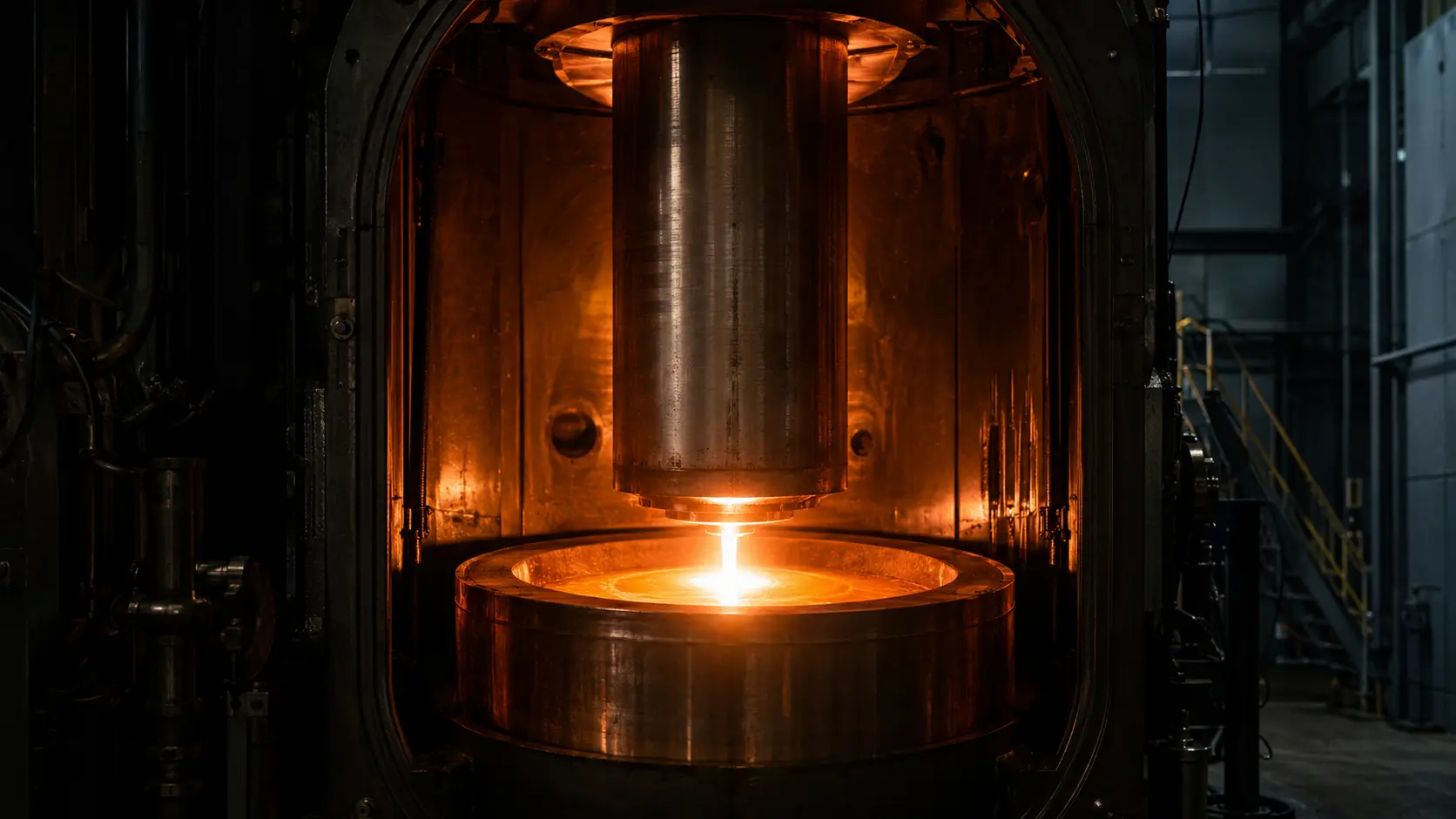
The operation begins with a massive, unrefined cylinder of solid titanium known as a consumable electrode. Engineers lower this cylinder into a water-cooled copper crucible and seal the entire surrounding chamber in a deep vacuum. This vacuum strips away reactive atmospheric gases that would otherwise permanently contaminate and embrittle the hot metal.
A high-voltage direct current strikes across the gap between the titanium cylinder and the bottom of the crucible, igniting a continuous electric arc. This arc generates localized temperatures exceeding 1,600°C, causing the bottom of the electrode to slowly drip liquid metal into the crucible below.
The true engineering challenge lies in managing the solidification matrix of the liquid pool that forms at the bottom of the crucible. If the electric arc runs too hot, the liquid pool becomes too deep, allowing heavier alloying elements like vanadium or iron to physically sink and pool together. This chemical separation, known as macro-segregation, forms beta flecks—soft, unstable micro-regions that act as initiation sites for catastrophic metal fatigue.
By tightly controlling the electrical current, the furnace maintains a perfectly shallow liquid pool. The titanium freezes against the water-cooled copper walls almost instantly, locking the dispersed chemical elements into a perfectly uniform, high-strength crystalline lattice before they have time to separate.
WHY IT MATTERS NOW
Global commercial aviation and next-generation military aerospace rely entirely on defect-free titanium alloys. The structural integrity of the F-35 fighter jet and the Boeing 787 Dreamliner depends on these specific metals to survive extreme aerodynamic stress and heat. Without the VAR process, producing aerospace-grade titanium at commercial scale is physically impossible.
The geopolitical supply chain for these highly refined ingots remains extremely concentrated. While many nations can mine raw titanium sponge, only a few specialized industrial conglomerates possess the proprietary furnace telemetry required to execute double or triple-melt VAR processing without ruining the final ingot. The expertise required to balance the electric arc makes VAR capacity a strict bottleneck in global defense manufacturing.
When Russia, a major historical supplier of aerospace titanium, faced heavy economic sanctions, the global aerospace market experienced a massive structural shock. Western aerospace giants aggressively pivoted to domestic suppliers, forcing secondary foundries to rapidly scale their VAR furnace capacity to meet the sudden surge in military and commercial demand.
A single VAR furnace costs tens of millions of dollars and requires massive amounts of continuous, stable electrical power to operate safely. A sudden drop in grid voltage during a multi-day melt permanently ruins the entire ingot, wasting hundreds of thousands of dollars of raw material. This reality makes the physical location of advanced metallurgy highly dependent on sovereign energy infrastructure and reliable baseload power grids.
WHAT MOST PEOPLE MISS
Industrial analysts frequently focus on the total tonnage of raw titanium a country exports, falsely assuming raw volume translates directly to aerospace dominance. They entirely miss that a standard titanium ingot must undergo the complete VAR process two or three separate times before it legally qualifies for critical rotating engine components.
Every successive melt further refines the chemical homogeneity, but it drastically increases the probability of an operational failure. If a microscopic piece of the water-cooled copper crucible flakes off and falls into the melt during the final pass, it creates a high-density inclusion that destroys the multi-million-dollar batch. Actual defect-free yield rates dictate market power far more than raw material extraction capabilities.
THE TRAJECTORY
Next 12–36 Months: Aerospace manufacturers will mandate strict digital twin telemetry for all VAR ingots. Foundries will integrate optical emission spectroscopy sensors directly into the vacuum chamber to monitor the liquid pool geometry in real-time, instantly adjusting the arc current to prevent beta fleck formation before the metal solidifies.
Next Five Years: The widespread adoption of Electron Beam Cold Hearth Melting (EBCHM) as a mandatory preliminary step. Foundries will use electron beams to vaporize high-density inclusions before the titanium ever reaches the final VAR furnace. This dual-process architecture will mathematically increase the final aerospace yield and drive down component costs.
Next Ten Years: Complete automation of the melt cycle using artificial intelligence. Neural networks will autonomously manage the highly chaotic plasma physics of the electric arc. These systems will predict and correct minor voltage fluctuations milliseconds before they can disrupt the shallow solidification matrix, removing human error from the metallurgy loop entirely.
What Could Go Wrong: Catastrophic crucible breaches. The liquid titanium sits millimeters away from pressurized cooling water, separated only by a thin copper wall. If an unstable electric arc wanders and strikes the crucible wall, it can vaporize the copper, mixing liquid water with molten titanium and triggering a massive, lethal steam explosion that destroys the entire foundry.
Most Likely Outcome: Vacuum arc remelting will remain the mandatory, irreplaceable bottleneck for all high-stress aerospace metallurgy. The absolute physics of liquid pool geometry require this exact electrical and thermal control to guarantee the survival of millions of commercial airline passengers.
KEY TERMS
- Term: Vacuum Arc Remelting (VAR): An industrial metallurgical process that melts a consumable metal electrode in a vacuum using an electric arc to produce highly pure, uniform ingots.
- Term: Beta Fleck: A localized microscopic defect in titanium alloys caused by chemical segregation, resulting in significantly lower structural strength.
- Term: Liquid Pool Geometry: The physical depth and shape of the molten metal during the melting process, which dictates how evenly the chemical elements solidify.
- Term: Consumable Electrode: A large, unrefined cylinder of solid metal that acts as both the electrical conductor and the raw material source in a VAR furnace.
- Term: Segregation: The unwanted separation of different chemical elements within an alloy during the cooling and freezing process.
SOURCES
- Titanium Association — Advanced Melting Technologies and Yield Optimization in Aerospace Alloys
- Journal of Materials Processing Technology — Solidification Dynamics and Defect Formation in Vacuum Arc Remelted Titanium
- Federal Aviation Administration (FAA) — Metallurgical Requirements and Defect Tolerances in Commercial Turbine Rotors
- Department of Defense (DoD) — Supply Chain Vulnerabilities in Strategic Aerospace Materials