Advertisement
)

AT A GLANCE
- Concept: Closed Drift: Magnetic fields trap electrons in a continuous circular loop to maximize atomic collisions.
- Concept: Xenon Propellant: A heavy, inert noble gas that provides optimal mass for efficient plasma acceleration.
- Concept: Specific Impulse: A metric defining extreme fuel efficiency, replacing heavy chemical rockets with lightweight electricity.
- Concept: Stationkeeping: The continuous micro-adjustments required to keep satellites perfectly positioned against atmospheric drag.
HOW A HALL-EFFECT THRUSTER WORKS
The expansion of global space infrastructure depends on keeping thousands of satellites perfectly positioned in orbit. But most people do not realize that these modern spacecraft maneuver without burning traditional chemical rocket fuel. The reason is the extreme physical weight of combustible propellants, which mathematically bankrupts the launch economics of massive satellite constellations.
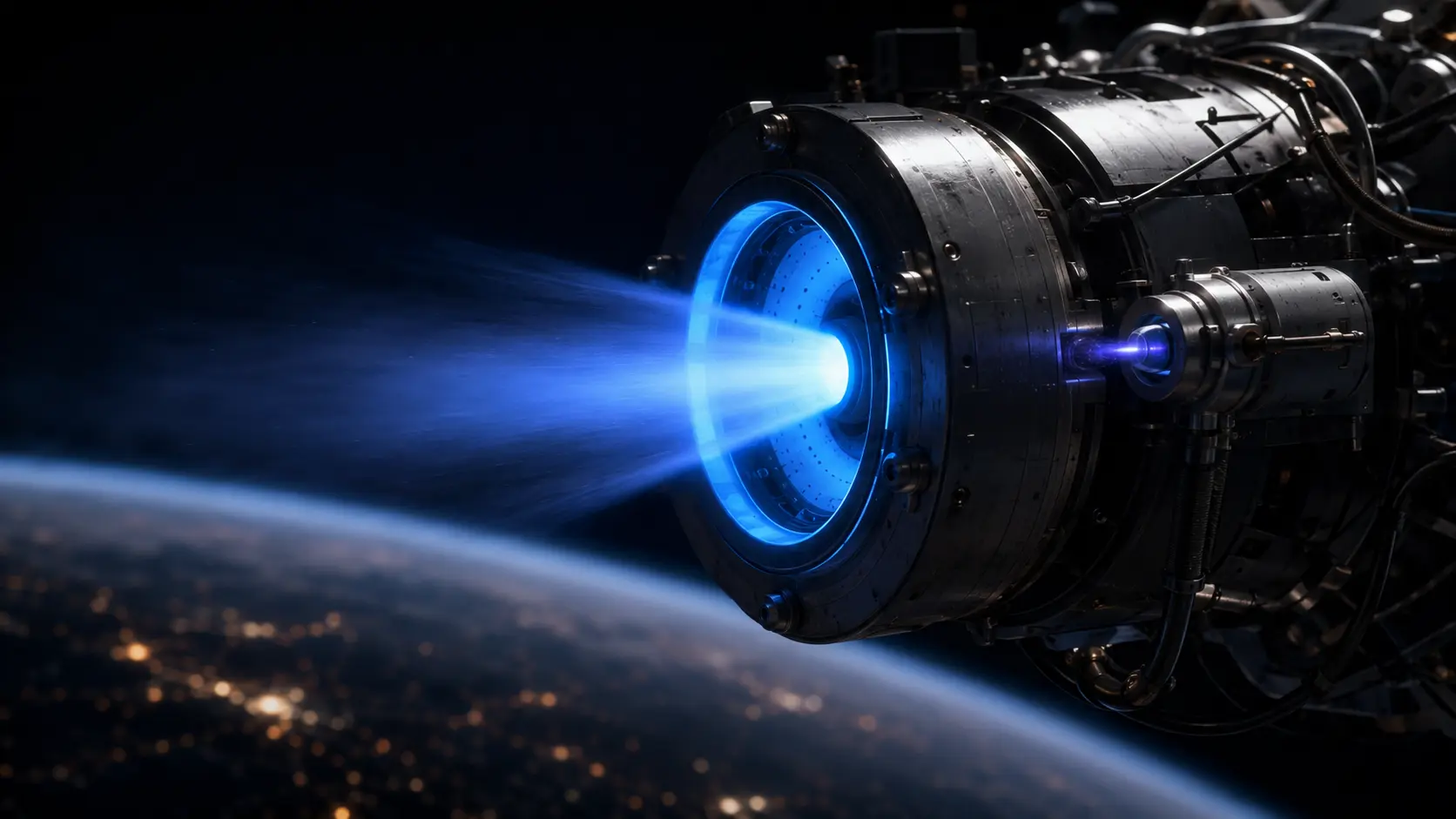
Engineers bypass this weight limit by replacing chemical fire with electromagnetism. A Hall-effect thruster uses electricity generated by solar panels to power a magnetic engine that throws atoms into the vacuum of space. The engine injects xenon gas into a circular, ceramic-lined chamber. Xenon is a heavy, stable noble gas, making it the perfect physical mass to accelerate.
To create thrust, the engine must strip electrons away from the xenon atoms, converting the neutral gas into a positively charged plasma. The thruster applies an intense magnetic field perpendicular to an electrical field across the chamber. This precise cross-field topology traps free electrons, forcing them to spiral endlessly in a continuous ring.
This ring creates a dense “closed-drift” cloud of negative charge. When the injected xenon atoms drift into this cloud, they violently collide with the trapped electrons. The collision knocks electrons off the xenon atoms, turning them into heavy positive ions.
The axial electric field instantly repels these positive ions, accelerating them out the back of the engine at over 30,000 miles per hour. Finally, a component called a hollow cathode shoots a stream of electrons directly into the exhaust plume. This neutralizes the plasma, ensuring the spacecraft does not build up a negative charge and accidentally pull the exhaust ions back like a magnet.
WHY IT MATTERS NOW
Global telecommunications providers are actively launching tens of thousands of satellites to build low-latency space internet grids. Launching this massive hardware volume is financially impossible if each satellite requires heavy tanks of liquid hydrazine to stay in orbit.
Ion propulsion provides an extreme specific impulse, meaning it extracts vastly more total thrust from a single kilogram of fuel than a chemical rocket. This efficiency shrinks the required fuel tank size exponentially. Launch providers can pack dozens of flat-paneled satellites into a single rocket fairing, directly subsidizing the commercial viability of mega-constellations like Starlink and Kuiper.
Low-Earth Orbit is an incredibly hostile and crowded environment. Satellites must constantly execute collision avoidance maneuvers to dodge orbital debris. They must also continuously counteract the slight atmospheric drag that constantly pulls them back toward Earth.
When a major solar storm hits the planet, the Earth’s atmosphere physically expands, increasing the drag on low-orbiting satellites. A chemical rocket would burn through months of limited fuel in a few days just to maintain altitude. Hall-effect thrusters simply throttle up their electrical power, drawing continuous energy from the sun to push through the increased drag without prematurely exhausting their physical mass budget.
WHAT MOST PEOPLE MISS
Media coverage frequently treats space as a perfect, frictionless vacuum, assuming electric thrusters simply run forever. They entirely miss the severe mechanical erosion happening inside the thruster channel itself. The exact same plasma that provides the thrust simultaneously attacks the physical engine.
As the positively charged xenon ions accelerate out of the thruster, a small percentage of them inevitably strike the ceramic discharge channel. This constant high-speed bombardment slowly erodes the walls atom by atom. The true engineering mastery of modern electric propulsion is magnetic shielding, which physically shapes the magnetic field lines to push the ionization zone away from the walls, extending the engine’s lifespan from a few hundred hours to well over ten thousand hours.
THE TRAJECTORY
Next 12–36 Months: Mega-constellation operators will permanently transition away from xenon propellant to argon and krypton. As the geopolitical supply of highly expensive xenon tightens, commercial operators will accept the slightly lower atomic efficiency of argon to radically reduce the unit cost of mass-produced satellites.
Next Five Years: The deployment of dynamically shifting multi-mode thrusters. Software will allow a single Hall-effect thruster to shift seamlessly between a high-thrust mode for rapid orbital altitude changes and a high-efficiency mode for decades of slow, continuous stationkeeping.
Next Ten Years: The commercialization of air-breathing electric propulsion. Satellites operating in extremely low orbits will deploy specialized intakes to physically scoop up ambient atmospheric oxygen. The thruster will ionize this free oxygen to produce infinite thrust, entirely eliminating the need to carry any onboard propellant tanks.
What Could Go Wrong: Catastrophic hollow cathode failure. The entire system relies on the external cathode neutralizing the exhaust plume. If a micrometeoroid strike or electrical short disables this specific component, the satellite instantly builds a massive static charge, stalling the ion beam and permanently disabling the spacecraft’s ability to maneuver.
Most Likely Outcome: The closed-drift ionization architecture will establish itself as the absolute baseline for all low-Earth orbit and deep-space robotic operations. The physics of extracting extreme momentum from solar electricity mathematically ensures the obsolescence of chemical thrusters for routine orbital maintenance.
KEY TERMS
- Term: Hall Effect: The physical principle where a magnetic field forces moving electrons to drift perpendicularly to their original path, creating a trapped current.
- Term: Specific Impulse: A mathematical measurement of rocket efficiency defining exactly how much thrust is generated per unit of physical propellant consumed.
- Term: Plasma: The fourth state of matter, created when neutral atoms are stripped of their electrons to form a highly conductive, ionized gas.
- Term: Stationkeeping: The continuous, calculated firing of thrusters to maintain a satellite’s precise orbital altitude and geometric positioning.
- Term: Magnetic Shielding: An advanced internal engine design that shapes magnetic field lines to prevent high-speed ions from physically eroding the thruster walls.
SOURCES
- National Aeronautics and Space Administration (NASA) — Hall-Effect Thruster Technology and Magnetic Shielding Dynamics
- Jet Propulsion Laboratory (JPL) — Closed-Drift Ionization Kinetics in Electric Propulsion Systems
- Institute of Electrical and Electronics Engineers (IEEE) — The Economics of Xenon and Alternative Propellants in Mega-Constellations
- American Institute of Aeronautics and Astronautics (AIAA) — Cathode Neutralization and Spacecraft Charging in Electric Propulsion