
AT A GLANCE
- Concept: Zero-Boil-Off: Active refrigeration systems keep liquid propellants at extreme sub-zero temperatures indefinitely.
- Concept: Thermal Stratification: Heat pockets form inside tanks because zero gravity prevents natural fluid convection.
- Concept: Settling Thrust: Micro-acceleration pushes floating liquid to the bottom of a tank to enable pumping.
- Concept: The Tsiolkovsky Limit: Refueling in orbit breaks the strict mathematical relationship between payload and fuel mass.
HOW IT WORKS
Reaching orbit consumes nearly all of a rocket’s fuel. To travel further to the Moon or Mars, a spacecraft must refill its tanks in Low Earth Orbit. This requires an orbital propellant depot storing thousands of tons of liquid oxygen and liquid methane.
These propellants are cryogenic. Liquid methane boils into a gas at negative 161 degrees Celsius. In orbit, a spacecraft experiences brutal thermal extremes, baking in direct solar radiation on one side while freezing in the shadow of the Earth on the other.
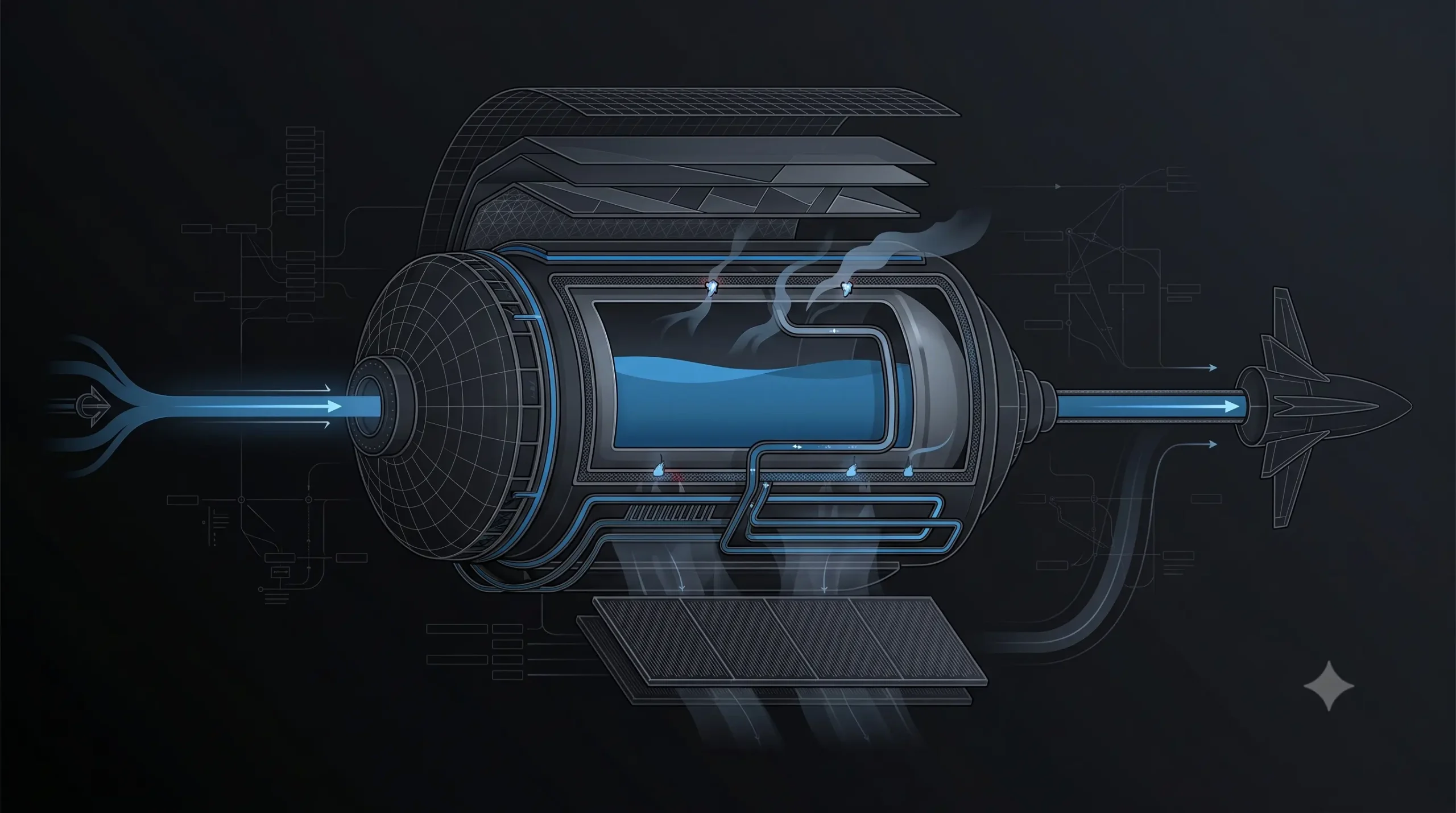
Without gravity, heat behaves unpredictably. Natural convection ceases to exist. Warmer fluid does not rise to the top of the tank. Instead, heat builds up along the sun-facing walls, causing dangerous thermal stratification and localized boiling.
Engineers manage this using strict thermodynamic controls. They wrap the depot in dozens of sheets of Multi-Layer Insulation (MLI) to reflect solar radiation. Internal active cryocoolers continuously cycle the fluid, extracting heat and venting it into space through massive external radiators to maintain a zero-boil-off state.
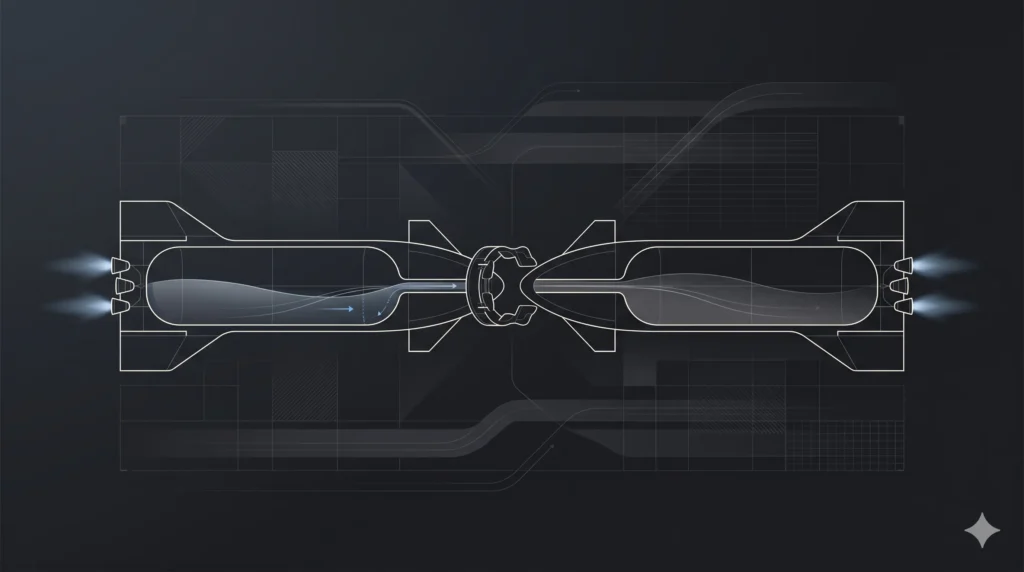
Transferring the fluid presents a severe physical challenge. In zero gravity, liquid and gas mix into a chaotic, floating slush. Before valves open, the depot must fire small thrusters. This microscopic acceleration settles the liquid firmly at the bottom of the tank, ensuring the pumps ingest pure liquid rather than destructive gas bubbles.
Orbital Cryogenic Depot Simulator
Balance thermal insulation and active cryocooling to achieve a Zero-Boil-Off state for 1,000 tons of liquid methane in Low Earth Orbit.
WHY IT MATTERS NOW
The entire architecture of the Artemis program and human lunar industrialization relies entirely on this specific fluid transfer mechanism. Super heavy-lift rockets cannot carry heavy cargo directly to the lunar surface. The physics of planetary escape velocity forbid it.
Orbital refueling acts as the ultimate cheat code for orbital mechanics. A fully fueled Starship leaving Low Earth Orbit can deliver over one hundred tons of useful payload directly to the Moon. Without refueling, that exact same ship arrives completely empty.
This thermodynamic capability dictates the economics of the new space race. Depots decouple the launch vehicle from the deep-space transport. A space agency can use cheap, reusable rockets to slowly ferry cheap fuel into orbit over several weeks, filling the depot like a strategic reserve.
The nation or corporation that perfects orbital Cryogenic Fluid Management effectively controls the logistics supply chain to cislunar space. Mastering zero-gravity fuel transfer transforms the rocket from a single-use projectile into a continuous, continent-spanning maritime shipping network operating above the atmosphere.
WHAT MOST PEOPLE MISS
The public and media focus entirely on rocket engine thrust and launch cadences. They assume that building a bigger rocket guarantees deep-space success.
The hidden reality is that the rocket is merely a delivery truck. The actual enabling technology of space industrialization is extraterrestrial plumbing. You cannot ignite a vacuum-optimized Raptor engine if the fuel lines are choked with warm, expanded methane vapor.
If a depot loses its active cooling capacity, the cryogenic liquids expand into gas rapidly. The internal pressure rises until the tank physically bursts. Maintaining deep-space logistics requires treating spacecraft not just as vehicles, but as high-pressure, zero-gravity cryogenic refrigerators.
THE TRAJECTORY
Next 12–36 Months: SpaceX and NASA will execute the first large-scale, ship-to-ship cryogenic transfers in Low Earth Orbit. These initial tests will experience higher-than-expected boil-off rates, forcing rapid software iterations to control fluid slosh dynamics during the physical docking phase.
Next Five Years: Dedicated, permanent propellant depots will separate from the launch vehicles entirely. These orbital structures will feature massive solar arrays dedicated purely to powering industrial-grade cryocoolers, establishing the first permanent zero-boil-off reserves in human history.
Next Ten Years: Deep-space logistics will shift from Earth-launched fuel to In-Situ Resource Utilization (ISRU). Automated lunar surface refineries will mine water ice, split it into hydrogen and oxygen, and launch it up to cislunar depots. This severs the deep-space economy from the severe gravitational penalty of Earth.
What Could Go Wrong: When two massive, partially filled tanks dock in orbit, the liquid inside continues to move. This fluid slosh carries immense kinetic energy. If the autonomous flight computers fail to predict and counteract this shifting center of mass, the joined vehicles will lose attitude control and spin violently out of orbit.
Most Likely Outcome: Cryogenic fluid management will mature into a highly standardized, automated utility. Direct-to-destination rocket launches will become economically obsolete. Every major deep-space mission will mandate a mandatory stop at a commercial orbital depot to maximize payload efficiency.
KEY TERMS
- Cryogenic Fluid Management (CFM): The engineering discipline of storing, cooling, and transferring super-chilled liquid propellants in the vacuum of space.
- Zero-Boil-Off (ZBO): A state achieved when active refrigeration extracts heat from a tank at the exact same rate that solar radiation introduces it.
- Thermal Stratification: The dangerous formation of uneven temperature layers within a fluid due to the absence of gravity-driven convection.
- Ullage: The empty volume of space inside a propellant tank containing vaporized gas rather than usable liquid.
- Multi-Layer Insulation (MLI): Highly reflective, microscopic layers of specialized plastic used to shield spacecraft from extreme solar radiation.
SOURCES
- NASA Glenn Research Center — Cryogenic Fluid Management Technologies
- American Institute of Aeronautics and Astronautics (AIAA) — In-Orbit Propellant Transfer Dynamics
- SpaceX — Starship Human Landing System Concept of Operations
- Government Accountability Office (GAO) — NASA Lunar Programs and Technical Risks