Advertisement
)

AT A GLANCE
- Concept: Centrifugal Compression: High-speed spinning impellers throw natural gas outward to increase pipeline pressure.
- Concept: Aerodynamic Surge: A catastrophic event where downstream gas pressure overpowers the compressor, flowing backward.
- Concept: Recycle Loop: A physical pipe connecting the high-pressure exit directly back to the low-pressure entrance.
- Concept: Anti-Surge Valve: An automated mechanical gate that opens in milliseconds to keep forward gas flowing.
HOW AN ANTI-SURGE VALVE WORKS
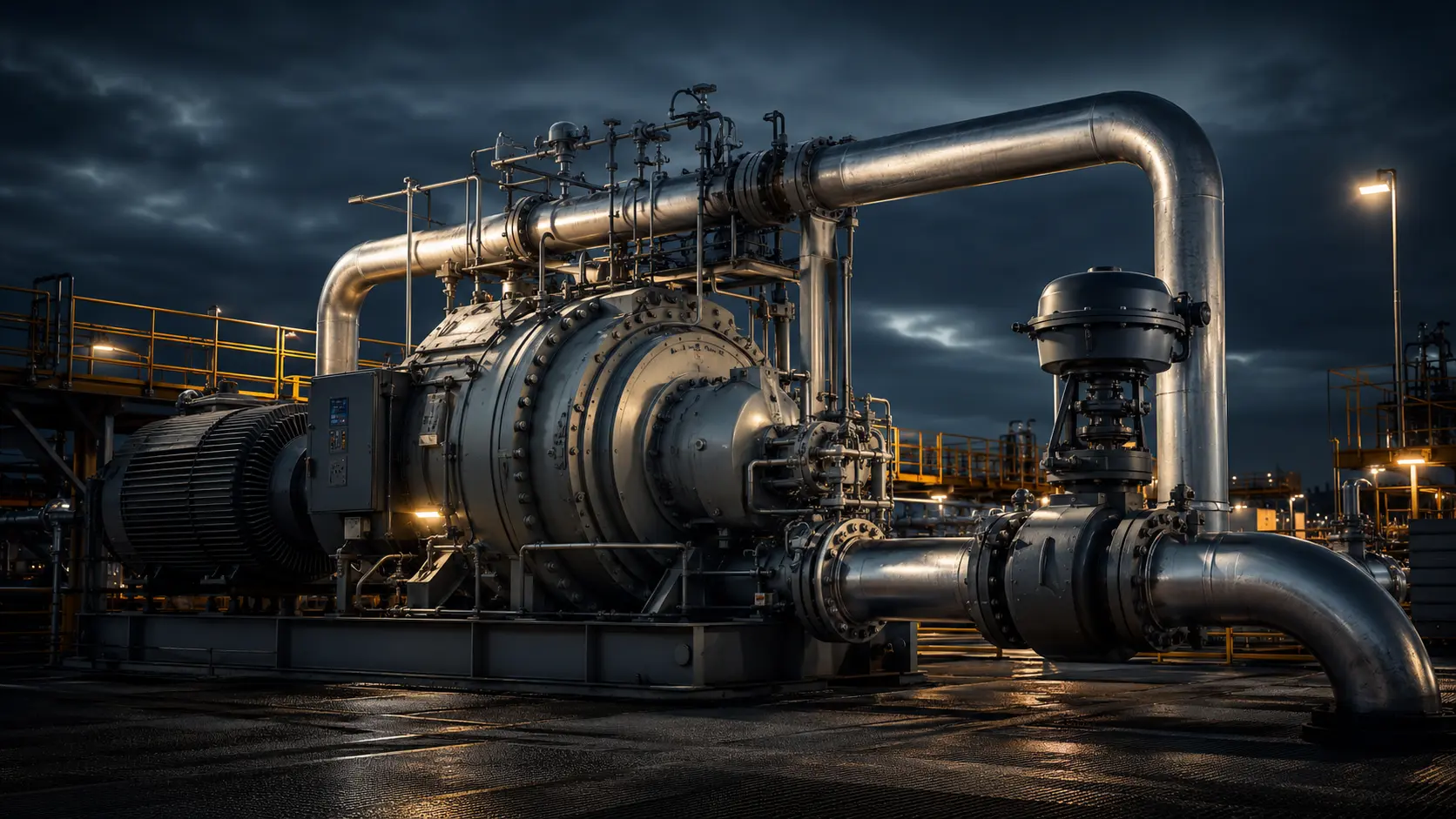
Natural gas does not move through global pipelines naturally; it requires massive mechanical force. Midstream operators use centrifugal compressors—massive industrial turbines—to physically push the gas across thousands of miles of steel pipe.
Inside these compressors, a spinning metal impeller accelerates the gas outward, converting kinetic energy into intense pressure. As long as the pressure leaving the machine is higher than the pressure sitting in the pipeline ahead of it, the gas flows smoothly forward.
However, aerodynamic physics dictates a strict operational boundary. If a downstream facility suddenly closes a valve, the pressure inside the pipeline rapidly spikes, eventually becoming stronger than the forward push of the compressor.
When this pressure differential flips, the gas violently reverses direction. This reverse flow slams into the forward-spinning compressor blades at supersonic speeds, causing a catastrophic mechanical failure known as an aerodynamic surge.
To prevent this destruction, engineers install an anti-surge recycle loop. When electronic sensors detect the gas slowing down, a massive bypass valve snaps open in milliseconds, taking the high-pressure gas from the exit and looping it back to the entrance.
This artificial loop mathematically tricks the compressor. It guarantees a constant volume of forward-moving gas across the impellers, completely stabilizing the aerodynamics until operators can safely spin down the turbine or correct the pipeline pressure.
WHY IT MATTERS NOW
Global energy security depends entirely on the uninterrupted flow of natural gas. When geopolitical conflicts sever traditional pipeline routes, nations rely on Liquefied Natural Gas (LNG) export terminals to supply allied grids across oceans.
These LNG terminals utilize some of the largest centrifugal compressor trains on Earth to flash-freeze the gas into a liquid state. If a single compressor train suffers an unmitigated aerodynamic surge, the entire multibillion-dollar facility shuts down for months while heavy machinery is rebuilt.
A concrete example occurred during the recent European energy crisis. When European grids scrambled to import American LNG, the physical strain on US midstream pipelines pushed compressor stations to their absolute maximum operational limits.
The anti-surge algorithms act as the invisible regulators of this global trade. By allowing pipeline operators to run compressors safely on the ragged edge of their aerodynamic limits, these automated valves maximize the total volume of fuel crossing the continent daily.
Consequently, the companies manufacturing these specialized quick-response valves and control algorithms hold massive influence over global energy logistics. They sell the exact physical insurance policy that keeps industrial civilization from freezing during winter demand spikes.
WHAT MOST PEOPLE MISS
Industrial analysts frequently assume that an anti-surge valve is a simple open-or-shut emergency switch. They completely miss the extreme thermodynamic penalty of using the recycle loop.
When a compressor loops highly pressurized gas back to its suction intake, it retains all the physical heat generated during the initial compression. If the anti-surge valve stays open too long without running the gas through an external cooler, the recycled gas rapidly superheats, physically melting the internal seals of the compressor.
Operators are therefore caught in a brutal mechanical paradox. Opening the valve saves the turbine blades from aerodynamic destruction, but leaving it open destroys the machine through thermal overload.
THE TRAJECTORY
Next 12–36 Months: Operators will transition to fully electric variable-frequency drive (VFD) compressors. Engineers will integrate VFDs directly with anti-surge controllers, adjusting motor speed in milliseconds rather than relying solely on mechanical valves to manage pressure transients.
Next Five Years: Hydrogen blending will alter physical flow dynamics. As governments force pipelines to carry a mix of natural gas and hydrogen, the vastly lighter weight of hydrogen molecules will radically shift the aerodynamic surge line, requiring complete algorithmic rewrites of every anti-surge controller globally.
Next Ten Years: Artificial intelligence will simulate entire continental pipeline networks in real-time. These digital twins will predict downstream pressure spikes hours in advance, preemptively slowing distant compressors before a physical surge condition ever materializes.
What Could Go Wrong: Valve actuator failure. The anti-surge valve must open completely in less than one second. If moisture freezes inside the pneumatic actuator during a winter storm, the valve will physically stick shut, guaranteeing the total destruction of the compressor during a pressure anomaly.
Most Likely Outcome: The anti-surge recycle loop will remain the mandatory fail-safe for global gas infrastructure. The physical realities of fluid dynamics require a mechanical bypass to manage the chaotic pressure waves inherent in civilization-scale energy transmission.
KEY TERMS
- Centrifugal Compressor: An industrial machine that increases the pressure of a gas by throwing it outward from a high-speed spinning impeller.
- Aerodynamic Surge: A violent flow reversal occurring when pipeline pressure exceeds a compressor’s ability to push forward.
- Recycle Loop: A physical pipe bypass that routes discharged gas back to the intake to maintain minimum forward flow.
- Surge Line: The exact mathematical boundary on a compressor map marking where forward flow collapses into reverse flow.
- Valve Actuator: The mechanical mechanism that physically forces a heavy industrial valve open or closed in milliseconds.
SOURCES
- American Petroleum Institute (API) — Standard 617: Axial and Centrifugal Compressors and Expander-Compressors
- Turbomachinery Laboratory at Texas A&M University — Centrifugal Compressor Surge Control and Aerodynamic Instability
- Pipeline Research Council International (PRCI) — Transient Flow Dynamics and Anti-Surge Valve Topologies
- Department of Energy (DOE) — Infrastructure Reliability in High-Pressure Natural Gas Transmission