Advertisement
)

AT A GLANCE
- Concept: Shor’s Algorithm: A quantum calculation capable of instantly breaking standard internet encryption.
- Concept: Harvest Now, Decrypt Later: Adversaries storing encrypted data today to break it tomorrow.
- Concept: Lattice Mathematics: Hiding encryption keys inside multidimensional grids of deliberate geometric noise.
- Concept: ML-KEM: The official federal standard algorithm replacing legacy public-key encryption protocols.
IN SIMPLE WORDS
For forty years, the internet has protected your banking, emails, and corporate secrets using a specific mathematical trick. Systems multiply two massive prime numbers together. For a standard computer, figuring out those two original numbers takes millions of years.
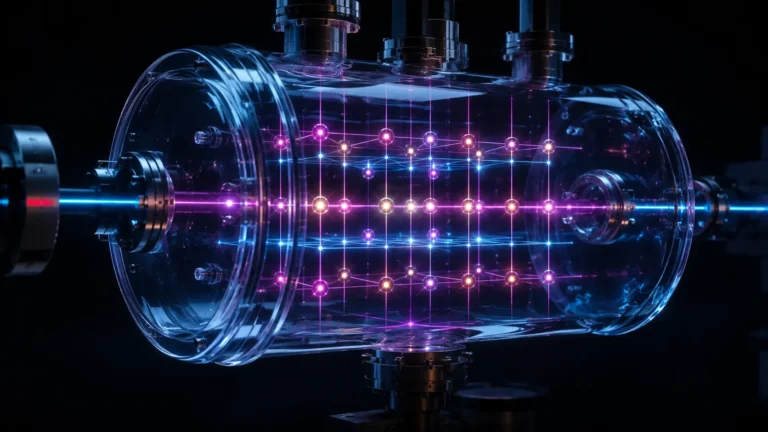
But computers are changing. Quantum computers operate on entirely different laws of physics. They can solve this specific prime-number math problem in hours. If a quantum computer falls into the hands of a hostile nation, every secret on the internet becomes instantly readable.
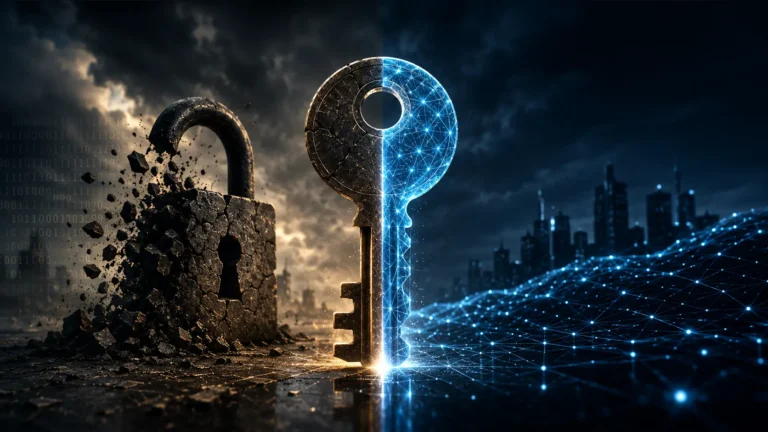
Post-quantum cryptography is the solution. Instead of using prime numbers, engineers are rebuilding the internet’s security using complex, multidimensional grids called lattices. Finding a password inside this grid is like finding a specific grain of sand in a storm. Not even a quantum computer possesses the processing power to solve it.
HOW IT WORKS
The modern internet relies heavily on the RSA and Elliptic Curve Cryptography (ECC) algorithms. These systems protect data through the mathematical difficulty of prime factorization and discrete logarithms.
In 1994, mathematician Peter Shor published Shor’s Algorithm. He proved that a sufficiently large quantum computer could exploit quantum superposition to solve both prime factorization and discrete logarithms in polynomial time. Once hardware engineers build a quantum processor with enough stable, error-corrected qubits, legacy encryption mathematically collapses.
To prevent this, the National Institute of Standards and Technology (NIST) standardized a new mathematical foundation called the Module-Lattice-Based Key-Encapsulation Mechanism (ML-KEM), formerly known as Kyber-768.
ML-KEM abandons prime numbers completely. Instead, it hides encryption keys using the geometry of multidimensional lattices. The algorithm generates a public key by defining a grid of points in hundreds of dimensions and inserting a mathematically calculated layer of noise.
The underlying formula relies on polynomial rings defined over Z_q[X]/(X^n + 1). The system applies the “Learning with Errors” (LWE) framework. It takes a known mathematical vector, adds a small, randomized error vector, and transmits the noisy result over the network.
An adversary intercepting this data only sees mathematically unsolvable static. Only the receiving server, holding the exact private key matrix, possesses the algebraic inverse required to filter out the intentional noise and agree on a shared, secure symmetric key.
REAL WORLD EXAMPLE
Every time you open a web browser and see a padlock icon next to a URL, your computer executes a Transport Layer Security (TLS) handshake. The browser and the server use public-key cryptography to agree on a secret session key.
Today, companies like Cloudflare and Google are actively forcing these TLS handshakes to use post-quantum cryptography. If a user accesses a Google Workspace document via the Chrome browser, the connection automatically initiates an ML-KEM handshake.
The browser generates a lattice-based public key, injects mathematical noise, and sends it to the Google server. The server solves the matrix, agrees on the symmetric key, and encrypts the document. This happens in milliseconds, totally invisible to the user, yet structurally immune to quantum interception.
WHY POST-QUANTUM CRYPTOGRAPHY MATTERS NOW
Adversarial nation-states are currently executing massive “harvest now, decrypt later” campaigns. Intelligence agencies are actively siphoning petabytes of encrypted global banking data, sovereign communications, and proprietary corporate algorithms from undersea cables.
They cannot read this data today. They are storing it in hyperscale server farms, waiting for the exact day a functional quantum computer comes online—an event security professionals call Q-Day.
Once Q-Day arrives, every intercepted historical secret becomes instantly readable. If an intelligence agency captures the encrypted blueprints for a next-generation fighter jet today, those blueprints will still be strategically valuable when quantum hardware breaks the encryption five years from now.
Organizations cannot wait for quantum hardware to mature before upgrading their defenses. By the time a quantum processor successfully factors a 2048-bit RSA key, the historical data is already stolen. Implementing ML-KEM immediately is the only structural defense against this retroactive surveillance.
COMMON MISCONCEPTIONS
Many executives assume post-quantum cryptography requires buying an actual quantum computer. In reality, post-quantum algorithms are strictly classical software. They run on standard laptops and smartphones; they are simply designed to resist quantum attacks.
Engineers often believe that doubling the size of current RSA keys will protect against quantum threats. Shor’s algorithm scales exponentially, meaning a quantum computer that breaks RSA-2048 will easily break RSA-4096 shortly after. Increasing key size only delays the inevitable by a few months.
People assume the transition will happen automatically through routine software updates. In reality, migrating to post-quantum standards requires mapping and rewriting thousands of deeply embedded, legacy IT systems that govern industrial control grids and financial clearinghouses.
WHAT MOST PEOPLE MISS
IT managers frequently treat post-quantum cryptography as a simple protocol swap. They entirely miss the brutal network physics of lattice-based algorithms.
ML-KEM public keys are massive. A standard Elliptic Curve public key requires just 32 bytes of data, whereas an ML-KEM-768 public key requires 1,184 bytes. This exponential 3,600% increase in payload bloats the initial TLS handshake.
When millions of these bloated handshakes hit a corporate firewall simultaneously, the hardware physically chokes. The sheer volume of bytes causes severe packet fragmentation, dropping connections and physically slowing down the internet’s core routing infrastructure. Securing the network mathematically creates a severe operational bottleneck mechanically.
THE ECONOMIC AND STRATEGIC IMPACT
The financial sector faces the highest systemic exposure. The global banking system processes over $6 trillion daily through systems relying entirely on legacy public-key infrastructure. A sudden quantum break would instantly erase trust in global digital ledgers.
Hardware vendors stand to gain massive capital influxes. Semiconductor designers are currently embedding dedicated ML-KEM acceleration logic directly into network interface cards (NICs) and mobile processors. This hardware ossification is mandatory to eliminate the severe computational latency caused by polynomial vector multiplication.
Strategically, the US federal government has mandated that all civilian agencies migrate completely to post-quantum cryptography by 2035. Defense contractors failing to demonstrate ML-KEM compliance will immediately lose access to multi-billion-dollar procurement pipelines. Control over the mathematical standards of the new internet directly translates to geopolitical cyber dominance.
THE TRAJECTORY
Next 12–36 Months: Global web browsers and enterprise servers will force a transition to hybrid cryptography. Systems will wrap data in both a classical elliptical curve algorithm and an ML-KEM lattice, ensuring security against both current classical attacks and future quantum threats while hardware compatibility stabilizes.
Next Five Years: The hardware ossification of lattice mathematics. Network appliance manufacturers will release physical firewalls and load balancers equipped with application-specific integrated circuits (ASICs) designed exclusively to process large polynomial matrices at line rate.
Next Ten Years: The complete deprecation of RSA and Elliptic Curve Cryptography. Regulatory bodies like the NSA and European cybersecurity agencies will legally ban classical asymmetric encryption algorithms in all government, financial, and critical infrastructure environments.
What Could Go Wrong: A catastrophic algorithmic break. Lattice-based cryptography is mathematically much younger than prime factorization. If a brilliant mathematician discovers a classical shortcut to solve the Learning with Errors problem, the entire ML-KEM framework collapses, leaving the internet completely defenseless.
Most Likely Outcome: ML-KEM will successfully replace the internet’s aging cryptographic foundation. The sheer geopolitical necessity of protecting state secrets guarantees unlimited funding and forced compliance across all tier-one commercial infrastructure.
KEY TERMS
- Shor’s Algorithm: A quantum computing formula capable of finding the prime factors of an integer, easily breaking legacy internet encryption.
- ML-KEM (Kyber): Module-Lattice-Based Key-Encapsulation Mechanism, the official federal standard algorithm for post-quantum key exchange.
- Harvest Now, Decrypt Later: A cyber espionage tactic where adversaries steal and store encrypted data today to decrypt it when quantum computers mature.
- Lattice Cryptography: A security framework that hides data within a complex, multidimensional grid of points that quantum processors cannot efficiently map.
- Learning with Errors (LWE): A mathematical problem that creates security by injecting small, random numerical errors into linear equations.
- Hybrid Cryptography: The practice of combining a traditional encryption algorithm with a post-quantum algorithm to ensure redundant security during the transition period.
- Key Encapsulation Mechanism (KEM): A cryptographic technique used to securely establish a shared symmetric passcode over a public, insecure network.
BEGINNER FAQ
What is post-quantum cryptography? It is a new generation of mathematical algorithms designed to secure digital communications. These algorithms run on standard computers but are complex enough to resist being hacked by highly advanced quantum computers.
Why is current encryption failing? Current encryption relies on multiplying large prime numbers, which takes standard computers millions of years to reverse. Quantum computers use quantum physics to process information differently, allowing them to reverse this specific math in hours.
When will quantum computers break the internet? Experts refer to this exact moment as Q-Day. While estimates vary, most intelligence agencies predict a quantum computer capable of breaking current encryption will exist between 2030 and 2035.
What is harvest now, decrypt later? Hackers and foreign governments are actively stealing heavily encrypted data right now. They cannot read it, but they are storing it on hard drives until quantum computers are powerful enough to break the locks.
Do I need to buy a quantum computer to use this? No. Post-quantum cryptography consists of classical software updates. Your current smartphone, laptop, and web browser will run these new algorithms automatically once tech companies deploy the updates.
What is ML-KEM? ML-KEM stands for Module-Lattice-Based Key-Encapsulation Mechanism. It is the specific mathematical algorithm chosen by the US government to become the new global standard for internet security.
How does lattice math work? Instead of using prime numbers, lattice math creates a grid with hundreds of dimensions. The encryption key is hidden at a specific point inside this grid, wrapped in mathematical static that makes it impossible to find without the correct passcode.
Will this slow down my internet? Initially, it might cause minor delays. Post-quantum algorithms require much larger data files to establish a secure connection. Network engineers are currently upgrading servers and firewalls to handle this extra data without slowing down web traffic.
Is my bank account safe? Yes, for now. Global financial institutions are actively spending billions of dollars to upgrade their systems to post-quantum standards long before quantum computers become a physical threat.
SOURCES
- National Institute of Standards and Technology (NIST) — FIPS 203: Module-Lattice-Based Key-Encapsulation Mechanism Standard
- Cybersecurity and Infrastructure Security Agency (CISA) — Quantum-Readiness: Migration to Post-Quantum Cryptography
- Institute of Electrical and Electronics Engineers (IEEE) — Performance Evaluation of Kyber KEM in TLS 1.3 Handshakes
- European Union Agency for Cybersecurity (ENISA) — Post-Quantum Cryptography Integration and Hardware Acceleration