Advertisement
)

AT A GLANCE
- Concept: Solid Electrolyte: A hard, non-flammable material that conducts lithium ions between battery electrodes.
- Concept: Lithium-Metal Anode: Pure lithium used to maximize energy, entirely replacing heavy graphite structures.
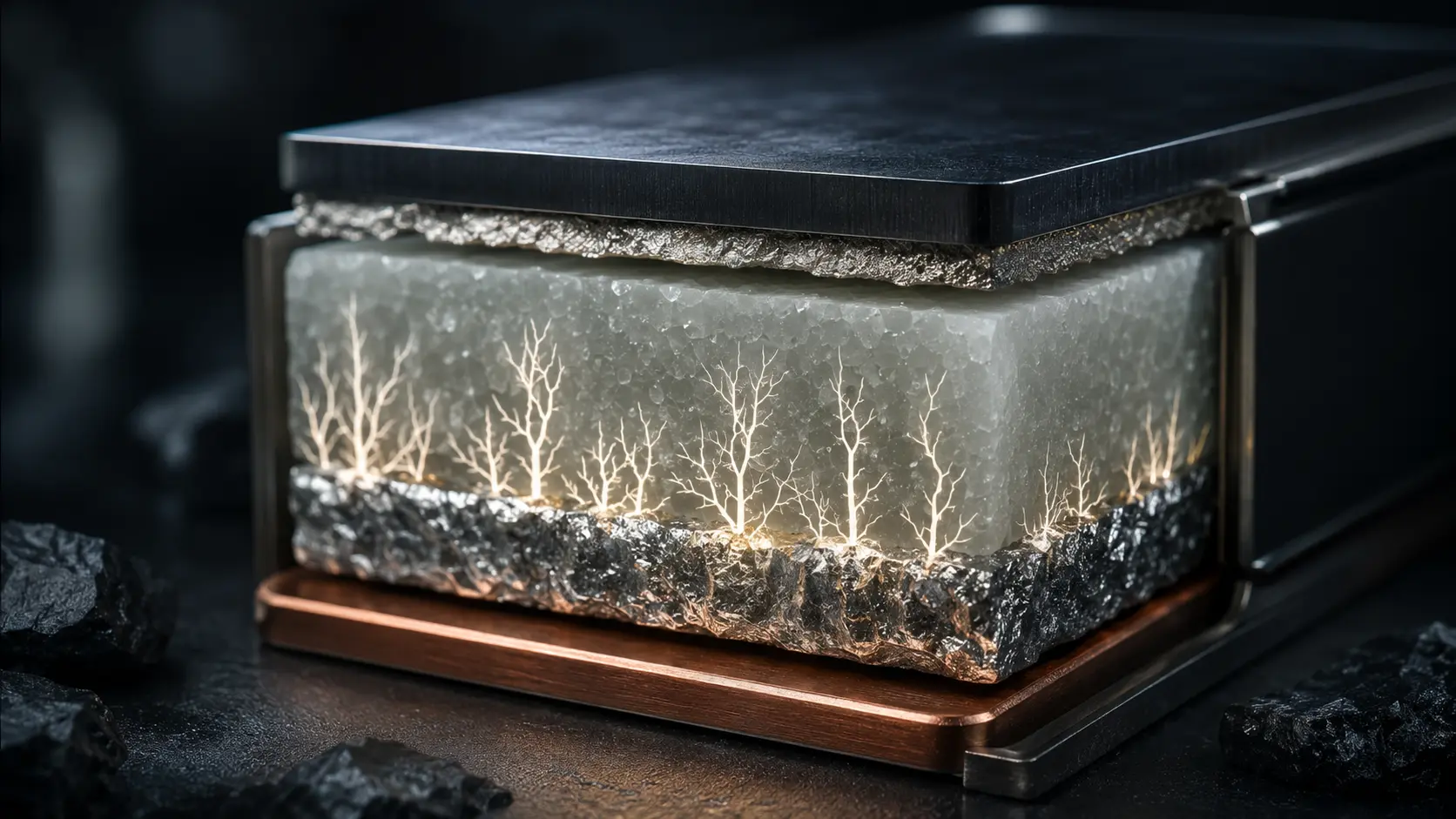
- Concept: Lithium Dendrite: A sharp, metallic needle that can grow through a battery and cause short-circuits.
- Concept: Interfacial Resistance: The electrical friction occurring where the rigid solid electrolyte meets the metal electrodes.
IN SIMPLE WORDS
Imagine a standard lithium-ion battery as a swimming pool. The energy (lithium ions) swims from one side to the other through a liquid chemical. This liquid is heavy, takes up space, and catches fire easily if damaged.
Now, imagine draining that pool and replacing the water with a perfectly formed block of glass that still lets the energy move through it. This is a solid-state battery.
By removing the liquid, engineers can pack significantly more energy into a smaller space. Cars can drive further. Phones charge in minutes instead of hours. Most importantly, because there is no liquid fuel inside, the battery cannot explode in a crash. It is the holy grail of energy storage, but manufacturing a solid material that performs flawlessly at the atomic level remains an incredibly difficult physical challenge.
HOW IT WORKS
Traditional lithium-ion batteries rely on liquid electrolytes to ferry lithium ions between a graphite anode and a metal-oxide cathode. The liquid is a volatile organic solvent that fundamentally limits how much energy the cell can store safely. Solid-state architectures replace this liquid with a rigid, non-flammable solid electrolyte, typically composed of sulfide glass-ceramics, oxides, or specialized polymers.
This single structural change creates a massive electrochemical advantage. Because the solid electrolyte acts as an impenetrable physical barrier, engineers can completely remove the bulky graphite anode. They replace it with a pure lithium-metal anode, the most energy-dense material physically possible for a battery.
However, mating two completely solid materials creates a severe mechanical challenge. At the microscopic level, neither the solid electrolyte nor the lithium metal is perfectly flat. When these two solids press together, tiny microscopic gaps or voids form at the boundary.
These interfacial voids act as physical bottlenecks for the electrical current. When a driver plugs into a fast charger, billions of lithium ions rush toward the anode. The current concentrates intensely at the few points where the ceramic and the metal physically touch.
If this localized electrical bottleneck forces the critical current density to spike wildly, the metal begins growing as a sharp, crystalline needle known as a lithium dendrite. This metallic needle can physically fracture the ceramic separator. Once fractured, it bridges the gap between the positive and negative electrodes and instantly short-circuits the cell.
REAL WORLD EXAMPLE
Toyota and QuantumScape are actively racing to commercialize this technology for the automotive market. Volkswagen-backed QuantumScape uses a proprietary ceramic separator designed to physically block dendrite growth during rapid charging.
In standard electric vehicles, the heavy battery pack dictates the entire design of the car. If a manufacturer replaces the traditional liquid pack with a solid-state pack of the same physical size, the vehicle’s range jumps from 300 miles to over 600 miles. Conversely, the automaker can cut the battery size in half, radically reducing the vehicle’s weight and manufacturing cost while maintaining a standard driving range.
WHY IT MATTERS NOW
The global automotive industry has bet hundreds of billions of dollars on the electric transition, but consumer adoption is stalling. “Range anxiety” and hour-long charging times remain the absolute barriers to mass-market electric vehicle adoption. Solid-state batteries mathematically solve both problems, allowing a car to recharge to 80% in under ten minutes.
Beyond terrestrial transport, solid-state chemistry acts as the primary enabler for electric aviation. Commercial aircraft require extreme energy density to achieve lift. Legacy lithium-ion cells are simply too heavy relative to the power they provide to fly an airliner across an ocean.
The geopolitical stakes are equally massive. Currently, China completely dominates the processing of graphite and liquid electrolytes required for legacy batteries. Solid-state architectures bypass these specific supply chains, providing Western nations a reset opportunity to domesticate the next generation of energy storage manufacturing.
Control over the patents for sulfide and oxide solid electrolytes will define the financial winners of the 2030s. Automakers that secure exclusive access to scalable solid-state tech will instantly obsolete the fleets of their competitors. This creates a winner-take-all dynamic in the global transport sector.
COMMON MISCONCEPTIONS
- “Solid-state batteries are entirely new.” Engineers have used tiny solid-state batteries in pacemakers for decades. Scaling those low-power architectures up for electric vehicles is the actual modern engineering challenge.
- “Solid ceramics easily stop soft lithium metal.” People assume hard ceramics act as perfect physical walls. In reality, lithium dendrites exploit microscopic seams, called grain boundaries, to crack and penetrate hard ceramics like tree roots breaking concrete.
- “Solid-state means zero degradation.” While they do not use volatile liquids, solid-state batteries still experience mechanical fatigue. The lithium metal expands and contracts during charging, eventually causing the battery to degrade over thousands of cycles.
WHAT MOST PEOPLE MISS
Clean-energy commentators frequently assume that the primary hurdle to solid-state commercialization is discovering the perfect chemical recipe. They entirely miss that the real problem is high-pressure mechanical engineering.
To prevent interfacial voids and stop dendrites, many first-generation solid-state cells require immense external physical pressure to force the layers together. Automakers must wrap the battery in heavy steel frames and industrial clamps to compress the cell at pressures exceeding 50 atmospheres. This massive external steel casing frequently cancels out the weight savings achieved by removing the liquid, creating a brutal engineering paradox.
THE ECONOMIC AND STRATEGIC IMPACT
The financial winners in the next decade of battery manufacturing will not just be chemical companies. The market will heavily reward precision manufacturing equipment makers capable of depositing flawless, nanometer-thin ceramic layers at high volume without creating microscopic defects.
Oil and gas producing nations view solid-state commercialization as the final tipping point for peak oil demand. When electric vehicles achieve cost parity, 600-mile ranges, and gas-station-equivalent charging times, the primary utility of internal combustion engines vanishes.
Supply chain dominance will shift from companies mining graphite toward companies refining high-purity lithium and specialized sulfur compounds. Global commodities markets are already restructuring their long-term forecasts to account for the total removal of graphite from next-generation anodes.
THE TRAJECTORY
Next 12–36 Months: Tier-one battery suppliers will release semi-solid batteries as a commercial bridge. These cells use a solid electrolyte but retain a tiny percentage of liquid solvent at the interface to wet the boundary. This eliminates voids without requiring extreme external clamping pressure.
Next Five Years: The commercialization of silver-carbon interlayer architectures. Material scientists will coat the lithium anode with a microscopic buffer layer to chemically regulate lithium deposition. This will act as an electrochemical traffic controller, preventing localized current density spikes during rapid charging.
Next Ten Years: True zero-external-pressure solid-state packs will reach mass production. Advanced isostatic pressing will allow foundries to fuse the sulfide matrix directly into the lithium metal at the atomic level. Automakers will finally install lightweight packs without heavy steel compression frames.
What Could Go Wrong: Severe moisture sensitivity. Sulfide solid electrolytes react violently with trace amounts of humidity, generating highly toxic hydrogen sulfide gas. If manufacturing facilities cannot maintain perfect dry-room conditions, factory yields will collapse entirely.
Most Likely Outcome: Solid-state batteries will secure absolute dominance in the premium automotive and electric aviation sectors. The sheer mathematical limit of lithium-metal energy density ensures the industry will successfully engineer around the mechanical penalties to scale production.
KEY TERMS
- Solid-State Electrolyte: A rigid, non-flammable material that conducts ions between battery electrodes without liquid solvents.
- Lithium-Metal Anode: A battery terminal made of pure lithium metal, offering vastly more energy storage than traditional graphite structures.
- Lithium Dendrite: A sharp, needle-like metallic crystal that grows inside a battery during charging and can cause a catastrophic short circuit.
- Critical Current Density: The specific electrical threshold at which smooth lithium deposition fails and destructive dendrite growth begins.
- Interfacial Resistance: The electrical friction that occurs when ions try to cross the microscopic physical boundary between two solid materials.
- Grain Boundary: The microscopic physical seam separating individual crystal structures within a compressed ceramic material.
BEGINNER FAQ
What is a solid-state battery? It is a battery that replaces liquid chemical electrolytes with a solid piece of glass or ceramic. This makes the battery vastly safer and capable of holding more energy.
Why are traditional lithium-ion batteries dangerous? Traditional batteries use a liquid electrolyte that is highly flammable. If the battery is punctured or overheats, this liquid can ignite and cause a severe chemical fire.
How much further can an EV drive with a solid-state battery? Depending on the exact chemistry, a solid-state battery can increase a vehicle’s range by 50 to 80 percent compared to a lithium-ion battery of the exact same size.
Why aren’t they in cars right now? Manufacturing solid materials that touch each other perfectly without microscopic gaps is incredibly difficult. If there is a gap, the battery struggles to charge and can physically break itself.
What is a lithium dendrite? It is a tiny, sharp spike of metal that grows inside the battery when it charges too fast. If it grows long enough, it touches the other side of the battery and causes a short circuit.
How fast can a solid-state battery charge? Because they do not overheat like liquid batteries, solid-state cells can safely accept massive amounts of electricity. They can potentially charge an electric vehicle to 80 percent in under ten minutes.
Are solid-state batteries better for the environment? Yes. They require less total material to store the same amount of energy, and they completely eliminate the need for toxic, flammable liquid solvents.
Will they make electric cars cheaper? Initially, they will be very expensive and only appear in luxury cars. As factories learn to mass-produce them, the reduction in raw materials will eventually make them much cheaper than current batteries.
SOURCES
- Joule — The Role of Mechanical Pressure in Suppressing Lithium Dendrites in Solid-State Batteries
- Nature Energy — Interfacial Void Formation and Critical Current Density in Sulfide Solid Electrolytes
- Department of Energy (DOE) — Solid-State Battery Commercialization and Interfacial Engineering Challenges
- Advanced Energy Materials — Grain Boundary Penetration Mechanics of Lithium Metal in Ceramic Separators