Advertisement
)

AT A GLANCE
- Concept: Qubit Decoherence: The rapid loss of quantum information caused by minor temperature fluctuations or radiation.
- Concept: Logical Qubit: A single, reliable unit of computing power created by grouping many unstable physical qubits.
- Concept: Surface Code: A geometric checkerboard pattern of qubits designed to detect and fix errors automatically.
- Concept: Syndrome Measurement: Extracting error data from a quantum system without looking directly at the fragile data.
IN SIMPLE WORDS
Imagine trying to write a complex novel while someone constantly bumps your elbow. You would make spelling mistakes on every page.
Standard computers solve this by making multiple copies of the data. If one copy corrupts, the computer simply checks the backups. Quantum computers cannot do this. The fundamental laws of physics dictate that looking at quantum data destroys it instantly, meaning you cannot copy it.
Furthermore, quantum bits are incredibly fragile. A stray cosmic ray or a fraction of a degree of heat causes them to immediately forget their information.
Quantum error correction solves this impossible physics problem. It spreads a single piece of information across a vast grid of physical hardware. It uses specialized “helper” bits to constantly monitor the grid for mistakes without ever looking at the actual data. This allows the computer to fix its own errors in real time, turning a fragile, noisy machine into a reliable supercomputer.
HOW IT WORKS
Standard digital computers process information using binary bits of ones and zeroes. They experience an error roughly once in every billion billion operations. Quantum computers use physical qubits, which process complex probabilities, but they experience an error roughly once in every thousand operations.
This extreme fragility is called decoherence. To calculate a useful algorithm, a quantum computer must run trillions of operations without a single mistake. Because physical qubits cannot currently achieve this reliability, physicists developed the concept of the logical qubit.
A logical qubit is not a physical piece of hardware. It is a mathematical abstraction created by grouping hundreds or thousands of physical qubits together. The most prominent architecture for building these logical qubits is the topological surface code.
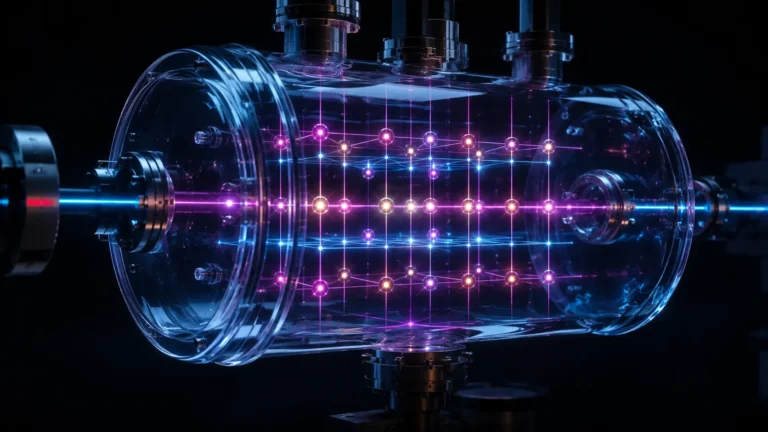
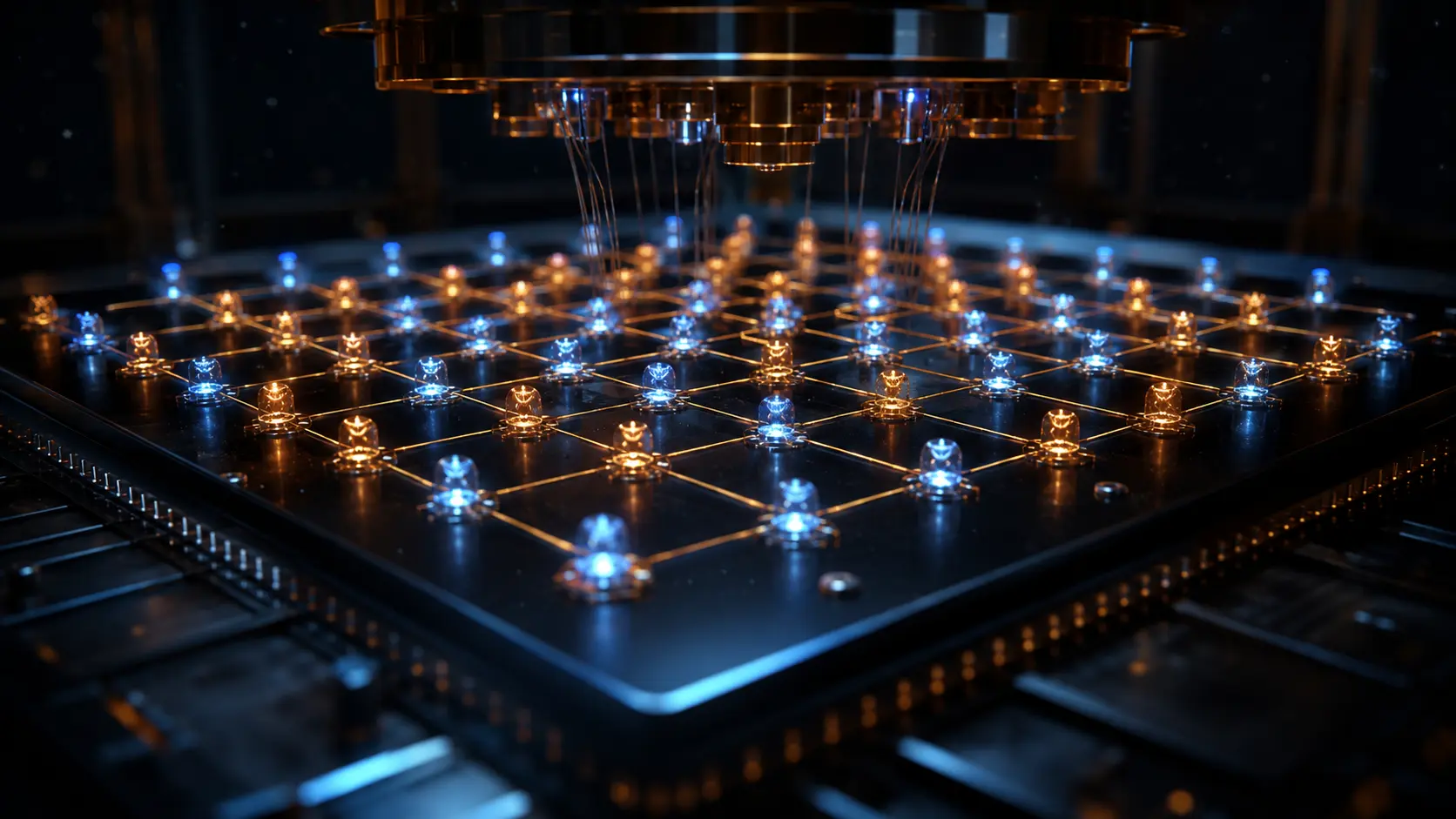
In a surface code, engineers arrange physical qubits on a two-dimensional grid, alternating like squares on a checkerboard. Half of these are “data qubits” that hold the actual computational information. The other half are “measure qubits,” or ancilla qubits, which act as active sentinels.
The laws of quantum mechanics state that directly measuring a data qubit collapses its delicate state, completely erasing the calculation. To bypass this, the computer entangles a measure qubit with its neighboring data qubits. The system then reads the measure qubit to extract a “syndrome”—a mathematical clue indicating if an error occurred nearby, without ever looking at the data itself.
A classical supercomputer sits outside the cryogenic chamber, rapidly analyzing these syndrome measurements in real time. It identifies the exact location of the error and applies a corrective microwave pulse to the specific physical qubit before the error can spread and corrupt the entire logical block.
REAL WORLD EXAMPLE
Google Quantum AI recently demonstrated this exact mathematical mechanism inside their Sycamore processor. They arranged physical superconducting qubits into a surface code lattice to test error suppression.
Instead of the error rate increasing as they added more physical qubits, the error rate actually dropped. By scaling a distance-3 logical qubit up to a distance-5 logical qubit, they proved that adding more physical hardware successfully suppresses quantum noise. This milestone proved that fault-tolerant quantum computing is physically possible, shifting the industry from theoretical physics into brute-force engineering.
WHY IT MATTERS NOW
The global technology sector has invested billions into raw quantum hardware, but these noisy, intermediate-scale machines lack the reliability to solve real commercial problems. Until error correction matures, a quantum computer is merely an expensive physics experiment.
Commercializing quantum computing depends entirely on these mathematical shields. Chemical companies cannot simulate complex molecular binding if the processor forgets the math halfway through the calculation. Error correction is the strict dividing line between a scientific novelty and a trillion-dollar industrial asset.
Geopolitically, the stakes center heavily on national security and cryptography. A fault-tolerant quantum computer running Shor’s algorithm will easily break the RSA encryption protecting the global financial system.
However, running Shor’s algorithm requires thousands of perfect logical qubits. The nation that masters error correction first dictates the timeline for the global post-quantum cryptographic migration. Controlling the hardware scaling directly determines when existing sovereign secrets become readable.
COMMON MISCONCEPTIONS
- “Error correction prevents errors from happening.” It does not stop errors. It simply detects and reverses them faster than they can accumulate and crash the system.
- “Quantum computers can just use classical error correction.” Classical systems copy data to create backups. The No-Cloning Theorem in quantum mechanics makes copying unknown quantum states physically impossible.
- “More physical qubits equal a better computer.” If a manufacturer adds thousands of physical qubits without implementing error correction, the system just generates more unreadable noise and fails faster.
WHAT MOST PEOPLE MISS
Hardware announcements constantly boast about building 1,000-qubit processors. They completely ignore the physical-to-logical overhead ratio.
To create just one reliable logical qubit using surface codes, a system might require up to 1,000 physical qubits dedicated entirely to error checking. A highly publicized 1,000-qubit machine actually yields exactly one useful logical qubit. To run a commercially valuable algorithm, a company will need a machine with a million physical qubits, exposing a massive gap between current hardware and actual utility.
THE ECONOMIC AND STRATEGIC IMPACT
The hardware manufacturers that solve the overhead ratio will capture the entire quantum market. Companies like IBM, Google, and Quantinuum are racing to discover more efficient error-correcting codes, such as Low-Density Parity-Check (LDPC) codes, which require fewer physical qubits per logical qubit.
Cryptographic security firms benefit massively from this timeline. The known engineering difficulty of scaling error correction gives the global banking system exactly enough time to upgrade their networks to post-quantum standards before a threat emerges.
Governments funding these initiatives view error correction as a strict matter of sovereign capability. The extreme cost of the cryogenic cooling and classical supercomputing required to manage syndrome extraction ensures that fault-tolerant machines will remain heavily centralized, tightly controlled assets.
THE TRAJECTORY
Next 12–36 Months: Major quantum hardware labs will successfully demonstrate algorithms running across multiple logical qubits simultaneously. These demonstrations will finally exceed the break-even point, where the error correction definitively outpaces the natural hardware noise.
Next Five Years: The integration of classical decoding ASICs. Companies will move the classical supercomputers that read the error syndromes directly inside the cryogenic fridge. This will drastically reduce the data latency between the quantum chip and the classical controller.
Next Ten Years: The transition to advanced LDPC codes and alternative physical architectures. Trapped-ion and neutral-atom systems, which feature natural, all-to-all connectivity, will utilize highly efficient error codes that require significantly fewer physical qubits than superconducting surface codes.
What Could Go Wrong: Correlated cosmic ray strikes. If high-energy radiation hits the quantum chip, it can flip dozens of qubits simultaneously. Surface codes are designed to catch single, isolated errors. A massive, correlated burst of errors will overwhelm the logical qubit and crash the calculation instantly.
Most Likely Outcome: Quantum error correction will succeed, but the overhead ratio dictates a slow, grueling timeline. Fault-tolerant quantum computing will become a massive, capital-intensive heavy industry, completely isolated to major cloud providers and national laboratories.
KEY TERMS
- Physical Qubit: The actual, unstable hardware component—such as a superconducting circuit or trapped ion—that holds raw quantum data.
- Logical Qubit: A reliable, highly stable mathematical construct created by grouping many physical qubits together to act as one.
- Surface Code: A specific geometric arrangement of qubits used to detect and correct errors locally across a two-dimensional grid.
- Syndrome Measurement: The process of reading specialized “helper” qubits to detect nearby errors without collapsing the delicate quantum state of the actual data.
- Decoherence: The rapid degradation of quantum information caused by environmental interference like heat, electromagnetism, or radiation.
- No-Cloning Theorem: A fundamental rule of quantum physics stating that it is impossible to create an identical copy of an unknown quantum state.
- Fault Tolerance: A system’s ability to continue operating properly and accurately even when its individual internal components fail.
BEGINNER FAQ
What is quantum error correction? It is a software and hardware system that catches and fixes mistakes in a quantum computer. It groups many fragile quantum bits together to create a single, highly reliable processor.
Why do quantum computers make mistakes? Quantum bits are incredibly sensitive to their environment. A tiny fluctuation in temperature, a stray magnetic field, or natural background radiation causes them to instantly lose their data.
Why can’t we fix them like normal computers? Normal computers fix errors by constantly copying data to create backups. A fundamental law of physics makes it impossible to copy quantum information, forcing engineers to use complex, indirect mathematical checks.
What is a logical qubit? It is a single, perfect unit of computing power. Because individual physical bits are so noisy, engineers group hundreds of them together to act as one highly stable logical qubit.
How many physical qubits make one logical qubit? Currently, depending on the hardware quality, it takes anywhere from a few hundred to over a thousand physical qubits to create a single logical qubit.
What is a surface code? It is the most popular blueprint for arranging qubits. It lays them out in a grid, alternating between data-holding qubits and active error-checking qubits.
How long until we have a fully corrected quantum computer? Most industry experts project it will take at least another decade to build a machine with the millions of physical qubits required to run highly complex, fault-tolerant algorithms.
Why is everyone investing in this if it takes so long? A fully corrected quantum computer will solve chemistry, materials science, and cryptography problems that the fastest supercomputers on Earth could never solve in a billion years.
SOURCES
- Google Quantum AI — Suppressing Quantum Errors by Scaling a Surface Code Logical Qubit
- IBM Quantum — Quantum Error Mitigation and the Path to Fault Tolerance
- Nature — Quantum Error Correction with High-Fidelity Superconducting Qubits
- Massachusetts Institute of Technology (MIT) — Low-Density Parity-Check Codes and Quantum Scaling