Advertisement
)

AT A GLANCE
- Concept: Static Weights: Traditional artificial intelligence locks its mathematical parameters the moment the training phase ends.
- Concept: Continuous-Time: Processing data as a fluid, ongoing stream of time rather than sequential, frozen snapshots.
- Concept: Differential Equations: The calculus frameworks governing how the network’s internal nodes behave and adapt over time.
- Concept: Parameter Efficiency: Achieving complex autonomous reasoning using thousands of nodes instead of billions.
IN SIMPLE WORDS
Most modern artificial intelligence operates like a printed map. Engineers spend months teaching a computer how to drive a car. Once the training finishes, the map is printed. If a new, unexpected road closure appears in the real world, the AI fails because the map cannot change.
Liquid Neural Networks (LNNs) operate like a live GPS navigating a storm. Inspired by the brain of a tiny roundworm, these networks do not freeze after training. When they encounter new conditions—like heavy rain blocking a camera or sudden wind pushing a drone—the network actively adjusts its own internal logic to make sense of the chaos.
Because they only focus on the most critical information, these networks are incredibly small. Instead of requiring a massive server farm to process data, a liquid network can run on a microchip the size of a postage stamp. This grants robots and vehicles the ability to think, adapt, and survive independently in the physical world.
HOW A LIQUID NEURAL NETWORK WORKS
Traditional deep learning models, including massive large language models, rely on discrete-time recurrent structures or static feedforward layers. During the training phase, supercomputers adjust the network’s parameters (weights and biases) to recognize patterns. Once deployed into inference, these weights are mathematically frozen. The system applies the exact same rigid calculation to every new piece of data it sees.
Liquid Neural Networks abandon this static rigidity. They belong to a specialized class of models known as Continuous-Time Recurrent Neural Networks (CTRNNs). Instead of moving data through a frozen grid of numbers, the internal state of every node in a liquid network is governed by an ordinary differential equation (ODE).
The core mathematical architecture dictates that the network computes time continuously. The hidden state $x(t)$ of a neuron evolves dynamically according to the equation:
dx(t) / dt = − (x(t) / τ) + f(x(t), I(t), θ)
In this structure, I(t) represents the continuous input from the environment, such as a video feed. The breakthrough mechanic of an LNN is that the time constant τ is not a fixed number. The network actively computes and alters its own time constant based on the incoming data stream, allowing the nodes to speed up or slow down their processing dynamically.
[Direct Text Answer] The fundamental advantage of a liquid neural network is its ability to alter its mathematical weights dynamically during inference to ignore environmental noise. [Explanation of Method] Use this interactive model to simulate how an autonomous drone driven by a traditional static network deviates from its path under heavy sensor noise, while a Liquid Neural Network continuously updates its differential equations to maintain a stable, adaptive trajectory.
Because the network filters out irrelevant data in real time, it requires vastly fewer parameters to operate. A traditional Convolutional Neural Network (CNN) requires tens of millions of static parameters to keep an autonomous car in its lane. An LNN accomplishes the exact same task using roughly 20,000 dynamic parameters, executing the logic instantly without accessing an external memory bank.
REAL WORLD EXAMPLE
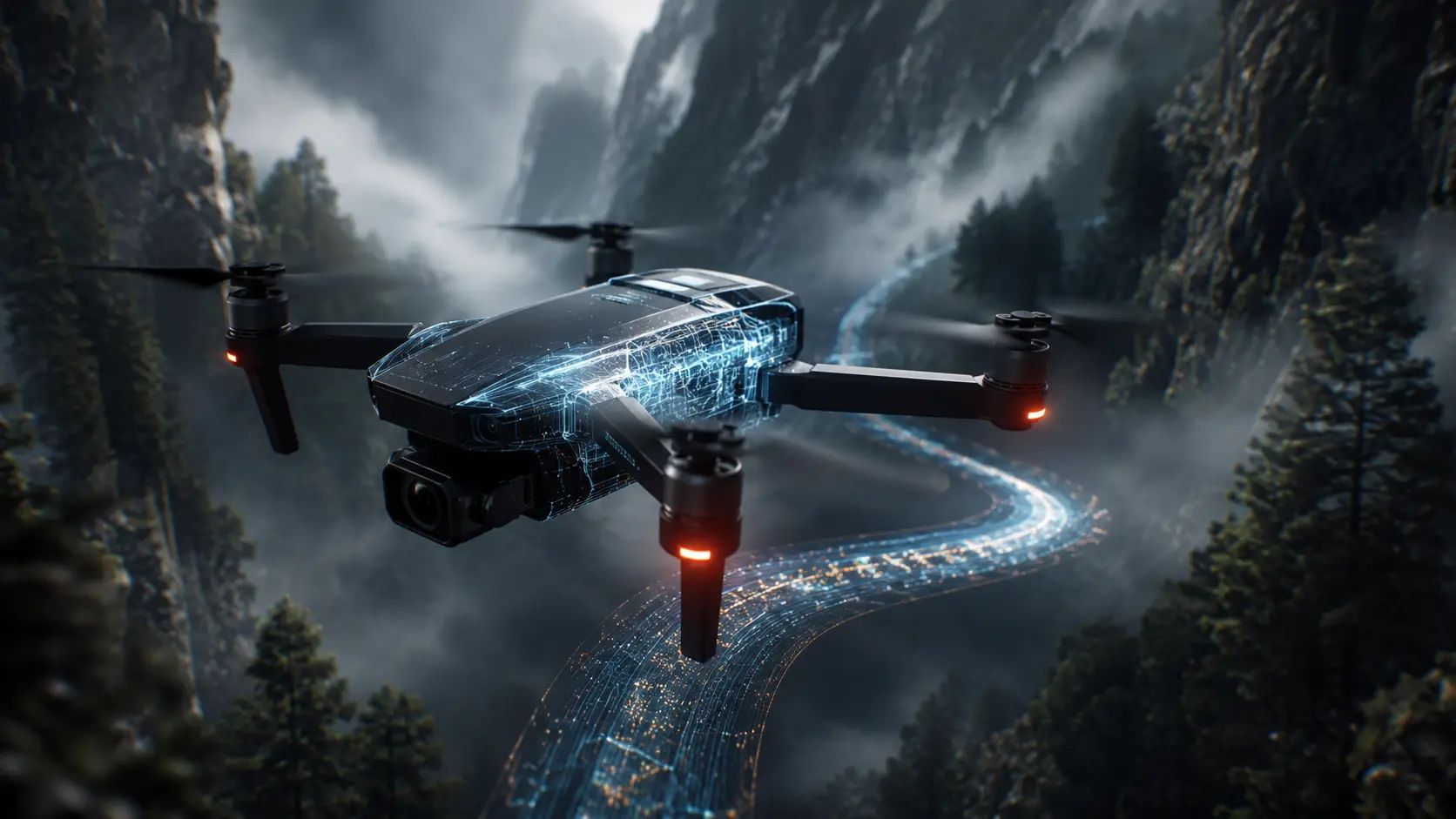
Researchers at the Massachusetts Institute of Technology (MIT) deployed liquid neural networks to control autonomous quadcopter drones in a dense forest.
Initially, the engineers trained the drones on visual data captured exclusively during the summer. When they brought the drones back in the winter, the forest looked entirely different. The trees were bare, snow covered the ground, and the lighting angles had shifted.
A traditional neural network crashed immediately. Its frozen weights could not comprehend the new pixels. The drone running the LNN successfully navigated the winter forest on the first try. The differential equations dynamically suppressed the visual noise of the snow and locked onto the structural horizon, adapting to the seasonal shift entirely on the fly.
WHY IT MATTERS NOW
The current boom in artificial intelligence is entirely dependent on brute-force hardware scaling. Massive neural networks require warehouse-sized data centers drawing gigawatts of electricity to function. This architecture physically traps AI inside the cloud.
Autonomous systems—like self-driving cars, industrial warehouse robots, and military drones—cannot rely on the cloud. If a vehicle moving at highway speeds loses its 5G cell tower connection for a fraction of a second, the AI cannot calculate the next frame, resulting in a fatal crash.
Robotics requires strict edge computing. The intelligence must live entirely on the local silicon chip inside the machine. Liquid neural networks provide the exact mathematical efficiency required to run advanced autonomous reasoning on low-power, lightweight microprocessors like a Raspberry Pi.
This mathematical efficiency fundamentally alters the commercial viability of physical automation. By eliminating the need for expensive, heavy, power-hungry graphics processing units (GPUs) on the robotic chassis, manufacturers can produce highly capable autonomous machines at a fraction of the current cost.
COMMON MISCONCEPTIONS
- “Liquid networks will replace large language models.” LNNs and LLMs serve entirely different purposes. LLMs excel at processing massive datasets of static text for knowledge retrieval. LNNs excel at processing continuous, time-series data for physical control and navigation.
- “The network forgets its training when it changes.” The core algorithms of the network do not erase themselves. The LNN adjusts how heavily it weighs incoming sensor data in the present moment, keeping its fundamental training intact while adapting its immediate responses.
- “Liquid means it uses a liquid coolant.” The term “liquid” strictly refers to the fluid, adaptable nature of its mathematical equations, not the physical hardware or cooling systems running the code.
WHAT MOST PEOPLE MISS
Software engineers focus heavily on the adaptability of LNNs, but they frequently miss the radical implication for system interpretability.
Modern deep learning models are notoriously opaque “black boxes.” When a self-driving car utilizing a traditional neural network crashes, engineers struggle to determine exactly which of the billion frozen parameters caused the steering wheel to turn.
Because an LNN operates using just a few thousand parameters governed by standard calculus, researchers can actually trace the exact mathematical logic the network used to make a decision. This physical transparency is the absolute prerequisite for securing regulatory approval to deploy autonomous heavy machinery in civilian airspace and public roads.
THE ECONOMIC AND STRATEGIC IMPACT
The integration of liquid networks threatens the total hardware monopoly currently enjoyed by GPU manufacturers. If robots no longer require massive parallel processing to navigate the world, the market will rapidly shift toward specialized, low-power edge ASICs (Application-Specific Integrated Circuits) designed specifically to solve differential equations.
In the defense sector, LNNs solve the absolute vulnerability of electronic warfare. Modern drones rely heavily on continuous communication links to human operators or centralized command nodes. Adversaries easily jam these signals, disabling the drone. LNN-equipped drones operate completely tether-free, surviving massive electronic interference by adapting their flight profiles locally without ever calling home.
Logistics and agriculture companies capture the immediate commercial upside. Tractor fleets and warehouse delivery robots equipped with liquid intelligence can operate in heavy rain, dust storms, and unpredictable factory floors without requiring human intervention or expensive remote-control infrastructure.
THE TRAJECTORY
Next 12–36 Months: Defense contractors will heavily adopt LNNs for small, tactical loitering munitions and surveillance drones. These systems will demonstrate the ability to track moving targets autonomously through heavy visual clutter and active signal jamming.
Next Five Years: Integration into commercial Advanced Driver Assistance Systems (ADAS). Automotive manufacturers will replace bulky, multi-model traditional perception stacks with highly efficient liquid networks. This will radically reduce the size and cost of the onboard computers required to run self-driving software.
Next Ten Years: The deployment of planetary and deep-sea exploration robotics. Because these environments feature a continuous, multi-minute communication delay with Earth, machines must possess absolute local autonomy. LNNs will allow Martian rovers to dynamically navigate unpredictable terrain without waiting for human confirmation.
What Could Go Wrong: Mathematical instability during extreme edge cases. Differential equations are highly sensitive to their initial conditions. If a liquid network encounters a bizarre, physically contradictory sensor input, the ODE solver could theoretically fail to converge, causing the drone or vehicle to freeze its control surfaces instantly.
Most Likely Outcome: Liquid Neural Networks will become the undisputed standard for robotic perception and physical autonomy. The sheer physical necessity of processing continuous sensor data on low-power, localized hardware ensures that dynamic ODE models will overtake static deep learning in the physical world.
KEY TERMS
- Liquid Neural Network (LNN): An advanced AI architecture that actively adjusts its internal mathematical weights in real-time to process continuous streams of data.
- Continuous-Time Recurrent Neural Network (CTRNN): A type of network where the internal states change smoothly over time, rather than in discrete, separated steps.
- Ordinary Differential Equation (ODE): A calculus formula that describes how a variable changes over time, used to govern the internal logic of an LNN.
- Edge Computing: The practice of processing data directly on the local device (like a drone or car) instead of relying on a distant cloud server.
- Time Constant: A mathematical parameter in a neural network that determines how fast or slow a specific node reacts to new incoming information.
- Inference: The operational phase of artificial intelligence where a trained model analyzes new data and makes a decision.
BEGINNER FAQ
What is a liquid neural network? It is a type of artificial intelligence that can change how it thinks while it is actively working, allowing it to adapt to surprises in the real world.
Why is it called ‘liquid’? The network’s mathematical rules are fluid. Instead of being permanently frozen after training, the equations bend and shift to handle unexpected data.
How is this different from ChatGPT? ChatGPT is a static model trained on massive amounts of text. A liquid network is a dynamic model trained on physical movement and time, designed to steer vehicles and fly drones.
Why are they so much smaller than regular AI? Because they actively adapt, they do not need to memorize every possible scenario in advance. They focus only on the most important data in the present moment, requiring far fewer mathematical parameters.
Can they run on a regular computer? Yes. Because they are so small and efficient, liquid neural networks can run easily on tiny, cheap computer chips inside drones and cell phones.
Why are they better for self-driving cars? A self-driving car encounters chaotic weather, changing light, and unpredictable drivers. A liquid network naturally adapts to this visual noise without getting confused.
Will this AI replace human engineers? No. This technology is strictly focused on helping machines navigate physical environments. It does not write code, draft emails, or generate art.
Who invented Liquid Neural Networks? The core concepts and functional models were primarily developed by researchers at the Massachusetts Institute of Technology (MIT) Computer Science and Artificial Intelligence Laboratory (CSAIL).
SOURCES
- Massachusetts Institute of Technology (MIT) CSAIL — Liquid Time-Constant Networks
- Nature Machine Intelligence — Closed-form Continuous-time Neural Networks for Edge Robotics
- Institute of Electrical and Electronics Engineers (IEEE) — ODE-based Recurrent Models for Autonomous Navigation
- Defense Advanced Research Projects Agency (DARPA) — Agile Robotics and Edge-Compute Perception Frameworks