Advertisement
)

AT A GLANCE
- Concept: Von Neumann Bottleneck: The physical speed limit caused by continuously moving data between memory and processors.
- Concept: Memristor: A microscopic device that remembers its electrical resistance state without continuous power.
- Concept: Crossbar Array: A dense grid of intersecting wires that executes matrix multiplication instantly using physics.
- Concept: Mixed-Signal Design: Hardware that combines analog mathematical cores with digital control and communication circuits.
IN SIMPLE WORDS
Imagine a master chef working in a kitchen where all the ingredients are stored in a warehouse down the street. For every single dish, the chef must run to the warehouse, grab one item, and run back. The chef spends 90 percent of their energy running and only 10 percent cooking.
Modern computers operate exactly this way. They shuffle digital zeroes and ones back and forth between memory and processing cores millions of times a second.
Analog in-memory computing fixes this by turning the warehouse shelves into mini-kitchens. Instead of moving digital numbers, the microchip pushes a specific amount of electricity through a grid of specialized resistors. The natural laws of physics calculate the answer instantly as the electricity flows through the grid. This eliminates the massive data traffic jam, allowing artificial intelligence chips to run exponentially faster while burning a fraction of the electricity.
HOW ANALOG IN-MEMORY COMPUTING WORKS
Deep learning inference is dominated by matrix-vector multiplication (MVM). In standard von Neumann architectures, executing an MVM requires constant data retrieval across a memory bus. This creates an unyielding energy penalty known as the memory wall.
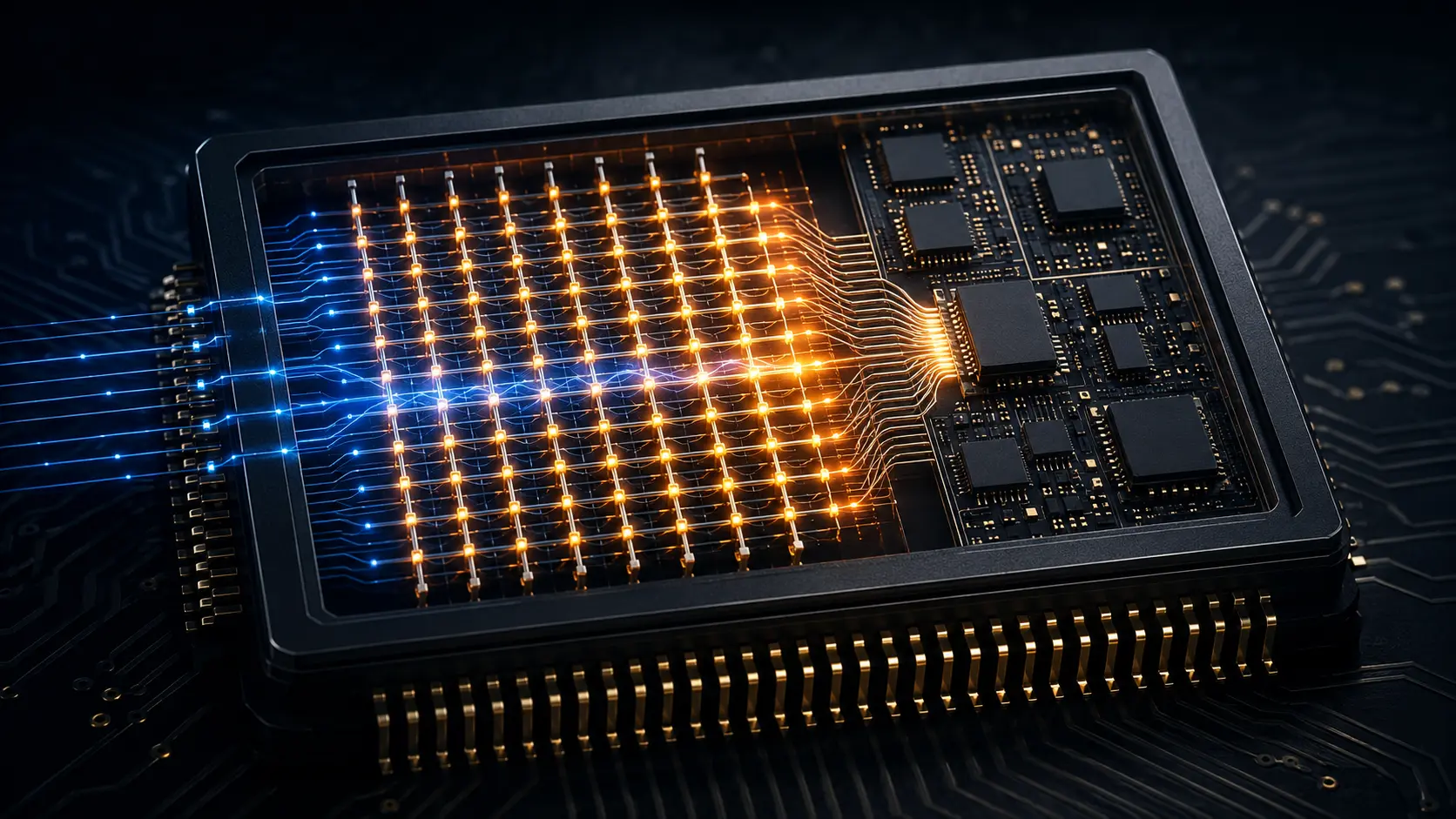
Analog compute-in-memory (CiM) eliminates this physical separation. Engineers construct a crossbar array—a dense grid of horizontal wordlines and vertical bitlines. At every intersection sits a non-volatile memory element, typically a Phase-Change Memory (PCM) cell, Resistive RAM (RRAM), or memristor.
The conductance G of each memristor serves as an artificial neural network weight. To execute a calculation, the digital input vector is converted into an analog voltage vector V by Digital-to-Analog Converters (DACs). When the voltage travels down the horizontal wordlines, each memristor passes a specific current based on Ohm’s Law (I = V × G).
According to Kirchhoff’s Current Law, these individual currents sum perfectly along the vertical bitlines. The total current at the bottom of the column represents the exact dot product of the input vector and the weight matrix: Ij = Σ Gij Vi.
This means the hardware computes massive matrix multiplications in a single clock cycle, natively in the analog domain, regardless of the array’s size.
Analog-to-Digital Converters (ADCs) at the end of the bitlines convert this physical current back into digital numbers. The digital data then passes to the next layer of the neural network.
REAL WORLD EXAMPLE
In 2026, the transition toward edge artificial intelligence is forcing automakers to rethink onboard computing. Autonomous vehicles require constant, real-time object detection processing thousands of camera frames per second.
Using a standard digital graphics processor drains the electric vehicle’s battery and generates excessive heat. Automotive hardware startups are deploying analog CiM chips that run perception neural networks natively in crossbar arrays. The chip classifies pedestrians and traffic lights in microseconds, consuming microwatts of power instead of hundreds of watts, making real-time autonomous navigation energetically viable.
WHY IT MATTERS NOW
The artificial intelligence industry is experiencing the “inference flip,” with inference workloads accounting for over two-thirds of all AI compute by 2026. Agentic AI systems now require continuous, real-time logic parsing.
Executing these constant queries on digital GPUs is economically and thermodynamically unsustainable. Data centers are physically exhausting the capacity of municipal power grids.
Analog computing fundamentally resets the energy-per-inference equation. By avoiding the massive power draw of moving data across memory buses, analog accelerators offer energy efficiency up to two orders of magnitude greater than standard digital architectures.
This hardware shift liberates AI from massive server farms. It enables complex neural networks to operate entirely on battery-powered edge devices, completely independent of cloud connectivity or latency restrictions.
COMMON MISCONCEPTIONS
- “Analog means old technology like vacuum tubes.” Analog CiM utilizes exotic, highly advanced nanotechnology and nanomaterials to precisely control electrons at the atomic scale.
- “Analog chips will replace GPUs entirely.” Analog chips are notoriously noisy and subject to physics-based variations, making them unsuitable for training AI models. They are strictly optimized for running pre-trained inference.
- “The entire chip is analog.” These are hybrid mixed-signal chips. They require massive digital peripheral circuits—like ADCs and DACs—to interface with the rest of a standard digital computer system.
WHAT MOST PEOPLE MISS
Hardware analysts focus obsessively on the theoretical efficiency of the analog crossbar, but they frequently ignore the brutal power cost of the peripheral converters.
Converting signals back and forth between digital logic and analog voltages is highly energy-intensive. In many analog AI chips, the ADCs and circuits combatting analog non-idealities—like shot noise and conductance drift—consume the majority of the total power. If a foundry cannot mathematically optimize these converters, the energy benefits of the analog crossbar are entirely erased.
THE ECONOMIC AND STRATEGIC IMPACT
The explosion of analog inference accelerators threatens the monopoly of traditional GPU designers. Cloud providers are increasingly fragmenting their data centers, shifting inference workloads onto highly specialized, custom-built ASICs to reduce token generation costs.
This provides a massive strategic advantage to foundries specializing in advanced packaging and non-volatile memory integration. Combining ferroelectric memory or PCM into standard manufacturing lines requires proprietary metallurgical and material science expertise.
Geopolitically, analog computing lowers the barrier to entry for silicon sovereignty. Because analog architectures derive their speed from physical laws rather than extreme transistor density, nations can manufacture highly competitive edge AI chips on older, unrestricted 65nm fabrication equipment.
THE TRAJECTORY
Next 12–36 Months: Analog CiM will dominate ultra-low-power consumer electronics. Smartwatches, industrial IoT sensors, and biometric devices will utilize analog wake-word detection to operate for months on a single battery charge.
Next Five Years: The commercial standardization of noise-aware algorithm training. AI models will be trained digitally with simulated analog noise injected directly into the code, ensuring they remain highly accurate when deployed onto imprecise memristor hardware.
Next Ten Years: The convergence of analog compute with 3D monolithic integration. Foundries will stack memory crossbars directly on top of logic circuits, utilizing dense vertical vias to eliminate horizontal data movement entirely.
What Could Go Wrong: Severe conductance drift. The microscopic materials inside memristors naturally decay and shift over time. If the physical resistance values shift unpredictably, the chip’s mathematical accuracy will collapse, rendering the neural network useless.
Most Likely Outcome: Analog computing will secure a permanent, dominant niche in edge AI and specialized cloud inference workloads. Digital architecture will maintain absolute control over AI training and high-precision scientific calculations, resulting in a bifurcated, hybrid hardware ecosystem.
KEY TERMS
- Compute-in-Memory (CiM): A hardware architecture that performs calculations directly inside the memory array, avoiding data transfer delays.
- Von Neumann Bottleneck: The severe performance limitation caused by separating the central processing unit from the memory storage.
- Memristor: A two-terminal electrical component that changes its resistance based on the current flowing through it and retains that state when power is lost.
- Crossbar Array: A grid of perpendicular nanowires with memory devices at the intersections, used to execute matrix math in parallel.
- Matrix-Vector Multiplication (MVM): The foundational mathematical operation of deep learning, where an array of weights is multiplied by an input vector.
- Conductance Drift: The natural, unwanted physical decay of a memory cell’s resistance state over time, causing calculation errors.
- Mixed-Signal: An integrated circuit that contains both digital and analog processing elements on the same chip.
BEGINNER FAQ
What is the Von Neumann bottleneck? It is a physical traffic jam inside modern computers. Because the memory is separated from the processor, the computer spends more time and energy moving data back and forth than it does actually calculating.
Why do AI chips use so much energy? Artificial intelligence requires trillions of calculations per second. Moving that massive amount of digital data across the physical wires of a microchip generates intense friction and heat, burning huge amounts of electricity.
What does analog mean in computing? Digital computing uses strict 1s and 0s. Analog computing uses a continuous flow of electricity, like a dimmer switch, to represent numbers.
How does a crossbar array do math? It uses the basic laws of physics. When you push electricity through a grid of specialized resistors, the voltage naturally changes. The current that comes out the other end is the exact mathematical answer you need.
What is a memristor? It is a microscopic memory resistor. It remembers how much electricity passed through it previously and holds that specific resistance level even when the power is turned off.
Why not use this for regular computers? Analog math is slightly noisy and imprecise. It is perfect for artificial intelligence, which deals in probabilities, but terrible for running a bank ledger or a spreadsheet that requires exact precision.
Does this replace digital GPUs? No. GPUs are still required to train AI models because training demands extreme mathematical precision. Analog chips are used for inference—running the model after it is already trained.
What is an ADC? An Analog-to-Digital Converter. Because the analog crossbar creates physical currents, an ADC must translate that physical measurement back into a digital 1 or 0 for the rest of the computer to understand.
What is the downside of analog computing? The physical materials degrade slightly over time. Variations in temperature or manufacturing can alter the electrical resistance, introducing small math errors into the system.
Why is this important for edge devices? Devices like drones, cars, and security cameras run on batteries and cannot always connect to the cloud. Analog chips allow them to process heavy AI locally without draining their battery instantly.
SOURCES
- IBM Research — Algorithm Architecture Co-Design for Analog In-Memory Computing
- Institute of Electrical and Electronics Engineers (IEEE) — Mathematical Optimization of Analog Compute-in-Memory Crossbars
- Nature Electronics — Memristor-Based In-Memory Computing and Non-Volatile Architectures
- Zylos Research — AI Chip Hardware Acceleration Trends 2026