Advertisement
)

AT A GLANCE
- Concept: Long-Duration Energy Storage: Systems designed to output electricity continuously for 8 to 24 hours without recharging.
- Concept: Cryogenics: The physics of producing and maintaining materials at extremely low temperatures, typically below
below -150°C. - Concept: Phase Change: Altering a substance’s physical state—like turning a gas into a liquid—to radically increase its physical density.
- Concept: Synchronous Inertia: The physical, spinning momentum of a mechanical turbine that keeps the electrical grid’s frequency stable.
IN SIMPLE WORDS
Imagine trying to capture a hurricane in a jar so you can use the wind later. You cannot store wind directly, and building enough standard batteries to power a major city for days would bankrupt the local government. To solve this, engineers are freezing the air itself.
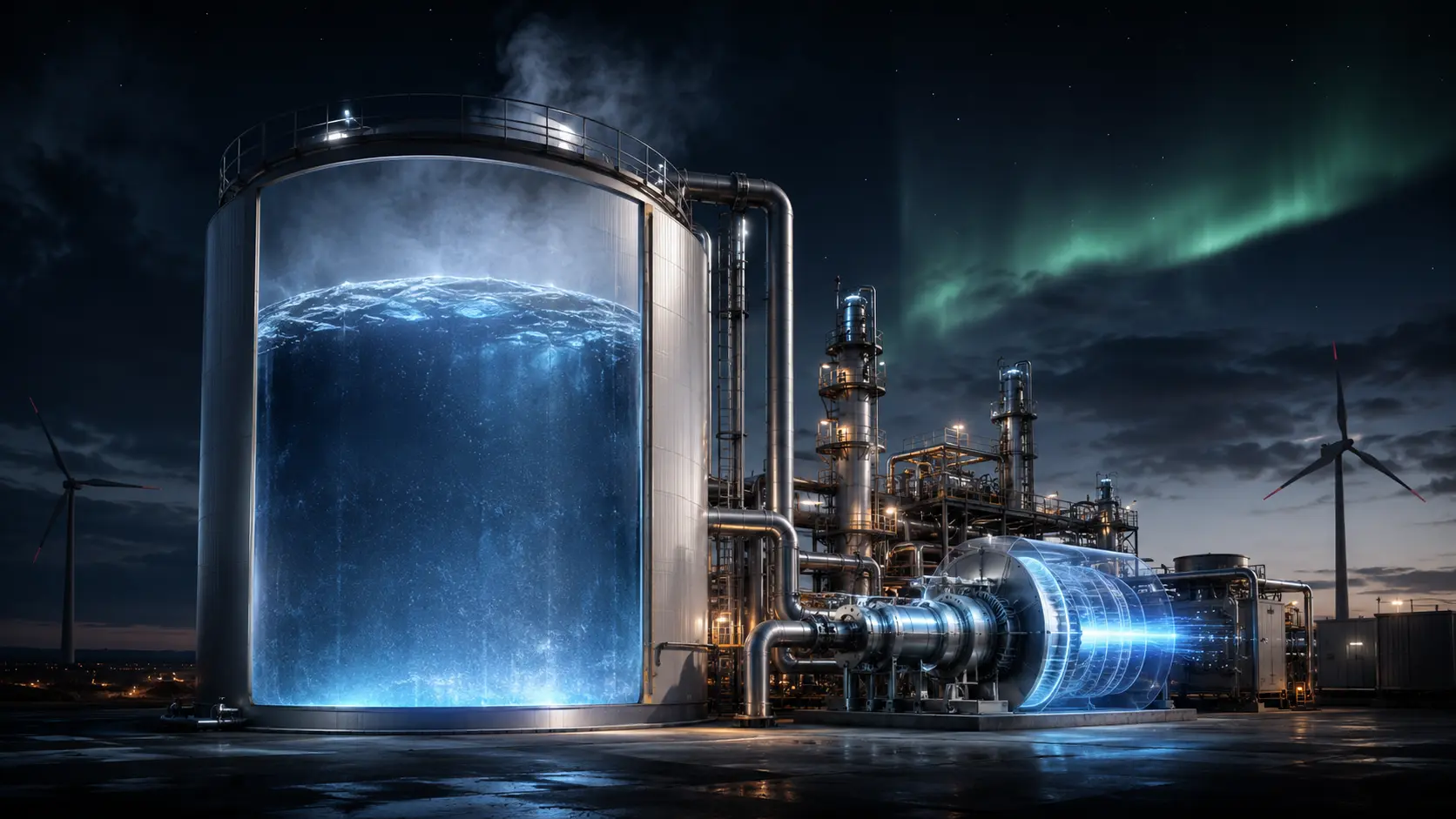
When wind turbines generate more power than a city needs, that excess electricity powers giant industrial refrigerators. They suck in normal atmospheric air and chill it to nearly 200 degrees below zero. At this extreme temperature, the air condenses into a dense liquid. You can store millions of gallons of it in standard, insulated tanks.
When the wind stops blowing, operators open a valve. The liquid air is exposed to ambient heat, boils rapidly back into a gas, and expands with explosive force. This massive rush of expanding air spins a generator, sending clean electricity back to the city without burning a single drop of fuel.
HOW LIQUID AIR ENERGY STORAGE WORKS
Liquid Air Energy Storage (LAES) functions as a massive, mechanical battery that uses atmospheric air as the primary storage medium. The architecture operates on the Claude thermodynamic cycle, breaking the process into three distinct phases: charging, storing, and discharging.
During the charging phase, excess renewable electricity powers massive industrial compressors. The system pulls in ambient air, cleans it, and compresses it to extremely high pressures. Compressing a gas naturally generates intense thermal energy. Engineers capture this compression heat and store it in insulated reservoirs of thermal oil or molten salt for later use.
The compressed air then passes through a series of cold boxes, dropping its temperature to temperature to -196°C. At this specific thermal boundary, the air undergoes a phase transition into a liquid. This liquid air is 700 times denser than its gaseous state, allowing massive amounts of potential energy to be held in standard, unpressurized cryogenic tanks indefinitely.
When the electrical grid requires power, the system initiates the discharge phase. High-pressure pumps push the liquid air into an evaporator. The liquid is exposed to ambient environmental temperatures and the heat previously stored during the compression phase.
This thermal exposure causes a violent volumetric expansion. The liquid flashes back into a gas, increasing its volume exponentially. This high-velocity gas rushes through a series of expansion turbines, spinning massive generators to produce electricity. The overall round-trip efficiency is dictated by how effectively the system manages these thermal extremes, expressed as:
ηLAES = (Wturbine + Qcold_recovery) / (Wcompressor + Qheat_storage)
Because the process relies strictly on mechanical expansion and phase changes, the hardware utilizes standard steel piping and commercial turbomachinery, entirely avoiding the chemical degradation that permanently degrades standard chemical batteries.
REAL WORLD EXAMPLE
In late 2025, China activated the world’s largest liquid air energy storage facility in the Gobi Desert. Known as the Super Air Power Bank, the 600-megawatt-hour (MWh) plant co-locates directly with a massive 250-megawatt solar array.
During the day, the intense desert sun overproduces electricity. Instead of turning the solar panels off, the excess power compresses air into insulated tanks at tanks at -194°C. When the sun sets and solar generation flatlines, the liquid expands to drive a 60-megawatt turbine. This single facility can discharge clean power continuously for 10 hours, effectively bridging the overnight supply gap for 30,000 local homes without requiring a single lithium-ion battery cell.
WHY IT MATTERS NOW
The global transition toward intermittent renewable energy is exposing a fatal flaw in modern grid architecture. Wind and solar power cannot be commanded to produce energy exactly when consumers demand it. This timing mismatch leads to massive curtailment—grid operators are forced to turn off wind turbines during high-wind, low-demand hours simply because the electricity has nowhere to go.
Currently, lithium-ion batteries are deployed to capture this excess power. However, lithium batteries are economically viable only for short-duration storage, typically lasting two to four hours. Building a lithium-ion facility large enough to power a city through a multi-day wind drought is mathematically cost-prohibitive.
Liquid air energy storage solves the deep-storage economic puzzle. Because the storage medium is atmospheric air, expanding a facility’s capacity only requires building larger steel tanks, not mining and processing expensive heavy metals. This drastically lowers the Levelized Cost of Storage (LCOS) for durations exceeding eight hours.
Furthermore, LAES addresses the critical decline in grid inertia. Traditional coal and gas plants use massive, heavy, spinning metal turbines. This physical spinning mass naturally resists sudden drops in grid frequency. Solar panels and lithium batteries lack physical mass, making the grid highly brittle. LAES utilizes heavy mechanical expansion turbines, providing the exact physical synchronous inertia the grid requires to remain stable during shocks.
COMMON MISCONCEPTIONS
- “The system burns natural gas to heat the air.” Modern closed-loop LAES systems do not combust fossil fuels. They solely utilize the ambient heat of the atmosphere and the thermal energy captured earlier during the air compression phase.
- “Liquid air energy storage requires specific geography.” Unlike pumped hydro storage, which strictly requires two mountain reservoirs, or compressed air storage, which requires massive underground salt caverns, a LAES plant can be built on any flat industrial plot.
- “It is a totally unproven science.” The air liquefaction process is completely standard industrial chemistry. The liquid natural gas (LNG) and industrial gas sectors have built and operated the required cryogenic compressors and storage tanks reliably for decades.
WHAT MOST PEOPLE MISS
Energy analysts focus heavily on the heat generated during compression, but they frequently overlook the mathematical importance of cold recovery.
When the liquid air boils back into a gas to spin the turbine, it releases massive amounts of extreme cold into the surrounding machinery. Advanced LAES facilities capture this “waste cold” using high-grade anti-freeze loops. They store the cold and recycle it to help chill the incoming air during the next charging cycle. By recycling both the heat of compression and the cold of expansion, operators push the round-trip efficiency of the plant from a baseline of 40% up toward 70%.
THE ECONOMIC AND STRATEGIC IMPACT
The primary financial beneficiaries are legacy industrial engineering conglomerates. Companies like Siemens Energy, MAN Energy Solutions, and Atlas Copco already manufacture the specialized compressors and turbines required. LAES allows these heavy-industry giants to pivot their existing supply chains away from fossil fuels and directly into the renewable energy sector.
Geopolitically, LAES offers absolute supply chain independence. The global lithium and rare-earth mineral markets are tightly concentrated and subject to severe export controls and trade tariffs. A nation building a LAES plant relies entirely on domestic steel, standard industrial labor, and ambient air, immunizing its energy grid against foreign commodity blockades.
Natural gas peaker plants are the absolute losers in this transition. Utilities traditionally rely on expensive, carbon-heavy gas turbines to handle sudden spikes in evening electricity demand. As multi-hour cryogenic storage reaches commercial scale, these peaker plants will lose their primary function, stranding billions of dollars in fossil fuel infrastructure.
THE TRAJECTORY
Next 12–36 Months: The launch of first-generation commercial grid stabilizers. Highview Power’s Carrington facility in the United Kingdom will come online in 2026, delivering 300 MWh of storage while specifically selling stability services—like inertia and voltage control—back to the national grid operator.
Next Five Years: The integration of LNG co-location. Project developers will aggressively build LAES facilities directly adjacent to Liquefied Natural Gas import terminals. The LAES plant will siphon the massive amounts of waste cold generated when LNG is turned back into a gas, pushing the cryogenic efficiency of the air liquefaction process to its theoretical physical limit.
Next Ten Years: The gigawatt-hour standardization of coal plant retrofits. Utilities will decommission aging coal power plants and replace the boilers with LAES infrastructure. By reusing the site’s existing high-voltage transmission lines and steam turbine halls, grid operators will transform heavily polluting assets into massive clean energy batteries at a fraction of the cost of greenfield development.
What Could Go Wrong: The capital expenditure “valley of death.” LAES plants require massive upfront capital and take years to construct. If governments heavily subsidize standard chemical batteries while ignoring long-duration mechanical storage, private infrastructure funds may refuse to finance LAES projects due to the prolonged return on investment horizon.
Most Likely Outcome: Liquid air energy storage will not replace lithium-ion batteries. Instead, the grid will bifurcate. Lithium batteries will dominate short-duration frequency regulation and daily shifting, while massive cryogenic LAES plants will become the mandatory baseload backbone, providing the multi-day resilience necessary to phase out natural gas entirely.
KEY TERMS
- Liquid Air Energy Storage (LAES): A long-duration energy storage system that uses electricity to cool atmospheric air until it liquefies, storing it in tanks to generate power later.
- Claude Cycle: A specific thermodynamic cycle used to liquefy gases by combining intense mechanical compression with subsequent rapid expansion.
- Cryogenics: The branch of physics and engineering dealing with the production and effects of very low temperatures.
- Curtailment: The deliberate reduction of electricity generation, often required when wind or solar farms produce more power than the grid can safely absorb.
- Synchronous Inertia: The physical momentum provided by heavy, spinning mechanical rotors that helps maintain a stable electrical frequency on the power grid.
- Cold Recovery: An efficiency process that captures the extreme low temperatures released when liquid air evaporates, reusing that thermal energy to cool the next batch of air.
BEGINNER FAQ
What is liquid air energy storage? It is a technology that acts like a massive battery. It uses excess electricity to freeze normal air into a liquid. When power is needed, the liquid turns back into a high-pressure gas to spin a generator.
How cold does the air have to be? To turn normal atmospheric air into a liquid, the system must cool it to roughly -196°C (about -320°F).
Why not just use lithium-ion batteries? Lithium batteries are excellent for storing power for a few hours. However, buying enough batteries to power a city for several days is far too expensive. Liquid air offers a much cheaper way to store massive amounts of energy for long periods.
Is liquid air explosive or dangerous? No. Because the storage tanks hold liquid air at normal atmospheric pressure, they do not carry the explosion risks of high-pressure hydrogen or natural gas.
Does this process burn any fuel? No. The expansion of the gas is entirely driven by exposing the extremely cold liquid air to normal, warm environmental temperatures and the heat saved from the compression process.
Where can these plants be built? Unlike pumped hydro storage which requires mountains, or compressed air storage which requires underground caves, a liquid air facility can be built on any flat piece of industrial land.
How efficient is the system? A well-designed system returns about 50 to 60 percent of the electricity put into it. While this is lower than a lithium battery, the ability to store vast amounts of power cheaply makes it highly economical at a large scale.
What happens to the heat generated during the process? When the air is compressed, it gets very hot. The facility captures this heat, stores it in insulated tanks of oil or molten salt, and uses it later to help heat the liquid air back into a gas.
Who is currently building these systems? Companies like Highview Power in the United Kingdom are building commercial-scale plants. China also recently activated a massive 600-megawatt-hour facility in the Gobi Desert.
Can this technology power an entire city? Yes. A single large-scale LAES facility can store gigawatt-hours of electricity, providing enough continuous power to run hundreds of thousands of homes for an entire day.
SOURCES
- Massachusetts Institute of Technology (MIT) — The Role of Long-Duration Energy Storage in a Deeply Decarbonized Grid
- International Renewable Energy Agency (IRENA) — Innovation Landscape for Smart Electrification and Cryogenic Storage
- Department of Energy (DOE) — Long Duration Energy Storage Earthshot Technical Assessment
- Institute of Electrical and Electronics Engineers (IEEE) — Thermodynamic Efficiency and Cold Recovery in Liquid Air Energy Storage Systems