Advertisement
)

AT A GLANCE
- Concept: Enhanced Geothermal System (EGS): Injecting water into hot, dry, impermeable rock to create a synthetic geothermal reservoir.
- Concept: Directional Drilling: The ability to steer a drill bit horizontally miles beneath the Earth’s surface.
- Concept: Hydraulic Stimulation: Pumping high-pressure fluid to open microscopic fractures in solid bedrock, improving fluid flow.
- Concept: Closed-Loop System: A sealed subterranean pipe network that circulates fluid to absorb heat without touching the rock.
IN SIMPLE WORDS
The center of the Earth is hotter than the surface of the sun. This heat constantly radiates outward, but it is trapped beneath miles of solid rock.
Historically, we could only harvest this energy if nature did the hard work for us—where underground water naturally touched hot rock and bubbled up as steam or geysers, like in Iceland or California. These natural hot springs are extremely rare.
Advanced geothermal technology removes the need for natural water. Engineers simply drill a massive hole into solid, hot, dry rock. They pump cold water down the hole, force it through microscopic cracks in the stone to absorb the extreme heat, and pull the boiling water back up a second hole. This creates an infinite, synthetic steam engine. By adapting the deep-drilling techniques perfected by the oil and gas industry, we can now tap into endless, clean, 24/7 power directly beneath our feet, almost anywhere in the world.
HOW ENHANCED GEOTHERMAL SYSTEMS WORK
Traditional geothermal energy requires three naturally occurring geological features: heat, fluid, and permeability (cracks for the fluid to flow through). If any of these are missing, the well fails. Enhanced Geothermal Systems (EGS) physically engineer the missing elements—usually the fluid and the permeability—miles below the surface.
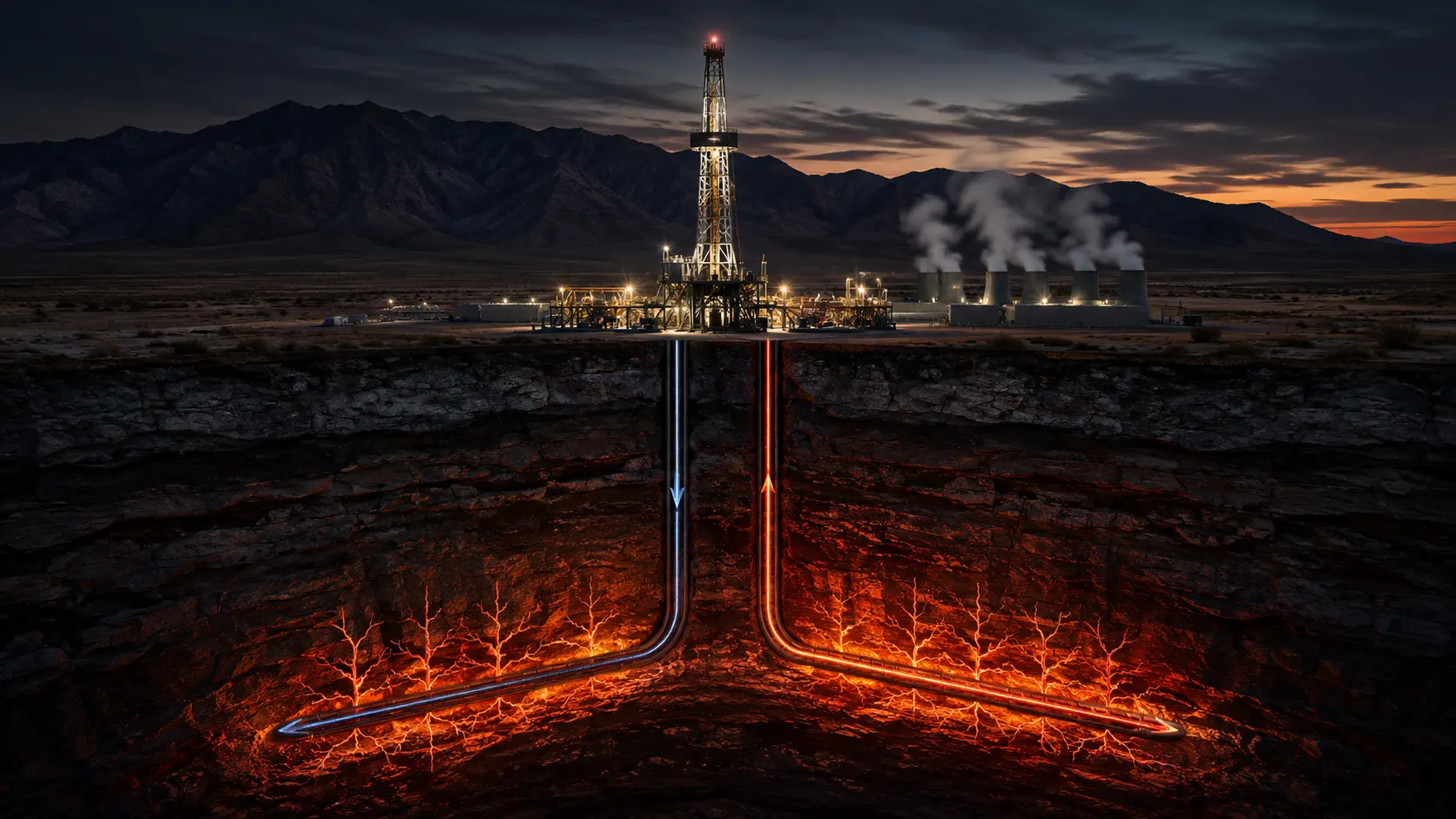
The process begins with directional drilling. A drill rig bores a vertical wellshaft roughly two to three miles into the Earth’s crust, targeting crystalline basement rock where temperatures exceed 200°C. Once at the target depth, the drill bit steers horizontally, creating a vast lateral footprint in the hot, dry rock.
To extract the heat, the rock must be made permeable. Engineers execute a hydraulic stimulation—frequently adapting hydraulic fracturing (fracking) techniques from the shale oil industry. They pump a high-pressure mixture of water and sand down the well. The intense pressure forces microscopic, pre-existing fractures in the granite to shear and prop open, creating a massive subterranean sponge.
With the reservoir artificially stimulated, operators drill a second “production” well into the same fractured zone to intersect the newly created fluid pathways. Cold water is pumped down the injection well. As the water is forced through the hot, fractured granite, it undergoes intense thermal exchange. The water flashes into a supercritical fluid—a state where it behaves like both a gas and a liquid.
This supercritical fluid rushes up the production well at immense pressure. At the surface, it passes through a heat exchanger, transferring its thermal energy to a secondary working fluid with a lower boiling point. This secondary fluid boils into vapor, spins a standard steam turbine to generate electricity, and then cools back into a liquid. The original geothermal water is then injected back down the first well in a continuous, closed-loop cycle, ensuring zero water loss and zero carbon emissions.
REAL WORLD EXAMPLE
Fervo Energy is actively proving the commercial viability of EGS in the Nevada desert. For decades, geothermal startups failed because drilling through abrasive, hard granite destroyed drill bits too quickly, ruining the project economics.
Fervo repurposed modern oilfield technology, specifically polycrystalline diamond compact (PDC) drill bits and fiber-optic telemetry. At their “Project Red” facility, they successfully drilled two horizontal wells 10,000 feet deep, running parallel to each other. By applying multi-stage hydraulic fracturing between the two wells, they created a highly precise synthetic reservoir. The facility now continuously delivers 3.5 megawatts of carbon-free baseload power to the local grid, proving that the tools of the fossil fuel era can successfully harvest endless clean energy.
WHY IT MATTERS NOW
The fundamental crisis of the modern renewable energy grid is intermittency. Wind and solar power are cheap, but they are entirely dependent on the weather. To keep the lights on when the sun sets, grid operators are currently forced to burn natural gas or rely on enormously expensive lithium-ion battery banks that only last for a few hours.
Enhanced geothermal energy provides the holy grail of grid infrastructure: clean, scalable baseload power. Unlike a solar panel, an EGS plant operates 24 hours a day, 365 days a year. It provides the heavy, spinning synchronous inertia that electrical grids physically require to prevent blackouts during rapid demand spikes.
Furthermore, the technology allows for total geographic independence. Legacy geothermal power was strictly limited to volcanic regions or tectonic fault lines. Because EGS creates its own synthetic reservoirs, utilities can theoretically drill for heat anywhere on Earth, bringing baseload power directly beneath massive energy sinks like industrial manufacturing hubs or artificial intelligence data centers.
This initiates a massive reallocation of human capital. The oil and gas industry possesses the exact workforce required to scale this technology. The transition allows roughnecks, drilling engineers, and petroleum geologists to seamlessly transfer their specialized subterranean skills into a permanently sustainable, zero-carbon industry.
COMMON MISCONCEPTIONS
- “Geothermal energy will cause massive earthquakes.” While high-pressure fluid injection causes micro-seismicity (tiny tremors), modern EGS uses precise fiber-optic monitoring to ensure the fractures remain safely below the threshold of human perception.
- “Geothermal uses too much water.” A modern EGS operates as a completely sealed, closed-loop system. After the initial fracture, the same volume of water circulates continuously without evaporating into the atmosphere or depleting local aquifers.
- “We need volcanoes to make it work.” The Earth gets hotter the deeper you dig anywhere on the planet. EGS bypasses the need for natural volcanic activity by simply drilling deep enough to hit the required thermal gradient.
WHAT MOST PEOPLE MISS
Energy commentators focus heavily on the electricity generated, but they completely overlook the extreme metallurgical challenge of the subterranean environment.
Deep crystalline granite is hostile. At 250°C and 10,000 psi, the chemical composition of the water becomes highly corrosive. It dissolves minerals directly out of the bedrock. As this mineral-rich, super-heated brine rises to the surface and cools, the minerals instantly precipitate, forming thick layers of silica scale that can physically choke the steel pipes shut in a matter of weeks. Managing this brutal subterranean chemistry is just as critical as the drilling itself.
THE ECONOMIC AND STRATEGIC IMPACT
The primary financial beneficiaries are legacy oilfield service companies. Giants like Halliburton, Schlumberger, and Baker Hughes are aggressively pivoting toward EGS, realizing they can sell their proprietary drilling fluids and telemetry software to clean-energy startups at massive premiums.
Hyperscale cloud providers, including Google and Microsoft, are directly funding EGS development. Because artificial intelligence data centers require massive amounts of continuous electricity, tech companies are signing long-term power purchase agreements (PPAs) with geothermal developers at above-market rates to guarantee their access to 24/7 carbon-free power.
Strategically, sovereign nations view advanced geothermal as the ultimate defense against imported fossil fuels. Countries in Europe, heavily reliant on imported natural gas for winter heating, are rapidly deploying deep geothermal district heating networks. By pumping Earth-warmed fluid directly into municipal radiators, they permanently sever their reliance on foreign natural gas pipelines.
THE TRAJECTORY
Next 12–36 Months: First-of-a-kind (FOAK) commercial projects will activate in the American West and Europe. Startups will prove that multi-stage hydraulic fracturing in hard granite is repeatable, drastically lowering the risk premium for institutional infrastructure investors.
Next Five Years: The deployment of Closed-Loop Advanced Geothermal Systems (AGS). Instead of fracturing the rock and pushing water through the stone, companies like Eavor will drill massive, sealed subterranean radiators. They will circulate proprietary conductive fluids inside the pipes, absorbing heat purely by conduction without the fluid ever touching the rock, eliminating the risk of micro-earthquakes entirely.
Next Ten Years: The era of millimeter-wave energy drilling. To drill ten miles deep where temperatures exceed 500°C, traditional steel drill bits will fail by melting. Engineers will deploy gyrotrons—machines that shoot high-power microwaves—to literally vaporize the rock, unlocking supercritical geothermal heat anywhere on the planet.
What Could Go Wrong: Thermal short-circuiting. If a hydraulic fracture accidentally connects the injection well to the production well too directly, the cold water will bypass the hot rock matrix entirely. The production well will start pumping up cold water, rendering the multi-million-dollar drilling operation completely useless.
Most Likely Outcome: Advanced geothermal systems will successfully scale to become the foundation of the global zero-carbon grid. By perfectly balancing the intermittency of wind and solar, EGS will eventually decouple industrial civilization from the combustion of fossil fuels without sacrificing grid reliability.
KEY TERMS
- Enhanced Geothermal System (EGS): A man-made reservoir created by injecting fluid into hot, dry rock to extract the Earth’s internal heat.
- Directional Drilling: The practice of steering a drill bit along a curved path to bore horizontally through specific subterranean rock formations.
- Hydraulic Stimulation: The high-pressure injection of fluid into bedrock to shear and open microscopic fractures, increasing permeability.
- Supercritical Fluid: A substance held at extreme temperature and pressure where it behaves simultaneously as both a dense liquid and a highly energetic gas.
- Baseload Power: The minimum amount of electrical power needed to be supplied to the electrical grid continuously, day and night.
- Closed-Loop System: A pipe network where the working fluid circulates continuously without ever being released or exposed to the outside environment.
BEGINNER FAQ
What is an enhanced geothermal system? It is a technology that generates electricity by drilling deep into hot, dry rock, pumping cold water down to absorb the heat, and bringing the boiling water back up to spin a turbine.
How is this different from traditional geothermal? Traditional geothermal only works where natural hot water already exists, like geysers. Enhanced geothermal creates its own hot water reservoir by drilling into dry rock and adding the water manually.
Does this use fracking? Yes, it borrows hydraulic fracturing techniques from the oil and gas industry to crack open the hot granite so water can flow through it.
Is fracking for geothermal safe? Unlike oil fracking, which uses complex chemical cocktails to extract hydrocarbons, geothermal fracturing primarily uses high-pressure water and sand in deep, solid granite, posing vastly less risk to drinking water aquifers.
Can we build these power plants anywhere? Theoretically, yes. The Earth gets hotter the deeper you drill everywhere. However, the closer the heat is to the surface, the cheaper it is to drill, making certain regions economically better than others.
Do these plants run at night? Yes. Unlike solar or wind power, the heat of the Earth is constant. Geothermal plants provide 24/7 continuous electricity regardless of the weather.
Why haven’t we done this sooner? Drilling through miles of solid, super-heated granite is incredibly difficult and expensive. The drill bits used to wear out almost instantly. Only recent advancements in oilfield drilling technology have made it possible.
Will this cause earthquakes? Pumping water underground can cause tiny micro-earthquakes, usually too small for humans to feel. Strict regulations and advanced sensors ensure the pressure is carefully managed to avoid larger tremors.
SOURCES
- Department of Energy (DOE) — Enhanced Geothermal Shot: Analysis of EGS Technology and Cost Reductions
- Massachusetts Institute of Technology (MIT) — The Future of Geothermal Energy: Impact of Enhanced Geothermal Systems
- National Renewable Energy Laboratory (NREL) — Geothermal Energy and the Clean Energy Transition
- Society of Petroleum Engineers (SPE) — Directional Drilling and Hydraulic Stimulation in Crystalline Basement Rock