Advertisement
)

AT A GLANCE
- Concept: Latent Space: A compressed mathematical representation of reality where the AI processes physical rules efficiently.
- Concept: Spatio-Temporal: The combined understanding of physical space (pixels) and how it changes over time (video frames).
- Concept: Autoencoder: A neural network that compresses raw video into smaller data tokens and reconstructs it.
- Concept: Action-Conditioned: An AI model that predicts future video frames based on a specific input, like turning a steering wheel.
IN SIMPLE WORDS
Imagine closing your eyes and holding a glass of water. If you drop the glass, you do not need to watch it hit the floor to know it will shatter. Your brain possesses a “world model”—an internal, deeply learned simulation of gravity, fragility, and momentum.
Standard artificial intelligence, like ChatGPT, does not have this. It only predicts the next word in a sentence of text. It has no physical common sense.
A World Model AI is built to predict the next physical event in a sequence. By ingesting millions of hours of driving footage and drone video, the AI learns that cars cannot pass through solid brick walls and that rain makes asphalt slippery. It constructs a virtual, mathematical universe inside its code. This allows physical robots and self-driving cars to “think ahead” and practice dangerous scenarios internally, effectively dreaming about the physical world before taking an action in real life.
HOW WORLD MODELS WORK
Traditional computer vision systems identify objects in isolated, static images. They can label a stop sign, but they cannot inherently predict how a car will interact with that stop sign over the next ten seconds. World models solve this by modeling the transition dynamics of the physical environment.
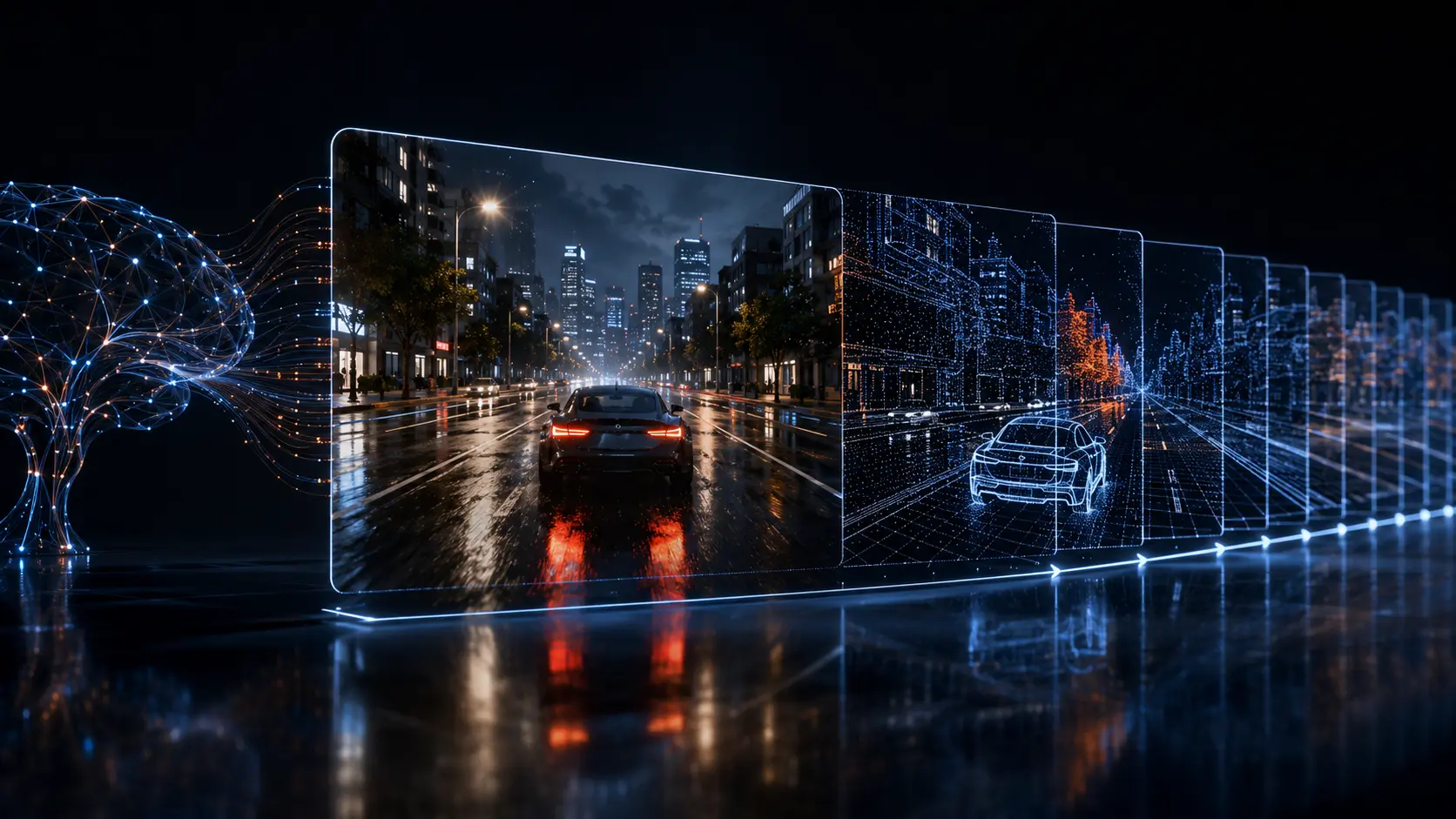
The architecture fundamentally relies on compressing raw reality. Feeding 4K video directly into a prediction engine is computationally impossible. Instead, the system uses a spatial-temporal autoencoder. This neural network acts as a funnel, stripping away irrelevant pixel noise and compressing the video into a lower-dimensional mathematical grid known as a latent space.
Inside this latent space, the AI calculates physical interactions using a predictive loop. The transition dynamics can be expressed mathematically as z_{t+1} = P(z_t, a_t). Here, the future state of the world (z_{t+1}) is predicted by taking the current state of the world (z_t) and applying a specific action (a_t).
Once the model predicts the future latent state, a decoder network translates that compressed mathematics back into highly realistic, human-viewable video pixels. If the input action (a_t) is “slam on the brakes,” the model outputs a generated video showing the car’s nose dipping and the scenery slowing down, adhering to the learned laws of inertia.
Unlike hard-coded physics engines (like Unreal Engine) that rely on strict Newtonian equations typed by human developers, a world model learns physics purely through empirical observation. It deduces geometry, lighting, and collision boundaries simply by watching how light and matter interact across billions of training frames.
REAL WORLD EXAMPLE
The British autonomous driving company Wayve developed GAIA-1, a generative world model explicitly designed for autonomous vehicles.
Traditional self-driving systems require millions of lines of human-written code to dictate how a car should react to a cyclist or a red light. GAIA-1 bypassed this. Wayve fed the model massive amounts of video, text, and action data (the exact steering angles and pedal pressures used by human drivers).
When engineers asked GAIA-1 to simulate driving down a London street and then provided a digital command to “steer hard right,” the model instantly generated a highly realistic, completely synthetic video of the car veering off the road and crashing into a curb. It accurately predicted the physical consequences of the steering action without ever needing to execute the crash in the real world.
WHY IT MATTERS NOW
The artificial intelligence industry has hit a massive data wall. Large Language Models (LLMs) have essentially consumed every book, article, and piece of text ever published on the public internet.
To achieve the next plateau of machine intelligence—specifically, enabling robots to navigate the physical world—text is entirely insufficient. A robot cannot learn how to fold laundry or assemble a microchip by reading a Wikipedia article. It must understand spatial relationships, force, and friction.
World models provide the exact synthetic data engine required to train physical robotics. Because physical robots are extremely expensive and slow to operate, gathering real-world data of a robot failing to open a door millions of times is economically impossible.
A world model acts as an infinite training gym. Engineers place the digital brain of a robot inside the world model’s simulation. The robot practices opening a digital door ten million times overnight. Because the world model accurately simulates the physics of the door handle, the robot can download that learned experience and flawlessly open a real, physical door the next morning.
COMMON MISCONCEPTIONS
- “World models use traditional game physics.” A video game engine mathematically calculates gravity using the formula 9.8 m/s². A world model does not know that formula; it simply hallucinates the visual effect of gravity because it watched millions of objects fall in its training videos.
- “They are just video generators.” Deepfake generators create static or random videos based on a text prompt. A true world model is action-conditioned. It allows a user to input a specific mechanical action and outputs a physically accurate consequence.
- “They possess true understanding of reality.” They still suffer from severe hallucinations. If pushed into a scenario they have never seen—like a glass shattering into water—they frequently generate physically impossible results, like the glass bouncing like rubber.
WHAT MOST PEOPLE MISS
Software engineers focus heavily on the video output of these models, but they entirely overlook the power of the “Joint Embedding Predictive Architecture” (JEPA).
Pioneered by researchers like Yann LeCun, JEPA dictates that a world model does not actually need to predict every single pixel of the future. Predicting exactly how the texture of a tree’s leaves will look in ten seconds is computationally wasteful. Advanced world models predict the abstract, high-level state of the environment. They calculate that a car will be in an intersection, ignoring the precise shadow cast by a cloud, saving massive amounts of compute power while maintaining strict physical accuracy.
THE ECONOMIC AND STRATEGIC IMPACT
The primary financial victims of this transition are legacy simulation companies. Autonomous vehicle companies currently spend hundreds of millions of dollars building rigid, hard-coded 3D simulation cities to test their cars. As generative world models become capable of instantly hallucinating infinite, physically accurate driving scenarios based on text prompts, the market for manual 3D simulation software will collapse.
For the robotics industry, this acts as the ultimate catalyst. Startups building humanoid robots, such as Figure or Tesla’s Optimus, will utilize world models to rapidly accelerate their deployment timelines. The barrier to entry shifts from hardware engineering to access to extreme cloud compute clusters capable of running these massive video prediction loops.
Strategically, the nation that possesses the most advanced world models will dominate industrial automation. By training robotic swarms entirely in synthetic environments, a country can deploy autonomous manufacturing facilities and logistics networks years faster than competitors reliant on physical, real-world robotic trial and error.
THE TRAJECTORY
Next 12–36 Months: The integration of world models into end-to-end autonomous driving systems. Instead of having separate software modules for cameras, radar, and steering, car manufacturers will deploy single, massive neural networks that ingest live video and output immediate steering commands based on their internal physical predictions.
Next Five Years: The democratization of robotic foundational models. Companies will open-source generic physical world models. A robotics startup will download a pre-trained model that already understands gravity, friction, and object permanence, requiring them only to train the robot on the specific layout of their factory.
Next Ten Years: The emergence of real-time, interactive generative environments. The distinction between a video game and a video will disappear. Software will generate entire, highly realistic virtual universes frame-by-frame in real-time, responding perfectly to human inputs without a single line of traditional 3D rendering code.
What Could Go Wrong: Compounding temporal drift. World models operate by predicting the next frame based on the previous frame. If the model makes a 1 percent error in predicting physical reality at second 1, that error multiplies exponentially. By second 30, the simulation completely diverges from reality, rendering the model useless for long-term strategic planning.
Most Likely Outcome: World models will permanently bridge the divide between digital artificial intelligence and physical robotics. The ability to mathematically simulate reality will eliminate the need for massive real-world data collection, drastically accelerating the deployment of autonomous machines in human environments.
KEY TERMS
- World Model: An AI system that builds an internal representation of an environment, allowing it to simulate the physical consequences of actions.
- Latent Space: A highly compressed, mathematical representation of data where an AI model identifies patterns and rules efficiently.
- Autoencoder: A type of neural network that compresses raw input (like a video) down to its core mathematical features, and then rebuilds it.
- Spatio-Temporal: Data that involves both physical space (the geometry of a scene) and time (how that scene changes over a sequence of video frames).
- Action-Conditioned: An AI prediction that changes based on a specific physical input, such as steering left or applying brakes.
- Tokenization: The process of breaking down a complex video or image into smaller, digestible chunks of data that an AI model can read and process.
BEGINNER FAQ
What exactly is an AI world model? It is a type of artificial intelligence that has watched enough video to learn how the physical world works. It understands concepts like gravity and object permanence.
How is a world model different from ChatGPT? ChatGPT predicts text. If you ask it what happens when you drop an apple, it uses text to tell you it falls. A world model physically simulates the visual action of the apple falling and hitting the ground.
Why do we need AI to simulate physics? We want to build robots that clean houses and cars that drive themselves. Training these machines in the real world is incredibly dangerous and expensive. A world model lets them practice safely inside a computer.
Doesn’t a video game engine already do this? Video games use strict math equations programmed by humans to mimic gravity. A world model learns gravity naturally just by observing videos, meaning it can simulate highly complex things—like fluid splashing—that game engines struggle to code perfectly.
Does a world model actually “think”? No. It does not possess consciousness. It is a massive probability engine that calculates the most statistically likely physical outcome based on the videos it was trained on.
What does “action-conditioned” mean? It means the simulation reacts to your choices. If the AI is simulating a car on a road, and you press a digital brake pedal, the AI generates the video of the car stopping.
Why haven’t we built these until now? They require massive amounts of computing power. Processing thousands of hours of 4K video to teach an AI how physical space changes over time was mathematically impossible for older microchips.
Are world models perfect? Not yet. Because they guess what happens next based on probability, they sometimes make bizarre physical mistakes, like making a solid object float or magically pass through a wall.
SOURCES
- Meta Fundamental AI Research (FAIR) — Joint-Embedding Predictive Architecture (JEPA)
- Wayve Autonomous Mobility — GAIA-1: A Generative World Model for Autonomous Driving
- OpenAI Technical Research — Video Generation Models as World Simulators (Sora)
- Institute of Electrical and Electronics Engineers (IEEE) — Model-Based Reinforcement Learning and Spatio-Temporal Autoencoders