Advertisement
)

AT A GLANCE
- Concept: Zero-Day Vulnerability: A software security flaw known only to the attacker, giving the software vendor zero days to fix it.
- Concept: Exploit Chain: A sequence of multiple distinct software vulnerabilities strung together to completely bypass device security.
- Concept: Return-Oriented Programming: An advanced evasion technique that forces a computer to execute malicious commands using its own legitimate code.
- Concept: Automated Fuzzing: The process of hurling millions of random data inputs at software per second to force a hidden crash.
IN SIMPLE WORDS
Imagine discovering a hidden, unmapped tunnel that leads directly inside the vault of the world’s most secure bank. You have two choices.
You can tell the bank manager, who might thank you and pay you a small reward for helping them pour concrete into the tunnel. Or, you can draw a highly detailed map of that tunnel and sell it in secret to a foreign intelligence agency for millions of dollars.
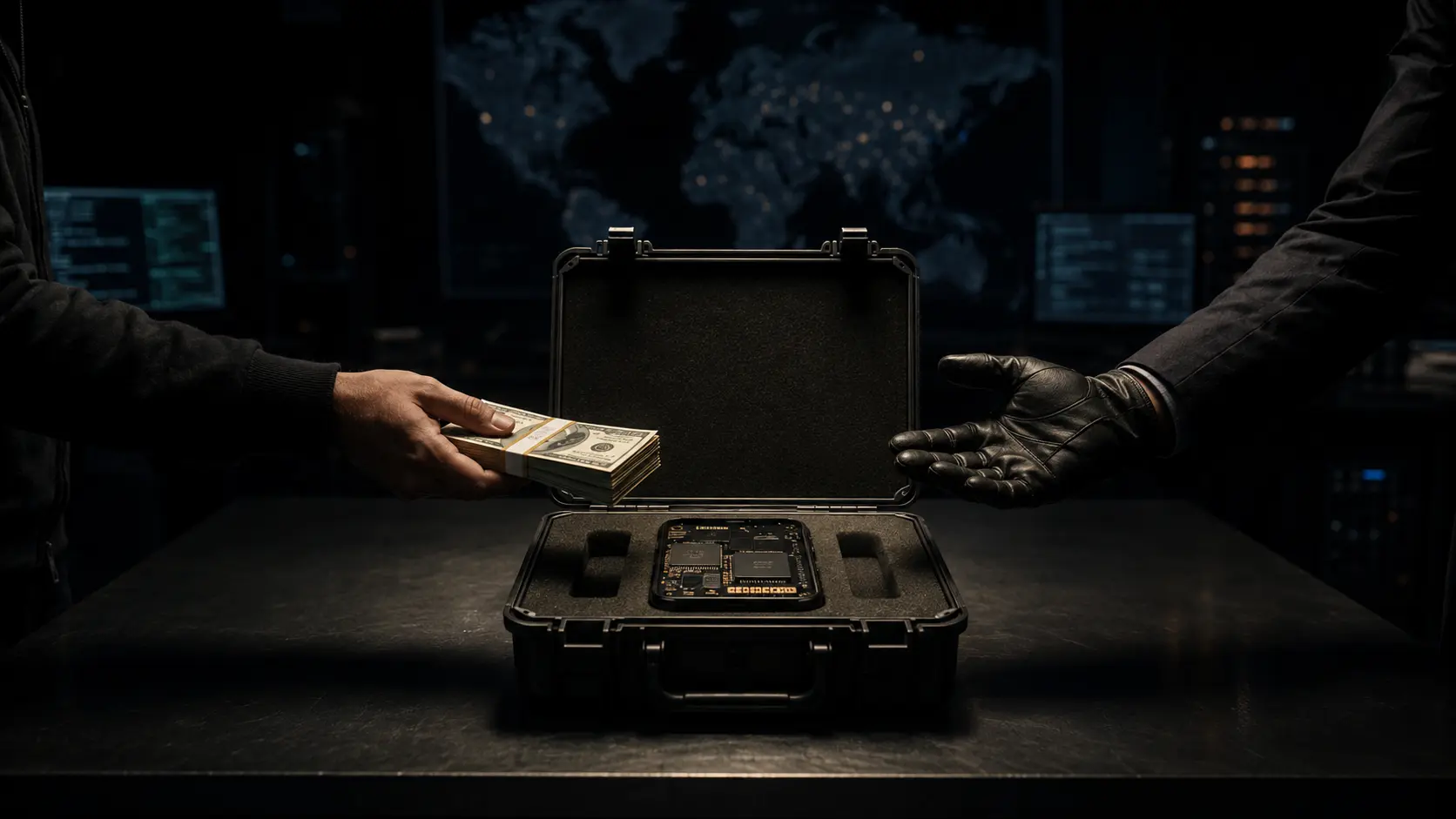
In the digital world, this is the zero-day exploitation market. Independent researchers constantly probe global software like iOS, Android, and Windows looking for invisible structural flaws. When they find one, they do not alert Apple or Google. Instead, they sell the digital blueprint to specialized brokers. These brokers test the flaw, package it into a reliable cyber weapon, and auction it to sovereign governments who use it for international espionage, surveillance, and cyber warfare.
HOW ZERO-DAY EXPLOITS AND CHAINS WORK
The creation of a commercial zero-day exploit begins with vulnerability discovery. Research teams deploy automated fuzzing clusters—massive banks of servers that relentlessly bombard a target software application with malformed data. The goal is to trigger an unexpected memory crash.
When a crash occurs, human engineers analyze the exact memory state to see if it can be controlled. They look for a memory corruption primitive, such as a buffer overflow or a use-after-free error. This primitive is the absolute baseline requirement; it proves that the software can be manipulated to read or write data where it shouldn’t.
Once a primitive is established, the attacker must bypass modern operating system defenses. Systems like Address Space Layout Randomization (ASLR) randomly shuffle where code lives in memory, making it difficult for an attacker to know where to strike. To defeat this, engineers construct a heap exploitation layout. They meticulously arrange the computer’s temporary memory architecture so that their malicious data always lands in a predictable location.
Next, they must bypass Data Execution Prevention (DEP), which stops the computer from running code disguised as raw data. They do this using Return-Oriented Programming (ROP). An ROP chain acts like a ransom note made of cut-out magazine letters. The attacker links together tiny, harmless snippets of the application’s own legitimate code to silently execute a malicious command.
A single vulnerability is rarely enough to compromise a modern device. Brokers demand fully weaponized exploit chains. This requires linking a browser vulnerability to gain initial entry, a sandbox escape flaw to break out of the app’s restricted environment, and a privilege escalation flaw to achieve “root” or total control over the operating system.
REAL WORLD EXAMPLE
Zerodium is the most famous commercial zero-day broker in the world. Operating publicly, they publish a highly detailed pricing matrix detailing exactly what they will pay independent researchers for specific cyber weapons.
The pinnacle of their pricing chart is the “Zero-Click” remote code execution exploit for modern mobile operating systems. A zero-click exploit requires no interaction from the victim—no clicking a link, no opening an attachment. The attacker simply sends a hidden, malformed iMessage or WhatsApp packet, and the target’s phone is instantly compromised in the background. Zerodium routinely offers upwards of $2.5 million in cash for a single, reliable iOS or Android zero-click exploit chain, which they then resell to government intelligence clients at a massive premium.
WHY IT MATTERS NOW
Geopolitical power projection relies entirely on digital intelligence. The days of sending physical spies to wiretap foreign embassies are largely obsolete. Today, intelligence agencies must infiltrate the encrypted mobile devices of foreign diplomats, generals, and executives.
Because end-to-end encryption apps like Signal and WhatsApp protect data while it travels across the internet, governments cannot intercept messages in transit. They must compromise the endpoint device itself. They need to read the screen before the message is encrypted, or after it is decrypted.
This requirement fuels an insatiable government demand for endpoint zero-day exploits. Democratic and authoritarian regimes alike depend on this gray market to supply the ammunition for their national security apparatus. Intelligence agencies treat high-quality exploits exactly like physical munitions stockpiles.
However, this creates a severe societal conflict of interest. When a Western intelligence agency buys a critical vulnerability in global networking hardware to spy on an adversary, they intentionally leave that flaw unpatched. This leaves the domestic civilian infrastructure—banks, hospitals, and power grids—completely vulnerable to the exact same flaw if an adversary discovers it independently.
COMMON MISCONCEPTIONS
- “Hackers always report flaws to tech companies for bug bounties.” Corporate bug bounties pay a fraction of what gray market brokers pay. A flaw that Apple buys for $100,000 can easily sell for $2,000,000 to a defense contractor.
- “Zero-days are just advanced computer viruses.” A zero-day is not a virus; it is the invisible, unlocked door that allows a virus or spyware payload to enter a secure system without being detected.
- “Only rogue nations buy from exploit brokers.” The largest clients of the commercial zero-day market are the intelligence and law enforcement agencies of major Western democracies.
WHAT MOST PEOPLE MISS
Cyber security analysts often focus on the raw technical brilliance of an exploit, but they miss the brutal financial decay of its shelf life.
A zero-day exploit is a rapidly depreciating asset. The moment the software vendor (like Microsoft or Google) independently discovers the flaw and issues a security patch, the exploit’s value instantly drops to zero. Brokers must constantly evaluate “bug collision” risk—the statistical probability that a rival intelligence agency or the software creator will find the exact same vulnerability before the broker can secure a return on their multi-million dollar investment.
THE ECONOMIC AND STRATEGIC IMPACT
The primary financial beneficiaries are elite cybersecurity boutique firms, often staffed by former intelligence officers, operating out of jurisdictions with favorable export controls. These firms act as the central clearinghouses, vetting the math behind the exploit and verifying the buyer’s sovereign credentials.
The primary losers are global technology conglomerates and their users. Companies spend billions on internal security architecture, only to have state-sponsored actors bypass it completely using purchased, undisclosed flaws.
Strategically, the gray market acts as a great equalizer. In the past, only nations with massive signals intelligence agencies, like the NSA or GCHQ, could develop elite cyber weapons. Today, a smaller nation without a domestic cyber capability can simply allocate a portion of its defense budget to buy world-class exploitation tools from private brokers, instantly elevating its geopolitical espionage capabilities.
THE TRAJECTORY
Next 12–36 Months: The integration of specialized Artificial Intelligence into vulnerability discovery. Large Language Models tuned specifically on assembly code and memory allocation will augment human researchers. This will drastically reduce the time it takes to identify complex memory corruption primitives, flooding the broker market with lower-tier vulnerabilities.
Next Five Years: The escalation of hardware-level exploitation. As operating systems like iOS and Android become nearly impenetrable at the software level, researchers will shift focus entirely to the microchips. Brokers will pay the highest premiums for flaws inside the physical silicon, baseband modems, and secure enclaves, which cannot be easily patched with a software update.
Next Ten Years: The implementation of extreme sovereign export controls. Recognizing that zero-days are weapons of mass disruption, major governments will enforce strict international treaties governing their sale. Brokers will be heavily regulated, forcing the true shadow market deeper into illicit, decentralized cryptocurrency networks.
What Could Go Wrong: A catastrophic stockpile leak. If a private zero-day broker is successfully hacked by a rogue state, their entire vault of unpatched cyber weapons could be dumped onto the public internet. This would instantly arm global ransomware cartels with military-grade tools, triggering a global wave of unstoppable corporate extortion events.
Most Likely Outcome: The zero-day market will become fully institutionalized. It will operate parallel to the traditional defense contracting industry. Prime aerospace and defense corporations will acquire boutique brokerages, integrating zero-day discovery directly into standard government military procurement cycles.
KEY TERMS
- Zero-Day Vulnerability: A software flaw unknown to the vendor, meaning they have had zero days to create a defensive patch.
- Memory Corruption Primitive: The foundational software error that allows an attacker to improperly read, write, or alter data inside a computer’s memory.
- Exploit Chain: A series of distinct vulnerabilities linked together to sequentially defeat multiple layers of system security.
- Automated Fuzzing: A testing technique that hurls massive amounts of random, invalid data at a program to force a hidden error or crash.
- Return-Oriented Programming (ROP): An attack technique that hijacks a program’s control flow by executing short sequences of its own legitimate, existing code.
- Zero-Click Exploit: A cyber weapon that compromises a device perfectly in the background without requiring the victim to click or interact with anything.
BEGINNER FAQ
What is a zero-day broker? A zero-day broker is a middleman company. They buy secret software flaws from independent hackers and sell them for a massive profit to government intelligence agencies.
Why would a hacker sell to a broker instead of Apple or Google? Money. Technology companies offer “bug bounties” that pay tens of thousands of dollars. A broker will pay millions of dollars for the exact same information.
Is selling a zero-day exploit illegal? In many parts of the world, it is completely legal. It is treated as selling specialized digital research. However, selling it to a hostile foreign nation usually violates strict international export laws.
What do governments do with these exploits? They use them for espionage. They deploy these secret flaws to silently break into the smartphones of terrorists, foreign diplomats, or rival military commanders to steal encrypted messages.
What is a zero-click exploit? It is the most dangerous type of cyber weapon. It allows a hacker to take over your phone completely without you ever clicking a bad link or answering a strange text message.
How do hackers find these flaws? They use supercomputers to hurl millions of random inputs at a software program every second, looking for a tiny mathematical error that causes the program’s memory to crash.
Why doesn’t the software company just fix the flaw? Because they do not know it exists. The broker and the government buyer keep the flaw a closely guarded secret so the software company cannot patch the vulnerability.
What happens if the software company finds the flaw on their own? They release a security update. The moment a user updates their phone, the government’s multi-million dollar cyber weapon becomes completely useless against that device.
SOURCES
- Cybersecurity and Infrastructure Security Agency (CISA) — Known Exploited Vulnerabilities and Zero-Day Defense Strategies
- RAND Corporation — The Zero-Day Market: Economics and Geopolitics of Cyber Weapons
- Google Project Zero — Year in Review: A Retrospective on In-the-Wild Exploits
- Belfer Center for Science and International Affairs — State-Sponsored Cyber Espionage and Exploit Proliferation