Advertisement
)

AT A GLANCE
- Concept: Electrochemistry: Creating electricity through chemical reactions rather than burning fuel in a mechanical engine.
- Concept: Yttria-Stabilized Zirconia: A specialized ceramic that acts as the cell’s core, conducting oxygen ions at extreme heat.
- Concept: Microgrid: An independent, localized power system that can completely detach from the main electrical grid.
- Concept: Combined Heat and Power: Capturing the intense exhaust heat from the fuel cell to warm nearby buildings.
IN SIMPLE WORDS
Imagine trying to power a massive data center the size of a shopping mall. You could plug into the local power grid, but one storm could knock out the wires, taking your servers offline. You could use giant diesel generators, but they are loud, dirty, and prone to mechanical failure.
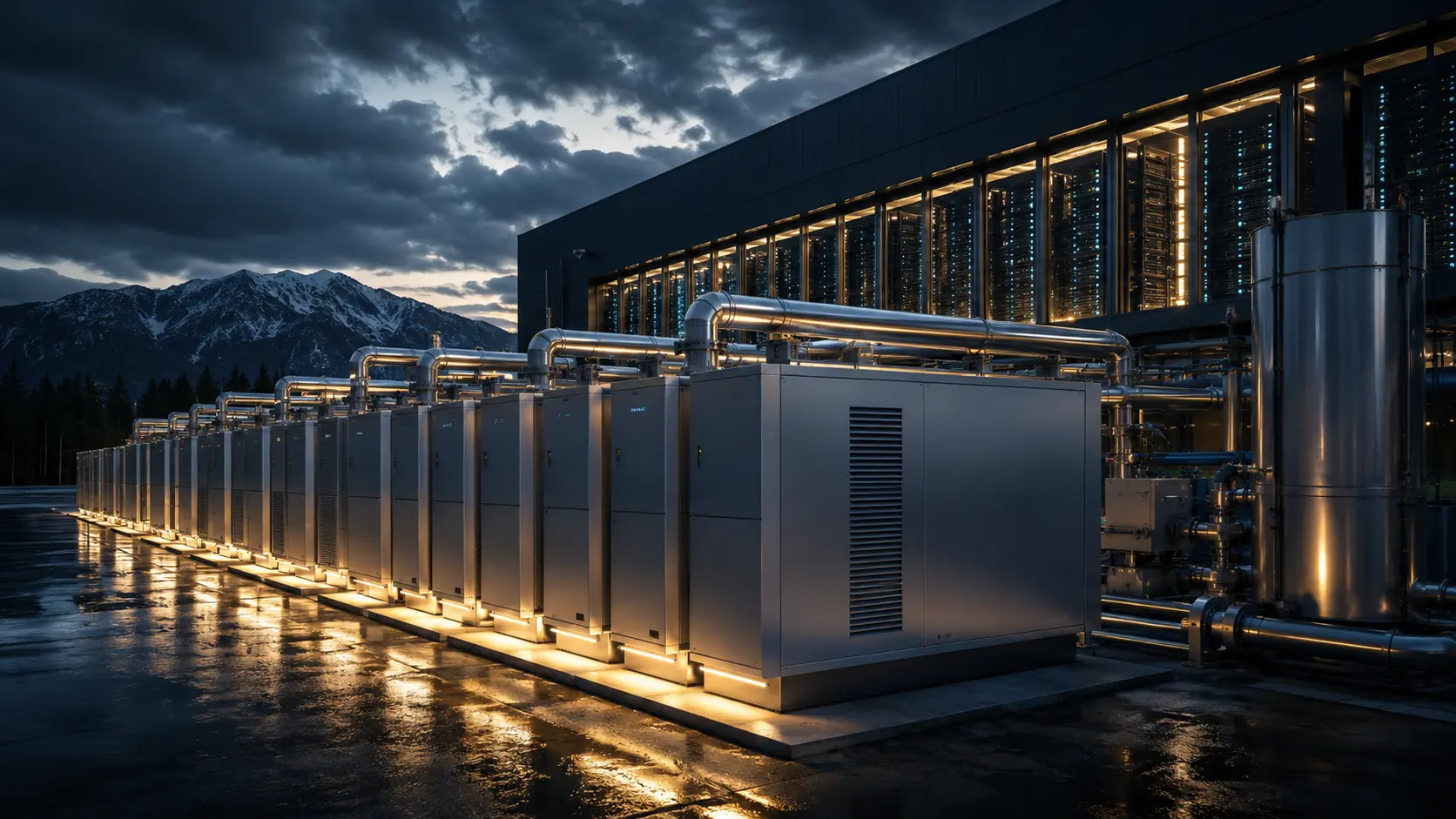
Solid oxide fuel cells offer a completely different solution. They are silent, metal boxes that create electricity without burning anything. You pipe natural gas or hydrogen into one side, and pure electricity comes out the other.
Because there are no moving parts, they rarely break down. By clustering hundreds of these boxes together outside a data center, companies can build their own independent power plants. This guarantees endless electricity regardless of what happens to the public grid.
HOW SOLID OXIDE FUEL CELLS WORK
Traditional power plants burn fuel to spin massive mechanical turbines, a process that wastes massive amounts of energy as heat and friction. Solid Oxide Fuel Cells (SOFCs) bypass mechanics entirely. They generate electricity through direct electrochemical oxidation.
The core of an SOFC is the electrolyte. Unlike standard car batteries that use liquid acids, an SOFC uses a solid ceramic layer, typically made of yttria-stabilized zirconia (YSZ). This ceramic acts as a perfect gatekeeper.
To function, the ceramic electrolyte must be heated to extreme temperatures, usually between 600°C and 1,000°C. At this intense heat, the ceramic becomes highly conductive to oxygen ions but completely blocks electrons.
Air enters the cathode side of the cell, where oxygen molecules split into ions. These ions migrate through the hot ceramic electrolyte toward the anode side. On the anode side, a continuous stream of fuel like natural gas or hydrogen flows in.
When the oxygen ions hit the fuel at the anode, they react. This chemical reaction frees electrons. Because the ceramic blocks the electrons from traveling backward, they are forced to travel through an external wire, creating a steady, high-voltage electrical current before combining with the exhaust.
REAL WORLD EXAMPLE
In late 2025 and early 2026, artificial intelligence forced data centers to seek massive new power sources. Bloom Energy, the primary manufacturer of commercial SOFCs, closed over $7.6 billion in contracts in a matter of months.
When developers broke ground on a massive 1.8-gigawatt AI data center campus in Wyoming, they chose solid oxide fuel cells to supply the first 900 megawatts. The fuel cells allowed the companies to build an entirely independent microgrid, completely bypassing the massive, multi-year wait time to connect to the local public utility grid.
WHY IT MATTERS NOW
The artificial intelligence infrastructure boom has broken the global electrical grid. Training a single advanced AI model requires tens of thousands of specialized microchips running simultaneously. These AI factories draw hundreds of megawatts of continuous power.
Traditional power utility companies simply cannot build new transmission lines fast enough. In key technology markets, the wait time to connect a new data center to the public grid has stretched to nearly ten years. Technology companies cannot wait a decade to launch their computing clusters.
SOFCs offer a “power-in-a-box” solution. A company can order a cluster of fuel cells and have a functional, high-capacity power plant running on their property in less than 12 months. Because the cells run on standard natural gas pipelines, they do not require new electrical transmission towers to be built across the city.
Furthermore, as the global energy sector transitions toward hydrogen, SOFCs provide highly resilient infrastructure. While they currently run on natural gas to produce electricity with lower emissions than the standard grid, these exact same fuel cells can switch to running on 100 percent green hydrogen once it becomes commercially viable at scale.
COMMON MISCONCEPTIONS
- “Fuel cells are essentially giant batteries.” Batteries only store electricity generated somewhere else. Fuel cells actually generate their own electricity continuously, as long as fuel is supplied to the system.
- “They are 100 percent zero-emission right now.” Currently, most commercial SOFCs run on natural gas. While they are far cleaner than burning coal, they still emit some carbon dioxide. They will only become zero-emission when powered purely by green hydrogen.
- “They can be turned on and off instantly.” Because the internal ceramic must reach 800°C to function, SOFCs take hours to warm up to their operating temperature. They are designed to run continuously 24/7, making them terrible for quick, emergency backup power.
WHAT MOST PEOPLE MISS
While data center engineers prioritize the electrical generation, they frequently underutilize the massive thermal exhaust.
Because the fuel cell operates at 800°C, the exhaust gas leaving the machine is incredibly hot. Using Combined Heat and Power (CHP) systems, this exhaust can be captured to boil water and run massive absorption chillers. The fuel cell can simultaneously provide the electricity to run the data center servers and the cooling power required to keep those exact same servers from overheating.
THE ECONOMIC AND STRATEGIC IMPACT
The primary financial beneficiaries are the commercial real estate developers who build AI data centers. By securing independent microgrid power, developers can build massive tech campuses on cheap, rural land that lacks heavy electrical infrastructure, drastically lowering their upfront capital costs.
The losers in this transition are the traditional, heavily regulated public utility companies. As massive technology corporations pull their data centers off the public grid to use private fuel cells, the utility companies lose their largest and most profitable customers.
Strategically, this shift accelerates grid decentralization. Instead of relying on a few massive, vulnerable nuclear or coal plants, modern infrastructure will rely on thousands of distributed microgrids. This makes the overall national computing infrastructure far more resilient against severe weather events and targeted physical attacks.
THE TRAJECTORY
Next 12–36 Months: The massive deployment of primary-power microgrids. Hyperscale technology companies will increasingly refuse to connect their new AI campuses to the public grid, relying entirely on massive clusters of SOFCs for their primary electricity.
Next Five Years: The transition to reversible fuel cells. Engineers will commercialize solid oxide systems that can run in reverse (electrolysis). During times of excess grid power, the cell will use electricity to turn water into hydrogen. During power shortages, it will use that hydrogen to generate electricity.
Next Ten Years: The integration into heavy maritime shipping. Massive cargo ships will replace their highly polluting diesel engines with multi-megawatt SOFC arrays. Running on liquefied natural gas or ammonia, these silent fuel cells will allow cargo ships to cross oceans with near-zero acoustic and particulate pollution.
What Could Go Wrong: A severe natural gas supply shock. While SOFCs avoid the electrical grid, they are entirely dependent on continuous natural gas pipeline pressure. A coordinated cyberattack on regional gas pipelines would instantly starve the fuel cells of fuel, causing a massive blackout at the dependent data centers.
Most Likely Outcome: Solid oxide fuel cells will become the mandatory infrastructure standard for all mission-critical commercial real estate. They will serve as the invisible, highly reliable baseload engines powering the artificial intelligence economy.
KEY TERMS
- Solid Oxide Fuel Cell (SOFC): An electrochemical device that converts fuel into electricity using a solid ceramic material at extremely high temperatures.
- Yttria-Stabilized Zirconia (YSZ): The specialized ceramic material that conducts oxygen ions while blocking electrons inside the fuel cell.
- Microgrid: A localized power network that can generate its own electricity and disconnect from the traditional, large-scale electrical grid.
- Combined Heat and Power (CHP): The process of capturing the wasted heat from power generation and using it to heat or cool a building.
- Electrolyte: The physical barrier inside a battery or fuel cell that allows specific ions to pass through while forcing electrons to take a longer path.
BEGINNER FAQ
What is a solid oxide fuel cell? It is a metal box that creates electricity using a chemical reaction instead of burning fuel. It provides highly reliable power directly to a building without needing the public power grid.
Why do data centers want them? Data centers use massive amounts of power for artificial intelligence. The public electrical grid is too slow to upgrade, so data centers use fuel cells to build their own private power plants.
Do they use standard batteries? No. A battery runs out of power and needs to be recharged. A fuel cell keeps making electricity continuously as long as you pipe fuel into it.
What kind of fuel do they use? Right now, most commercial systems run on standard natural gas. In the future, they will run on clean hydrogen to eliminate carbon emissions entirely.
Are they loud like a generator? No. Because they do not have any spinning engines or mechanical parts, they are virtually silent. This makes them perfect for urban environments or hospital campuses.
Why are they so hot inside? The core of the machine is made of ceramic. The ceramic only allows the necessary chemical reactions to happen when it is heated to roughly 800 degrees Celsius.
Can I put one in my house? Usually, no. They are massive, expensive industrial machines designed for commercial buildings, factories, and tech campuses that require millions of watts of power.
What happens if the main power grid goes down? The fuel cell keeps running perfectly. It acts as an independent microgrid, ensuring that the data center never loses power during a city-wide blackout.
SOURCES
- United States Department of Energy (DOE) — Solid Oxide Fuel Cell Technology and Distributed Generation
- Argonne National Laboratory — High-Temperature Electrochemistry and Ceramic Electrolytes
- Electric Power Research Institute (EPRI) — Microgrids and Commercial Fuel Cell Deployment
- Bloom Energy Corporation — 2026 Data Center Power Report and Advanced Energy Solutions