Advertisement
)

AT A GLANCE
- Concept: AI memory systems preventing factual hallucinations.
- Mechanism: High-dimensional math matching queries to stored facts.
- Structure: Knowledge graphs organizing entities into relational networks.
- Impact: Makes AI safe for medical, legal, and financial use.
IN SIMPLE WORDS
Large language models like ChatGPT do not actually know facts. They simply predict the next most logical word in a sentence based on patterns. When they lack a specific pattern, they confidently invent one, which is called a hallucination.
To fix this, engineers created Retrieval-Augmented Generation (RAG). Think of it like giving a student an open-book exam instead of forcing them to rely on memory.
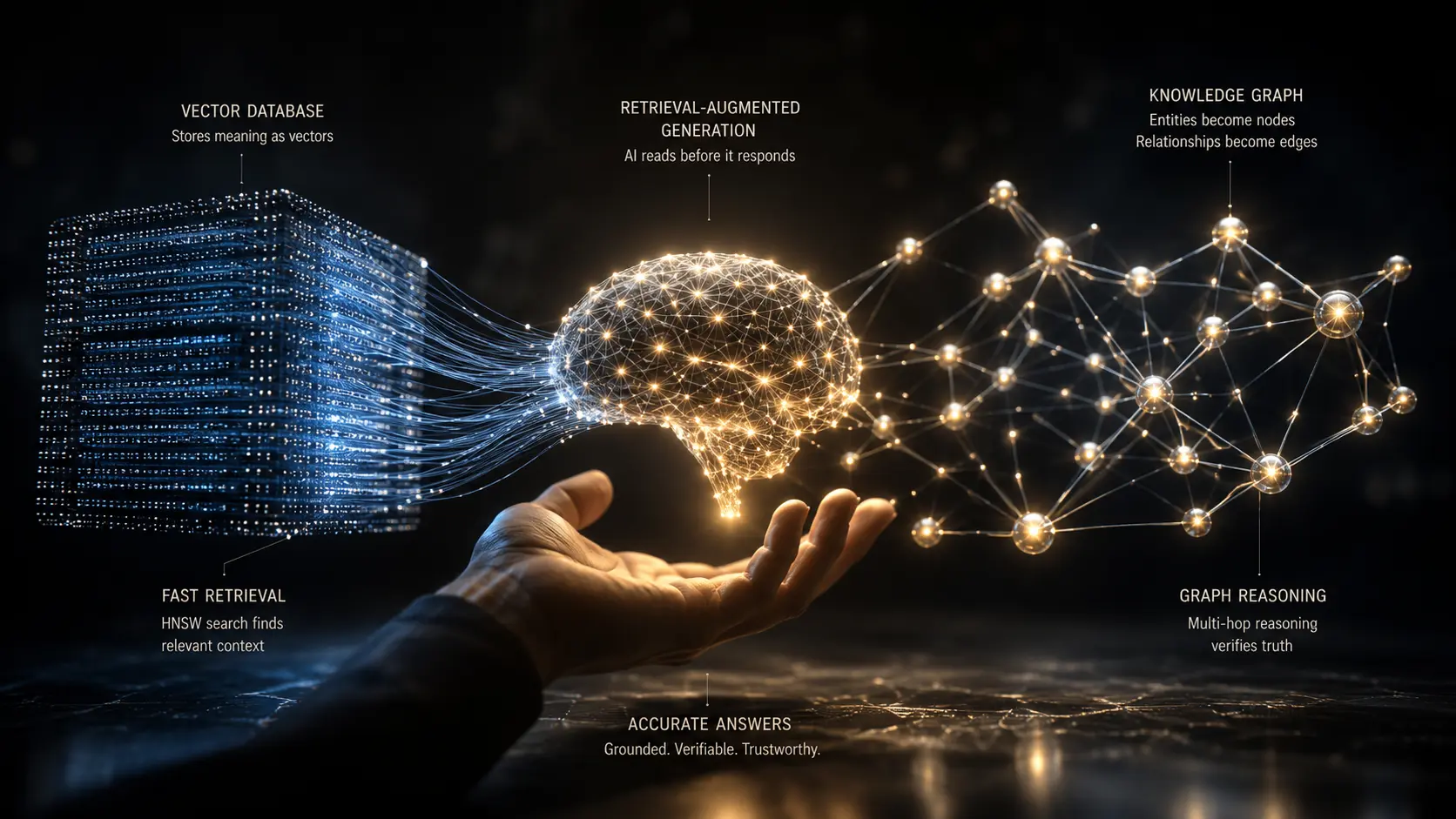
A vector database acts as the index of that book, instantly finding the exact paragraph containing the answer. GraphRAG takes this a step further by connecting those facts like a detective’s evidence board. Instead of just finding a single document, GraphRAG maps how people, places, and events relate to each other. This combination allows AI to read the facts, verify the relationships, and provide a perfectly accurate answer.
HOW GRAPHRAG WORKS
The system relies on turning words into complex mathematics. Text is converted into numbers called vector embeddings, which capture the meaning of the data.
These numbers are plotted in high-dimensional space within a vector database. Words with similar meanings cluster together naturally. When a user asks a question, the system plots the question in that same mathematical space to find the closest clusters of facts.
To search millions of vectors in milliseconds, databases use an algorithm called Hierarchical Navigable Small World (HNSW). HNSW builds a layered graph where top layers allow massive skips across the data, while lower layers handle fine-grained precision. This makes similarity search incredibly fast.
However, standard vector search struggles with “multi-hop” reasoning, where an answer requires connecting multiple separate documents. GraphRAG solves this by converting retrieved data into a knowledge graph. It maps entities as nodes and their relationships as edges.
When processing a complex prompt, GraphRAG forces the AI to traverse this graph logically. The AI evaluates how a person is connected to a company, and how that company is connected to a legal ruling. This deterministic traversal prevents the AI from skipping logical steps and inventing conclusions.
REAL WORLD EXAMPLE
A corporate law firm uses an internal AI tool to analyze millions of past case files and contracts.
Using standard AI, the model might hallucinate a legal precedent by mixing up the names from two different lawsuits. It does this because both names appear frequently in similar contexts.
By implementing GraphRAG, the firm’s system first maps every client, contract, and ruling into a strict knowledge graph. When a lawyer asks about a specific corporate merger, the AI first pulls the exact documents from the vector database. It then traces the precise relationship lines in the graph, ensuring it only cites cases that physically link to the requested entities. The AI provides a flawless legal brief with verifiable citations.
WHY IT MATTERS NOW
Artificial intelligence has reached the limit of what raw scaling can achieve. Simply adding more data and computing power to a model does not cure its tendency to hallucinate. For AI to move beyond creative writing and enter mission-critical enterprise applications, it must become strictly deterministic.
Currently, major corporations are hesitant to deploy generative AI for customer service or financial advising. A single hallucinated return policy or fabricated investment advice can result in massive legal liability. Accuracy is no longer a luxury; it is a strict regulatory requirement.
The integration of GraphRAG represents a massive shift in AI architecture. Rather than treating the language model as an all-knowing oracle, engineers now treat it simply as a reasoning engine. The actual “knowledge” is kept entirely separate in highly secure, easily updated vector databases.
This separation of logic and memory creates a highly lucrative enterprise market. Companies spend millions to index their private data securely so they can safely deploy internal AI agents without leaking intellectual property or generating falsehoods.
COMMON MISCONCEPTIONS
- Misconception: AI hallucinations are software bugs that will eventually be patched.
- Reality: Hallucinations are a fundamental feature of how language models predict text. They cannot be patched out; they must be constrained by external memory systems like RAG.
- Misconception: Vector databases store text exactly like a traditional SQL database.
- Reality: Vector databases store mathematical coordinates representing the semantic meaning of text, allowing searches based on concepts rather than exact keyword matches.
- Misconception: GraphRAG is just a faster version of standard RAG.
- Reality: GraphRAG completely changes the retrieval method by organizing data hierarchically and relationally, allowing the AI to understand complex, multi-step connections that standard RAG misses.
- Misconception: Giving an AI a vector database makes it self-aware.
- Reality: A vector database simply acts as a fast filing cabinet. The AI uses it to look up text before generating a response, with no impact on its fundamental programming.
WHAT MOST PEOPLE MISS
The true power of GraphRAG is that it makes AI explainable.
When a standard neural network makes a decision, it operates as a “black box.” Engineers cannot see exactly why the model chose specific words. This opacity is unacceptable in heavily regulated industries like medicine or finance.
Because GraphRAG forces the AI to traverse a strict path of nodes and edges to build its answer, the system leaves a perfect audit trail. A human reviewer can look at the knowledge graph and see exactly which document and which relationship led to the AI’s conclusion. It turns a probabilistic guess into a transparent, verifiable chain of logic.
THE ECONOMIC AND STRATEGIC IMPACT
Who Wins: Database infrastructure providers like Pinecone, Qdrant, and Neo4j, which build the systems that hold these complex vector embeddings. Microsoft, which open-sourced GraphRAG, positions its Azure cloud as the default home for enterprise AI deployments.
Who Loses: AI startups trying to build massive, know-it-all foundation models from scratch. They are being outmaneuvered by companies building smaller, cheaper reasoning models paired with highly accurate GraphRAG architecture.
Who Controls the System: Cloud infrastructure giants and enterprise data architects. The value is shifting away from the AI model itself and moving toward the proprietary, highly structured knowledge graphs owned by individual corporations.
Why Investors and Governments Care: Investors see vector databases and graph infrastructure as the “picks and shovels” of the AI gold rush. Governments require GraphRAG architectures to ensure automated systems used in public services remain transparent, accurate, and free from dangerous factual errors.
THE TRAJECTORY
Next 12–36 Months: Enterprise AI adoption will surge as companies finalize their internal vector databases. Standard RAG will become commoditized, and advanced GraphRAG pipelines will become the standard requirement for any AI system touching legal, medical, or financial data.
Next Five Years: Knowledge graphs will become dynamic and self-updating. AI agents will constantly read incoming global news, emails, and market reports, automatically adjusting the weights and edges in their vector databases without human intervention.
Next Ten Years: The concept of a “standalone” large language model will disappear. Every commercial AI system will natively rely on continuous, real-time GraphRAG architectures pulling from decentralized, global knowledge networks to guarantee perfect factual accuracy.
What Could Go Wrong: If the underlying data ingested into a vector database is poisoned, biased, or factually incorrect, GraphRAG will confidently cite those falsehoods as absolute truth. An AI is only as accurate as the knowledge graph it searches.
Most Likely Outcome: GraphRAG and vector architecture will permanently solve the hallucination problem for enterprise use cases. The AI industry will split, with creative models used for brainstorming and strict GraphRAG systems commanding the lucrative corporate automation market.
KEY TERMS
- Vector Embedding: A mathematical representation of text that captures its underlying semantic meaning.
- Vector Database: A specialized storage system designed to rapidly query and retrieve high-dimensional vector embeddings.
- Knowledge Graph: A network structure that organizes information by mapping entities as nodes and their relationships as edges.
- RAG (Retrieval-Augmented Generation): A technique where an AI searches an external database for facts before answering a prompt.
- GraphRAG: An advanced form of RAG that uses knowledge graphs to enable complex logical reasoning and multi-step data retrieval.
- Hallucination: A phenomenon where an AI generates false, illogical, or invented information while presenting it as fact.
- HNSW (Hierarchical Navigable Small World): A popular search algorithm used in vector databases to find similar data rapidly.
BEGINNER FAQ
What is a vector database used for? A vector database is used to store and search unstructured data like text, images, or audio by converting them into mathematical numbers. It allows artificial intelligence to find information based on its meaning rather than relying on exact keyword matches.
How does RAG stop AI hallucinations? RAG stops hallucinations by forcing the AI to read a verified, factual document before it generates a response. Instead of guessing the answer from its training data, the AI acts as a summarizer of the retrieved facts.
What is the difference between RAG and GraphRAG? Standard RAG searches a database for text that is mathematically similar to the user’s question, which often misses complex context. GraphRAG organizes the data into a web of relationships, allowing the AI to connect different concepts and perform logical reasoning.
Why do language models hallucinate in the first place? Language models hallucinate because they are built to predict the next logical word, not to store factual databases. If they lack information on a topic, their underlying math still forces them to produce a plausible-sounding sequence of words.
Are vector databases faster than regular databases? Vector databases are highly optimized for a specific task called similarity search. While they are incredibly fast at finding related concepts in massive unstructured datasets, traditional relational databases are still faster and better for managing highly structured tables of data.
Can GraphRAG be used with any AI model? Yes, GraphRAG is an architectural framework that sits outside the AI model. It can be paired with almost any large language model to improve its accuracy and reasoning capabilities.
How are knowledge graphs built for AI? Knowledge graphs are built by processing raw text documents and extracting specific entities, such as people or companies. The system then defines the relationships between those entities to create an interconnected map of information.
Do I need to be a programmer to use GraphRAG? Currently, setting up a GraphRAG system requires software engineering and data architecture skills. However, many cloud providers and software companies are releasing out-of-the-box platforms to make it accessible to non-technical business users.
SOURCES
- Microsoft Research: Project GraphRAG Documentation
- IBM Technology: Enterprise Architecture and Knowledge Graphs
- Pinecone Research: Foundations of Vector Similarity Search
- Qdrant Documentation: HNSW Indexing Fundamentals