Advertisement
)

At a Glance
Concept: Uses flowing liquids to extract heat directly from high-density computer processors.
Why it matters: AI chips run too hot for traditional air conditioning to manage effectively.
Who uses it: Cloud providers, enterprise data centers, and advanced research facilities.
Biggest takeaway: Liquid cooling is now a physical requirement to sustain artificial intelligence development.
In Simple Words
Imagine running a marathon while wearing a heavy winter coat. Eventually, your body would overheat, forcing you to stop. Computers face the exact same physical limit.
When artificial intelligence systems process massive amounts of data, their microchips generate intense heat. For decades, data centers managed this by using giant fans and industrial air conditioners to blow cold air over the machines. But modern AI chips generate so much heat that air can no longer carry it away fast enough.
Liquid cooling solves this problem by bringing water or specialized chemical fluids directly to the chips. Because liquid is roughly three thousand times more effective at holding heat than air, it acts like a high-speed thermal sponge. The fluid absorbs the heat, carries it away from the computer, cools down, and loops back. It is the only practical way to keep the internet running without melting the hardware.
Why This Matters
The technology industry has hit a thermal wall.
A standard server rack in a traditional data center consumes about 5 to 10 kilowatts of power. Today, a single rack of artificial intelligence servers can consume over 100 kilowatts. This creates an enormous thermodynamic problem. You cannot physically push enough cold air through a metal cabinet to remove 100 kilowatts of heat. If you try, the metal warps, the silicon fails, and the systems shut down to prevent fires.
Artificial intelligence models are becoming larger, requiring tens of thousands of processors to run simultaneously. This requires unprecedented electrical energy. If cooling systems fail to keep up, the progression of AI technology stops entirely.
Furthermore, traditional air cooling consumes massive amounts of electricity just to spin mechanical fans and compress chemical refrigerants. In many facilities, up to 40% of the total electricity bill goes toward air conditioning. Transitioning to liquid cooling drastically reduces facility power consumption. This frees up grid capacity for the actual computers, saves millions of dollars in operational costs, and reduces the environmental footprint of global computing infrastructure.
HOW LIQUID COOLING WORKS
The transition from air to liquid cooling relies on basic physics, specifically thermal capacity. Water is 3,427 times denser than air and has a specific heat capacity four times higher. This means it absorbs heat faster and holds more of it.
Here is how the modern cooling ecosystem functions.
1. Direct-to-Chip Cooling
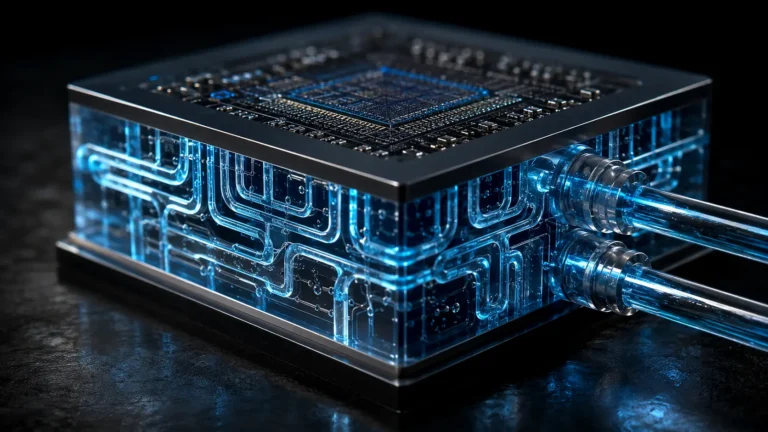
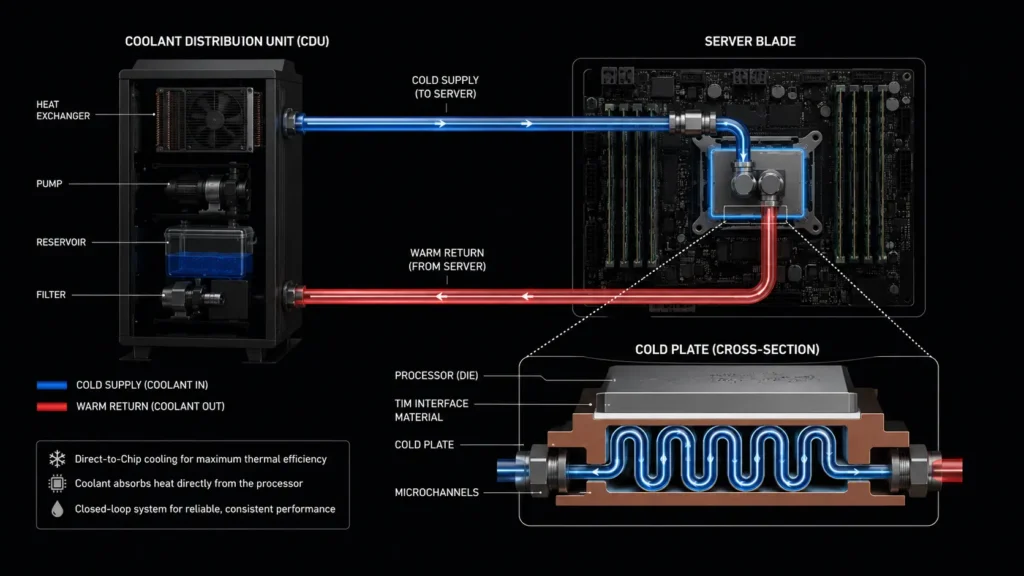
The most common approach today is direct-to-chip, also known as cold plate cooling. A sealed metal block made of highly conductive copper or aluminum sits directly on top of the silicon processor.
Inside this block are hundreds of microscopic channels. A specialized coolant mixture flows into the block, passes through the microchannels to maximize contact with the hot metal, absorbs the heat, and flows out.
2. Coolant Distribution
The heated liquid leaves the server and travels to a Coolant Distribution Unit (CDU). The CDU acts as the heart of the system. It isolates the high-purity fluid touching the expensive servers from the raw facility water.
Inside the CDU, a heat exchanger transfers the thermal energy from the warm server fluid into the colder facility water. The server fluid loops back to the computers, while the warm facility water is pumped outside to cooling towers to release the heat into the atmosphere.
3. Immersion Cooling
For maximum efficiency, some facilities bypass plumbing entirely and use immersion cooling. In this system, entire servers are lowered into tanks filled with a specialized dielectric fluid.
Dielectric fluids do not conduct electricity, meaning computers can run safely while completely submerged. The fluid surrounds every single component, absorbing heat uniformly.
4. Two-Phase Thermodynamics
Advanced immersion systems use two-phase boiling. The engineered fluid is designed to boil at a low temperature, often around 50°C (122°F).
When the processor gets hot, the liquid touching it immediately boils and turns into a gas. This phase change absorbs a massive amount of energy—known as the latent heat of vaporization—without increasing the temperature of the fluid. The gas rises to the top of the sealed tank, hits a cold condenser coil, turns back into liquid, and rains back down onto the servers.
5. System Limitations
Despite its efficiency, liquid cooling introduces new operational risks. Water is heavy, requiring reinforced concrete floors. Plumbing introduces the risk of catastrophic leaks. Furthermore, retrofitting an older data center built for air circulation into a liquid-cooled facility requires tearing out infrastructure, which is often more expensive than building a new facility from scratch.
Real-World Applications
The world’s largest technology companies have already accepted liquid cooling as a mandatory standard.
Meta is currently redesigning its global data center architecture. They paused billions of dollars in construction projects to alter blueprints, shifting away from air conditioning toward direct-to-chip liquid cooling to support their massive AI clusters.
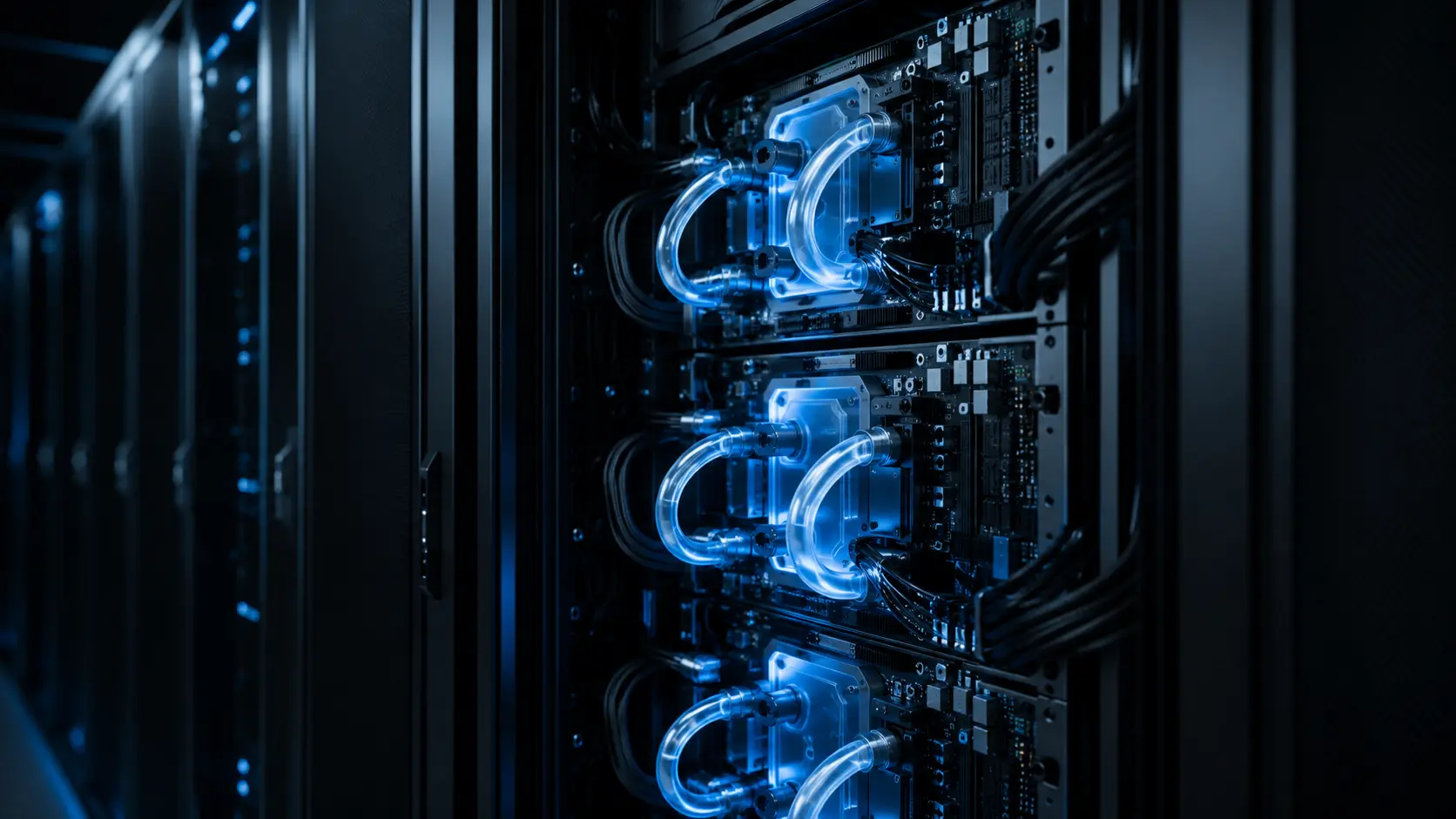
NVIDIA, the leading manufacturer of AI processors, engineered its latest GB200 NVL72 server racks strictly for liquid cooling. The system packs 72 graphics processing units into a single cabinet, generating so much heat that air cooling is physically impossible. Two miles of coolant pipes run through the cabinet to keep the silicon stable.
High-performance computing centers, such as the Frontier supercomputer at Oak Ridge National Laboratory, use warm-water cooling systems. The system pumps 6,000 gallons of water per minute to cool the massive machine, which holds the record as the fastest computer in the world.
Economic & Strategic Impact
The shift to liquid cooling fundamentally alters the economics of data centers.
The standard metric for data center efficiency is Power Usage Effectiveness (PUE). A PUE of 1.0 means every watt of electricity goes to the computers. Traditional air-cooled data centers average a PUE of 1.5, meaning 50% of the power is wasted on cooling. Liquid cooling can drive PUE down to 1.05. For a massive facility, that difference saves tens of millions of dollars annually.
Governments are heavily invested in this transition. Artificial intelligence facilities are straining national power grids, leading to utility delays and regulatory scrutiny. Liquid cooling allows companies to expand computing power without proportionally increasing their draw on local electrical grids.
The market for specialized cooling hardware is surging. Companies that manufacture cold plates, coolant distribution units, and heavy-duty industrial piping are securing multi-year contracts, creating a lucrative new sector within industrial technology.
Advantages
• Higher Compute Density: Servers can be packed tightly together because bulky fans and wide air aisles are no longer necessary.
• Eliminates Thermal Throttling: Processors slow themselves down when they get hot. Liquid cooling keeps temperatures stable, allowing chips to run at maximum speed continuously.
• Massive Energy Savings: Removing mechanical fans from millions of servers significantly reduces electricity consumption.
• Waste Heat Recovery: Liquid captures heat so efficiently that the resulting hot water can be piped into municipal systems to heat nearby homes and offices.
Limitations
• High Capital Expenditure: Building the complex plumbing networks and redundant pumps requires massive upfront investment.
• Leak Risks: A single faulty valve in a direct-to-chip system can destroy millions of dollars of hardware instantly.
• Maintenance Complexity: Technicians cannot simply swap out a broken server. They must handle quick-disconnect valves, fluid drainage, and pressure checks.
• Chemical Concerns: Many specialized dielectric fluids contain PFAS (forever chemicals), which are facing strict environmental bans globally.
Common Misconceptions
Misconception: Water and electronics cannot mix, making liquid cooling highly dangerous. Reality: While direct-to-chip uses water, it is isolated inside sealed copper blocks. Immersion systems use dielectric fluids, which are chemically engineered to have zero electrical conductivity.
Misconception: Liquid cooling is a completely new technology. Reality: IBM used liquid cooling for massive mainframe computers in the 1960s. It only disappeared because silicon chips became highly efficient in the 1990s, allowing fans to take over until AI reversed the trend.
Misconception: The liquid must be ice cold to work. Reality: Modern systems often use “warm water” cooling (up to 40°C or 104°F). Because processors operate near 85°C (185°F), even warm water easily absorbs and carries away the heat.
What Most People Miss
Liquid cooling changes the fundamental real estate model of the internet.
Historically, data centers were massive, sprawling warehouses because servers needed physical space to breathe. The limiting factor for a building was floor space.
Liquid cooling flips this equation. By removing air aisles, operators can achieve ten times the computing power in the exact same footprint. The limiting factor is no longer physical space; it is the amount of electricity the local utility can deliver to a single city block. This allows tech giants to build smaller, hyper-dense facilities closer to urban centers, completely altering how digital real estate is valued.
| Feature | Traditional Air Cooling | Direct-to-Chip Liquid | Two-Phase Immersion |
| Purpose | Standard IT and enterprise servers. | High-density AI and supercomputing. | Ultra-dense, maximum efficiency computing. |
| Advantages | Cheap, well understood, easy maintenance. | Targets the hottest components efficiently. | Silent, cools all components equally. |
| Limitations | Hits physical limits past 30kW per rack. | Cools chips, but not ambient board heat. | High chemical cost, difficult to service. |
| Typical Use Cases | Corporate IT, older cloud servers. | Modern AI clusters, GPU farms. | Crypto mining, extreme computing. |
| Cost | Low | High | Very High |
| Best Fit | Legacy infrastructure. | High-performance retrofits. | New purpose-built facilities. |
Case Study
Situation: NVIDIA designed the Blackwell architecture to train the next generation of artificial intelligence models, requiring massive data processing speeds.
Challenge: The resulting GB200 NVL72 rack system processes data so fast that it draws up to 120 kilowatts of power per cabinet. Moving that much energy creates lethal amounts of heat. Traditional air fans could not physically move enough volume to prevent the silicon from melting.
Solution: NVIDIA abandoned air cooling for the rack. They engineered a closed-loop liquid cooling system using precise cold plates on every single GPU and CPU, connected by miles of internal piping and blind-mate liquid connectors.
Outcome: The system operates safely. More importantly, because the chips remain perfectly chilled, they never trigger thermal throttling.
Lessons Learned: Extreme computing power can no longer be separated from extreme thermal engineering. The cooling system is now as important as the silicon itself.
Future Outlook
Next 12–24 Months
The industry will see a massive wave of retrofits. Existing data centers will install hybrid systems, adding liquid cooling loops to specific high-density racks while keeping air conditioning for older equipment. The supply chain for industrial pumps and valves will remain tight.
Next 3–5 Years
New data centers will be built as liquid-native facilities. Air conditioning will be reduced to a secondary role. Immersion cooling will gain market share as chemical companies develop environmentally safe, PFAS-free dielectric fluids.
Next 10 Years
Thermal management will move inside the silicon package itself. Engineers will design microfluidic channels directly into the microscopic layers of the processors. Coolant will flow through the actual computer chips, not just across metal blocks on top of them.
Most Likely Scenario
Liquid cooling will become the invisible baseline of the modern economy. Just as indoor plumbing is expected in modern architecture, liquid thermal management will become a standard utility requirement for any facility processing artificial intelligence.
Key Takeaways
• AI processors generate heat that exceeds the physical limits of traditional air cooling.
• Liquid holds and transfers heat roughly 3,000 times more effectively than air.
• Direct-to-chip cooling pumps fluid through metal blocks placed directly on hot processors.
• Immersion systems submerge computers entirely in non-conductive engineered fluids.
• Liquid cooling reduces data center energy waste, saving millions in operating costs.
• High-density cooling allows massive AI clusters to fit into smaller real estate footprints.
• Future AI hardware requires liquid infrastructure as a mandatory operational baseline.
Glossary
Cold Plate: A highly conductive metal block with internal channels that transfers heat from a chip to a flowing liquid.
Coolant Distribution Unit (CDU): The pumping station that circulates specialized coolant to the servers and transfers heat to the facility water.
Dielectric Fluid: An engineered liquid that does not conduct electricity, allowing electronic components to be safely submerged.
Direct-to-Chip: A cooling method that targets only the hottest components (like the CPU or GPU) using sealed liquid loops.
Latent Heat of Vaporization: The massive amount of energy a liquid absorbs when it boils and changes into a gas.
Microchannels: Microscopic grooves cut into cold plates to maximize the surface area where fluid touches hot metal.
Power Usage Effectiveness (PUE): A ratio measuring data center efficiency; closer to 1.0 means less energy is wasted on cooling.
Thermal Throttling: A safety mechanism where a computer chip slows itself down to prevent overheating and physical damage.
Frequently Asked Questions
Why is air cooling no longer enough? Modern AI chips draw too much electricity. The resulting heat is so dense that fans cannot physically push enough air through the server chassis to remove it fast enough.
Does water ever touch the computer chips? In direct-to-chip systems, water is completely sealed inside metal blocks and pipes. It never touches the electronics. In immersion systems, the fluid touches everything, but it is an engineered chemical that does not conduct electricity.
What happens if a liquid cooling pipe leaks? Data centers use negative pressure pumps and advanced leak detection sensors. If a drop of fluid escapes, the system instantly senses the pressure drop, halts the flow, and alerts technicians before damage occurs.
Is liquid cooling better for the environment? Yes. Traditional data centers use massive amounts of electricity just to run air conditioners. Liquid cooling requires far less energy, reducing the facility’s overall carbon footprint and relieving stress on the power grid.
Can old data centers switch to liquid cooling? Yes, but it is difficult. Operators must install heavy piping, reinforce floors to handle the weight of water, and add coolant distribution units. Many companies prefer building new facilities instead.
What is two-phase immersion cooling? It is a system where computers are submerged in a fluid that boils at a very low temperature. The boiling action absorbs massive amounts of heat rapidly, turning the liquid into gas, which is then condensed and reused.
How does this affect the speed of artificial intelligence? Chips run faster when they are cold. By removing heat efficiently, liquid cooling prevents chips from slowing down to protect themselves, allowing AI models to train significantly faster.
What is warm water cooling? Instead of using chilled water, some systems use water at room temperature or higher. Because computer chips run extremely hot, even warm water can absorb their heat, saving the energy normally used for refrigeration.
Are there environmental risks to the fluids used? Some highly efficient immersion fluids belong to a chemical class called PFAS, which persist in the environment. The industry is currently racing to develop biodegradable alternatives ahead of strict global regulations.
Who makes liquid cooling hardware? The market includes specialized infrastructure companies like Vertiv, CoolIT Systems, and Supermicro, as well as massive industrial manufacturers adapting to the data center boom.
Sources
• American Society of Heating, Refrigerating and Air-Conditioning Engineers (ASHRAE) TC 9.9 Data Center Guidelines
• Uptime Institute Intelligence: High-Density Cooling Trends
• IEEE (Institute of Electrical and Electronics Engineers): Thermal Management in High-Performance Computing
• Open Compute Project (OCP) Advanced Cooling Facilities Sub-Project