Advertisement
)

At a Glance
Concept: Aggregating thousands of small, private energy devices to act as one large power plant.
Why it matters: It prevents blackouts without requiring the construction of expensive, polluting fossil fuel plants.
Who uses it: Utility companies, energy aggregators like Tesla, and everyday homeowners.
Biggest takeaway: The future power grid will rely on millions of decentralized residential batteries rather than a few massive centralized generators.
In Simple Words
For over a century, electricity flowed in one direction: a massive power plant burned coal or gas, generated electricity, and sent it through wires to your home.
Today, that model is breaking down. During extreme heatwaves, everyone turns on their air conditioning at the same time. The grid runs out of power, causing rolling blackouts. The traditional solution was to build more multibillion-dollar power plants that might only be used a few days a year.
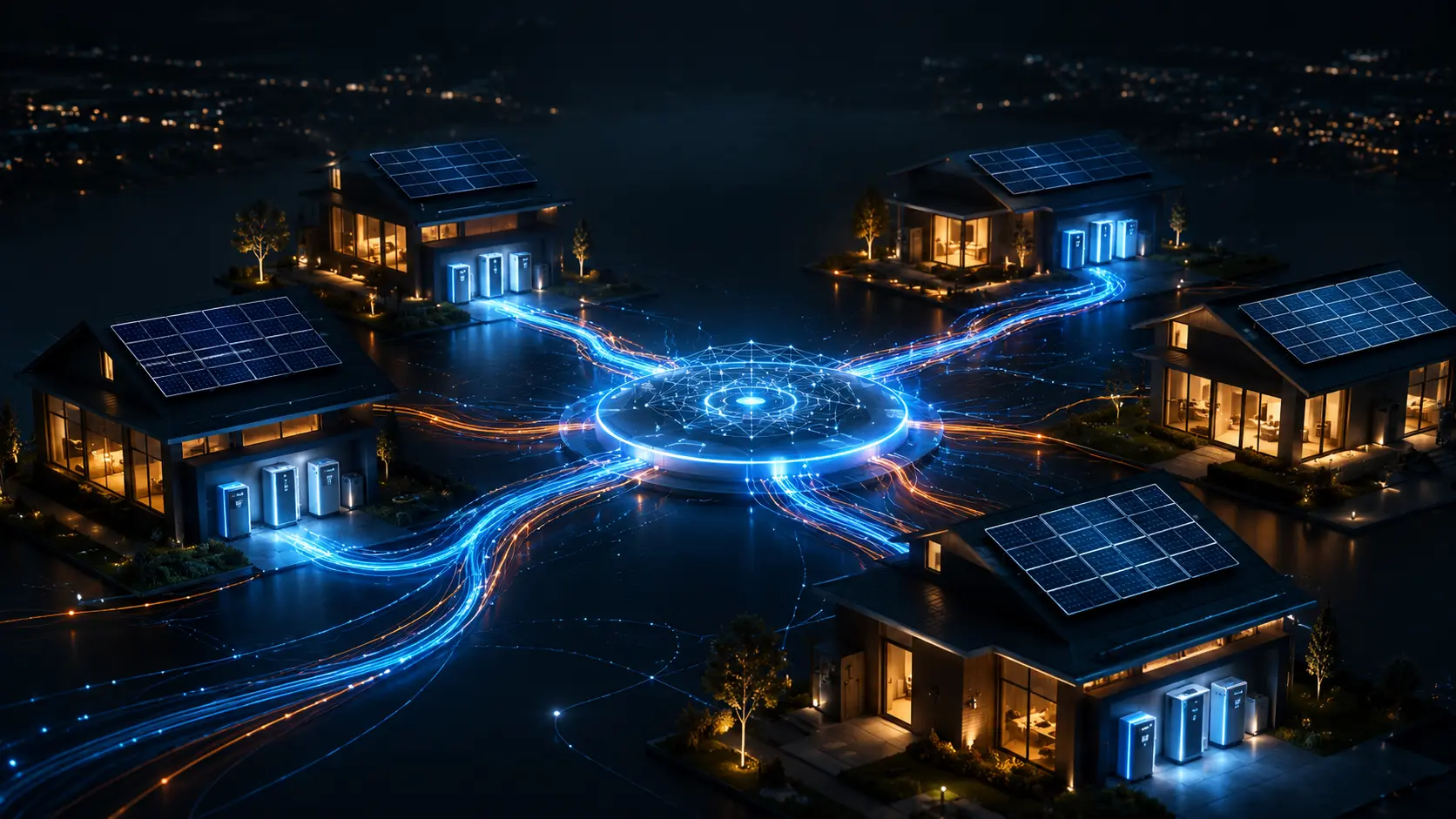
A Virtual Power Plant (VPP) offers a smarter solution. Instead of building a new power plant, a software company digitally connects thousands of homes that already have solar panels, wall batteries, and electric vehicles. When the grid is about to fail, the software signals all those home batteries to discharge a small amount of electricity into the grid at the exact same second.
Suddenly, thousands of small batteries act together as one giant power plant, saving the grid from failure—and the homeowners get paid for the electricity they provided.
Why This Matters
The global transition to renewable energy has created a massive stability problem for the power grid.
Solar panels stop working when the sun sets, which is exactly when people come home from work and use the most electricity. Wind turbines stop generating when the air is still. To survive this transition, the grid needs massive amounts of energy storage that can instantly release power when renewable generation drops.
Building centralized, utility-scale battery farms is incredibly slow and expensive due to permitting, land acquisition, and supply chain delays.
Virtual Power Plants bypass these bottlenecks entirely. Millions of people are already buying home batteries (like the Tesla Powerwall) and electric vehicles for their own personal backup power. By networking these existing, privately funded devices together, cities gain instant access to gigawatts of stored energy without spending taxpayer money to build new power plants.
VPPs are shifting the balance of power. Energy is no longer something you just buy from a monopoly; it is an asset you can sell back to the market.
HOW VIRTUAL POWER PLANTS WORK
Creating a Virtual Power Plant requires complex orchestration. It is not just about having batteries; it is about controlling them perfectly in real-time.
Here is how the digital grid operates.
1. Distributed Energy Resources (DERs): The foundation of a VPP is the physical hardware sitting in people’s homes, collectively known as Distributed Energy Resources (DERs). These include rooftop solar panels, home batteries, smart thermostats, and bi-directional electric vehicle chargers. These devices must be connected to the internet and capable of responding to external commands.
2. The Aggregator Software: A middleman, known as an aggregator, creates a software platform that links these thousands of DERs together. The aggregator asks homeowners for permission to control their batteries during grid emergencies, usually in exchange for financial compensation. This software creates a unified dashboard, showing exactly how much energy is stored across the entire network.
3. Distributed Energy Resource Management Systems (DERMS): The core brain of the VPP is the DERMS software. It constantly monitors grid frequency, wholesale electricity prices, and weather forecasts.If the DERMS predicts a spike in electricity demand at 6:00 PM, it will quietly charge the networked home batteries using cheap, abundant solar power at 1:00 PM.
4. Market Clearing and Dispatch: When the grid faces a shortage, the wholesale price of electricity skyrockets. Traditional natural gas “peaker plants” usually turn on to capture this high price. Instead, the aggregator bids into the wholesale energy market just like a gas plant. Once the bid clears, the DERMS sends a near-instantaneous digital signal to 10,000 home batteries, commanding them to discharge 2 kilowatts of power each. Instantly, 20 megawatts of electricity flow into the grid—preventing a blackout and capturing the high market price, which the aggregator then shares with the homeowners.
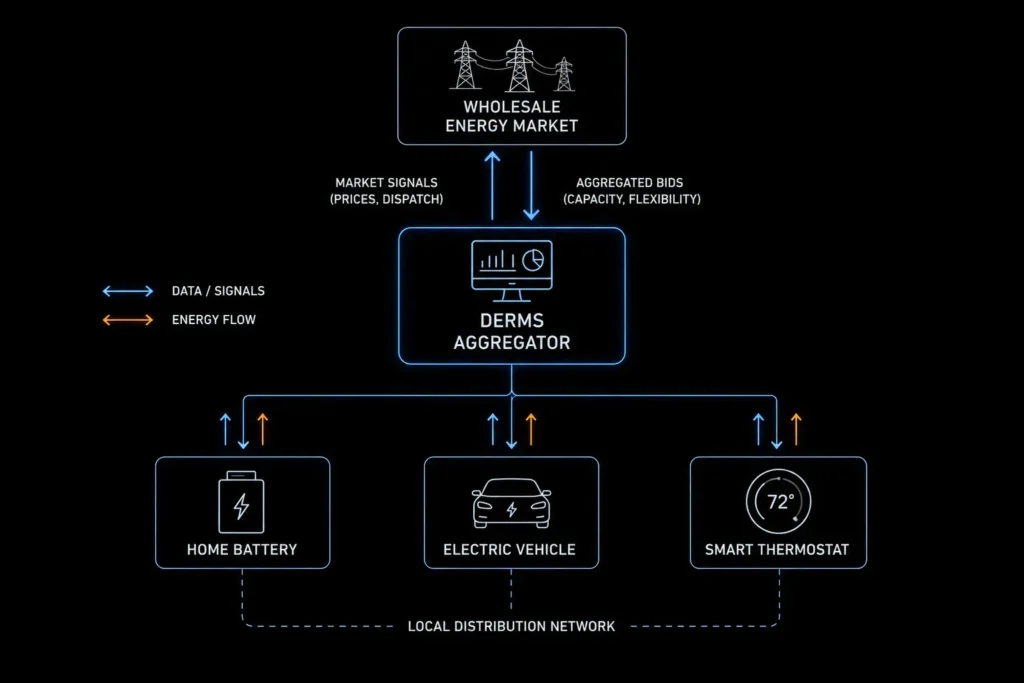
5. System Limitations: The primary challenge is communication latency and hardware fragmentation. A VPP might need to connect batteries made by Tesla, LG, and Enphase, all communicating over different home Wi-Fi networks. If a neighborhood loses internet connectivity, the aggregator loses control of those batteries, reducing the VPP’s reliability exactly when the grid might need it most.
Real-World Applications
Virtual Power Plants have moved from theoretical whitepapers to critical infrastructure.
Tesla’s California VPP: In California, Tesla operates one of the world’s largest VPPs. During a severe heatwave in September 2022, the state grid operator (CAISO) issued an emergency alert to prevent rolling blackouts. Tesla’s software activated thousands of Powerwalls across the state, instantly injecting over 16 megawatts of power into the grid, stabilizing the system. Homeowners were paid $2 for every kilowatt-hour they contributed.
South Australia’s Grid: South Australia has heavily embraced VPPs. The government partnered with private aggregators to install solar and batteries on public housing. This network now operates as a massive VPP, providing crucial frequency regulation services that keep the regional grid stable when large fossil-fuel generators unexpectedly trip offline.
Smart Thermostat Aggregation: VPPs are not just about batteries; they also manage demand. Companies like OhmConnect network smart thermostats. Instead of injecting power into the grid during a crisis, they simply turn down the air conditioning in 50,000 homes by two degrees. To the grid, a sudden drop in demand is mathematically identical to a sudden injection of power.
Economic & Strategic Impact
VPPs represent a massive shift in infrastructure economics.
For utility companies, managing peak demand has historically been the most expensive part of running a grid. Maintaining natural gas peaker plants that only run 50 hours a year is incredibly inefficient, driving up electricity rates for everyone. VPPs eliminate the need for these expensive standby plants, potentially saving billions of dollars in infrastructure costs over a decade.
For consumers, VPPs change the financial logic of home solar and batteries. Previously, a home battery was a defensive purchase—an expensive backup for when the grid failed. By participating in a VPP, that battery becomes an income-producing asset, drastically reducing the time it takes for the hardware to pay for itself.
Strategically, widespread VPP adoption makes a nation’s energy grid highly resilient. A centralized power plant is a single point of failure vulnerable to natural disasters or cyberattacks. A VPP distributed across 100,000 homes is nearly impossible to take down with a single strike.
Advantages
Zero Land or Construction Costs: VPPs utilize infrastructure that homeowners have already purchased and installed.
Instantaneous Response: Digital batteries can inject power into the grid in milliseconds, much faster than firing up a mechanical gas turbine.
Consumer Revenue: Ordinary people receive direct financial compensation for helping stabilize public infrastructure.
Reduced Emissions: VPPs prevent highly polluting fossil-fuel peaker plants from turning on during high-demand hours.
Limitations
Fragmented Hardware Standards: Different battery manufacturers use proprietary software, making it technically difficult for an aggregator to combine different brands into one unified VPP.
Internet Dependency: The entire system relies on stable residential internet connections; if the Wi-Fi goes down, the battery cannot receive the dispatch signal.
Regulatory Barriers: Many regional energy markets still use outdated rules that legally prevent decentralized residential batteries from bidding into wholesale electricity markets.
Consumer Trust: Homeowners must trust that the aggregator will not drain their battery entirely right before a local blackout occurs.
Common Misconceptions
Misconception: VPPs require everyone to buy a Tesla Powerwall.
Reality: While Tesla is a major player, VPPs can aggregate any brand of battery, electric vehicle, smart thermostat, or even commercial refrigeration system, provided they have internet connectivity.
Misconception: Participating in a VPP leaves your house without backup power.
Reality: Aggregators allow homeowners to set a reserve limit. For example, a user can instruct the software to never drain the battery below 30%, ensuring they always have personal backup power for an emergency.
Misconception: VPPs are small experiments that do not generate meaningful power.
Reality: Large VPPs already generate hundreds of megawatts—equivalent to mid-sized natural gas or coal power plants.
What Most People Miss
The biggest untapped resource for Virtual Power Plants is not the batteries mounted on garage walls; it is the batteries inside electric vehicles.
A standard home battery holds about 13 kilowatt-hours of energy. A Ford F-150 Lightning electric truck holds over 130 kilowatt-hours—ten times the capacity.
As Vehicle-to-Grid (V2G) technology becomes standard, millions of electric cars parked in driveways and office buildings will plug in and become active participants in VPPs. A fleet of just 10,000 electric vehicles holds enough stored energy to power a small city for hours. Unlocking EV batteries will turn the global transportation fleet into the largest power plant in human history.
Comparison Table
| Feature | Traditional Peaker Plant | Virtual Power Plant (VPP) |
| Purpose | Provide emergency power during peak demand. | Provide emergency power during peak demand. |
| Infrastructure | Massive, centralized industrial facility. | Thousands of decentralized residential devices. |
| Response Time | 5 to 15 minutes to spin up turbines. | Milliseconds. |
| Capital Cost | Hundreds of millions of dollars. | Minimal (software layer utilizes existing private hardware). |
| Emissions | High (burns natural gas or coal). | Zero (discharges stored renewable energy). |
| Resilience | Single point of failure. | Highly distributed and redundant. |
| Best Fit | Legacy grid architecture. | Modern, decentralized renewable grids. |
Case Study
Situation: The state of Texas operates an isolated power grid (ERCOT) that frequently faces extreme stress during summer heatwaves and winter freezes.
Challenge: Building new power plants to handle rare, extreme weather events is expensive and slow. Texas needed a fast, scalable way to inject power into the grid during emergencies to prevent catastrophic blackouts like the one experienced in 2021.
Solution: In 2023, the Public Utility Commission of Texas launched a pilot program allowing residential VPPs to compete directly in the state’s wholesale electricity market. Aggregators networked thousands of residential batteries across Dallas and Houston.
Outcome: When grid demand spiked, the ERCOT control center signaled the VPPs. The aggregated batteries instantly dispatched power into the grid, capturing wholesale prices that briefly spiked to thousands of dollars per megawatt-hour. The grid remained stable, and participating homeowners received significant payout credits on their electricity bills.
Lessons Learned: Allowing decentralized private batteries to compete on a level playing field with massive industrial power plants creates immediate grid resilience without taxpayer-funded construction.
Future Outlook
Next 12–24 Months: Utility companies worldwide will shift from running small VPP pilot programs to fully integrating DERMS software into their core control rooms. Home battery manufacturers will increasingly use VPP compatibility as a primary selling point for consumers.
Next 3–5 Years: Vehicle-to-Grid (V2G) capabilities will become standard on most new electric vehicles. Aggregators will begin offering EV owners subsidized charging rates in exchange for the right to discharge 10% of the car’s battery during extreme grid events.
Next 10 Years: The concept of a “one-way” electricity consumer will disappear. Buildings, neighborhoods, and commercial centers will operate as microgrids, constantly trading energy back and forth with the macro-grid via advanced VPP algorithms.
Most Likely Scenario: Virtual Power Plants will become the primary mechanism for managing peak electricity demand globally. The construction of new fossil-fuel peaker plants will cease entirely, as digital aggregation proves faster, cheaper, and more reliable than centralized mechanical generation.
Key Takeaways
A Virtual Power Plant (VPP) uses software to coordinate thousands of small, private energy devices to act as one massive power plant.
VPPs utilize existing home batteries, solar panels, and smart thermostats to inject power or reduce demand during grid emergencies.
They replace the need for expensive, highly polluting natural gas “peaker plants.”
Homeowners are financially compensated for allowing aggregators to use their stored energy.
Advanced software called DERMS predicts grid stress and automatically coordinates the decentralized hardware.
A VPP provides immediate grid resilience because it eliminates a single point of failure.
Unlocking electric vehicle batteries (V2G) will exponentially increase the power capacity of future VPPs.
Glossary
Aggregator: A company that uses software to network thousands of individual energy devices together, managing them as a single entity in the energy market.
Distributed Energy Resources (DER): Small-scale units of local power generation or storage, such as rooftop solar panels or residential batteries.
DERMS (Distributed Energy Resource Management System): The central software brain that monitors, controls, and dispatches the networked devices in a VPP.
Frequency Regulation: The process of instantly injecting or absorbing small amounts of power to keep the electrical grid perfectly balanced at its required frequency (e.g., 60 Hz).
Microgrid: A localized energy system that can disconnect from the traditional grid and operate autonomously using local generation and storage.
Peaker Plant: A traditional power plant, usually running on natural gas, that only operates during times of peak electricity demand.
Vehicle-to-Grid (V2G): Technology that allows an electric vehicle to not only draw power from the grid but also discharge stored energy from its battery back into the grid.
Frequently Asked Questions
What happens if I need my battery power while the VPP is using it? You are always in control. VPP software allows homeowners to set a reserve limit—for example, keeping 20% of the battery strictly for personal use in case of a blackout.
Do I need solar panels to participate in a VPP? No. While solar panels help generate the power cheaply, you can participate with just a home battery that charges from the grid when electricity is cheap and discharges when the grid needs it most.
How much money can a homeowner make from a VPP? It varies widely depending on the region, the size of the battery, and how often the grid experiences stress. Payouts can range from a few hundred to over a thousand dollars a year.
Is my data secure in a VPP network? Aggregators use encrypted connections to communicate with your hardware, similar to banking apps. However, as VPPs become critical infrastructure, they are increasingly targeted by cybersecurity regulations to prevent hacking.
Why don’t utilities just build their own big batteries? Utilities are building large utility-scale batteries, but finding land, securing permits, and connecting massive facilities to transmission lines takes years. VPPs utilize hardware that is already installed and ready to go.
Can an electric vehicle power a house? Yes, if the vehicle and the home charger support bi-directional charging. This allows the car’s massive battery to power the home during a blackout or discharge into a VPP.
What is a smart thermostat’s role in a VPP? A VPP isn’t just about adding power; it’s also about reducing demand. By turning down thousands of smart thermostats by a few degrees for 15 minutes, the VPP instantly removes massive stress from the grid.
Does frequent discharging ruin my home battery? Lithium-ion batteries do degrade with use, but most VPP aggregators carefully manage the depth of discharge to minimize wear. Many programs also offer extended warranties as an incentive to join.
Sources
• US Department of Energy (DOE): Virtual Power Plant Commercial Liftoff Report
• Federal Energy Regulatory Commission (FERC): Order 2222 (Distributed Energy Resource Market Participation)
• Rocky Mountain Institute (RMI): The Economics of Virtual Power Plants
• California Independent System Operator (CAISO): Distributed Energy Resource Integration