Advertisement
)

At a Glance
- Concept: A globally shared, open-standard “vocabulary” that computer hardware uses to understand software.
- Why it matters: It breaks the absolute control that companies like Intel and ARM hold over global microchip design.
- Who uses it: Tech giants like Google and Western Digital, deep-tech startups, and governments seeking technological sovereignty.
- Biggest takeaway: The true value of RISC-V is not just that it is free; it is that engineers can legally alter its core logic to build highly specialized chips for artificial intelligence.
In Simple Words
To understand RISC-V, you must understand how chefs use recipes.
For decades, building a computer chip was like wanting to bake a cake using a recipe owned by a famous restaurant. Companies like ARM or Intel own the “recipes” for how microchips process data. If you want to use their recipe to build your own chip, you must pay them millions of dollars in licensing fees. Furthermore, you are legally forbidden from changing the ingredients.
RISC-V changes this completely. It is the Wikipedia of microchip recipes.
Maintained by a global non-profit organization, the RISC-V recipe is completely free and open to the public. Any student, startup, or massive technology company can download the blueprints, design a microchip, and sell it. More importantly, they are completely free to modify the recipe, adding their own custom instructions to make the chip process data exactly the way they want. It is the democratization of hardware.
Why This Matters
The global economy runs on microchips, but the foundational architecture of those chips is controlled by a duopoly.
The computers on your desk run on the x86 architecture, controlled by Intel and AMD. The smartphones in your pocket and the sensors in your car run on the ARM architecture, controlled by the British company ARM Holdings. This creates an extreme bottleneck. Every company that wants to build a modern mobile device or internet-of-things (IoT) sensor must pay a “tax” to ARM in the form of licensing fees and per-chip royalties.
This concentration of intellectual property creates two massive problems.
First, it stifles hardware innovation. If a startup wants to build a radical new chip for artificial intelligence, paying millions of dollars just to access the basic ARM instruction set is financially crippling.
Second, it creates severe geopolitical vulnerabilities. In the modern era, semiconductors are weapons of statecraft. Because ARM utilizes Western intellectual property, Western governments can legally order ARM to stop licensing its architecture to foreign adversaries. When this happens, a sanctioned nation instantly loses the ability to design modern computer chips.
RISC-V neutralizes both problems simultaneously. Because it is an open-source standard housed in Switzerland, no single corporation or country owns it. It cannot be sanctioned, it cannot be revoked, and it carries zero licensing fees. It provides a neutral, globally accessible foundation for the future of computing.
HOW THE RISC-V ARCHITECTURE WORKS
To understand how an open-source project replaces billion-dollar corporate infrastructure, we must start with the fundamental physics of computing.
Here is the step-by-step mechanics of the RISC-V architecture.
Step 1: The Instruction Set Architecture (ISA)
A microchip is a physical piece of silicon. Software is a digital list of commands. These two things do not naturally speak the same language.
They require a translator, known as an Instruction Set Architecture (ISA). The ISA is the fundamental dictionary of commands that the processor physically understands—such as “add two numbers,” “store this data in memory,” or “jump to a new task.” RISC-V is simply a new, highly efficient dictionary.
Step 2: The Base Integer Set
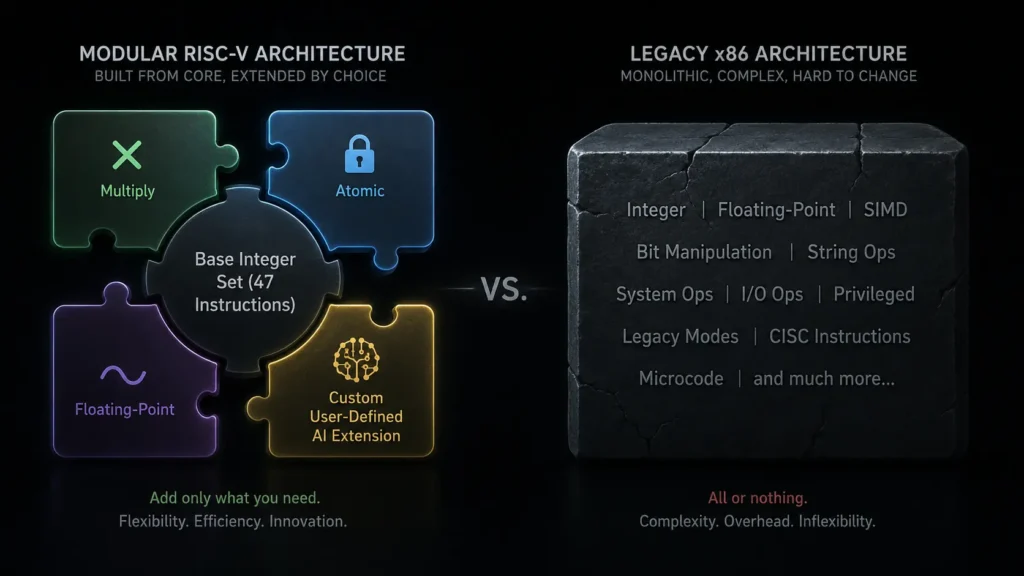
Legacy ISAs like x86 have been around since the 1970s. Over decades, they have accumulated thousands of complex instructions, resulting in massive, bloated dictionaries that require heavy, power-hungry silicon to process.
RISC-V stands for Reduced Instruction Set Computer. It takes a minimalist approach. The core RISC-V “dictionary” consists of exactly 47 fundamental instructions. This base set is permanently frozen; it will never be changed or updated. This guarantees that software written for a basic RISC-V chip today will still run perfectly on a RISC-V chip fifty years from now.
Step 3: Modular Extensions
Because 47 instructions are not enough to run a modern supercomputer, RISC-V uses a modular architecture.
Engineers can snap “extensions” onto the base set like Lego blocks. If you are building a smartwatch, you might only need the base set to save battery life. If you are building a supercomputer, you can add the standard “Vector Extension,” which allows the chip to process massive chunks of mathematical data simultaneously. You only include the exact silicon logic you need, making the final chip incredibly small and energy-efficient.
Step 4: Custom Instructions
The defining technical advantage of RISC-V is open customization.
If a company is building an AI chip for autonomous driving, they might realize their software executes one specific mathematical equation millions of times a second. Under the ARM model, they cannot change the chip’s core logic to optimize this equation. With RISC-V, the engineers can write a brand new, custom hardware instruction specifically for that equation and physically bake it into the silicon.
Step 5: The Verification Burden
The freedom of RISC-V comes with a significant engineering penalty. When a company licenses a core from ARM, they receive a fully tested, mathematically verified, ready-to-print blueprint. ARM guarantees it works.
When a company builds a custom chip using the open RISC-V standard, they must design the physical silicon pathways themselves. They bear the entire financial and technical burden of verifying that the chip actually calculates correctly before spending millions of dollars to print it at a semiconductor foundry.
Real-World Applications
RISC-V has rapidly transitioned from university laboratories to commercial deployment.
Data Center Storage: Western Digital, one of the world’s largest hard drive manufacturers, ships billions of devices annually. Each hard drive requires a tiny microcontroller chip to route data. By transitioning these microcontrollers to custom RISC-V designs, Western Digital eliminated massive per-unit licensing fees while optimizing the chips perfectly for storage routing.
Artificial Intelligence Accelerators: Google’s Tensor Processing Units (TPUs) are the custom supercomputer chips that train massive AI models. Deep inside these TPUs, Google utilizes custom-built RISC-V cores to manage the flow of data across the chip, leveraging the open standard to avoid reliance on third-party IP.
Aerospace and Satellites: The European Space Agency (ESA) is adopting RISC-V for satellite microcontrollers. Space missions require highly specialized chips that can survive cosmic radiation. By using an open standard, the ESA ensures it is never locked into a single commercial vendor whose proprietary architecture might become obsolete during a ten-year mission to deep space.
Economic & Strategic Impact
The rise of RISC-V fundamentally rewrites the economics of semiconductor design.
For tech startups, it slashes the barrier to entry. Historically, raising capital to build a new microchip meant dedicating the first few million dollars entirely to IP licensing fees before a single engineer was hired. RISC-V eliminates this upfront cost, allowing venture capital to flow directly into raw engineering and innovation.
For traditional IP monopolies, the threat is existential. Companies like ARM base their valuations on the premise that hardware manufacturers have no alternative but to pay their toll. As RISC-V matures, it provides a credible, free exit route for ARM’s largest customers, placing massive downward pressure on licensing costs globally.
Strategically, RISC-V is the ultimate tool for technological sovereignty. China is investing billions of state funds into RISC-V development. By building an entire domestic technology ecosystem around an open standard, Beijing ensures that future US export controls cannot cut off its access to the fundamental language of modern computing.
Advantages
Extreme Customizability
Engineers can surgically modify the core instruction set to perfectly match their software workloads, achieving processing speeds and energy efficiencies impossible on locked, proprietary architectures.
Zero Licensing Fees
Companies can download the ISA and design a chip without paying millions in upfront licensing costs or sacrificing a percentage of their revenue in per-chip royalties.
Prevention of Vendor Lock-In
Because the standard is open and globally shared, a company’s software ecosystem will never be held hostage by a single corporate entity suddenly changing its licensing terms or pricing model.
Global Strategic Neutrality
Housed as an independent foundation in Switzerland, the architecture is immune to the export controls and geopolitical sanctions that frequently disrupt the global semiconductor supply chain.
Limitations
Software Ecosystem Fragmentation
Because companies can create custom instructions, software compiled for one RISC-V chip might not easily run on another company’s RISC-V chip. This fragmentation makes it difficult to build a universal operating system like Windows or Android.
High Verification Costs
Designing the architecture is free, but physically designing and testing the silicon layout is incredibly expensive. Companies must hire specialized verification engineers to ensure their custom chips do not contain fatal logic errors.
Immature Desktop Support
While RISC-V excels in tiny embedded sensors and highly specific data center tasks, the software ecosystem for general-purpose computing (like running a standard desktop browser and video games) remains years behind x86 and ARM.
Common Misconceptions
Misconception: RISC-V provides you with a free, ready-to-print microchip blueprint.
Reality: RISC-V only provides the instruction set—the language the chip must understand. Engineers must still physically design the billions of transistors required to execute that language.
Misconception: RISC-V is an anti-capitalist project and companies cannot make money from it.
Reality: While the foundational standard is open-source, companies can design a highly advanced physical chip using RISC-V and keep that physical design strictly proprietary. They can sell the finished chip for massive profits.
Misconception: RISC-V will quickly replace Intel processors in home computers.
Reality: The desktop and laptop market is heavily entrenched in legacy software written specifically for x86 and ARM. RISC-V is currently conquering the invisible embedded systems market (hard drives, IoT sensors, automotive chips) where software is custom-written by the hardware manufacturer.
What Most People Miss
The true disruption of RISC-V is that it moves the value of a microchip from the hardware up to the software.
In the past, hardware engineers built a generic processor, and software engineers were forced to write code that fit within the limitations of that hardware.
RISC-V reverses this paradigm. It enables “software-defined hardware.” Today, an artificial intelligence company will write its software first. They will then analyze the code, identify the exact mathematical bottlenecks, and design a custom RISC-V chip specifically to execute that exact software algorithm. The hardware bends to serve the software, resulting in extreme computational efficiency.
Comparison Table
| Feature | x86 (Intel / AMD) | ARM (ARM Holdings) | RISC-V (Open Standard) |
| Business Model | Closed, proprietary, manufactured by owner. | IP Licensing model; customers rent the blueprints. | Open-source standard; free for anyone to use. |
| Instruction Set | Complex Instruction Set Computer (CISC). | Reduced Instruction Set Computer (RISC). | Reduced Instruction Set Computer (RISC). |
| Customizability | None (strictly controlled). | Very limited (requires expensive architectural licenses). | Infinite (users can freely add custom instructions). |
| Primary Market | Desktop PCs, Laptops, Legacy Servers. | Smartphones, Tablets, IoT devices. | Embedded systems, AI accelerators, custom silicon. |
| Licensing Cost | N/A (Internal use only). | High upfront fees + per-chip royalties. | Zero. |
| Geopolitical Risk | High (Subject to US export controls). | High (Subject to US/UK export controls). | Zero (Housed in neutral Switzerland). |
Case Study
Situation: The European Union recognized that its automotive and industrial manufacturing sectors were dangerously dependent on foreign semiconductor architectures. If global supply chains fractured, European industries could be cut off from the microchips required to build modern vehicles.
Challenge: Europe needed to build a sovereign semiconductor ecosystem, but creating a new proprietary architecture from scratch to compete with ARM or Intel would take decades and cost hundreds of billions of euros.
Solution: In 2023, a coalition of Europe’s largest automotive chipmakers—including Infineon, NXP, Bosch, and Nordic Semiconductor—formed a joint venture company explicitly dedicated to accelerating the commercialization of RISC-V processors.
Outcome: By pooling their resources to develop shared, open-source RISC-V core designs, these European giants are actively bypassing foreign IP licensing. They are establishing a localized, sovereign supply chain for the microcontrollers that operate braking systems, engine management, and in-cabin electronics.
Lessons Learned: RISC-V functions as an economic shield. It allows strategic industries to collaborate on base-level technology for free, ensuring supply chain security while reserving their capital to compete on higher-level features and manufacturing.
Future Outlook
Next 12–24 Months
The automotive and IoT industries will experience massive RISC-V adoption. As automakers shift to “software-defined vehicles,” they will require highly customized microcontrollers. Dozens of deep-tech startups will release commercial RISC-V cores designed specifically for machine learning tasks at the “edge” (e.g., smart cameras and factory sensors).
Next 3–5 Years
The threat of fragmentation will force the industry to standardize. Major tech companies will solidify “profiles”—agreed-upon sets of RISC-V extensions that ensure software compatibility across different manufacturers. This standardization will pave the way for RISC-V to enter the higher-margin smartphone and tablet markets, directly confronting ARM’s monopoly.
Next 10 Years
RISC-V will likely become the default architecture for all new, specialized silicon. Data centers will abandon generic processors in favor of racks of highly specialized, custom RISC-V chips designed specifically to route data and train AI models with maximum thermal efficiency.
Most Likely Scenario
RISC-V will not completely destroy ARM or x86, just as Linux did not destroy Windows. Instead, it will become the foundational “Linux of hardware.” It will capture the vast majority of the embedded and specialized computing market, commoditizing basic chip design and shifting global technological power away from IP licensors toward advanced software developers and physical foundries.
Key Takeaways
- RISC-V is a free, open-source set of instructions that a microchip uses to process software.
- It breaks the hardware monopolies of x86 (Intel/AMD) and ARM by eliminating millions of dollars in licensing fees.
- The base instruction set is extremely small (47 instructions) and permanently frozen to guarantee long-term software compatibility.
- Engineers can legally snap on modular extensions or invent their own custom instructions to build highly specialized chips.
- RISC-V reverses traditional engineering, allowing companies to design “software-defined hardware” perfectly optimized for specific AI workloads.
- The open standard protects nations and corporations from sudden geopolitical sanctions and export controls.
- While the architecture is free, companies still face the massive engineering burden of physically designing and testing the silicon layout.
Glossary
Base Integer Set: The foundational, permanently frozen 47 instructions required to build a functioning RISC-V processor.
CISC (Complex Instruction Set Computer): A processor design approach (like x86) that attempts to handle highly complex tasks with a single, massive instruction, leading to heavy power consumption.
Instruction Set Architecture (ISA): The standardized “dictionary” or bridge that software code uses to communicate physical commands to the hardware transistors.
IP Licensing: The business model used by companies like ARM, where they charge millions of dollars for the right to use their proprietary chip blueprints.
RISC (Reduced Instruction Set Computer): A processor design approach that uses only simple, highly optimized instructions that execute in a single clock cycle, prioritizing speed and energy efficiency.
Silicon Foundry: A massive, multibillion-dollar factory that physically manufactures the microchips designed by engineers.
Technological Sovereignty: A nation’s ability to maintain control over critical technologies and infrastructure without relying on foreign intellectual property.
Vector Extension: A modular addition to the RISC-V ISA that allows the processor to crunch massive sets of numbers simultaneously, critical for graphics and artificial intelligence.
Frequently Asked Questions
Who owns RISC-V?
No single entity owns it. It is an open standard maintained by RISC-V International, a global non-profit organization headquartered in Switzerland.
Is RISC-V an actual physical microchip?
No. It is a set of rules and instructions (an architecture). To get a physical chip, a company must design the physical layout of transistors that follows those rules, and pay a foundry to manufacture it.
Why is it called RISC-V?
RISC stands for Reduced Instruction Set Computer. The “V” is the Roman numeral for five, indicating it is the fifth generation of RISC architecture developed by researchers at the University of California, Berkeley.
Can I make money if the design is open-source?
Yes. You can use the free open-source instruction set to design a highly advanced, proprietary physical microchip. You are not required to share your physical chip design with the world, and you can sell it for profit.
Does RISC-V work with Windows or Apple software?
Currently, very poorly. Windows and macOS are written specifically for x86 and ARM architectures. Moving those massive operating systems to RISC-V requires rewriting vast amounts of core software, which is a slow, ongoing process.
Why do geopolitical analysts care about RISC-V?
Because the standard is housed in a neutral country, the United States cannot legally use export controls to prevent Chinese or Russian companies from downloading and using the RISC-V architecture to build advanced domestic microchips.
What is the difference between ARM and RISC-V?
Both are RISC architectures designed for efficiency. However, ARM is a for-profit corporation that tightly controls its architecture and charges licensing fees. RISC-V is a non-profit open standard that is completely free to use and modify.
Why don’t companies just use x86 for everything?
The x86 architecture is massive, complex, and requires high energy consumption, making it ideal for plugged-in desktop computers but terrible for battery-powered smartwatches, IoT sensors, or highly specialized AI accelerators.
Sources
• RISC-V International: Official Architecture Specifications and Market Reports
• Semiconductor Industry Association (SIA): Open-Source Hardware and ISA Trends
• Institute of Electrical and Electronics Engineers (IEEE): The Evolution of Reduced Instruction Set Computers
• Center for Strategic and International Studies (CSIS): Semiconductors and Technological Sovereignty