Advertisement
)

At a Glance
- Concept: Centralized software that monitors and controls distributed physical machinery.
- Why it matters: If these systems fail or are hacked, cities lose power, water, and manufacturing capabilities instantly.
- Who uses it: Utility companies, energy grids, and large-scale manufacturing megafabs.
- Biggest takeaway: Aging industrial systems were built for efficiency, not cybersecurity, making them the primary target for modern geopolitical warfare and ransomware syndicates.
In Simple Words
Imagine running a massive city water system. You have thousands of pipes, valves, and chemical tanks spread across a hundred miles. If a pipe bursts or a tank needs more chlorine, you cannot physically drive a human to every valve to turn it by hand.
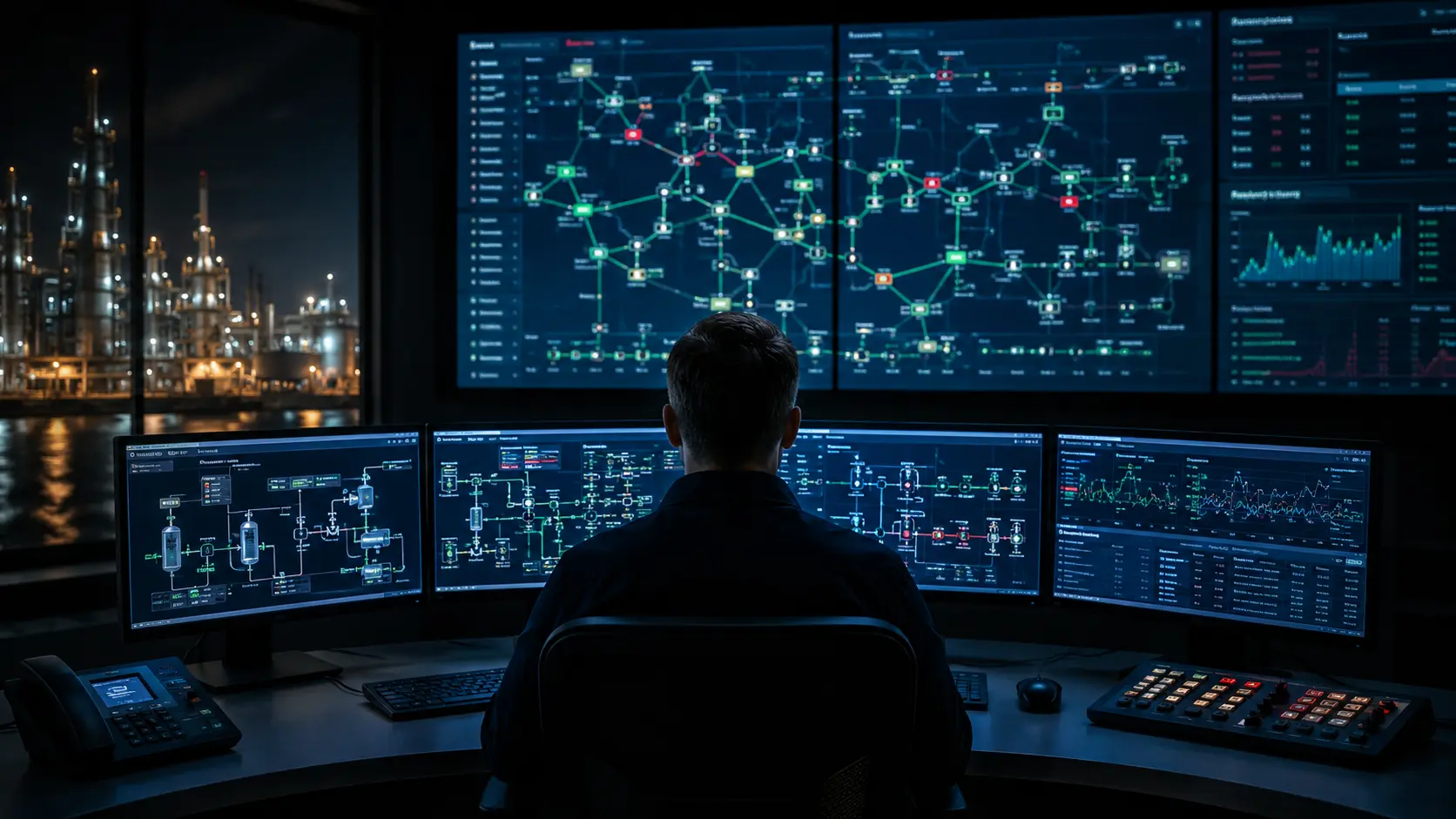
Instead, you use a computer network. You install digital sensors on every valve. Those sensors send continuous data back to a central control room. From a single screen, an operator clicks a button, and a physical valve fifty miles away instantly opens.
That entire network of sensors, wires, and control screens is called SCADA (Supervisory Control and Data Acquisition). It is the digital nervous system of the physical world. Without it, modern civilization—from electricity distribution to pharmaceutical manufacturing—would immediately freeze.
Why This Matters
The global economy is entirely dependent on automation. SCADA systems control the power grid that lights your home, the pipelines that deliver natural gas, and the robotic assembly lines that build your car.
Historically, these systems were “air-gapped,” meaning they were physically disconnected from the internet. Today, the drive for corporate efficiency has forced companies to connect these industrial networks to corporate IT networks and the cloud. This IT/OT (Information Technology / Operational Technology) convergence has created a terrifying attack surface.
When hostile nations engage in modern warfare, they do not always bomb power plants; they hack the SCADA systems running them. A compromised system allows a remote attacker to open floodgates, shut down electrical substations, or poison drinking water. Protecting these legacy systems has become the highest priority for national security and global infrastructure resilience.
The Big Picture
To understand SCADA, you must look at how industrial environments scale.
A single factory machine can be controlled by a simple, isolated computer. But when you are managing an oil pipeline stretching from Texas to New York, or an electrical grid covering an entire European country, local control is impossible. You need overarching “supervisory” control.
SCADA is not the physical machine itself. It is the communication architecture that sits above the machinery. It gathers millions of data points per second, translates that raw data into visual charts for human operators, and securely routes human commands back down to the physical hardware. It bridges the gap between digital intent and physical action.
HOW SCADA SYSTEMS WORK
Moving digital commands into the heavy machinery of the physical world requires a rigid, multi-layered architecture.
Here is exactly how a SCADA system functions.
1. The Fundamental Problem
Before SCADA, facility operators had to manually read analog dials and turn physical switches across massive industrial plants. As infrastructure scaled globally, deploying humans to monitor every pressure valve 24/7 became physically and economically impossible. Industry required a way to centralize physical control.
2. Programmable Logic Controllers (PLCs)
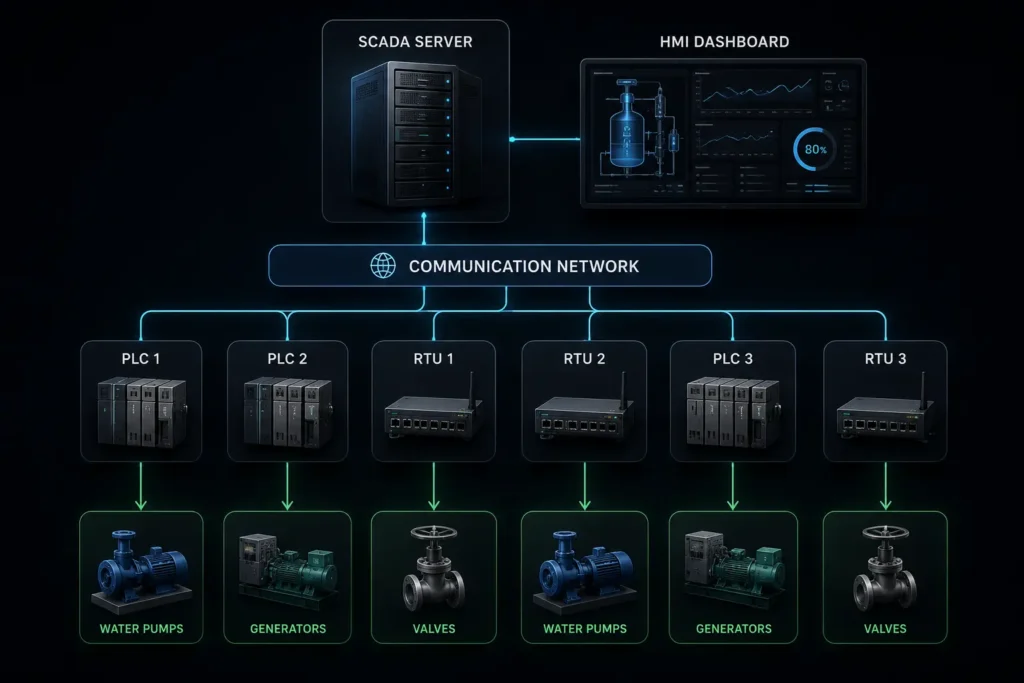
Engineers solved local automation by placing rugged microcomputers directly on the machinery. These are Programmable Logic Controllers (PLCs) and Remote Terminal Units (RTUs). A PLC connects directly to a physical motor or sensor. If a water tank gets too full, the physical sensor tells the PLC, and the PLC immediately executes its programmed logic to shut off the pump.
3. Centralized Telemetry
A PLC only knows what is happening to its specific machine. SCADA provides the big picture. The central SCADA software constantly pings thousands of PLCs across a geographic region, collecting their data. It pulls this massive telemetry into a centralized database, establishing a real-time state of the entire infrastructure.
4. Human-Machine Interfaces (HMIs)
Raw data is useless to a human operator. The SCADA system feeds the telemetry into a Human-Machine Interface (HMI). This is a graphical dashboard showing a digital map of the entire facility. If a pump fails, it flashes red on the HMI. The operator clicks the screen to activate a backup pump. The SCADA system translates that click into code and sends it back to the specific PLC.
5. Communication Protocols and Vulnerabilities
To send these messages, SCADA relies on industrial communication protocols like Modbus or DNP3. These protocols were invented decades ago and were designed for speed and reliability over slow radio links. Consequently, they completely lack modern encryption. If a hacker accesses the network, the SCADA system blindly trusts any command it receives, assuming it came from the legitimate operator.
Real-World Applications
SCADA operates silently in the background of nearly every industrial sector.
Power Grids: Electrical utilities use SCADA to balance the supply and demand of electricity in real-time. If a severe storm knocks out a transmission line, the SCADA system automatically detects the voltage drop and allows operators to remotely open and close massive circuit breakers to reroute power, preventing a cascading regional blackout.
Water and Wastewater Treatment: Municipal water plants rely heavily on SCADA to continuously monitor water pressure, pH levels, and chemical reservoirs. The system automatically signals PLCs to dose exact amounts of chlorine or fluoride to keep drinking water safe for entire cities.
Automotive and Advanced Manufacturing: Massive assembly lines use SCADA to track the exact position of parts, monitor the health of robotic welding arms, and ensure factory-floor safety overrides are functioning. If a machine overheats, the SCADA system halts the line before a fire breaks out.
Economic & Strategic Impact
The global SCADA market is projected to reach $20 billion by 2030.
For infrastructure operators, the primary economic driver is the Industrial Internet of Things (IIoT). By feeding SCADA data into advanced artificial intelligence, companies can predict when a machine will fail weeks before it actually breaks. This shift from reactive repair to predictive maintenance saves billions of dollars in unplanned downtime annually.
Strategically, SCADA vulnerabilities represent a severe national security threat. Cybersecurity agencies routinely issue warnings about state-sponsored hackers probing internet-connected PLCs. Because replacing an entire nation’s aging SCADA infrastructure would cost trillions of dollars, governments are forced into a defensive posture. They must patch and digitally isolate outdated, inherently insecure industrial systems from hostile foreign intelligence services.
Advantages
- Centralized Visibility: Allows a small team of operators to monitor assets spread across thousands of square miles.
- Automated Safety: PLCs can execute localized safety shutdowns in milliseconds, preventing industrial disasters before a human operator even registers the alarm.
- Predictive Maintenance: Continuous data logging allows engineers to spot mechanical wear and tear, replacing cheap parts before they cause catastrophic system failures.
- Massive Cost Reduction: Eliminates the need for large physical patrols and manual data collection at remote industrial sites.
Limitations
- Severe Cybersecurity Flaws: Legacy industrial protocols (like Modbus) transmit commands in plain text without authentication, making them highly vulnerable to spoofing.
- High Upgrade Costs: Shutting down a city’s power grid to upgrade SCADA software is often impossible, meaning systems run on outdated operating systems for decades.
- IT/OT Convergence Risks: Connecting the factory floor to corporate IT networks exposes physical machinery to standard internet malware and ransomware.
Common Misconceptions
Misconception: SCADA systems are safely air-gapped from the internet.
Reality: The air gap is largely a myth in modern industry. IT/OT convergence means most SCADA systems are now indirectly connected to the internet through corporate networks, billing systems, or unauthorized remote-access modems.
Misconception: A SCADA system is just a passive database.
Reality: While it logs data, it is an active control system. It has the physical authority to open valves, speed up turbines, and shut down heavy machinery.
Misconception: Hackers need advanced zero-day exploits to attack SCADA.
Reality: While advanced attacks like Stuxnet exist, many SCADA breaches occur simply because engineers leave remote-access software exposed to the internet with default passwords.
What Most People Miss
The greatest threat to SCADA systems is invisible shadow-IT.
Facility managers often believe their Operational Technology (OT) network is completely isolated from the outside world. However, third-party contractors and engineers frequently install unauthorized cellular modems or remote-access software (like TeamViewer) to troubleshoot machines from home.
This creates a direct, unmonitored bridge from the public internet straight into the heart of critical infrastructure. A multimillion-dollar corporate firewall is rendered completely useless if a single technician leaves a remote-access portal open on a water pump controller.
Comparison Table
| Feature | SCADA (Supervisory Control) | PLC (Programmable Logic Controller) | DCS (Distributed Control System) |
| Primary Function | Centralized monitoring and high-level control. | Localized, direct control of physical machinery. | Highly complex, localized process control. |
| Geographic Scope | Wide Area (Pipelines, Grids, Cities). | Single Machine (A motor or valve). | Single Facility (A chemical refinery). |
| Decision Speed | Seconds to Minutes (Human-in-the-loop). | Milliseconds (Automated logic). | Milliseconds (Automated logic). |
| Network Reliance | Requires telecommunications over long distances. | Hardwired directly to the machine. | High-speed local area networks. |
| Failure Impact | Loss of visibility; machines continue current logic. | Immediate shutdown of specific machinery. | Total shutdown of the local factory process. |
Case Study
Situation: On February 5, 2021, the municipal water treatment plant in Oldsmar, Florida, experienced a highly dangerous cyber intrusion. The plant provided drinking water to approximately 15,000 residents.
Challenge: Like many underfunded municipal facilities, the plant utilized legacy SCADA software and allowed employees to monitor the systems remotely.
Solution (The Incident): A plant operator watched his mouse cursor begin moving on its own across the SCADA HMI screen. A hacker had gained remote access through poorly secured TeamViewer software installed on an engineering workstation. The hacker navigated to the chemical controls and deliberately increased the amount of sodium hydroxide (lye)—used to control water acidity—from a safe 100 parts per million to a highly toxic 11,100 parts per million.
Outcome: The operator immediately recognized the malicious command and reversed the sodium hydroxide levels back to normal before the poisoned water left the facility. Steps were taken to sever remote access to the plant.
Lessons Learned: The Oldsmar incident proved that highly sophisticated, nation-state malware (like Stuxnet) is not required to cause physical devastation. Poorly managed remote access to a standard SCADA system is enough to threaten the lives of thousands of citizens.
Future Outlook
Next 12–24 Months
Ransomware syndicates will aggressively pivot from targeting corporate IT networks to directly targeting Operational Technology (OT) and SCADA systems. Because shutting down physical manufacturing lines causes immediate, catastrophic revenue loss, companies are far more likely to pay massive ransoms quickly.
Next 3–5 Years
The industry will actively attempt to implement Zero-Trust architectures within industrial environments. Regulators will enforce strict network segmentation, mandating that the SCADA systems controlling physical infrastructure must cryptographically verify every single command, moving away from the legacy assumption that internal network traffic is inherently safe.
Next 10 Years
Cloud-native SCADA and artificial intelligence will become standard. AI agents will continuously monitor grid telemetry, identifying anomalies and automatically rerouting power or shutting down compromised valves at superhuman speeds. This will create “self-healing” infrastructure capable of resisting both mechanical failures and active cyber warfare.
Most Likely Scenario
Despite rapid advancements in software, the physical hardware takes decades to replace. Advanced AI overlays will be grafted onto inherently insecure legacy PLCs. The world will continuously operate in a fragile state, relying on external firewalls and network segmentation to protect unencrypted, decades-old communication protocols from modern digital weapons.
Key Takeaways
- SCADA systems bridge the gap between digital software commands and heavy physical machinery.
- They rely on local PLCs and RTUs to interface directly with motors, pumps, and sensors.
- Telemetry is gathered into a central database and displayed to human operators via Graphical HMIs.
- IT/OT convergence has destroyed the concept of the “air gap,” exposing critical infrastructure to the internet.
- Legacy industrial protocols like Modbus were built without encryption, making them highly vulnerable to spoofing.
- Cyberattacks on SCADA systems can cause catastrophic physical damage, including power blackouts and water poisoning.
- Securing industrial control systems requires strict network segmentation and the removal of unauthorized remote access software.
Glossary
Air Gap: A security measure where a computer network is physically isolated from unsecured networks, including the public internet.
DCS (Distributed Control System): A localized control architecture heavily used in continuous process industries, like chemical refineries, where control is distributed among local microprocessors rather than centralized.
HMI (Human-Machine Interface): The graphical dashboard that allows human operators to visualize data and send commands to a SCADA system.
IIoT (Industrial Internet of Things): The network of interconnected sensors, instruments, and other devices networked together with computers’ industrial applications.
IT/OT Convergence: The integration of corporate Information Technology (IT) systems with the Operational Technology (OT) systems that control physical machinery.
PLC (Programmable Logic Controller): A ruggedized industrial digital computer adapted for the control of manufacturing processes and heavy machinery.
RTU (Remote Terminal Unit): A microprocessor-controlled electronic device that interfaces objects in the physical world to a distributed control system or SCADA system.
Telemetry: The highly automated communications process by which measurements are made and data is collected at remote points and transmitted to receiving equipment.
Frequently Asked Questions
Does a SCADA system control the internet?
No. SCADA systems use internal networks (and sometimes the internet) to control physical infrastructure, like water pipes and electrical substations. They do not control the internet itself.
Can a hacker blow up a power plant through SCADA?
It is extremely difficult but theoretically possible. Hackers can manipulate SCADA systems to disable safety overrides and force machinery to operate beyond safe physical limits, which can result in mechanical destruction or fires.
Why don’t they just upgrade the old, unencrypted SCADA protocols?
Upgrading requires replacing the physical hardware (PLCs) across thousands of miles of infrastructure. Taking a city’s water or power grid offline for weeks to replace computer chips is economically and practically unfeasible.
What is the difference between IT and OT?
IT (Information Technology) manages data, emails, and corporate software. OT (Operational Technology) manages physical machinery, valves, and robotic arms.
If SCADA is so vulnerable, why connect it to the internet?
Corporate executives demand real-time data to optimize supply chains and predict maintenance failures. Connecting the factory floor to the cloud saves millions of dollars, but sacrifices physical security.
What was Stuxnet?
Stuxnet was a highly sophisticated, state-sponsored computer worm discovered in 2010 that specifically targeted the SCADA systems controlling Iranian nuclear centrifuges, causing them to physically tear themselves apart.
Do everyday people interact with SCADA systems?
Not directly. However, every time you turn on a light switch, drink tap water, or buy a mass-produced car, you are relying on a SCADA system functioning correctly in the background.
How do engineers secure SCADA systems today?
They use deep network segmentation (firewalls between the corporate IT network and the OT network), strict access controls, and continuous monitoring to detect unauthorized commands before they reach the PLCs.
Sources
- Distk: Complete Guide to SCADA Systems in 2026
- Cibersafety: Protecting SCADA and PLCs in Industrial Environments
- Cybersecurity News: CISA Warns Iran-Linked Hackers Exploit Rockwell PLCs
- Industrial Defender: What the Jaguar Land Rover Cyberattack Taught Manufacturers
- Matisoft Cyber Security Labs: Case Studies – Stuxnet
- Defense Technical Information Center (DTIC): Cyber Risk to Mission Case Study – Oldsmar