Advertisement
)

At a Glance
- Concept: An automated traffic cop and manager for software containers across massive computer networks.
- Why it matters: It keeps modern digital infrastructure online during massive traffic spikes without requiring human intervention.
- Who uses it: Cloud architects, platform engineers, and enterprise IT departments at companies like Netflix, Uber, and Spotify.
- Biggest takeaway: Kubernetes abstracts physical servers away, allowing engineers to treat an entire data center as a single, unified computer.
In Simple Words
Imagine running a massive maritime shipping port. Instead of standard steel boxes, you are managing millions of software packages called “containers.” Each container holds a small, critical piece of a mobile app—like the video player, the login screen, or the payment processor.
In the early days of the internet, running these containers meant manually assigning them to physical servers. If a server crashed, an engineer had to wake up in the middle of the night, log into a terminal, and restart the software on a backup machine. If thousands of new users logged on at once, engineers had to manually configure more servers.
Kubernetes solves this by acting as the port’s automated harbor master.
You hand Kubernetes your software containers and define a set of rules—such as “always keep five copies of the payment processor running.” Kubernetes automatically places those containers onto available computers, monitors their health, restarts them if they crash, and instantly spins up new copies when traffic spikes. It manages fleets of machines with zero human effort.
Why This Matters
Modern software is no longer built as a single, massive block of code. Instead, it is broken down into hundreds of independent “microservices.”
While microservices make applications faster to update, they create a logistical nightmare. Managing five containers is easy. Managing fifty thousand containers across shifting cloud servers is impossible for human brains. Without an automated management layer, modern web applications would crash continuously under unpredictable internet traffic.
Today, this orchestration layer is non-negotiable. As of 2026, 82% of container users run Kubernetes in production, cementing its status as the enterprise standard.
Economically, Kubernetes has altered the cloud computing landscape. Before its creation, companies were highly vulnerable to vendor lock-in. Their deployment scripts only worked on one specific provider’s infrastructure. Because Kubernetes is an open standard that runs identically on Amazon Web Services, Google Cloud, or a private basement server, companies can move their software effortlessly. This restores corporate bargaining power and saves the tech industry billions in infrastructure overhead.
HOW KUBERNETES WORKS
To understand how Kubernetes orchestrates global infrastructure, we must look at how software packaging evolved.
1. The Fundamental Problem
For decades, applications ran directly on physical operating systems. If a server experienced a hardware failure, moving the software to a new machine was difficult because the code depended heavily on the specific settings of the underlying computer. When an application required more computing power, administrators had to physically buy and install new hardware.
2. The Insufficiency of Early Solutions
The technology industry solved the packaging problem by inventing containers (pioneered by Docker). Containers wrapped an application together with everything it needed to run—code, runtime, and system tools. This allowed the software to run identically on any computer.
However, Docker only solved how to run a single container. It did not solve how to coordinate 10,000 scattered containers across 500 different servers. If a server died, the containers on it still died.
3. The Core Mechanism
That missing coordination layer is Kubernetes (often abbreviated as K8s). It sits above the containers, grouping individual servers into a single “cluster.” Instead of managing servers, engineers manage the cluster. Kubernetes acts as the brain, determining exactly where containers should go to maximize efficiency and maintain uptime.
4. Technical Depth: Control Plane and Worker Nodes
Kubernetes separates its architecture into two distinct components: the brain and the muscle.
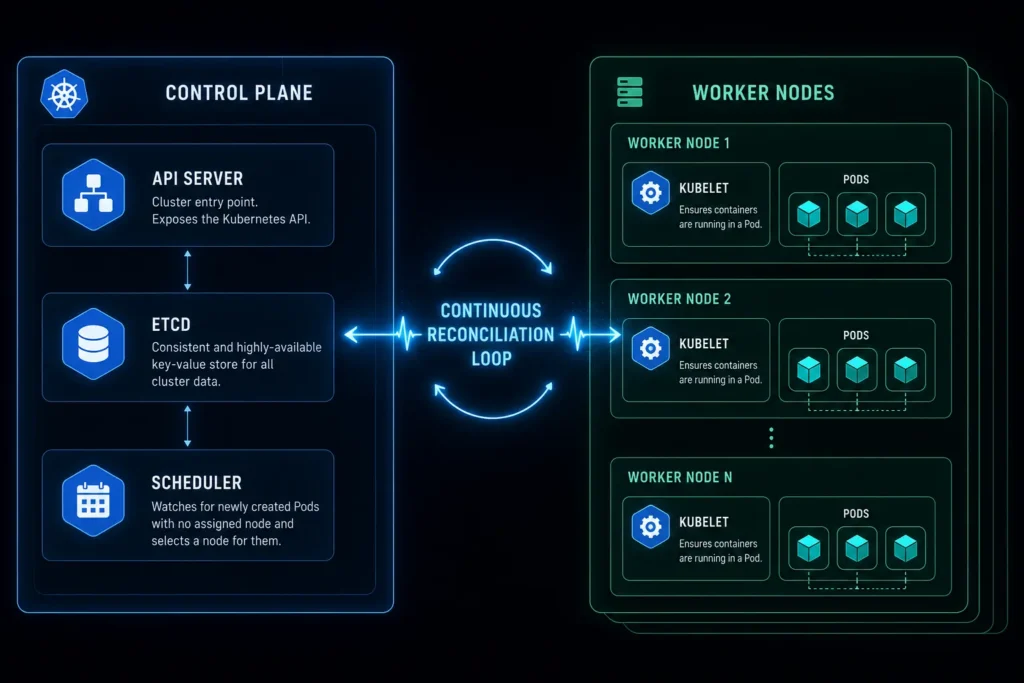
The Control Plane makes all global decisions. It contains the API Server (the front door for all commands), etcd (a secure database recording the exact state of the entire system), and the Scheduler (the algorithm that matches new containers to available machines).
The Worker Nodes are the actual computers running the workloads. Inside each node runs a software agent called a Kubelet. The Kubelet communicates continuously with the Control Plane.
Kubernetes does not manage containers directly; it wraps them in an atomic unit called a Pod. If a Pod crashes, the Kubelet reports the failure to the Control Plane, which instantly schedules a replacement Pod on a healthy node.
5. The Reconciliation Loop
The core intelligence of Kubernetes is its continuous reconciliation loop. Engineers never issue imperative commands like “start a container.” They write declarative rules: “I desire exactly 10 copies of this application to run.”
The Control Plane constantly compares the actual state of the cluster with this desired state. If a server catches fire and destroys two copies, the actual state drops to 8. The reconciliation loop detects the math error and immediately spins up two new copies, perfectly restoring the desired state without human intervention.
Real-World Applications
Kubernetes is the invisible infrastructure powering the digital services we use every day.
Generative AI Workloads: Artificial intelligence requires massive, highly coordinated computing power. By 2026, 66% of organizations hosting generative AI models rely on Kubernetes to manage their inference workloads. The platform acts as the operating system for AI, distributing complex mathematical calculations across vast clusters of specialized processors.
Streaming at Scale: Netflix handles hundreds of millions of concurrent global streams. They run their infrastructure on massive Kubernetes clusters. When a highly anticipated show premieres, Kubernetes detects the traffic surge and automatically spins up thousands of additional video delivery microservices in seconds, ensuring zero buffering.
Multi-Cloud Enterprise Architecture: Global financial institutions use Kubernetes to deploy their transaction software simultaneously across multiple public clouds and private, highly secure data centers. If one cloud provider experiences a major regional outage, Kubernetes automatically shifts the transaction routing to an alternative provider, maintaining absolute financial compliance.
Economic & Strategic Impact
Kubernetes changed the power dynamics of enterprise software.
For cloud providers, it is a double-edged sword. It drives massive consumption of raw cloud computing power, pushing the Kubernetes market to an estimated $3.13 billion in 2026. However, because Kubernetes standardizes deployments, it makes it radically easier for a customer to pack up their software and migrate away from a dominant provider to a cheaper competitor. This deeply commoditizes basic cloud infrastructure.
For enterprise corporations, it represents a massive operational cost-saving measure. By automating scaling, companies no longer need to over-provision expensive server capacity “just in case” traffic spikes. The software scales up during high-traffic hours and scales down to zero at night, cutting cloud computing bills drastically.
Strategically, Kubernetes became the foundation of modern DevOps culture. It bridges the gap between software developers (who write the code) and system administrators (who run the servers). It provides a universal declarative language that both teams use to manage complex systems safely.
Advantages
Self-Healing Infrastructure
Kubernetes constantly monitors the health of containers. If a physical server crashes, the system automatically reschedules the software to healthy machines without human intervention.
Horizontal Auto-Scaling
The platform tracks CPU and memory usage in real-time. When traffic spikes, it instantly adds new computing resources, and it removes them when demand drops to save money.
Vendor Agnosticism
Because the software acts as a universal abstraction layer, companies can migrate their entire architecture between AWS, Google Cloud, and Microsoft Azure without rewriting their codebase.
Declarative Configuration
Engineers define the exact desired state of the system in code. This allows massive digital infrastructure to be version-controlled, audited, and perfectly reproduced.
Limitations
Extreme Complexity
The terminology, networking models, and security configurations require extensive specialized training. Tool complexity and the resulting cultural shift within development teams remain the top barriers to enterprise adoption.
Operational Overhead
Managing a Kubernetes control plane requires dedicated maintenance, security patching, and database backup management. A single misconfiguration can expose the entire cluster to severe security breaches.
Overkill for Small Apps
Monolithic applications or simple websites do not benefit from complex container orchestration. Adopting Kubernetes for basic hosting introduces unnecessary architectural bloat and unjustifiable costs.
Common Misconceptions
Misconception: Kubernetes is a container runtime exactly like Docker.
Reality: Kubernetes does not run containers itself; it manages them. It relies on underlying runtimes (like containerd) to physically execute the container code on the hardware.
Misconception: Using Kubernetes guarantees your application will never crash.
Reality: Kubernetes automates recovery, but it cannot fix underlying bugs in your software code, physical disk failures, or poorly designed database architectures.
Misconception: Kubernetes is only for massive tech giants.
Reality: While Google originally built it, managed services (like Amazon EKS or Azure AKS) have made it highly accessible. Today, 79% of users run managed services rather than attempting to maintain the complex control plane themselves.
What Most People Miss
The true genius of Kubernetes is not its container management; it is its declarative API model.
In traditional infrastructure management, engineers wrote imperative scripts. These were long lists of procedural commands telling the computer: “Step 1, install this. Step 2, restart that. Step 3, copy this file.” If Step 2 failed halfway through, the system broke, and engineers had to manually figure out what broken state the machine was left in.
Kubernetes completely abandoned procedural scripting. Every configuration in Kubernetes is declarative. You never tell the system how to do something. You only tell it what the final result should look like.
The system figures out the execution path itself. This single paradigm shift is what allowed infrastructure to become as manageable, reliable, and version-controlled as software source code.
Comparison Table
| Feature | Virtual Machines (VMs) | Docker Containers | Kubernetes Orchestration |
| Primary Unit | Entire virtual operating system. | Single isolated application package. | Automated clusters of containerized Pods. |
| Resource Overhead | Heavy (runs a full OS kernel per VM). | Light (shares the host OS kernel). | Dynamic management layer over container clusters. |
| Boot Speed | Minutes. | Seconds. | Milliseconds for pods; automated cluster scaling. |
| Scaling Model | Manual provisioning or complex cloud scripts. | Manual execution on a single host. | Automated horizontal and vertical auto-scaling. |
| Self-Healing | Slow hypervisor failover. | None (requires external process monitoring). | Instant automated container restarting and rescheduling. |
| Best Fit | Running entirely different operating systems. | Packaging and testing a single software app. | Managing massive, distributed microservice architectures. |
Case Study
Situation: A high-growth European fintech startup experienced exponential user adoption, scaling from 50,000 daily active users to over 5 million within six months.
Challenge: Their legacy monolithic application was hosted on traditional virtual servers. During morning financial market openings, traffic surged by 800%, overwhelming the servers. Engineers spent their entire mornings manually provisioning new virtual machines, leading to frequent payment processing outages and severe regulatory stress.
Solution: The engineering leadership initiated a complete system re-architecture. They broke the monolithic app into smaller microservices, packed them into containers, and deployed the entire infrastructure onto a managed Kubernetes cluster.
Outcome: The system automated its response to traffic spikes. When morning transaction volume surged, Kubernetes automatically detected the CPU threshold crossing 75% and spun up 200 new Pods within thirty seconds. Latency dropped to zero, and manual server provisioning was eliminated.
Lessons Learned: Manual infrastructure management cannot scale with hyper-growth businesses. Adopting container orchestration is mandatory for any modern engineering organization experiencing rapid, unpredictable digital traffic.
Future Outlook
Next 12–24 Months
Platform engineering will dominate enterprise IT strategies. Rather than forcing developers to write complex Kubernetes configuration files, internal teams will build dedicated developer portals. These portals abstract Kubernetes entirely, allowing developers to deploy code with a single click while the orchestration engine handles the logistics in the background.
Next 3–5 Years
The boundary between virtualization and Kubernetes will blur. Lightweight WebAssembly (Wasm) runtimes will execute directly inside Kubernetes clusters alongside traditional containers. This will offer boot times measured in microseconds and vastly higher resource density for server farms.
Next 10 Years
Human engineers will rarely interact with raw Kubernetes manifests. Artificial intelligence agents will manage the control plane directly. They will analyze performance metrics, automatically rewrite scaling policies, and patch security vulnerabilities autonomously in real-time, removing human error from cloud management.
Most Likely Scenario
Kubernetes will become completely invisible. Just as modern software engineers do not write assembly code to talk to computer processors, future developers will not write raw Kubernetes YAML configurations. Kubernetes will settle into the foundational, highly commoditized operating layer of every corporate data center on Earth.
Key Takeaways
- Kubernetes is an open-source platform that automates the deployment, scaling, and management of containerized applications.
- It solves the operational chaos of managing thousands of microservices across distributed server networks.
- The architecture separates into a central “Control Plane” (the brain) and “Worker Nodes” (the muscle).
- Pods are the atomic units of deployment, housing one or more tightly coupled software containers.
- The continuous reconciliation loop constantly compares the actual state of the cluster with the desired state and self-heals discrepancies.
- Declarative configuration allows engineers to define what the system should look like in code rather than writing procedural execution scripts.
- It eliminates cloud vendor lock-in by providing a universal standard that runs identically across all major cloud providers.
Glossary
Cluster: A set of physical or virtual machines running Kubernetes to execute containerized applications.
Control Plane: The centralized command center of Kubernetes that makes global decisions about the cluster and detects systemic events.
Declarative Configuration: A method of defining infrastructure by stating the desired end state in code rather than providing step-by-step execution commands.
Docker: A popular software platform that packages applications and their dependencies into standardized isolated units called containers.
etcd: A secure, highly consistent key-value store in Kubernetes that records the exact configuration and state of the entire cluster.
Kube-API Server: The front-end component of the Kubernetes control plane that exposes the platform’s commands to users and administrators.
Microservices: An architectural software style where an application is built as a collection of small, independent services communicating over a network.
Pod: The smallest deployable computing unit in Kubernetes, containing one or more containers sharing storage and network resources.
Reconciliation Loop: The core automated process in Kubernetes that continuously checks if the actual state of the cluster matches the desired user state.
Worker Node: A physical or virtual machine in a Kubernetes cluster that runs actual containerized application workloads.
Frequently Asked Questions
What is the difference between Docker and Kubernetes?
Docker creates and runs individual software containers on a single computer. Kubernetes takes thousands of those containers and orchestrates them across a massive cluster of multiple computers. They work together rather than competing.
Is Kubernetes difficult to learn?
Yes. Kubernetes has a notoriously steep learning curve due to its extensive vocabulary, complex networking models, and rigorous configuration syntax.
Do small companies need Kubernetes?
Usually, no. If an application is simple or monolithic, running it on a traditional server or a basic Platform-as-a-Service (PaaS) is vastly cheaper and simpler than maintaining a Kubernetes cluster.
What is a managed Kubernetes service?
Running your own Kubernetes control plane is difficult. Major cloud providers offer managed versions (like Amazon EKS, Google GKE, or Azure AKS) where the cloud provider maintains the complex brain of the system for you.
Can Kubernetes run on my local laptop?
Yes. Tools like Minikube or Docker Desktop allow developers to spin up a single-node Kubernetes cluster directly on a local laptop for testing and development purposes.
How does Kubernetes handle security?
Kubernetes uses role-based access control (RBAC), network policies to restrict pod-to-pod communication, and encrypted secrets management. However, securing a cluster requires rigorous adherence to hardening best practices.
Does Kubernetes replace virtual machines?
Not entirely. Kubernetes often runs on top of virtual machines. Because multiple containers share a single VM’s operating system kernel, Kubernetes achieves drastically higher resource efficiency than running traditional VMs natively.
What happens if the control plane crashes?
If the control plane goes down, your existing application pods will generally keep running because worker nodes cache their instructions. However, you will temporarily lose the ability to scale up, spin up new pods, or make configuration changes until the control plane is restored.
Sources
- Cloud Native Computing Foundation (CNCF): 2025 Annual Cloud Native Survey
- Kubernetes Official Documentation: Concepts and Architecture Overview
- Spectro Cloud: State of Cloud Native and AI Workloads Report
- Google Cloud Architecture Center: Best Practices for Running Kubernetes Workloads