Advertisement
)

At a Glance
- Concept: Real-time software and sensor telemetry controlling the chemical energy flow inside a lithium-ion battery.
- Why it matters: It is the only safety net preventing electric vehicles (EVs) and grid storage batteries from catching fire due to thermal runaway.
- Who uses it: Automotive engineers, consumer electronics designers, and massive renewable energy storage operators.
- Biggest takeaway: You cannot directly measure how much energy is left in a lithium-ion battery; the BMS must guess the remaining capacity using highly complex mathematical models.
In Simple Words
An electric vehicle (EV) battery is not a single, giant battery. It is a tightly packed box containing thousands of individual, smaller battery cells.
Because lithium-ion chemistry is incredibly volatile, these cells cannot simply be wired together and forgotten. If just one of those thousands of cells gets too hot, charges too fast, or drains too low, it can catch fire and trigger a chain reaction that destroys the entire car.
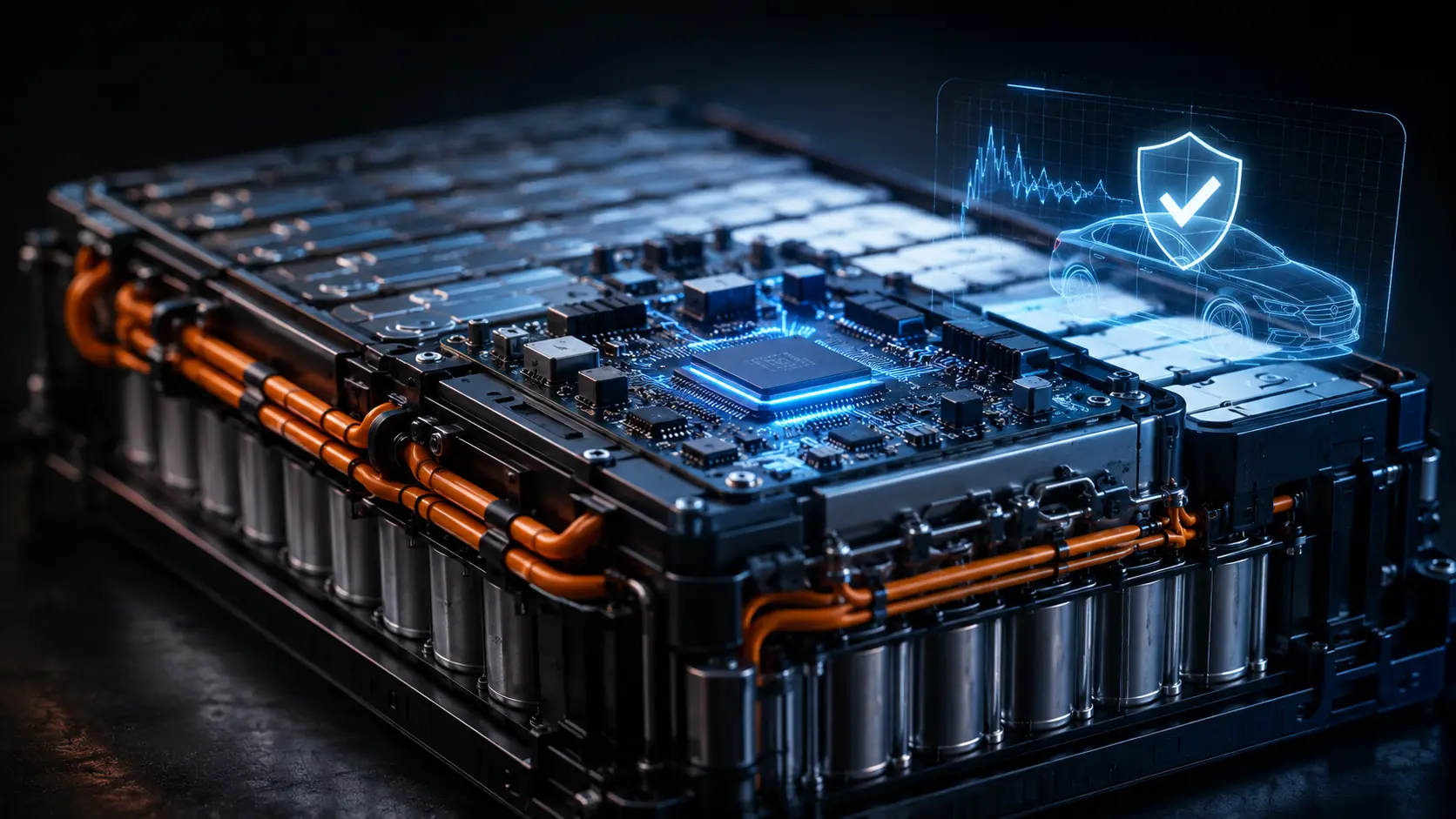
To prevent this, engineers install a Battery Management System (BMS). Think of the BMS as a dedicated traffic cop for electrical energy. It attaches tiny sensors to every single cell in the pack. It measures their exact temperature and voltage hundreds of times per second.
If the BMS detects a cell getting slightly too hot during a fast charge, it automatically slows down the charging speed. If a cell is completely drained, the BMS cuts the power to the motor, safely stopping the car before the cell is permanently damaged. It acts as the invisible safety shield between the raw chemical energy and the driver.
Why This Matters
The shift from fossil fuels to renewable energy relies entirely on the safety and longevity of lithium-ion batteries.
Lithium-ion cells are highly sensitive. Pushing them outside their strict operating windows causes rapid physical degradation or dangerous thermal runaway—an unstoppable chemical fire. A well-engineered BMS acts as an absolute safeguard, preventing these micro-abuse events and extending a battery’s lifespan from a few years to over a decade.
Economically, the BMS dictates the financial viability of electric vehicles and grid storage. In a modern Battery Energy Storage System (BESS), the battery cells themselves account for up to 70% of the total project cost. The BMS protects this massive capital investment.
Furthermore, a highly accurate BMS allows automakers to safely extract more range from the same battery pack. By 2026, the global EV battery management system market is valued at nearly $20 billion, driven heavily by automotive manufacturing in the Asia-Pacific region. The software managing the battery is now just as critical to an EV’s performance as the chemistry of the battery itself.
HOW BATTERY MANAGEMENT SYSTEMS WORK
Managing a massive array of volatile chemical cells requires bridging raw physical sensors with advanced mathematical software.
Here is exactly how a BMS controls an electric powertrain.
1. The Fundamental Problem
Traditional lead-acid batteries (like the one that starts a gas-powered car) are highly forgiving. They can be overcharged slightly without catching fire. Lithium-ion batteries are unforgiving. If a standard NMC (Nickel Manganese Cobalt) lithium cell is charged past 4.2 volts, or discharged below 2.5 volts, its internal structure breaks down. Because an EV pack contains thousands of cells, the failure of a single cell can ruin the entire pack.
2. Raw Sensor Telemetry
To prevent failure, the BMS requires perfect visibility. It uses precision hardware to gather three direct measurements:
- Voltage: The BMS tracks the exact voltage of every individual cell continuously.
- Current: A precision shunt or Hall-effect sensor measures the exact amount of electrical current flowing into or out of the total pack.
- Temperature: Thermistors distributed across the pack provide a real-time thermal map, ensuring no localized “hot spots” form during heavy acceleration.
3. State Estimation Algorithms
Surprisingly, there is no physical sensor that can directly measure how much “fuel” is left in a battery. The BMS must estimate the State of Charge (SoC) mathematically.
Basic systems use Open Circuit Voltage (OCV), which looks at a cell’s voltage while it is at rest to estimate its charge. However, this fails when a car is driving. Advanced automotive BMS software uses a Kalman Filter. This complex algorithm continuously compares the predicted voltage against the actual measured voltage, correcting itself in real-time to provide an accurate dashboard fuel gauge even under heavy load.
4. Cell Balancing
Even in a perfectly manufactured pack, individual cells charge and discharge at slightly different rates. Over time, some cells become full before others. Without intervention, the charger must shut off when the first cell is full, leaving the rest of the pack undercharged.
The BMS solves this through cell balancing. Most systems use passive balancing, where the BMS activates tiny resistors on the fullest cells, slowly bleeding off their excess energy as heat until the lower cells catch up. This keeps the entire pack perfectly synchronized.
5. Safety Disconnection and Contactors
If the algorithms detect that a cell has crossed a critical safety threshold (e.g., reaching 60°C during a fast charge), the BMS acts immediately. It controls massive, high-voltage physical switches called contactors. By opening the contactors, the BMS physically severs the connection between the battery and the car’s motor, triggering a safe emergency shutdown before a fire can ignite.
Real-World Applications
The strict requirements of a BMS scale dramatically depending on the specific application.
Electric Vehicles (EVs): Automotive BMS software is deeply integrated into the vehicle’s central computer. It communicates with the external fast-charger using Constant Current-Constant Voltage (CC-CV) profiles, ensuring the charger pushes the exact right amount of power based on the battery’s real-time temperature.
Grid-Scale Energy Storage: Massive solar and wind farms use stationary Battery Energy Storage Systems (BESS) to hold power for nighttime use. The BMS in these facilities connects to industrial SCADA systems, carefully managing charging cycles to provide frequency regulation and peak shaving services to the local utility grid.
Consumer Electronics: The battery in your smartphone or laptop uses a miniaturized, highly centralized BMS. It manages a single cell (or a small handful), primarily ensuring the battery does not overcharge when plugged in overnight, and accurately reporting the percentage back to your operating system.
Economic & Strategic Impact
The quality of a BMS directly dictates corporate liability and product success.
For automotive manufacturers, a poorly engineered BMS is an existential risk. If a BMS fails to detect a short-circuit, the resulting thermal runaway event leads to global news headlines, massive brand damage, and billion-dollar vehicle recalls. Consequently, modern automotive BMS hardware must adhere to ISO 26262, an international standard for functional safety, specifically targeting the rigorous ASIL-C or ASIL-D certification levels.
Strategically, the BMS limits how far a vehicle can travel. Automakers historically “locked away” 10% to 15% of a battery’s physical capacity as a safety buffer to prevent degradation. As BMS algorithms (like the Kalman filter) become more precise via cloud data and artificial intelligence, automakers can safely shrink this buffer. This provides consumers with more driving range without requiring the automaker to purchase more expensive lithium.
The rapid scaling of this technology has driven the global EV BMS market to aggressive heights. Forecasters estimate the specific EV BMS sector expanding at a compound annual growth rate (CAGR) exceeding 20% through 2035, cementing it as a foundational pillar of the modern automotive supply chain.
Advantages
- Thermal Runaway Prevention: It is the primary defense mechanism against catastrophic battery fires.
- Extended Asset Lifespan: By preventing micro-abuse events (slight overcharging or deep discharging), it ensures expensive battery packs survive for thousands of cycles.
- Accurate Range Estimation: Advanced algorithms provide the user with a highly accurate State of Charge (SoC), eliminating “range anxiety”.
- Pack Synchronization: Cell balancing guarantees that the entire capacity of the battery pack is usable, rather than being handicapped by a single weak cell.
Limitations
- Passive Balancing Inefficiencies: The standard industry practice of passive balancing wastes electrical energy by burning it off as heat, which requires additional cooling in tight automotive spaces.
- Wiring Complexity: Centralized BMS architectures require miles of fragile wiring harnesses to connect the central board to every single cell, increasing manufacturing costs and physical points of failure.
- Algorithmic Drift: As a battery physically ages, its internal chemistry changes. If the software model (State of Health estimation) fails to adapt to this aging, the dashboard fuel gauge becomes highly inaccurate.
Common Misconceptions
Misconception: A battery “fuel gauge” measures the physical electricity left in the battery.
Reality: Electricity is not a liquid. The BMS cannot directly measure capacity. It measures voltage, current, and temperature, and uses complex mathematical models to guess the State of Charge.
Misconception: The charger determines when a battery is full.
Reality: The external charger is “dumb.” The internal BMS dictates the charging process. It tells the charger exactly how much current to provide and forces the charger to stop when the cells reach their maximum safe voltage.
Misconception: All battery cells charge evenly.
Reality: Manufacturing inconsistencies mean cells always drift out of sync. Without a BMS actively balancing the cells, a single underperforming cell will permanently limit the entire car’s driving range.
What Most People Miss
A BMS does not just track the current charge; it tracks the battery’s permanent aging.
This metric is known as the State of Health (SoH). Every time you fast-charge an EV, microscopic physical damage occurs inside the lithium cells. Over several years, the internal resistance of the cells grows, and the maximum capacity shrinks.
The BMS constantly recalculates the SoH. If a 100 kWh battery degrades to 80 kWh after five years, the BMS updates its internal logic so that “100% full” on the dashboard now correctly refers to the new 80 kWh limit. This silent mathematical adjustment is what prevents an older electric car from suddenly dying when the dashboard claims it still has 20% range left.
Comparison Table
| Feature | Passive Cell Balancing | Active Cell Balancing |
| Primary Mechanism | Burns off excess energy from full cells as heat using resistors. | Transfers energy from full cells directly to empty cells. |
| Energy Efficiency | Low (energy is permanently wasted). | High (energy is retained within the pack). |
| Heat Generation | High (must be managed by cooling systems). | Very Low. |
| Hardware Complexity | Simple and inexpensive. | Highly complex; requires specialized inductors or capacitors. |
| Adoption Rate | Industry standard (dominates automotive and BESS). | Rare (used only in highly specialized or expensive applications). |
Case Study
Situation: Early electric vehicle manufacturers realized that unpredictable battery aging and unexpected cell drift were causing customer vehicles to shut down prematurely.
Challenge: The traditional automotive model relied on static, hard-coded software installed at the factory. If the BMS algorithm failed to account for a new type of chemical degradation discovered after the car was sold, the vehicle became a liability.
Solution: Automakers adopted Cloud-Connected BMS telemetry. Modern EVs continuously upload anonymized cell data (voltage, temperature, charging habits) to central cloud servers via cellular networks.
Outcome: By aggregating data from millions of vehicles, companies like Tesla and Rivian use machine learning to identify hidden degradation patterns. They rewrite the State of Charge (SoC) algorithms and deploy Over-The-Air (OTA) software updates directly to the car’s BMS.
Lessons Learned: A Battery Management System is no longer a static piece of hardware. It is a dynamic, continuously evolving software product. The ability to push OTA updates allows manufacturers to physically improve the safety and range of a battery years after it has left the factory floor.
Future Outlook
Next 12–24 Months
The industry will rapidly transition toward Wireless BMS (wBMS) architectures. By removing the complex, heavy copper wiring harnesses that traditionally connect the battery cells to the control board, automakers will save significant vehicle weight, reduce manufacturing complexity, and eliminate a major source of physical hardware failure.
Next 3–5 Years
Artificial intelligence will become natively integrated into BMS software. Rather than relying on rigid, pre-programmed chemical models, the BMS will use neural networks to learn the specific driving and charging habits of the individual owner, dynamically adjusting thermal management to maximize that specific battery’s lifespan.
Next 10 Years
As the first generation of millions of EVs reaches the end of its automotive life, the BMS will dictate the economics of battery recycling. The recorded State of Health (SoH) data stored inside the BMS will act as a “carfax” for the battery, allowing recyclers to instantly determine if a used EV pack can be repurposed for grid-storage, or if it must be shredded for raw materials.
Most Likely Scenario
The BMS will become heavily commoditized at the hardware level but fiercely competitive at the software level. As solid-state batteries eventually reach the commercial market, the underlying chemistry will change entirely. However, the requirement for a hyper-intelligent, predictive software layer to manage energy flow will remain the absolute foundation of all electrified infrastructure.
Key Takeaways
- A Battery Management System (BMS) is the hardware and software control unit that ensures lithium-ion battery packs operate safely.
- It continuously measures individual cell voltages, current, and temperatures using precision sensors.
- The BMS mathematically estimates the State of Charge (SoC) because the remaining electricity cannot be physically measured.
- It actively prevents thermal runaway by derating charging speeds or physically disconnecting the battery via contactors during emergencies.
- Passive cell balancing bleeds excess energy as heat to keep all cells perfectly synchronized, preventing a single weak cell from crippling the pack.
- Automotive BMS development is strictly governed by functional safety standards like ISO 26262 (ASIL-D).
- The global EV BMS market is expanding rapidly, with Asia-Pacific dominating manufacturing and deployment.
Glossary
Active Balancing: A complex cell balancing method that actively transfers electrical energy from high-voltage cells to low-voltage cells.
Contactor: A heavy-duty, high-voltage physical switch controlled by the BMS used to safely connect or disconnect the battery from the powertrain.
ISO 26262: An international standard for the functional safety of electrical systems in production automobiles.
Kalman Filter: An advanced mathematical algorithm used by a BMS to continuously predict and correct the State of Charge estimation based on noisy sensor data.
Passive Balancing: The standard balancing method where the BMS forces high-voltage cells to burn off excess energy as heat through resistors.
State of Charge (SoC): The estimated percentage of usable energy remaining in the battery pack; the digital fuel gauge.
State of Health (SoH): A metric estimating how much the battery’s maximum capacity and internal resistance have degraded over its lifetime compared to when it was new.
Thermal Runaway: An unstoppable, catastrophic chain-reaction chemical fire caused by overheating or short-circuiting a lithium-ion cell.
Frequently Asked Questions
Why do electric cars need a BMS but gas cars don’t?
Gas cars use simple 12V lead-acid batteries that are highly stable and can handle overcharging without catching fire. EVs use thousands of volatile lithium-ion cells that will catastrophically fail if pushed outside a strict voltage and temperature window.
Does the BMS control how fast my car charges?
Yes. While the external charger provides the power, the vehicle’s internal BMS dictates the exact charging profile. It tells the charger to slow down if the cells get too hot or approach their maximum voltage limit.
What happens if the BMS breaks?
If a modern BMS fails, the safety contactors automatically open, immediately cutting power to the vehicle. A stranded vehicle is preferable to an unmonitored battery pack, which could easily trigger thermal runaway.
Why does my EV range drop faster in the winter?
Lithium-ion cells become chemically sluggish in cold weather, temporarily increasing internal resistance. The BMS recalculates the State of Power (SoP) and restricts output to protect the cold cells, resulting in a lower displayed range.
What is the difference between centralized and distributed BMS?
A centralized BMS places all monitoring hardware on one main circuit board connected to every cell by wires. A distributed (or modular) BMS places smaller “slave” boards on individual battery modules, which communicate digitally back to a “master” board, reducing wiring complexity.
Can a software update give my car more range?
Yes. If automakers gather enough cloud telemetry to prove their battery cells degrade slower than expected, they can push an Over-The-Air (OTA) update to the BMS. This update safely unlocks previously hidden buffer capacity, increasing driving range.
Why is passive balancing used if it wastes energy?
Passive balancing is significantly cheaper, smaller, and easier to manufacture. The actual amount of energy wasted as heat (usually 50–200mA) is negligible compared to the massive capacity of an EV battery.
How does a BMS prevent fires?
It uses thermistors to constantly monitor cell temperature. If heat spikes, it throttles performance. If it detects a sudden voltage drop indicating a short circuit, it physically disconnects the battery in microseconds using MOSFETs or contactors.
Sources
- Battery Design: Battery Management System (BMS): Algorithms, Hardware & Safety
- Maxwell Energy: What Is BMS? Battery Management Systems Explained for EVs
- SciTePress: Analysis of Battery Management System Standards (ISO 26262 / IEC 62619)
- Research Nester: Electric Vehicle Battery Management System Market Size & Share, Growth Analysis 2035
- Fortune Business Insights: Battery Management System [BMS] Market Size, Share, 2034