Advertisement
)

At a Glance
- Concept: Utilizing delicate quantum states of photons to transmit encryption keys over fiber-optic cables or satellite links.
- Why it matters: Quantum computers will soon break the mathematical encryption protecting the global internet; QKD replaces vulnerable math with unbreakable physics.
- Who uses it: Telecommunication giants, central banks, defense contractors, and sovereign governments protecting classified data.
- Biggest takeaway: QKD does not transmit the actual classified data. It only transmits the “key” used to lock and unlock the data, guaranteeing the key was not stolen in transit.
In Simple Words
Every secure message sent across the internet is locked in a digital vault. To unlock it, the sender and the receiver must share a secret “key.”
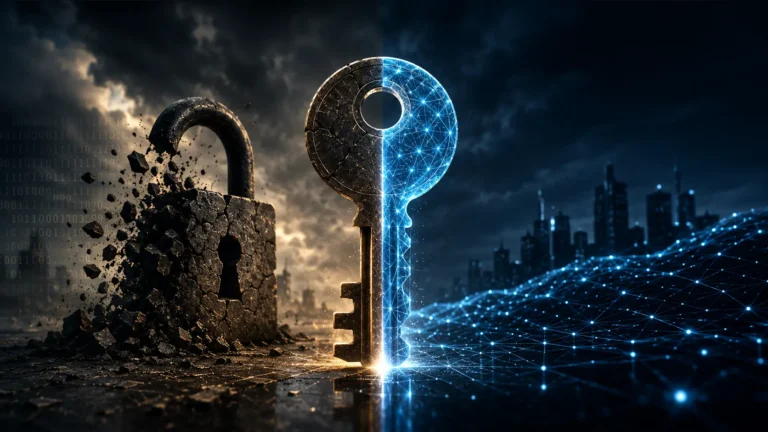
Currently, computers exchange this key using complex math puzzles. However, future quantum computers will be able to solve these puzzles instantly, allowing hackers to steal the key and unlock the vault.
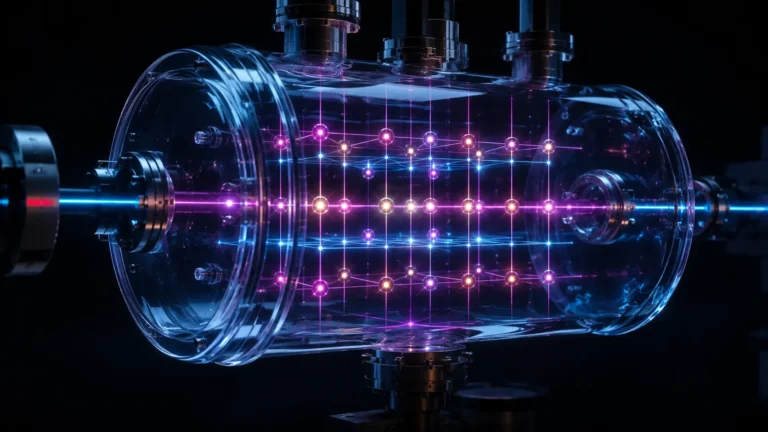
Quantum Key Distribution (QKD) solves this by abandoning math and using physics. Instead of sending the key as normal computer code, the sender encodes the key into single particles of light (photons) and fires them down a fiber-optic cable.
Because of the laws of quantum mechanics, it is physically impossible to observe or copy a quantum particle without altering it. If a hacker tries to intercept the photons mid-flight, the photons shatter or change their state. The sender and receiver instantly detect this disturbance. They throw away the compromised key and generate a new one, ensuring the data vault is never locked with a stolen key.
Why This Matters
The global intelligence community is currently engaged in a shadow war known as “Store Now, Decrypt Later” (SNDL).
Hostile nation-states and cyber syndicates are actively harvesting massive amounts of encrypted internet traffic. They cannot read the data today, so they store it in massive server farms. They are waiting for the day a fault-tolerant quantum computer comes online, capable of running Shor’s algorithm to shatter RSA and ECC encryption. When that day arrives, all harvested historical data—from military troop movements to central bank transfers—will be instantly exposed.
QKD neutralizes this threat permanently. It provides information-theoretic security. This means the security relies on the absolute laws of nature, independent of how much computing power a hacker possesses. Even an infinitely powerful quantum computer built a thousand years from now cannot crack a QKD transmission, because the physics of the photon transfer guarantee the key was never intercepted in the first place.
For heavily regulated industries like finance and healthcare, migrating core infrastructure to quantum-safe networks is no longer a futuristic theory. It is an immediate compliance mandate.
The Big Picture
Securing the future internet requires a dual-layered approach.
In August 2024, the U.S. National Institute of Standards and Technology (NIST) finalized its first Post-Quantum Cryptography (PQC) standards (FIPS 203, 204, and 205). PQC involves upgrading our current software with new, harder math puzzles that quantum computers struggle to solve.
However, PQC still relies on math. It is considered secure only until a mathematician proves otherwise.
QKD operates at the physical hardware layer. It does not rely on unproven math. To build a truly impenetrable network, telecommunication architects deploy hybrid systems. They use PQC to secure the software routing, and QKD to physically secure the fiber-optic hardware transmitting the keys. This “crypto diversity” guarantees that even if the software math is eventually broken, the physics of the hardware remain uncompromised.
How It Works
Sending digital data using quantum mechanics requires extreme precision. The infrastructure must generate, transmit, and read individual particles of light without destroying them.
Here is the step-by-step mechanism of a QKD network.
1. The Fundamental Problem
Classical encryption relies on asymmetric cryptography (like Diffie-Hellman), where a public key is openly shared over the internet. A hacker can silently intercept this mathematical exchange without the sender or receiver ever knowing. The communication channel has no physical alarm system.
2. The Quantum Alarm System
QKD leverages two absolute rules of quantum mechanics: Heisenberg’s Uncertainty Principle and the No-Cloning Theorem. These laws state that you cannot measure a quantum state without changing it, and you cannot make a perfect copy of an unknown quantum state. If an eavesdropper (named “Eve” in cryptography models) attempts to look at the photons traveling between the sender (“Alice”) and receiver (“Bob”), the photon’s fragile quantum state collapses, instantly spiking the error rate of the transmission.
3. DV-QKD vs. CV-QKD
Engineers use two primary methods to transmit the quantum states:
- Discrete-Variable QKD (DV-QKD): The original method. It encodes data into the polarization or phase of single photons (using the famous BB84 protocol). It requires highly sensitive, expensive single-photon detectors.
- Continuous-Variable QKD (CV-QKD): A modern, highly scalable approach. Instead of counting single photons, it encodes data into the amplitude and phase of continuous, coherent laser pulses. It uses standard telecom homodyne receivers, making it cheaper and easier to integrate into existing internet infrastructure, though it is highly sensitive to channel noise.
4. Optical Multiplexing (C-Band and O-Band)
A telecom company does not want to lay a dedicated, separate fiber-optic cable just for the quantum key (known as “dark fiber”). They want to send the fragile quantum key and the massive encrypted data payload down the exact same cable. This requires optical multiplexing. Engineers place the encrypted data on the standard telecom C-band (around 1550 nm) and the quantum key on the O-band (around 1310 nm).
5. Overcoming Raman Scattering
Multiplexing introduces a severe physics problem: Stimulated Raman Scattering. The high-power data lasers in the C-band bleed “white noise” into the O-band, blinding the delicate quantum detectors. To solve this, QKD networks use extreme high-isolation optical filters, suppressing the classical laser noise by up to 100 decibels so the single quantum photons can be safely detected.
6. Privacy Amplification
Once Alice and Bob successfully exchange a string of photons, they compare a subset of the data. If the error rate is below a strict mathematical threshold, they know no one intercepted the transmission. They apply a final mathematical algorithm called “privacy amplification,” which scrubs any residual, partial information a hacker might have gleaned, producing a flawless, perfectly secure symmetric encryption key.
Real-World Applications
QKD is actively deployed in securing high-value, point-to-point infrastructure.
European Quantum Communication Infrastructure (EuroQCI): The European Union is constructing a massive, integrated quantum communication network spanning the continent. By 2027, the EuroQCI project aims to secure critical governmental, infrastructural, and healthcare data centers across all member states, combining terrestrial fiber-optic QKD networks with orbital quantum satellites.
Financial Data Center Backhaul: Major banking institutions utilize commercial QKD equipment (from vendors like Toshiba and ID Quantique) to secure the data connections between their primary and backup data centers. Because these centers are usually located within 100 kilometers of each other, fiber-based QKD ensures that off-site daily ledger backups cannot be intercepted or duplicated by hostile state actors.
Satellite-to-Ground QKD (The Micius Satellite): Standard fiber-optic cables absorb light. After about 100 to 200 kilometers, the single photons die, limiting the range of QKD. China launched the Micius satellite to overcome this. The satellite generates quantum keys in the vacuum of space (where there is no optical resistance) and beams them directly down to ground stations separated by thousands of kilometers, establishing the first intercontinental quantum network.
Economic & Strategic Impact
The deployment of QKD fundamentally shifts cybersecurity spending from software to hardware.
For the telecommunications sector, QKD represents a highly lucrative, premium service tier. Internet Service Providers (ISPs) and dark fiber operators are upgrading their optical switches and deploying QKD nodes to offer “Quantum-Secured Bandwidth” as a subscription product to enterprise clients, governments, and military contractors.
Economically, the barrier to entry remains high. Installing highly sensitive quantum transceivers and optical filters across regional networks requires massive capital expenditure. This high initial cost is the primary reason smaller enterprises rely entirely on software-based PQC algorithms, leaving hardware-based QKD to massive corporations handling mission-critical data.
Strategically, the mastery of quantum networks dictates digital sovereignty. If a nation cannot protect its internal communications against a quantum adversary, it surrenders its diplomatic and military privacy. Governments are heavily subsidizing domestic QKD development to ensure their telecommunications backbones are not reliant on foreign-manufactured, potentially compromised optical equipment.
Advantages
Unconditional Information-Theoretic Security
Unlike mathematical algorithms that can be broken by future supercomputers or unforeseen mathematical shortcuts, QKD is protected by the immutable laws of physics.
Instant Intrusion Detection
The network operates as a physical tripwire. It is the only communication system on Earth that mathematically proves whether or not a third party has intercepted the transmission mid-flight.
Forward Secrecy Guarantee
Because the QKD keys are generated randomly and changed continuously (often multiple times per second), a hacker who somehow breaches a server to steal a key today cannot use it to decrypt data sent yesterday or data sent tomorrow.
Limitations
Distance Constraints in Fiber
Photons are absorbed by glass. Standard fiber-optic QKD is limited to roughly 100 to 200 kilometers before the signal degrades. Extending this range requires placing “Trusted Nodes” (highly secure, physical relay stations) every 100 kilometers to decrypt and re-encrypt the signal.
Extremely Low Key Generation Rates
Compared to classical networking speeds, transmitting and verifying single photons is incredibly slow. QKD is used strictly to exchange the small cryptographic keys, not to transmit the actual gigabytes of payload data.
High Capital Expenditure
Deploying CV-QKD or DV-QKD hardware requires precision optics, specialized cooling for detectors, and dedicated network engineering, making it orders of magnitude more expensive than simply deploying a software-based PQC algorithm.
Common Misconceptions
Misconception: QKD transmits your files and photos using quantum mechanics.
Reality: QKD only transmits the random string of characters (the key) used to lock the files. The actual files are encrypted using standard symmetric algorithms (like AES-256) and sent over regular internet channels.
Misconception: QKD makes post-quantum cryptography (PQC) obsolete.
Reality: They are complementary, not competitive. PQC provides quantum-resistant software security across the open internet, while QKD provides absolute physical security for point-to-point infrastructure. Most modern networks integrate both.
Misconception: A quantum computer is required to use Quantum Key Distribution.
Reality: QKD networks do not use quantum computers. They use standard telecom lasers, specialized filters, and photon detectors. You can deploy a QKD network today without owning a single qubit of quantum computing power.
What Most People Miss
The ultimate vulnerability in a QKD network is not the fiber-optic cable; it is the physical “Trusted Node.”
Because a photon dies after roughly 150 kilometers in fiber, a long-distance QKD network must stop the photon, read the key, and generate a brand new photon to continue the journey. This relay station is called a Trusted Node.
While the fiber-optic cable between the nodes is physically unhackable, the key is temporarily translated back into classical computer memory inside the Trusted Node. If a cyber-syndicate physically breaks into the building housing the Trusted Node, or infects the node’s local server with a traditional malware virus, they can steal the key before it is converted back into a photon. Securing the physical perimeter of these relay stations is the hardest logistical challenge of building a national quantum network.
Comparison Table
| Feature | Classical Asymmetric Encryption (RSA) | Post-Quantum Cryptography (PQC) | Quantum Key Distribution (QKD) |
| Security Foundation | Difficulty of factoring large prime numbers. | Difficulty of complex math (e.g., lattice-based problems). | The physical laws of quantum mechanics. |
| Vulnerable to Quantum Computers? | Yes (Shor’s Algorithm breaks it). | No (designed to resist quantum attacks). | No (immune to all computational power). |
| Hardware Required | Standard computers. | Standard computers. | Specialized lasers, optical filters, and photon detectors. |
| Implementation Layer | Software. | Software. | Hardware / Optical Physics. |
| Intrusion Detection | None. Hacker can copy data silently. | None. Hacker can copy data silently. | Absolute. Interception physically destroys the signal. |
| Primary Use Case | Current open internet protocols. | Next-generation open internet protocols (FIPS 203/204). | Securing physical fiber links between enterprise data centers. |
Case Study
Situation: A major European financial consortium needed to secure the daily transaction ledger backups moving between their primary headquarters and a disaster-recovery data center 80 kilometers away.
Challenge: Regulators mandated extreme protection against “Store Now, Decrypt Later” quantum attacks. However, leasing a dedicated “dark fiber” cable strictly for quantum keys was cost-prohibitive. They needed to run the quantum keys on the exact same lit fiber-optic cable currently carrying their high-traffic, classic data.
Solution: The banking group partnered with Toshiba to deploy a multiplexed CV-QKD system. They placed their classical encrypted data on the C-band (1550 nm) and the quantum key on the O-band (1310 nm) across the shared 80 km fiber.
Outcome: By implementing extreme high-isolation optical filters, the system suppressed the 60 dB of white noise generated by the classical data lasers (Stimulated Raman Scattering). The bank successfully transmitted unbreakable quantum keys without leasing new fiber, maintaining compliance with emerging European Central Bank quantum directives.
Lessons Learned: Commercial QKD is no longer limited to sterile laboratory dark fiber. Advanced optical multiplexing allows telecom providers to integrate physical quantum security directly into heavily congested, pre-existing commercial networks.
Future Outlook
Next 12–24 Months
Enterprise architectures will heavily embrace the “hybrid approach.” Chief Information Security Officers (CISOs) will mandate architectures that wrap QKD hardware keys inside NIST-approved PQC software algorithms (like ML-KEM). This dual-layer defense will become the standard requirement for all defense contractor and central banking network upgrades.
Next 3–5 Years
The industry will largely solve the “Trusted Node” vulnerability by deploying early-stage Quantum Repeaters. Unlike a trusted node that reads the key and breaks the quantum state, a true quantum repeater uses a phenomenon called “entanglement swapping.” This allows the network to boost the quantum signal across thousands of kilometers of fiber without the key ever taking a classical, readable form.
Next 10 Years
Terrestrial fiber networks and orbital satellite constellations will fully integrate, laying the physical hardware foundation for the Quantum Internet. Researchers will use this backbone not just for encryption keys, but to connect distant quantum supercomputers together, allowing them to share entangled qubits and process impossibly large molecular simulations as a single, planetary-scale machine.
Most Likely Scenario
QKD will not replace standard software encryption for the everyday consumer internet. The hardware is too expensive. Instead, QKD will become the invisible, ultra-secure backbone of the global economy, utilized exclusively by cloud providers, telecom backhauls, and financial clearinghouses to secure the main arteries of global data traffic.
Key Takeaways
- Quantum Key Distribution (QKD) uses single photons of light to physically guarantee the safe exchange of encryption keys.
- The system relies on Heisenberg’s Uncertainty Principle; any attempt to intercept the key physically destroys the photon, instantly alerting the sender.
- QKD does not send the actual data. It only safely transports the key, which is then used by standard algorithms (like AES-256) to encrypt the main payload.
- Discrete-Variable (DV-QKD) uses single photons, while Continuous-Variable (CV-QKD) uses coherent laser pulses, making CV more compatible with standard telecom gear.
- Optical multiplexing allows telecom companies to run quantum keys and standard data on the same fiber by using different light wavelengths and extreme noise filters.
- Standard fiber-optic QKD is limited to roughly 150 kilometers due to signal absorption, requiring “Trusted Nodes” to relay the signal further.
- The ultimate security architecture is a hybrid network, combining physical QKD hardware with mathematical Post-Quantum Cryptography (PQC) software.
Glossary
BB84 Protocol: The first and most famous QKD protocol, developed in 1984, which uses photon polarization states to encode bits of the cryptographic key.
Continuous-Variable QKD (CV-QKD): A QKD method that encodes information into the continuous amplitude and phase of a laser wave, using standard telecom homodyne detectors.
Discrete-Variable QKD (DV-QKD): A QKD method that encodes information into individual, countable single photons, requiring highly sensitive single-photon avalanche detectors.
Heisenberg’s Uncertainty Principle: A fundamental theory in quantum mechanics stating that the act of measuring a quantum state inherently alters it, serving as the basis for QKD’s intrusion detection.
No-Cloning Theorem: A law of quantum physics stating it is impossible to create an identical copy of an arbitrary, unknown quantum state.
Post-Quantum Cryptography (PQC): Next-generation software algorithms (like NIST’s ML-KEM) designed to be mathematically resistant to quantum computer attacks.
Stimulated Raman Scattering: Optical “white noise” generated when high-power traditional lasers bleed light across a fiber-optic cable, threatening to blind delicate quantum detectors.
Trusted Node: A highly secure physical relay station in a QKD network where the quantum key is temporarily converted back to classical data to boost its signal distance.
Frequently Asked Questions
Does QKD use a quantum computer?
No. QKD networks use standard telecom lasers and specialized optical filters. You do not need a quantum computer to secure your data using quantum physics.
What happens if a hacker tries to steal the QKD key?
The laws of physics dictate that the hacker’s observation changes the photon’s state. The sender and receiver instantly detect a spike in the error rate, abandon that specific key, and generate a new one before any data is sent.
Can QKD be hacked?
The physics of the photon transfer are mathematically unhackable. However, real-world implementations can be vulnerable. Hackers attack the physical hardware, such as trying to blind the photon detectors with bright lasers (a “blinding attack”) or breaking into the physical building housing a Trusted Node.
Why don’t we use QKD for all internet traffic?
It is far too expensive, slow, and requires specialized optical hardware at every endpoint. Your smartphone cannot physically generate and detect single photons over an open Wi-Fi network.
How is QKD different from PQC?
PQC (Post-Quantum Cryptography) is a software upgrade that uses harder math to secure data. QKD is a hardware upgrade that uses the physics of light to secure data.
What is optical multiplexing in QKD?
It is the process of sending both the delicate quantum key and the massive, classical encrypted data down the exact same fiber-optic cable by placing them on different light wavelengths (colors).
Why is distance a limitation in QKD?
Fiber-optic glass is not perfectly clear; it absorbs light over distance. In standard data networks, optical amplifiers boost the fading signal. Because of the No-Cloning Theorem, you cannot amplify a quantum signal without destroying the key, limiting distance to about 100-200 kilometers per link.
What is the Micius satellite?
It is a Chinese orbital satellite designed to bypass the distance limitations of fiber optics. By generating and beaming quantum keys through the vacuum of space, it successfully connected QKD networks in China and Europe.
Sources
- Coherent Market Insights: Quantum Key Distribution Market Size and Forecast, 2026-2033 (March 2026)
- National Institute of Standards and Technology (NIST): FIPS 203, FIPS 204, and FIPS 205 Post-Quantum Encryption Standards
- Grand View Research: Quantum Key Distribution Market Size & Trends Analysis Report (May 2026)
- Indie Inc: Discrete-Variable vs Continuous-Variable Quantum Key Distribution Protocols