Advertisement
)

At a Glance
- Concept: Cameras that mimic the human retina by only recording pixels that change brightness, ignoring empty environments.
- Why it matters: It eliminates motion blur and reduces data processing overhead by up to 1,000 times, allowing AI to track high-speed movement instantaneously.
- Who uses it: Drone manufacturers, autonomous vehicle companies, and robotics engineers requiring ultra-low-latency vision.
- Biggest takeaway: Moving from synchronous video frames to asynchronous event streams solves the critical data-processing bottleneck currently holding back real-time machine autonomy.
In Simple Words
Think about how a standard video camera works. It takes a complete picture of everything in front of it—say, 60 times a second. If you film a car driving past a stationary house, the camera records the stationary house 60 times a second, over and over again, wasting massive amounts of memory and processing power.
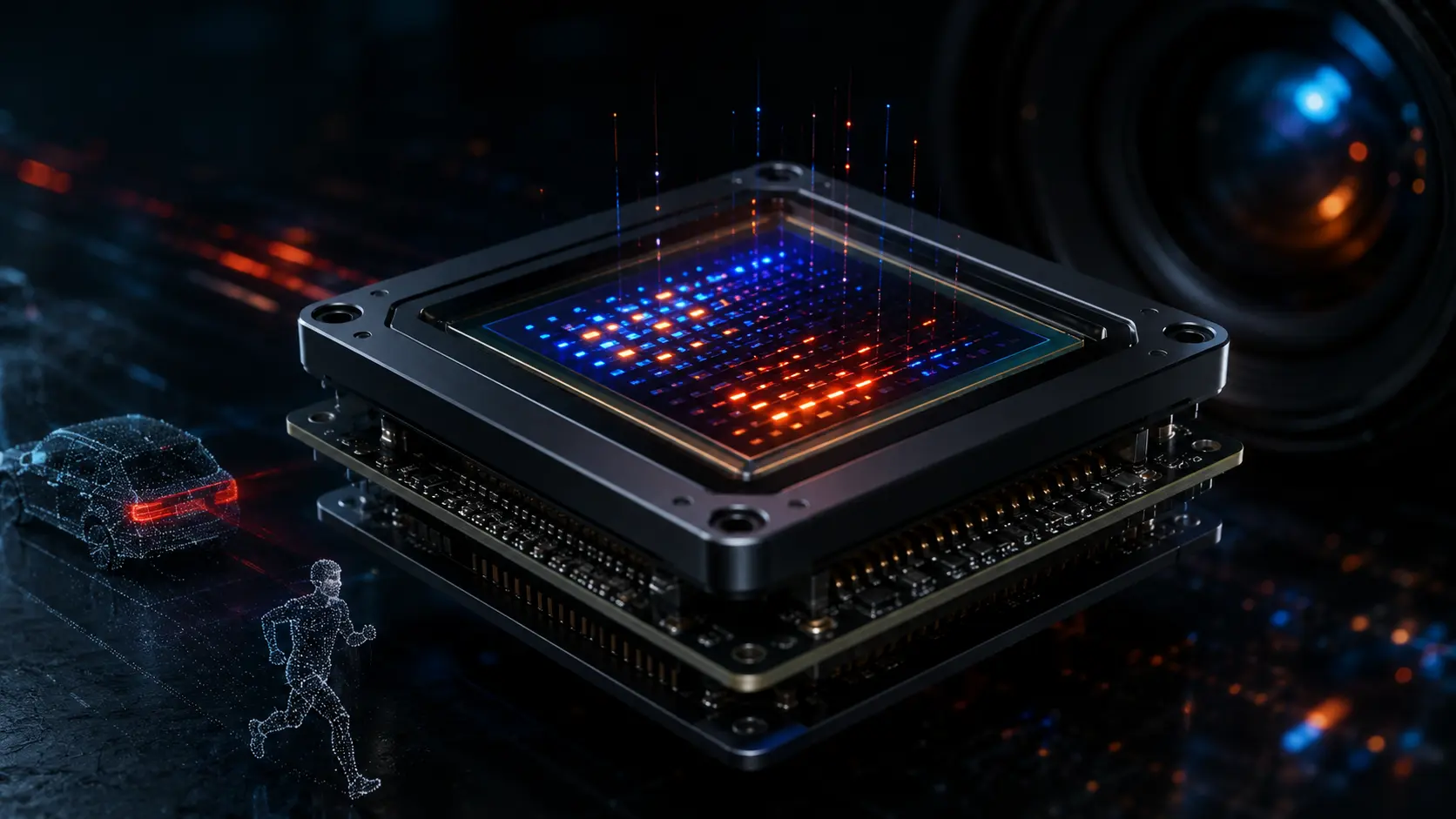
Neuromorphic vision sensors operate exactly like the biological human eye. Instead of taking constant, full-frame pictures, each individual pixel on the sensor acts as an independent alarm system. A pixel only sends a signal to the computer if the brightness directly in front of it changes. The stationary house is ignored completely, and the camera only records the precise, moving edges of the car.
Because the camera is not constantly snapping pictures of empty backgrounds, it processes data exponentially faster. This allows drones to dodge obstacles in milliseconds and self-driving cars to spot pedestrians in the dark without overwhelming their onboard computers.
Why This Matters
The future of autonomous robotics is currently hitting a physical data processing wall. To make self-driving cars and high-speed drones safer, engineers continuously upgrade them with higher-resolution, faster-frame-rate cameras. However, sending 120 high-definition frames per second to an AI processor creates a massive flood of redundant data. The AI must spend critical milliseconds sorting through millions of static, useless background pixels just to realize a child stepped into the street.
Neuromorphic vision sensors bypass this data bottleneck entirely. By outputting a sparse stream of “events” rather than dense video frames, the data payload drops by orders of magnitude.
Economically, this is reshaping the semiconductor and edge-computing markets. In 2026, collaborations between global sensor giants and neuromorphic pioneers have brought mass-market, stacked event-based sensors to commercial production. As the global neuromorphic hardware market aggressively scales toward multibillion-dollar valuations by 2030, this technology is moving out of university laboratories. It is becoming the foundational optical hardware required for next-generation industrial automation, augmented reality, and mobile computational photography.
How It Works
Translating the biological mechanics of the human retina into digital silicon requires abandoning the concept of “frame rates” entirely.
1. The Fundamental Problem of Frames
Traditional cameras capture the world synchronously. Every pixel on the sensor is told to open its shutter, absorb light, and report its value at the exact same time, governed by a global clock (e.g., 60 frames per second). Between those frames, the camera is effectively blind. If an object moves too fast during the exposure time, the image smears, creating motion blur that AI algorithms struggle to decode.
2. The Insufficiency of High-Speed Cameras
If a drone needs to track a fast-moving object, engineers traditionally use high-speed cameras shooting 1,000 frames per second. While this reduces motion blur, it creates a catastrophic computational load. The drone’s computer must process 1,000 high-definition images every single second. This drains the battery rapidly, generates immense heat, and requires heavy, expensive processors.
3. Asynchronous Pixel Circuitry (DVS)
Neuromorphic sensors use a Dynamic Vision Sensor (DVS) architecture. There is no global clock and no shutter. Every single pixel on the silicon chip operates completely independently. Each pixel continuously monitors the precise amount of light hitting it. The pixel only fires an electrical signal—called an “event”—if the light intensity changes by a specific, pre-programmed threshold.
4. The Event Stream
When a baseball is thrown across the camera’s view, the pixels registering the dark edge of the baseball suddenly sense a drop in brightness and fire an “off” event. As the baseball passes, the pixels behind it sense a return to a bright background and fire an “on” event. The camera outputs a continuous, sparse, asynchronous spiral of data coordinates (X, Y, Time, and Polarity) rather than a rigid grid of complete pictures.
5. Low-Latency Edge Integration
Because the output data is so small, the AI processor does not need to analyze a full image to figure out what moved. The sensor already isolated the movement physically at the hardware level. This allows spiking neural networks (SNNs) and specialized edge chips to process the precise trajectory of an object with microsecond temporal resolution, reacting to physical threats roughly 1,000 times faster than a traditional computer vision system.
Real-World Applications
Event-based vision is aggressively deploying into environments where traditional cameras fail.
Mobile Photography Deblurring: By pairing a traditional image sensor with an event-based sensor, modern smartphones natively cancel motion blur. The traditional sensor captures the color and detail, while the event sensor captures the exact trajectory of the movement continuously. The phone’s processor mathematically merges the two, reversing the smear in low-light action shots perfectly.
Autonomous Vehicle Safety: Self-driving cars struggle with extreme lighting changes, such as driving out of a dark tunnel into blinding sunlight. Because event sensors measure relative changes in contrast rather than absolute brightness, their High Dynamic Range (HDR) frequently exceeds 120 dB. They can clearly track the outline of a pedestrian in pitch darkness or looking directly into the sun without being blinded.
Industrial Machine Vision: Factory assembly lines use event sensors to inspect products moving at impossible speeds. Standard cameras would require massive strobe lights to freeze the motion of a pill bottle flying down a conveyor belt. A neuromorphic camera passively tracks the edge of the bottle, counting and inspecting thousands of units per second using a fraction of the processing power.
Economic & Strategic Impact
The commercialization of neuromorphic vision fundamentally lowers the compute costs of edge AI.
For original equipment manufacturers (OEMs), deploying heavy graphical processing units (GPUs) onto drones or Internet of Things (IoT) devices is financially and thermally prohibitive. Event sensors strip the visual data down to its bare mathematical essence before it ever reaches the processor. This allows engineers to use cheaper, lower-power microcontrollers to achieve high-end robotic autonomy, drastically lowering the bill of materials for industrial hardware.
Strategically, the event-based vision sector is consolidating rapidly. Major semiconductor foundries are integrating event sensors directly with neuromorphic processing chips. The global neuromorphic computing market is heavily driven by increasing demand for low-power edge computing and real-time data processing. The organizations that own the patents on these bio-inspired sensor integrations will control the optical hardware standards of the next robotics revolution.
Advantages
Microsecond Temporal Resolution
Because pixels report changes asynchronously the instant they happen, the sensor can track extremely fast-moving objects (like a spinning propeller or a bullet) without introducing any physical motion blur.
Extreme Data Efficiency
By ignoring static backgrounds and only transmitting movement data, the sensor reduces the data bandwidth sent to the processor by up to a factor of 1,000, saving massive amounts of battery and compute power.
Ultra-High Dynamic Range (HDR)
Traditional cameras are easily blinded by sudden light or darkness. Because each pixel independently measures relative contrast changes, event sensors function flawlessly in both blinding glare and near-pitch-black environments.
Limitations
Incompatibility with Standard AI
Standard computer vision models (like Convolutional Neural Networks) are built to analyze static, grid-based image frames. To use an event-based camera efficiently, engineers must completely rewrite their algorithms or utilize complex Spiking Neural Networks (SNNs) capable of interpreting asynchronous data streams.
Lack of Color and Static Detail
Because the sensor only triggers on movement, a perfectly still object sitting in front of a perfectly still camera becomes entirely invisible. Standard event sensors do not capture color or texture, making them useless for traditional photography unless paired with a secondary, conventional camera.
Background Noise Susceptibility
In highly chaotic environments (like a forest with thousands of leaves blowing in the wind), the sensor fires millions of useless events, rapidly eroding its data-efficiency advantages and overwhelming the processor with optical noise.
Common Misconceptions
Misconception: Event-based cameras take pictures really fast.
Reality: They do not take “pictures” at all. They output a continuous mathematical spreadsheet of individual pixel coordinates reporting brightness changes in real-time.
Misconception: Neuromorphic sensors are just infrared or night-vision cameras.
Reality: They detect standard visible light. Their ability to “see” in the dark comes from their extreme sensitivity to minute contrast changes, not from reading thermal heat signatures.
Misconception: They will eventually replace all standard video cameras.
Reality: They are highly specialized tools for tracking motion and edge dynamics. If an application requires analyzing color, reading text, or inspecting static details, a traditional frame-based camera remains vastly superior.
What Most People Miss
The ultimate power of neuromorphic vision is its synergy with Spiking Neural Networks (SNNs).
If you feed asynchronous event data into a standard GPU, the GPU must still run its internal clock synchronously, wasting much of the energy efficiency. However, when an event sensor is paired with a neuromorphic processor, the entire system becomes “event-driven.” The processor only consumes power when a specific pixel fires. If nothing moves, the entire hardware stack practically goes to sleep. This full end-to-end asynchronous architecture allows advanced AI to run on tiny batteries for years, making true edge autonomy physically possible.
Comparison Table
| Feature | Traditional Frame-Based Camera | Neuromorphic Vision Sensor (Event-Based) |
| Output Type | Dense, synchronous image frames. | Sparse, asynchronous stream of pixel changes. |
| Temporal Resolution | Limited by frame rate (e.g., 60 FPS). | Microsecond precision (equivalent to >10,000 FPS). |
| Data Volume | Extremely high (captures static backgrounds). | Extremely low (only captures moving edges). |
| Motion Blur | High risk during fast movement. | None. |
| Dynamic Range | Typically 60–80 dB (easily blinded). | >120 dB (operates in extreme lighting). |
| Static Object Visibility | Excellent. | Invisible (unless the camera itself moves). |
| Processing Power Required | Heavy (requires powerful GPUs). | Minimal (ideal for low-power edge microcontrollers). |
Case Study
Situation: A leading consumer drone manufacturer needed their quadcopters to autonomously navigate through dense, unpredictable forests at high speeds to track wildlife.
Challenge: Using standard HD cameras, the drone’s onboard computer could not process the video frames fast enough to detect small branches before the drone crashed. Attaching high-speed cameras generated too much data and drained the drone’s limited battery in minutes.
Solution: The engineering team integrated a low-power, event-based vision sensor into the drone’s navigation array. They trained a lightweight, event-driven algorithm specifically to recognize the sharp contrast edges of tree branches.
Outcome: Because the sensor completely ignored the static sky and distant background, the drone’s processor only received coordinates indicating exactly where incoming branches were moving relative to the camera. The drone reacted to obstacles in under 5 milliseconds, drastically increasing top flight speed while extending battery life due to the severely reduced compute load.
Lessons Learned: In highly constrained hardware environments, reducing the quality of the data is less effective than changing the nature of the data itself. Filtering out useless visual information at the absolute hardware level is the key to robotic agility.
Future Outlook
Next 12–24 Months
Mobile smartphone manufacturers will aggressively deploy stacked event-based sensors alongside traditional camera lenses. Advanced image signal processors (ISPs) will fuse the two data streams in real-time, completely eliminating motion blur from consumer low-light photography and high-speed sports captures.
Next 3–5 Years
The autonomous vehicle industry will standardize the inclusion of event-based sensors in their Advanced Driver Assistance Systems (ADAS). Event sensors will act as the ultimate failsafe for sudden pedestrian incursions or hard-braking events, reacting microseconds faster than LiDAR or traditional optical arrays in glaring sunlight or blinding rain.
Next 10 Years
Neuromorphic vision and neuromorphic computing will physically merge. Manufacturers will build “smart retinas” where the spiking neural network is printed directly onto the same silicon substrate as the light-gathering pixels. The camera will not just detect motion; it will recognize and classify the object before the data ever leaves the optical chip.
Most Likely Scenario
Event-based vision will not replace traditional synchronous cameras; it will complement them. The future of machine vision is hybrid. Drones, cars, and robots will rely on standard cameras to understand color, texture, and static context, while relying entirely on neuromorphic sensors to handle high-speed threat detection and low-latency motor control.
Key Takeaways
- Neuromorphic vision sensors mimic the biological human eye by only recording pixels that detect a change in brightness.
- They abandon traditional video frames, producing an asynchronous stream of data that inherently eliminates motion blur.
- By ignoring static backgrounds, they reduce data bandwidth by up to 1,000 times, allowing ultra-low-latency processing on the edge.
- Each pixel operates independently, providing extreme dynamic range capable of seeing clearly in both blinding light and deep shadows.
- To maximize their efficiency, event sensors should be paired with Spiking Neural Networks (SNNs) rather than traditional AI processing chips.
- They cannot see static objects or color, requiring them to be paired with traditional cameras for comprehensive machine vision.
- Commercial deployment is rapidly expanding into mobile photography, drone navigation, and autonomous vehicle safety systems.
Glossary
Asynchronous Computing: An architecture where operations occur independently whenever data is ready, rather than being forced to wait for a centralized global clock signal.
Dynamic Vision Sensor (DVS): The specific type of silicon circuitry used in neuromorphic cameras where each pixel acts as an independent light-change detector.
Edge Computing: Processing data directly on the localized device (like a drone or smartphone) rather than sending it to a distant cloud server.
Frame Rate: The frequency at which a traditional camera captures complete, static images, usually measured in Frames Per Second (FPS).
High Dynamic Range (HDR): A sensor’s ability to accurately capture both the darkest shadows and the brightest highlights in a single environment.
Motion Blur: The smearing effect that occurs in traditional cameras when an object moves significantly during the time the shutter is open.
Spiking Neural Network (SNN): A specialized type of artificial intelligence algorithm designed to closely mimic biological brain neurons, firing only when triggered by asynchronous data spikes.
Frequently Asked Questions
Why is it called “neuromorphic” vision?
“Neuromorphic” means mimicking the structure of the nervous system. These sensors are designed to operate like the biological human retina, which also transmits sparse, asynchronous spikes of electrical data to the brain only when something changes in our field of view.
Can an event-based camera record a normal video?
Not easily. If you point an event camera at a completely still room, it records nothing. To create a video that humans can easily understand, complex software must mathematically reconstruct the event spikes back into artificial 2D frames.
If the camera doesn’t see still objects, how does a self-driving car see a parked car?
If the self-driving car is moving, the entire background is moving relative to the camera. The sensor will fire events outlining every stationary object as the car drives past them, perfectly mapping the parked car’s edges.
Are these sensors expensive?
Historically, yes. However, major commercial collaborations, such as the partnership between Sony and Prophesee to mass-produce stacked event-based sensors (like the IMX636), have brought the cost down significantly for the 2025 and 2026 consumer and industrial markets.
Do event cameras work at night?
They work extremely well in low light, down to a few lux, because they detect minute changes in contrast rather than needing massive amounts of light to expose a full frame. However, in absolute pitch black, they still require some photon illumination to function.
Why haven’t event cameras replaced LiDAR?
LiDAR fires lasers to map absolute 3D distance and depth. Event cameras capture 2D brightness changes. They solve different problems. Autonomous vehicles combine both: LiDAR maps the static environment, and event cameras detect sudden, high-speed threats.
What is the neuromorphic hardware market size?
Driven by edge AI and autonomous robotics, the neuromorphic hardware market has grown exponentially, reaching multi-billion-dollar valuations in 2025 and 2026, with aggressive CAGR projections stretching into the 2030s.
Sources
- Event-based sensor IMX636 Prophesee Sony
- Event-based Vision for Mobile Imaging – Prophesee
- Fortune Business Insights: Neuromorphic Computing Market Size & Share Report 2034
- Coherent Market Insights: Neuromorphic Chip Market Size & Opportunities, 2026-2033