Advertisement
)
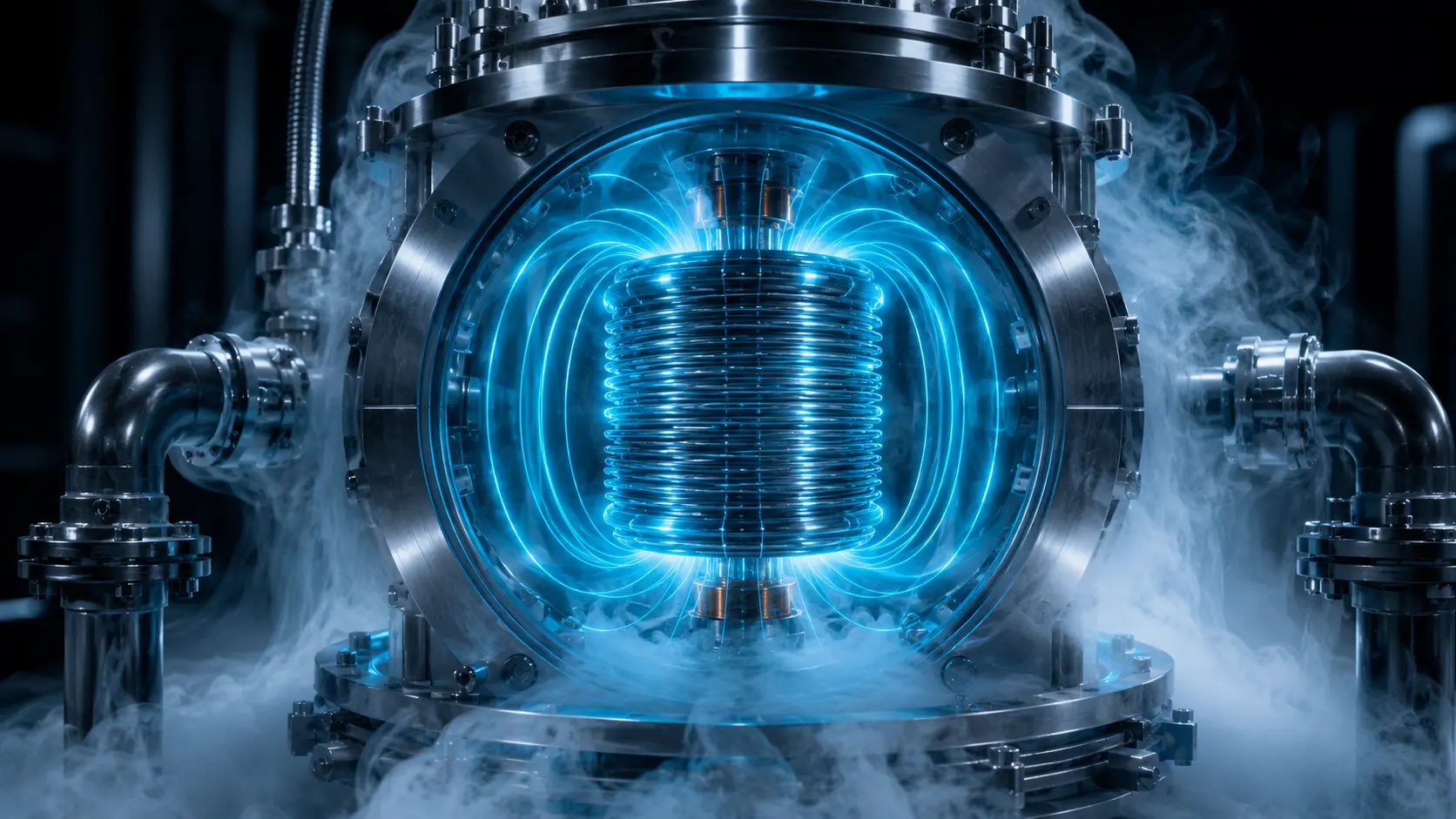

At a Glance
- Concept: A frictionless, cryogenic battery that stores electrical energy indefinitely in a magnetic field.
- Why it matters: It can discharge massive amounts of power in milliseconds, preventing catastrophic grid failures and protecting sensitive manufacturing plants from microscopic power dips.
- Who uses it: High-tech semiconductor foundries, utility grid operators, and military defense contractors.
- Biggest takeaway: Unlike chemical batteries that degrade over time, a SMES system has zero moving parts, relies purely on physics, and can be charged and discharged infinitely without losing capacity.
In Simple Words
If you push a heavy block across a concrete floor, you have to keep pushing, or friction will make it stop. If you push that same block across a perfectly smooth sheet of ice in a vacuum, it will slide forever without any extra effort.
Electricity works the same way. When electricity travels through normal copper wires, it encounters electrical “friction” called resistance. This resistance creates heat and wastes energy.
Superconducting Magnetic Energy Storage (SMES) removes the friction. Engineers take a coil of special wire and freeze it to near absolute zero. At this extreme temperature, the electrical resistance drops to exactly zero.
If you pump electricity into this frozen coil and connect the ends together, the electricity will run around the loop forever, creating a powerful magnetic field. Because there is no friction, no energy is lost. When the local power grid suddenly needs a massive, instantaneous burst of electricity, a switch is flipped, and that endlessly looping electricity is instantly routed out of the coil and back into the grid.
Why This Matters
The global power grid is losing its physical momentum.
For the last century, the grid was powered by massive, heavy, spinning metal turbines running on coal, natural gas, and nuclear power. Because these turbines are physically heavy, they have “inertia.” If a massive factory suddenly turns on, drawing a huge amount of power, the heavy turbines keep spinning through the shock, keeping the grid stable for a few crucial seconds.
As the world transitions to solar and wind power, those heavy spinning turbines are being retired. Solar panels and wind turbines are connected to the grid through digital inverters; they have zero physical inertia. When a sudden power surge hits a highly renewable grid, there is no heavy metal to absorb the shock. The voltage can drop instantly, triggering a cascading, city-wide blackout.
Lithium-ion batteries are excellent for storing solar power for the night, but their chemical reactions are too slow to catch a voltage drop that happens in milliseconds. Furthermore, asking a chemical battery to absorb thousands of micro-shocks every day will destroy its chemical structure within a few years.
SMES systems provide “synthetic inertia.” Because they release energy at the speed of light, they act as the ultimate shock absorbers for the modern, renewable grid. They ensure that even without heavy coal turbines, the delicate voltage requirements of modern civilization remain flawlessly stable.
The Big Picture
When evaluating energy storage, engineers divide technologies into two categories: Energy Density (how long it can run) and Power Density (how fast it can release the energy).
A lithium-ion battery is a marathon runner. It has high energy density and can power a house for an entire night, but it cannot release all its power in three seconds.
A SMES system is a sprinter. It has incredibly low energy density—a massive, multi-million-dollar SMES facility might only hold enough total energy to power a neighborhood for a few minutes. However, its power density is virtually unmatched. It can dump its entire electrical payload into the grid in a fraction of a second. This makes SMES useless for long-term storage, but irreplaceable for high-voltage power conditioning and emergency grid stabilization.
How It Works
Storing raw electricity as a magnetic field requires overcoming immense thermal and electromagnetic challenges.
Here is the exact mechanical and physical architecture of a SMES system.
1. The Fundamental Problem
A standard electromagnet consists of copper wire wrapped around a core. As long as a battery is attached, the electricity flows and creates a magnetic field. However, because copper has resistance, the electricity constantly turns into heat. If you disconnect the battery, the electricity stops, and the magnetic field collapses instantly. You cannot store energy this way.
2. The Superconducting Coil
To fix this, engineers replace the copper with a superconducting alloy, such as Niobium-Titanium (NbTi). When this material is frozen below its “critical temperature,” it undergoes a quantum phase transition. Electrons pair up (known as Cooper pairs) and glide through the atomic structure of the wire without hitting any atoms. Resistance drops to absolute zero.
3. The Cryogenic Refrigeration System
To achieve this quantum state, the coil is placed inside a cryostat—a highly insulated vacuum thermos. Liquid helium is pumped into the cryostat, chilling the coil to 4.2 Kelvin (roughly -452°F or -269°C). The refrigeration system must run continuously to maintain this extreme cold.
4. Charging and the Persistent Current Mode
To charge the SMES, engineers pump a Direct Current (DC) from the power grid into the frozen coil. As the current flows, it generates a massive magnetic field around the coil. Once the coil is fully “charged,” a superconducting switch connects the two ends of the coil together, forming a closed loop. The external power supply is disconnected. The electricity now loops endlessly in a circle—called a “persistent current”—holding the magnetic energy perfectly stable with zero degradation.
5. The Power Conditioning System (PCS)
When the grid needs the energy back, it needs it in Alternating Current (AC). The SMES uses a Power Conditioning System (PCS) packed with solid-state inverters. The switch is opened, and the direct current instantly floods out of the coil, into the PCS. The PCS converts the DC into a perfect AC sine wave and injects it into the power grid. Because there are no chemical reactions or moving physical parts, this entire discharge process occurs in milliseconds.
Real-World Applications
Because of their immense cost and specific capabilities, SMES systems are deployed in highly specialized, mission-critical environments.
Semiconductor Megafabs: Manufacturing modern microchips requires hundreds of complex machines operating in perfect synchronization. A voltage sag lasting just 100 milliseconds can ruin an entire batch of silicon wafers, costing the foundry millions of dollars. Semiconductor plants use localized SMES systems to actively monitor the incoming power lines. If the voltage dips for a fraction of a second, the SMES instantly injects power to fill the gap, ensuring the factory equipment never notices the disruption.
Pulse Power for Defense Systems: The military develops directed-energy weapons, such as electromagnetic railguns and high-energy lasers, which require massive bursts of power that a ship’s standard generator cannot provide instantly. SMES systems act as the firing capacitors. They charge up slowly using the ship’s reactor, and then dump massive gigawatt pulses into the weapon system in milliseconds.
Renewable Microgrid Stabilization: In isolated grids, such as islands relying heavily on wind power, sudden gusts or drops in wind speed cause severe frequency fluctuations. By integrating a SMES unit alongside a wind farm, the SMES absorbs the sudden spikes in generation and instantly fills the gaps during sudden lulls, smoothing the volatile wind energy into a perfectly steady, reliable electrical output.
Economic & Strategic Impact
The economics of SMES are defined by their incredibly high capital expenditure (CapEx) and extremely low operational expenditure (OpEx), excluding the cooling costs.
Building a SMES facility requires expensive superconducting alloys, vacuum-insulated cryostats, and a steady supply of liquid helium (which is a globally scarce and expensive element). However, the return on investment (ROI) is calculated in damage prevention. If a $5 million SMES system prevents a single 200-millisecond voltage sag that would have ruined $15 million worth of industrial manufacturing, the system pays for itself in a fraction of a second.
Strategically, the holy grail of SMES development is the commercialization of High-Temperature Superconductors (HTS). While “high temperature” is relative, HTS materials (like YBCO) become superconducting at roughly 77 Kelvin (-321°F). This temperature can be achieved using liquid nitrogen, which is vastly cheaper and easier to manufacture than liquid helium.
As HTS wire manufacturing scales and costs drop, SMES will transition from a niche industrial tool to a standard grid-level asset, providing the synthetic inertia required to permanently retire the last remaining fossil-fuel peaker plants.
Advantages
Infinite Cycle Life
Chemical batteries degrade every time they are charged and discharged. Because SMES relies purely on the physics of a magnetic field and zero-resistance wire, a SMES unit can be cycled millions of times without suffering a single percentage point of degradation.
Instantaneous Response Time
The system transitions from fully idle to maximum power output in less than a few milliseconds, making it the fastest-reacting energy storage technology currently available to grid operators.
Extremely High Round-Trip Efficiency
Because there is no electrical friction and no energy lost to chemical conversions, the energy put into a SMES coil is almost exactly the energy you get back out. The round-trip efficiency of the magnetic storage often exceeds 95%.
Limitations
The Parasitic Cooling Load
The refrigeration system required to keep the coil at near absolute zero consumes a constant stream of electricity. If the energy required to run the cryocooler is factored into the efficiency equation, the overall system efficiency drops significantly.
Low Energy Density
SMES systems are physically massive compared to the amount of total energy they store. A system the size of a shipping container might only hold enough total energy to match a few high-end electric car batteries, though it releases that energy exponentially faster.
Extreme Magnetic Fields
The massive magnetic field generated by the superconducting coil can interfere with nearby electronics, communications, and human medical devices (like pacemakers). SMES facilities must be built with heavy, expensive magnetic shielding, or buried deep underground to contain the electromagnetic radius.
Common Misconceptions
Misconception: SMES can be used to store solar power for nighttime use.
Reality: While technically possible, it is economically absurd. Using a multi-million-dollar cryogenic electromagnet to slowly release power over 8 hours is vastly more expensive than using standard lithium-ion batteries. SMES is strictly for high-power, short-duration applications.
Misconception: High-Temperature Superconductors (HTS) work at room temperature.
Reality: In the field of physics, “high temperature” simply means warmer than liquid helium. HTS materials still require liquid nitrogen to stay at -321°F. True room-temperature superconductors remain an unproven theoretical holy grail.
Misconception: If the power grid goes down, the SMES coil will stay frozen forever.
Reality: If the facility loses power, the cryocooler stops. The coil will slowly warm up. If it breaches its critical temperature, it instantly loses its superconductivity. The massive magnetic field will violently collapse, turning all the stored energy into intense heat in a fraction of a second—a dangerous event known as a “quench.”
What Most People Miss
The interaction between a SMES system and grid frequency is profound.
On an electrical grid, alternating current (AC) must maintain a perfect frequency (60 Hz in the US, 50 Hz in Europe). If supply and demand become unbalanced, the frequency drops. If it drops too far, the entire grid disconnects itself to prevent physical damage to home appliances and factory motors.
Grid operators traditionally pay natural gas plants a premium for “Frequency Regulation”—asking them to constantly throttle their engines up and down every few seconds to keep the frequency balanced. Because a SMES system connects to the grid through high-speed solid-state inverters, it can inject or absorb precise, microscopic bursts of power thousand of times a minute with zero mechanical wear and tear, performing frequency regulation with vastly higher precision than any spinning fossil-fuel turbine.
Comparison Table
| Feature | SMES (Superconducting) | Lithium-Ion Battery | Flywheel Energy Storage | Supercapacitor |
| Storage Mechanism | Magnetic Field. | Chemical Reaction. | Kinetic Energy (Spinning mass). | Static Electric Charge. |
| Response Time | Milliseconds. | Seconds. | Milliseconds. | Milliseconds. |
| Cycle Life | Infinite. | 2,000 to 5,000 cycles. | High (requires bearing maintenance). | ~1 Million cycles. |
| Energy Density (Duration) | Low (Seconds/Minutes). | High (Hours). | Low (Seconds/Minutes). | Very Low (Seconds). |
| Maintenance Burden | High (Cryogenic cooling systems). | Low (Degradation monitoring). | Moderate (Vacuum & Bearings). | Low. |
| Primary Grid Use | Voltage sag mitigation / Synthetic inertia. | Load shifting (Solar to Night). | Frequency regulation. | Brief pulse power. |
Case Study
Situation: A major semiconductor manufacturing facility in Taiwan experienced periodic, unpreventable microscopic voltage sags. These sags, often lasting less than 200 milliseconds, were caused by distant lightning strikes hitting the regional transmission grid.
Challenge: The factory’s photolithography machines operate at nanometer precision. A 200-millisecond drop in voltage was enough to misalign the lasers, permanently ruining millions of dollars’ worth of silicon wafers. Traditional backup diesel generators took 10 seconds to turn on—far too slow to catch a millisecond event.
Solution: The facility installed a Micro-SMES system directly inline with the factory’s main power feed. The superconducting coil sat fully charged in persistent current mode.
Outcome: When the next lightning strike caused the grid voltage to sag, the SMES system’s power conditioning system detected the drop in under 2 milliseconds. It instantly fired a massive burst of stored magnetic energy into the factory’s internal grid, holding the voltage perfectly level for the half-second required for the grid to stabilize.
Lessons Learned: In high-value manufacturing, raw energy storage capacity is irrelevant compared to response speed. The SMES unit only held a few seconds worth of power, but the speed of its delivery transformed a multi-million-dollar disaster into a completely unnoticeable non-event.
Future Outlook
Next 12–24 Months
The expansion of AI data centers will drive niche demand for SMES variants. Because a single data center now requires the power of a small city, any momentary power fluctuation threatens thousands of highly sensitive GPUs. Premium data center architects will increasingly evaluate SMES systems combined with standard uninterruptible power supplies (UPS) to guarantee absolute “six nines” (99.9999%) power quality.
Next 3–5 Years
Advancements in High-Temperature Superconducting (HTS) tape, particularly REBCO (Rare-Earth Barium Copper Oxide) materials, will reach commercial economies of scale. By replacing liquid helium cryogenics with liquid nitrogen cooling loops, the operational costs and physical footprint of SMES systems will drop by more than 50%, making them financially viable for standard municipal utility substations.
Next 10 Years
As coal and natural gas peaker plants are fully decommissioned in aggressive zero-carbon regions, grid operators will face a severe deficit of physical inertia. To prevent grid collapse, utility commissions will mandate the installation of hybrid storage parks. These facilities will pair massive, slow lithium-ion battery banks with lightning-fast SMES systems. The SMES will absorb the instant shocks, while the lithium batteries handle the heavy lifting over hours.
Most Likely Scenario
SMES will not replace chemical batteries. Instead, it will be categorized as a critical power-conditioning appliance. As the world becomes entirely dependent on hyper-sensitive digital infrastructure and renewable, inverter-based energy, the ability to store and release kinetic power frictionlessly at the speed of light will become a mandatory requirement for maintaining a modern, stable power grid.
Key Takeaways
- Superconducting Magnetic Energy Storage (SMES) stores electricity as a massive magnetic field by running current through a wire with zero electrical resistance.
- Achieving zero resistance requires freezing the coil to near absolute zero using complex cryogenic systems (liquid helium or nitrogen).
- SMES has very low energy density (duration) but unmatched power density (instantaneous burst), functioning as a sprinter rather than a marathon runner.
- It is the ultimate solution for “synthetic inertia,” instantly stabilizing voltage drops on renewable-heavy power grids.
- Unlike lithium-ion batteries, SMES systems have no chemical reactions or moving parts, allowing them to be charged and discharged infinitely without degrading.
- They are primarily used today to protect high-value manufacturing plants, like semiconductor fabs, from millisecond power interruptions.
- The primary limitation is the high capital cost of the superconducting alloys and the continuous power required to run the cryogenic refrigeration systems.
Glossary
Cooper Pairs: A phenomenon in quantum physics where electrons pair up at extremely low temperatures, allowing them to move through a conductive lattice without colliding with atoms, resulting in zero electrical resistance.
Cryostat: A highly insulated, vacuum-sealed container used to maintain extremely low cryogenic temperatures required for superconductivity.
Energy Density: A metric describing how much total energy a system can store (how long it can run).
High-Temperature Superconductor (HTS): Materials that achieve zero electrical resistance at temperatures higher than traditional superconductors, often capable of being cooled by liquid nitrogen (-321°F) rather than expensive liquid helium.
Power Conditioning System (PCS): The solid-state electronic interface that converts the direct current (DC) stored in the SMES coil into alternating current (AC) perfectly synchronized with the power grid.
Power Density: A metric describing how fast a system can discharge its stored energy.
Quench: A sudden, dangerous event where a superconducting wire loses its frozen state and regains electrical resistance, causing the stored magnetic energy to violently convert into heat.
Synthetic Inertia: The use of fast-acting power electronics and energy storage to mimic the stabilizing physical momentum traditionally provided by heavy, spinning fossil-fuel turbines.
Frequently Asked Questions
Why don’t we use SMES to power electric cars?
Because of energy density and cooling requirements. A SMES system large enough to drive a car 300 miles would be massive, incredibly heavy, and would require a liquid helium refrigeration system onboard. Chemical batteries are much lighter and hold power vastly longer.
How cold is “near absolute zero”?
Traditional Low-Temperature Superconductors (LTS) require cooling to 4.2 Kelvin, which is approximately -452°F or -269°C.
Does a SMES system make noise?
The superconducting coil itself is completely silent, as there are no moving parts. However, the external cryogenic refrigeration compressors and the solid-state cooling fans generate a persistent, industrial hum.
What happens if you touch the wire while it’s charged?
The coil is securely sealed inside a thick, vacuum-insulated cryostat. If you somehow breached the cryostat, the intense cold would instantly freeze human tissue, and breaching the system would trigger a violent “quench,” destroying the coil.
Is the magnetic field dangerous to humans?
Yes, close exposure to a multi-megawatt SMES magnetic field can interfere with pacemakers and pull ferromagnetic objects (like tools or keys) violently toward the machine. The systems are heavily shielded or placed in restricted exclusion zones.
How does SMES compare to a flywheel?
Both are used for fast power delivery and grid stabilization. A flywheel stores energy physically in a spinning mass in a vacuum; it eventually loses energy due to microscopic bearing friction. A SMES stores energy electromagnetically with absolute zero friction, making it even faster and more efficient, though more expensive to cool.
Are SMES systems actually used today?
Yes. While they are not on every street corner, commercial SMES systems are actively deployed at major semiconductor manufacturing plants, military installations, and specific utility substations that require flawless power quality.
Sources
- IEEE Xplore: Superconducting Magnetic Energy Storage (SMES) for Power Systems
- U.S. Department of Energy (DOE): Energy Storage Technology and Cost Characterization Report
- International Energy Agency (IEA): The Role of Synthetic Inertia in Highly Renewable Power Grids
- Journal of Energy Storage: Comparative Analysis of HTS and LTS in Magnetic Energy Storage