Advertisement
)

At a Glance
- Concept: Removing the regulatory barriers that prevented small-scale, decentralized energy devices from selling their power to the massive regional grid operators.
- Why it matters: It unlocks billions of dollars in latent energy storage. Millions of home batteries and electric vehicles (EVs) are useless to the broader grid unless they can legally aggregate and get paid for their capacity.
- Who uses it: Distributed Energy Resource Aggregators (DERAs), Virtual Power Plant (VPP) software startups, utilities, and regional grid operators (ISOs/RTOs).
- Biggest takeaway: A home battery cannot bid into the wholesale market alone. Order 2222 mandates that if a software company digitally groups enough home batteries together to hit a 100-kilowatt (kW) threshold, the grid operator must legally treat that software bundle exactly like a traditional power plant.
In Simple Words
Imagine you have a solar panel and a battery at your house. Currently, you use them to lower your own personal power bill. But what if the regional power grid is suffering from a massive heatwave, is about to crash, and is willing to pay premium prices for emergency electricity?
Your single home battery is too small for the giant grid operator to care about. They only talk to coal plants, nuclear facilities, and massive wind farms that generate immense amounts of power.
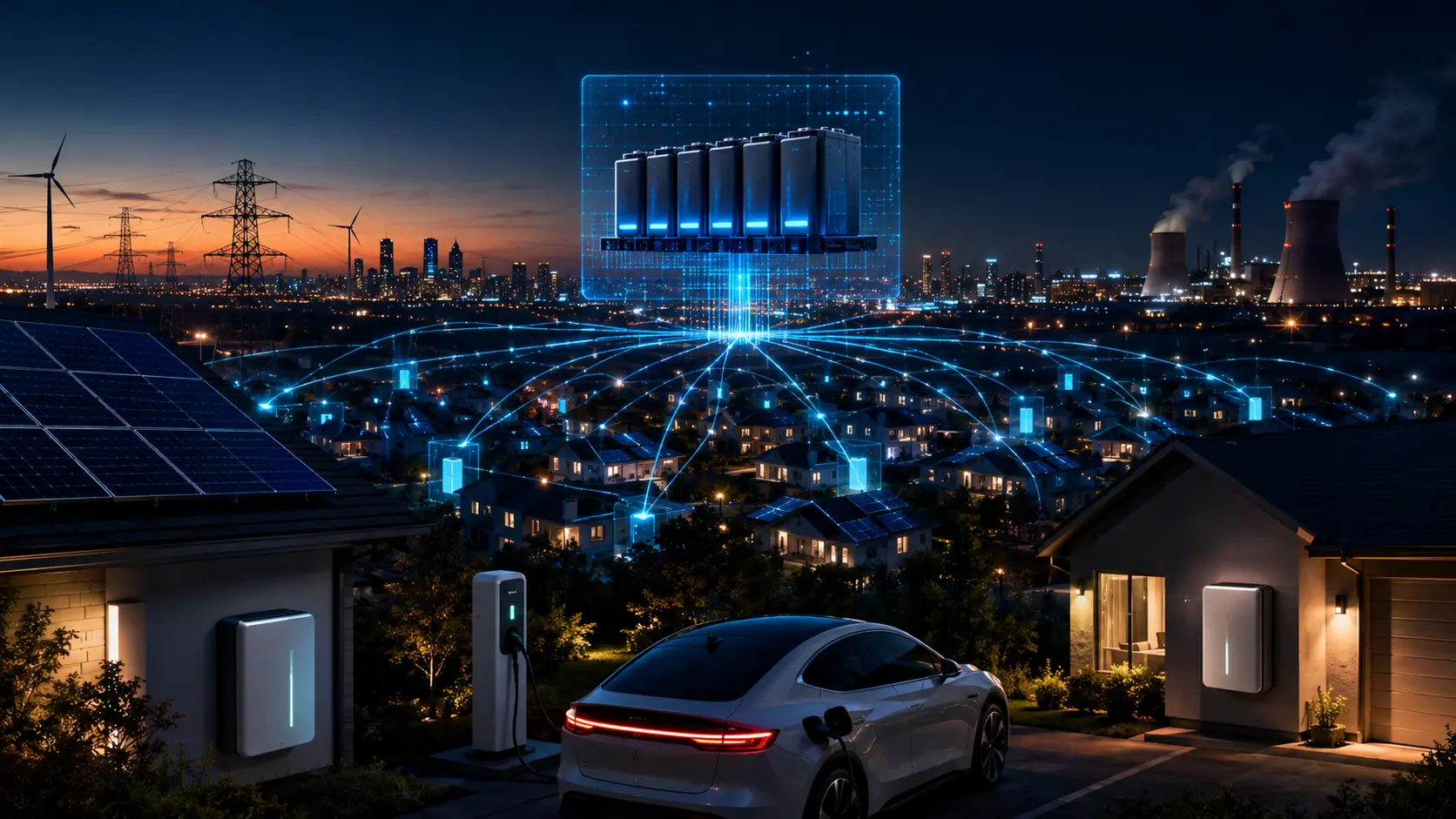
FERC Order 2222 changes this. It allows software companies (called aggregators) to digitally link your battery together with 10,000 other neighborhood batteries, creating a “Virtual Power Plant.” This federal law forces the organizations that run the power grid to treat this digital bundle of home batteries exactly the same as a physical, centralized power plant. It bridges the gap between your garage and the wholesale energy market, allowing regular homes and businesses to get paid for keeping the regional grid alive.
Why This Matters
The global transition to renewable energy is triggering a localized grid crisis. As the economy electrifies—adding millions of electric vehicles and heat pumps—the demand for electricity is spiking, while the retirement of reliable fossil-fuel plants reduces stable supply.
Building new, massive physical power plants takes a decade of permitting and billions of dollars. However, the capacity we need already exists; it is just decentralized. Millions of Americans have massive batteries sitting idle in their garages (either mounted on the wall or inside their EVs) for 95% of the day.
Until FERC Order 2222, this distributed hardware was locked out of the lucrative wholesale markets (Energy, Capacity, and Ancillary Services) governed by Independent System Operators (ISOs) and Regional Transmission Organizations (RTOs). By breaking down the monopolistic barriers to entry, Order 2222 fundamentally democratizes grid infrastructure. It turns energy consumers into “prosumers,” creating a massive new financial asset class out of hardware that has already been purchased, fundamentally altering the unit economics of residential solar and EV ownership.
The Big Picture
To understand this ruling, you must separate the “Retail” grid from the “Wholesale” grid.
When you pay your monthly electric bill, you are operating in the Retail Market. This is controlled by your local utility company and regulated by your state’s Public Utility Commission (PUC).
The local utility does not generate all the power it sells you. It buys that power in bulk from the Wholesale Market. The wholesale market is operated by massive regional entities like PJM, CAISO, and MISO. These markets cross state lines and are regulated by the federal government—specifically the Federal Energy Regulatory Commission (FERC).
Historically, rooftop solar and home batteries were trapped entirely in the retail market through simple, localized programs like “net metering.” FERC Order 2222 bridges the gap. It provides a legal framework for these small, retail-level devices to bypass the local utility and sell their collective power directly into the massive, federally regulated wholesale market.
How FERC Order 2222 Works
Injecting decentralized hardware into a massive, highly synchronized electrical grid requires flawless coordination. Here is the first-principles breakdown of the Order 2222 mechanism.
1. The Fundamental Problem
A regional grid operator (like ISO-NE or NYISO) balances supply and demand every five minutes to prevent blackouts. They cannot manually coordinate with 50,000 individual residential batteries; the telemetry and communication overhead would instantly crash their control systems. Furthermore, wholesale markets historically required resources to be massive (often a minimum of 1 to 5 Megawatts) just to place a bid.
2. The Insufficiency of Early Solutions
Early solutions like “Demand Response” allowed large commercial factories to get paid for turning their machines off during emergencies. While helpful, Demand Response is a negative action (using less power). The grid desperately needs positive action (injecting new power). Furthermore, retail net metering only allowed homes to spin their meters backward, providing no real-time dispatch control to the grid operator during acute crises.
3. The Core Mechanism: The DERA
FERC Order 2222 establishes a new type of market participant: the Distributed Energy Resource Aggregator (DERA). A DERA is usually a software company. The DERA acts as the single point of contact for the ISO/RTO. The DERA guarantees that its digital pool of small resources can collectively meet the strict, 100-kilowatt (kW) minimum size threshold mandated by FERC. The grid operator only sees and commands the DERA; the DERA’s software handles the complex orchestration of the thousands of individual home batteries underneath it.
4. Technical Depth: Locational Marginal Pricing (LMP) and Telemetry
A 100 kW injection of power is useless if the grid operator does not know exactly where it is on the grid. Power grids utilize Locational Marginal Pricing (LMP) nodes to calculate the exact value of electricity at specific geographical intersections.
Under Order 2222, a DERA must mathematically map its aggregated devices to specific pricing nodes. If the aggregation spans multiple nodes (a heterogeneous, multi-node aggregation), the DERA must use complex distribution factors to prove to the ISO exactly how much power will flow into each specific intersection. Furthermore, the DERA assumes the responsibility of providing real-time telemetry (metering data) to the ISO, guaranteeing the power was actually delivered.
5. Real-World Consequences: EDC Override
Because these small resources are physically connected to the local street-level wires, a major conflict arises. What if the federal ISO orders the DERA to discharge 5 Megawatts of aggregated power, but the local street transformer cannot handle the surge and will explode?
Order 2222 solves this by mandating coordination with the Electric Distribution Company (EDC)—the local utility. The local EDC is granted the legal authority to instantly override the federal ISO’s dispatch command if discharging the aggregated batteries would threaten the physical safety of the local distribution lines.
Real-World Applications
FERC Order 2222 enables a massive variety of commercial architectures previously deemed illegal or technically impossible.
Heterogeneous Virtual Power Plants (VPPs): Order 2222 explicitly mandates that aggregations can be “heterogeneous.” A DERA does not need a pool of identical batteries. They can bundle a 50 kW commercial solar array, a 30 kW backup diesel generator, a 10 kW smart thermostat network, and a 10 kW electric vehicle charger into a single 100 kW bid. This allows software companies to construct highly dynamic portfolios that cancel out each other’s weaknesses.
Fleet EV Charging Monetization: Commercial logistics companies managing fleets of electric delivery vans are using Order 2222 to offset their capital costs. When the fleet is parked overnight, a DERA aggregates the immense battery capacity of the 50 vans and bids them into the ISO’s “Ancillary Services” market. The fleet gets paid merely for being available to discharge power for frequency regulation, turning a depreciating vehicle into a revenue-generating grid asset.
Microgrid Resilience Integration: Universities and hospital campuses equipped with localized microgrids (combining solar, thermal storage, and battery backups) can now seamlessly transition from acting as passive loads to active wholesale market participants. During normal operations, they sell their excess aggregated capacity to the RTO. If a storm hits, they island themselves from the grid entirely.
Economic & Strategic Impact
The financial implications of Order 2222 are restructuring the utility sector.
Historically, traditional utilities operated as natural monopolies. They owned the centralized power plants and the transmission lines. Order 2222 breaks the generation monopoly. By allowing third-party DERAs to bundle residential hardware and bid into wholesale markets, power shifts from the utility giants to agile software startups and the hardware owners themselves.
Financially, this solves the “double counting” dilemma. RTOs and states have spent years battling over who gets credit for a megawatt of power. Order 2222 forces ISOs to establish strict rules preventing a home battery from getting paid twice for the exact same physical action (e.g., getting paid by the state for a retail peak-shaving program, while simultaneously getting paid by the federal ISO for a wholesale capacity bid).
Strategically, the implementation timeline has been a brutal battleground. While FERC issued the order in 2020, the complexity of aligning software telemetry and local utility safety overrides pushed actual market integration deep into the 2020s. In 2025 and 2026, major ISOs like MISO and ISO-NE finalized their compliance structures, officially opening the floodgates for mass commercial deployment.
Advantages
- Democratized Revenue: Regular consumers and small businesses gain access to the highly lucrative wholesale energy markets previously reserved for billionaire utility conglomerates.
- Grid Resilience without CapEx: The grid gains access to gigawatts of dispatchable emergency power without the public needing to fund the multi-billion dollar construction of new natural gas peaker plants.
- Technology Neutrality: Heterogeneous aggregation allows software companies to mix and match any combination of generation, storage, and demand reduction technologies to meet grid needs.
- Lower Consumer Costs: By increasing competition in the wholesale capacity markets, aggregated DERs drive down the clearing price of electricity, ultimately lowering rates for all ratepayers.
Limitations
- Small Utility Opt-Out Constraint: Order 2222 contains a crucial compromise. It prohibits DER aggregations from participating if they are located within the territory of a small utility (one that distributed 4 million MWh or less in the prior year), unless the local regulatory authority explicitly opts-in.
- The Telemetry Burden: Providing 5-minute interval metering data to an ISO requires highly expensive, specialized hardware and software integration that many small residential systems lack out of the box.
- EDC Override Friction: Local utilities (EDCs) can block an aggregation from discharging to “protect the local lines.” Critics argue that legacy utilities will weaponize this safety override to intentionally stifle competition from third-party DERAs.
- Jurisdictional Complexity: The boundary between federal wholesale markets (FERC) and state retail markets (PUCs) remains highly contentious, leading to massive administrative overhead for aggregators trying to operate in multiple states.
Common Misconceptions
Misconception: Order 2222 means I can call the grid operator and sell my solar power directly.
Reality: You cannot participate individually unless your system produces a massive amount of power. You must sign up with a third-party software company (a DERA), which legally represents you and bundles your hardware with thousands of others to meet the 100 kW minimum.
Misconception: The local utility will control my home battery.
Reality: The DERA controls your battery, acting on orders from the federal ISO/RTO. The local utility (EDC) only acts as a safety checkpoint to ensure the local wires don’t overheat.
Misconception: Order 2222 replaced Net Metering.
Reality: They are entirely different mechanisms. Net metering is a state-level retail billing arrangement. Order 2222 is a federal wholesale market participation rule. Regulators are actively building frameworks to ensure a single home can participate in both without illegally double-counting their electricity.
What Most People Miss
The hidden genius of Order 2222 is the mandate for Heterogeneous Aggregation.
If a DERA only aggregated solar panels, the bid would be useless to the grid at 8:00 PM when the sun sets. If a DERA only aggregated demand response (turning off AC units), the bid would be useless in the winter.
Order 2222 forces grid operators to accept bids that mix entirely different technologies together. A DERA can mathematically blend solar panels (for daytime energy), home batteries (for evening dispatch), and EV chargers (for overnight frequency regulation). This allows a scattered, chaotic collection of household appliances to behave mathematically exactly like a highly reliable, 24/7 baseload nuclear plant from the perspective of the grid operator.
Comparison Table
| Feature | Retail Net Metering | Traditional Demand Response | FERC Order 2222 Aggregation (DERA) |
| Market Level | Retail (State/PUC). | Wholesale (FERC/ISO). | Wholesale (FERC/ISO). |
| Primary Mechanism | Spinning the localized meter backward. | Being paid to consume less power during emergencies. | Actively injecting aggregated power and services into the grid. |
| Technology Focus | Almost exclusively Rooftop Solar. | Heavy Industrial Machinery / HVAC. | Heterogeneous (Batteries, Solar, EVs, Thermal). |
| Minimum Size Limit | None (Individual homes). | Usually 1 MW+. | 100 kW (Aggregated). |
| Direct ISO Relationship | No (Managed by local utility). | Yes (Through an aggregator). | Yes (Through a DERA). |
Case Study
Situation: The Independent System Operator of New England (ISO-NE) faced a massive influx of state-subsidized residential solar and battery installations, but these resources were invisible to the wholesale capacity market.
Challenge: ISO-NE had to redesign its entire market architecture to comply with FERC Order 2222. The hardest challenge was the “metering mandate.” ISO-NE historically relied on the local utility (the Host Utility) to provide all billing data. However, DERAs argued that relying on slow, legacy utilities for sub-metering data would cripple the high-speed settlement required for virtual power plants.
Solution: Throughout 2024 and 2025, ISO-NE submitted a series of compliance filings. After intense stakeholder debate, FERC ruled decisively in late 2023/2024: the DERA, not the legacy utility, must be designated as the entity responsible for providing high-speed metering information to the ISO for settlement purposes.
Outcome: With the data telemetry dispute resolved, ISO-NE locked in its final implementation timeline. Order 2222 compliance went live for energy and ancillary services in November 2026, seamlessly integrating massive new pools of aggregated residential hardware into the New England grid precisely as winter demand peaked.
Lessons Learned: The technological capability of DERs is irrelevant without modernized data settlement architecture. Stripping the localized data monopoly away from legacy utilities and giving it directly to agile software aggregators was the necessary catalyst for wholesale market disruption.
Future Outlook
Next 12–24 Months
The focus is strictly on ISO/RTO Execution and Interconnection Alignment. As regions like CAISO, NYISO, and ISO-NE operationalize their tariffs in 2026, states are rapidly updating their retail interconnection rules (like adopting IEEE 1547-2018 standards) to ensure localized distribution lines can physically handle the new bi-directional power flows triggered by the wholesale market.
Next 3–5 Years
The industry will face the EDC Override Reckoning. As tens of thousands of EVs attempt to discharge simultaneously during peak pricing events, local utilities will increasingly trigger their safety overrides to block the dispatch, claiming distribution transformer congestion. This will trigger massive legal battles at FERC, forcing utilities to invest billions in localized grid upgrades to handle the DERA traffic.
Next 10 Years
We will witness the rise of Automated Prosumer Arbitrage. Artificial intelligence agents integrated directly into smart home panels will autonomously analyze real-time LMP wholesale node pricing, household weather forecasts, and the family’s EV driving schedule. The AI will dynamically switch the house between retail self-consumption and DERA wholesale aggregation millisecond-by-millisecond to maximize the financial yield of the homeowner’s hardware.
Most Likely Scenario
FERC Order 2222 will be viewed historically as the “Telecommunications Act of 1996” for electricity. By legally decoupling the generation of power from the ownership of the transmission wires, it guarantees that the power grid of the 2030s will not be a centralized monolith, but a chaotic, highly efficient, heavily localized digital marketplace of interconnected hardware.
Key Takeaways
- FERC Order 2222 forces wholesale grid operators (ISOs/RTOs) to allow aggregated Distributed Energy Resources (DERs) to compete directly with traditional power plants.
- The regulation establishes the Distributed Energy Resource Aggregator (DERA), a third-party software entity that bundles small hardware to meet the strict 100 kW market minimum.
- Aggregations can be mathematically heterogeneous, mixing solar, batteries, and EVs to create a balanced, reliable dispatch profile.
- A critical compromise allows local utilities (EDCs) to override a DERA’s dispatch command if discharging the power would physically damage local street-level transformers.
- The order prevents “double counting,” ensuring a single battery cannot be paid twice by retail and wholesale markets for the exact same megawatt.
- Implementation required years of complex software updates, with major grid operators officially rolling out their compliance architectures between 2024 and 2029.
Glossary
Ancillary Services: Specialized grid services (like frequency regulation and voltage support) required to maintain the exact 60Hz stability of the electrical system, highly lucrative for fast-acting batteries.
Distributed Energy Resource (DER): Any small-scale unit of power generation or storage located on the consumer’s side of the meter (e.g., rooftop solar, EV chargers, smart thermostats).
Distributed Energy Resource Aggregator (DERA): The legally recognized software entity that bundles multiple DERs together to meet wholesale market size minimums and acts as the liaison to the grid operator.
Electric Distribution Company (EDC): The traditional, local utility company that owns and maintains the physical wooden poles and transformers on your street.
Heterogeneous Aggregation: A digital bundle of DERs that contains multiple different types of technologies (e.g., mixing solar with thermal storage).
Independent System Operator (ISO) / Regional Transmission Organization (RTO): The massive, federally regulated organizations that balance supply and demand across multi-state high-voltage transmission grids.
Locational Marginal Pricing (LMP): The exact wholesale price of electricity at a specific physical node on the grid, which fluctuates every five minutes based on local supply, demand, and transmission congestion.
Frequently Asked Questions
Does FERC Order 2222 apply to every state?
No. It only applies to areas managed by FERC-regulated ISOs and RTOs (like PJM, MISO, CAISO, NYISO, ISO-NE, and SPP). Regions without organized wholesale markets (like parts of the Southeast and West) are not subject to these specific ISO directives.
Can my local utility stop me from joining an aggregator?
Generally, no, unless you are served by a “small utility” (under 4 million MWh in annual sales). For those small utilities, the local regulator must explicitly “opt-in” to allow participation.
Who pays the homeowner for the power?
The federal grid operator (the ISO) pays the aggregator (the DERA) based on the wholesale clearing price. The aggregator takes a software fee/cut, and then passes the remaining revenue down to the homeowner based on their private contract.
How does the grid operator know my battery actually discharged?
The DERA is required to provide highly granular, real-time telemetry (metering data) back to the grid operator, mathematically proving that the aggregated power was injected at the correct geographical node.
Can I still use net metering if I join a DERA?
Yes, but with strict accounting limits. You can use net metering to offset your own bill, but the grid operator will use “double-counting” rules to ensure you are not paid the wholesale rate for the exact same electrons that just spun your retail meter backward.
Why did it take years to implement a rule passed in 2020?
Because upgrading the software systems of a multi-state power grid is incredibly dangerous. The ISOs had to rewrite their entire algorithmic bidding engines to handle thousands of small, multi-node aggregations while establishing new legal safety protocols with local street-level utilities.
Sources
- Federal Energy Regulatory Commission (FERC): Order No. 2222 Explainer: Facilitating Participation in Electricity Markets by Distributed Energy Resources
- OSTI.gov: FERC order 2222 & DER policy and implementation report (January 2026)
- ISO New England: FERC Order No. 2222 Compliance Timeline and MRWG Updates
- Midcontinent ISO (MISO): ERSC Working Group FERC Order 2222 Update (December 2025)