Advertisement
)

At a Glance
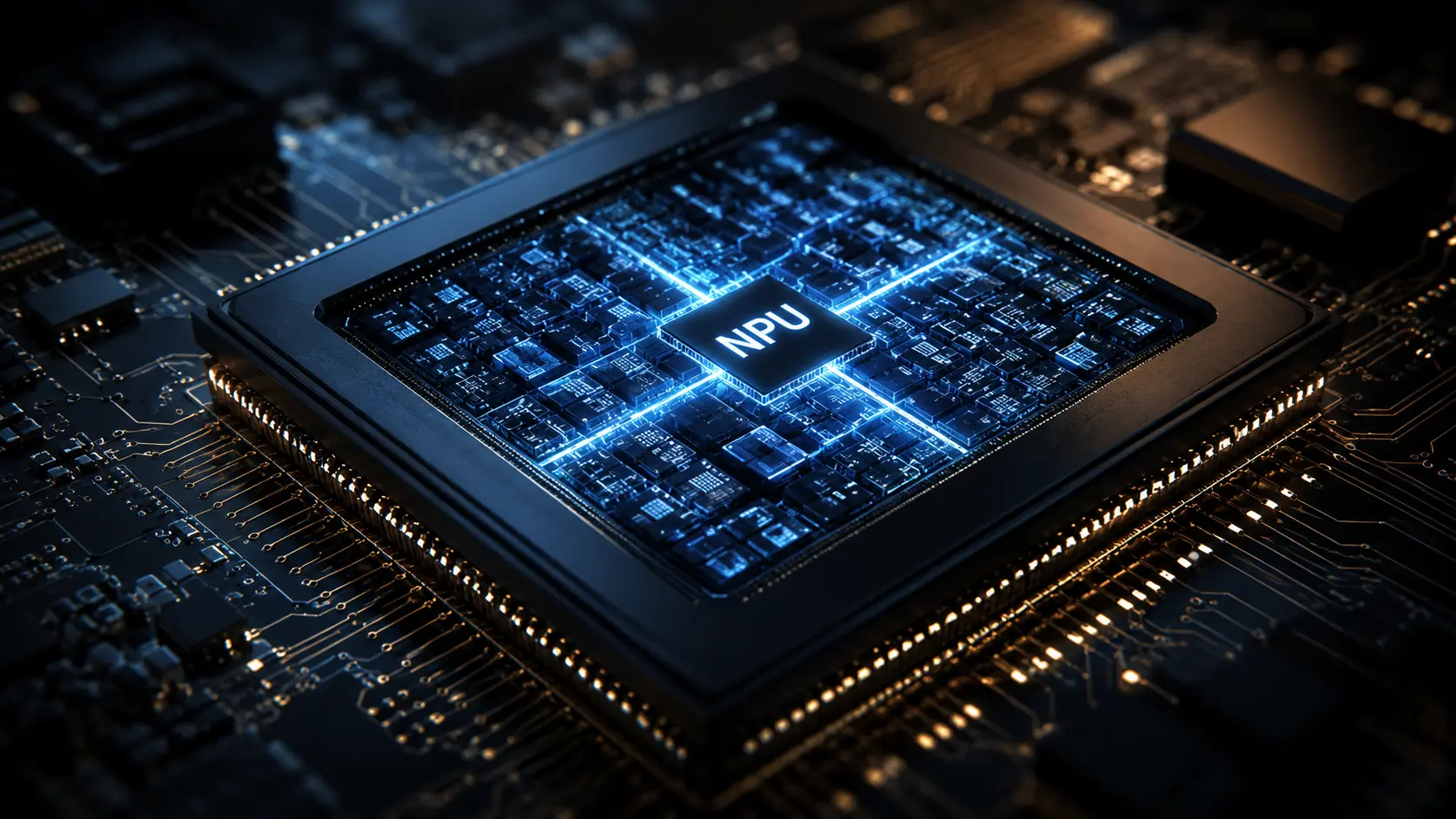
- Concept: A dedicated third “brain” inside modern computers, operating alongside the CPU and GPU, engineered exclusively for machine learning inference.
- Why it matters: Offloading AI tasks to cloud servers introduces latency, subscription fees, and catastrophic data privacy risks. NPUs pull the AI down to the “edge,” processing your private data directly on your physical device.
- Who uses it: Hardware engineers at Apple, Qualcomm, Intel, and AMD, alongside software developers optimizing local Large Language Models (LLMs).
- Biggest takeaway: An NPU is completely useless for traditional computing tasks like opening a spreadsheet. It trades general versatility for extreme performance-per-watt in one specific domain: running neural networks.
In Simple Words
Think of your computer’s processor (the CPU) as a brilliant, versatile professor. This professor can solve any complex problem you throw at them, but they solve them one at a time. The graphics card (the GPU) is like a massive stadium full of high school students. They cannot solve complex logic problems, but if you give them a million simple math equations, they will finish them all simultaneously.
For decades, computers only needed the professor and the students. Then, artificial intelligence arrived.
AI requires a very specific type of math—matrix multiplication—performed billions of times a second continuously. If you force the professor (CPU) to do it, the computer freezes. If you force the stadium of students (GPU) to do it, they require massive amounts of electricity, and your laptop battery dies in an hour.
The Neural Processing Unit (NPU) is a highly specialized assembly line built next door. It is designed to do absolutely nothing except matrix multiplication. Because it only does one thing, it does it faster and with a fraction of the electricity, allowing your laptop to run AI assistants continuously in the background without the fan ever turning on.
Why This Matters
The tech industry is rapidly pivoting away from the cloud.
For the last three years, generative AI was almost exclusively processed in massive, billion-dollar data centers owned by hyperscalers like Microsoft, Google, and Amazon. Every time you asked an AI a question, your data was sent over the internet, processed on an NVIDIA server, and sent back. This creates three critical bottlenecks: high latency, massive server costs for the tech companies, and severe privacy concerns for enterprise users who legally cannot send proprietary company data to a third-party cloud.
The NPU solves the “Edge AI” dilemma. By physically embedding an NPU into the silicon of everyday devices, the processing happens locally.
In 2024, Microsoft drew a hard line in the sand by establishing the “Copilot+ PC” standard, mandating that any new Windows AI laptop must contain an NPU capable of at least 40 Tera Operations Per Second (TOPS). This mandate triggered a massive silicon arms race. By 2026, chips like the Qualcomm Snapdragon X2, Intel Panther Lake, and AMD Ryzen AI 400 series have pushed NPU performance beyond 60 to 80 TOPS. For tech investors and developers, the NPU has become the defining hardware metric of the decade, shifting the financial burden of AI compute from the centralized cloud directly to the consumer hardware upgrade cycle.
The Big Picture
The rise of the NPU represents the final death of “Moore’s Law” and the triumph of Domain-Specific Architectures (DSA).
Historically, chipmakers made computers faster by shrinking transistors and packing more of them onto a general-purpose CPU. We have now hit the physical and thermal limits of silicon manufacturing; transistors simply cannot get much smaller without overheating.
Because we can no longer rely on raw physics to make general chips faster, engineers must rely on architecture. Domain-Specific Architecture means dedicating physical silicon real estate to highly specialized, hard-coded circuits that only perform one task. Just as devices in the 1990s added dedicated video-decoding chips so CPUs would not struggle to play DVD movies, modern System-on-Chips (SoCs) now dedicate up to 15 percent of their silicon die entirely to the NPU to handle neural networks.
HOW A NEURAL PROCESSING UNIT WORKS
Running a multi-billion parameter AI model on a thin, passively cooled laptop requires ruthless mathematical optimization at the hardware level.
1. The Fundamental Problem: Matrix Multiplication
Artificial neural networks operate through massive arrays of numbers called matrices. When an AI generates a sentence or identifies a face, it is calculating the mathematical relationship (the “weights”) between thousands of data points. This requires an operation called a dot-product, which involves multiplying two numbers and adding the result to a running total. A CPU processes these calculations sequentially, which is catastrophically slow for AI.
2. The Insufficiency of GPUs for Local Inference
Graphics Processing Units (GPUs) are excellent at parallel matrix math. However, a GPU is a power-hungry beast designed to render 3D video game environments. It requires its own dedicated Video RAM (VRAM) and draws anywhere from 40 to 400 watts of power. While NVIDIA GPUs dominate the cloud for training massive AI models, using a local laptop GPU for continuous, always-on AI inference (like live transcription or background blur) will drain a laptop battery in less than two hours.
3. The Core Mechanism: MAC Units
The NPU abandons general graphics rendering to focus entirely on Multiply-Accumulate (MAC) units. A MAC unit is a hardware circuit explicitly wired to multiply two numbers and add the product to an accumulator in a single clock cycle. An NPU packs tens of thousands of these MAC units into a dense, spatially arranged grid. Data flows directly from one MAC unit to the next without constantly writing back to the main memory, drastically reducing the electrical power required to move data across the chip.
4. Technical Depth: INT8 Quantization
To further reduce power and memory usage, NPUs heavily utilize “Quantization.” AI models are typically trained in the cloud using highly precise 32-bit floating-point numbers (FP32). NPUs use compilers to mathematically compress these weights down to 8-bit integers (INT8) or even 4-bit integers (INT4). While INT8 loses a microscopic fraction of precision, it shrinks the physical size of the AI model by 75 percent. This allows a massive 8-billion parameter model to fit comfortably into the laptop’s RAM and run lightning-fast on the NPU’s INT8-optimized circuits.
5. Real-World Consequences: Unified Memory Architecture
Because compressed AI models are still large, they require massive memory bandwidth. Modern NPUs (like the Apple M-Series or Intel Core Ultra) utilize a Unified Memory Architecture. The CPU, GPU, and NPU all share the exact same physical pool of ultra-fast LPDDR5X RAM on the package. The NPU does not need to waste time or power copying data back and forth from a separate memory bank; it accesses the AI weights directly, enabling real-time, low-latency AI generation with almost zero thermal buildup.
Real-World Applications
NPUs are transitioning from hidden background processors into front-facing application drivers.
Continuous Audio/Video Processing: Video conferencing tools use the NPU for Windows Studio Effects. The NPU analyzes the webcam feed 30 times a second, artificially blurring the background, canceling out background dog barks, and subtly shifting your eyes to maintain fake eye contact with the camera. Because this runs on the NPU, it draws less than 2 watts of power, keeping the laptop cool and silent during a three-hour meeting.
Local Large Language Models (LLMs): Developers use frameworks like ONNX Runtime, OpenVINO, or Apple’s CoreML to run models like Llama 3 or Mistral directly on the device. A lawyer can download 10,000 pages of confidential legal documents and use a local LLM to summarize them. Because the data never connects to an external server, the lawyer maintains absolute attorney-client privilege while bypassing cloud API subscription costs.
Real-Time Biometrics and Security: FaceID and fingerprint recognition algorithms rely entirely on the NPU. By processing the biometric matrix locally within a secure enclave, the device guarantees that your facial topography is never transmitted over a network where it could be intercepted by a threat actor.
Economic & Strategic Impact
The standardization of the NPU has fractured the legacy semiconductor hierarchy.
For decades, Intel and AMD dictated the pace of PC evolution through the x86 architecture. However, Qualcomm recognized the NPU shift early. Because ARM-based processors are natively built for low-power efficiency, Qualcomm leveraged its mobile NPU expertise to launch the Snapdragon X Elite in 2024, capturing the first wave of the Microsoft Copilot+ PC market and dealing a massive blow to Intel’s market share.
This forced a frantic strategic pivot in Silicon Valley. Intel dramatically accelerated its roadmap to launch the Lunar Lake and Panther Lake architectures, explicitly prioritizing NPU TOPS and unified memory over traditional raw CPU clock speeds.
Economically, the NPU is commoditizing AI inference. By pushing the computational heavy lifting down to the consumer hardware edge, hyperscalers like Microsoft can deploy widespread AI tools without absorbing the astronomical cloud-compute costs of running inference for a billion global users.
Advantages
- Extreme Energy Efficiency: NPUs can run AI inference workloads using up to 40% less power than an equivalent GPU, extending mobile battery life from hours to days.
- Absolute Data Privacy: Edge AI ensures that sensitive personal, medical, or corporate data never leaves the physical device, bypassing cloud security vulnerabilities entirely.
- Zero Latency: Because the processing happens locally on the silicon, there is no network lag. AI responses, voice recognition, and video filtering occur instantaneously in real-time.
Limitations
- Terrible at General Compute: An NPU is completely useless for non-AI tasks. It cannot run an operating system, it cannot render a 3D video game, and it cannot load a web browser.
- Training vs. Inference: NPUs are designed exclusively for “inference” (running an already-trained AI model). They lack the precision and raw parallel power required to “train” an AI model from scratch; that task remains heavily dependent on massive NVIDIA data center GPUs.
- Software Fragmentation: Unlike x86 software, which runs universally, AI models must be specifically compiled for different NPUs. A developer currently has to use different software toolchains to optimize an app for an Intel NPU (OpenVINO) versus a Qualcomm NPU (QNN) versus an Apple Neural Engine (CoreML).
Common Misconceptions
Misconception: A higher TOPS number means a better AI computer.
Reality: Tera Operations Per Second (TOPS) is a theoretical maximum metric. A 50 TOPS NPU with terrible memory bandwidth will easily be beaten by a 35 TOPS NPU connected to blazing-fast unified memory. The software compiler’s efficiency matters just as much as the raw hardware number.
Misconception: NPUs will replace GPUs.
Reality: They serve entirely different purposes. GPUs are still mandatory for high-end gaming, 3D rendering, and massive AI training workloads. The NPU simply handles the low-power, continuous AI tasks so the GPU can go to sleep and save battery.
Misconception: You need an internet connection to use AI.
Reality: With a modern NPU, you can download a quantized AI model (like Llama 3) to your local hard drive and generate text, code, and analysis while completely offline in airplane mode.
What Most People Miss
The true bottleneck of modern local AI is not the NPU’s speed—it is the memory bandwidth.
An LLM is essentially a massive file of parameters (numbers). To generate a single word, the NPU must read the entire model file from the RAM into its processing core. If you have a lightning-fast NPU but slow RAM, the NPU spends 90 percent of its time sitting idle, waiting for the data to arrive. This is why Apple’s M-Series chips historically performed so well in AI benchmarks despite quoting lower raw TOPS; their ultra-wide unified memory architecture allowed data to flow to the Neural Engine vastly faster than traditional PC architectures.
Comparison Table
| Feature | CPU (Central Processing Unit) | GPU (Graphics Processing Unit) | NPU (Neural Processing Unit) |
| Primary Design Focus | General-purpose sequential logic | Highly parallel graphics and compute | Matrix multiplication (AI Inference) |
| Power Consumption | Moderate to High | Extremely High | Extremely Low |
| Mathematical Precision | FP64 / FP32 (High precision) | FP32 / FP16 | INT8 / INT4 (Low precision / Quantized) |
| Best Use Case | Operating systems, spreadsheets, databases | 3D rendering, video editing, AI training | Always-on AI, local LLMs, biometric security |
| AI Efficiency | Very Poor | Excellent (but power hungry) | Unmatched performance-per-watt |
Case Study
Situation: In 2024, Microsoft prepared to deeply integrate its Copilot AI directly into the Windows 11 operating system, introducing features like “Recall” which constantly analyzes the user’s screen in the background.
Challenge: Running continuous computer vision and language models on traditional x86 CPUs or integrated GPUs completely destroyed laptop battery life and caused significant thermal throttling (overheating). Microsoft realized the software was unusable on legacy hardware.
Solution (The Hardware Mandate): Microsoft created the “Copilot+ PC” standard. They legally restricted the new AI features from running on any computer that did not possess a hardware NPU capable of at least 40 INT8 TOPS.
Outcome: This mandate caused a tectonic shift in the semiconductor supply chain. Qualcomm, leaning heavily on its mobile Hexagon NPU architecture, was the only company ready at launch with the Snapdragon X Elite (45 TOPS). Intel and AMD were forced to aggressively pull forward their roadmaps, heavily redesigning the silicon layouts of Lunar Lake and Strix Point processors to dedicate massive physical space to new NPU clusters just to meet the 40 TOPS baseline for the holiday sales cycle.
Lessons Learned: In the modern computing era, software dictates silicon. By establishing a hard minimum capability for local AI hardware, a software giant (Microsoft) successfully forced the entire global semiconductor manufacturing base to abandon decades of CPU-centric design in a matter of months.
Future Outlook
Next 12–24 Months
The TOPS war will plateau as memory bottlenecks become obvious. While 2026 silicon easily clears 60 to 80 TOPS, developers will realize that running larger local models (like 13-billion or 30-billion parameter LLMs) is constrained by standard 16GB or 32GB RAM capacities. Laptops will begin shipping with a minimum of 32GB to 64GB of highly integrated LPDDR5X RAM specifically to feed the hungry NPU pipelines, driving up base hardware costs for consumers.
Next 3–5 Years
Software fragmentation will be heavily resolved. Currently, developers must write different code to target Intel, AMD, and Qualcomm NPUs. Unified translation layers (like DirectML on Windows) will mature, allowing a software engineer to write an AI app once and have the operating system automatically route the matrix math to the most efficient NPU on the silicon, regardless of the manufacturer.
Next 10 Years
We will see the integration of NPUs directly into edge sensors rather than just central computer chips. “Smart Image Sensors” will feature microscopic NPUs printed directly onto the camera lens silicon. The camera will use its own NPU to analyze the video, identify a threat or a face, and only send the final metadata to the main computer. This absolute decentralization of inference will make the Internet of Things (IoT) vastly more secure, responsive, and completely independent of cloud architecture.
Most Likely Scenario
The NPU will become as invisible and ubiquitous as the GPU is today. Consumers will stop looking at TOPS metrics, just as they stopped counting CPU megahertz in the 2010s. The presence of a highly capable NPU will simply be assumed, serving as the silent, low-power engine that enables operating systems to anticipate user needs, natively translate languages, and sort data continuously in the background without the user ever explicitly opening an “AI application.”
Key Takeaways
- An NPU (Neural Processing Unit) is a specialized silicon accelerator designed exclusively to process the matrix multiplication math required by neural networks.
- By trading general flexibility for narrow specialization, NPUs run AI tasks exponentially faster and use vastly less power than traditional CPUs or GPUs.
- NPUs heavily utilize INT8 and INT4 quantization, compressing AI models into smaller integer formats to save memory bandwidth without sacrificing significant accuracy.
- The “Copilot+ PC” standard mandates a minimum of 40 TOPS (Tera Operations Per Second) to run local Windows AI features, forcing Intel, AMD, and Qualcomm to redesign their architectures.
- Running AI locally on an NPU eliminates cloud latency, bypasses API subscription costs, and guarantees absolute data privacy for sensitive enterprise workloads.
- Unified memory architecture—where the NPU shares the same ultra-fast RAM pool as the CPU—is often more critical to real-world AI performance than raw TOPS metrics.
Glossary
Copilot+ PC: A hardware standard established by Microsoft requiring a minimum of 16GB RAM and a 40 TOPS NPU to run localized Windows AI features.
Domain-Specific Architecture (DSA): Hardware designed specifically to accelerate a narrow set of tasks (like AI matrix math) efficiently, rather than handling general-purpose computing.
Inference: The process of running live data through an already-trained AI model to get an output (e.g., generating text or blurring a video background).
INT8 Quantization: A mathematical compression technique that converts highly precise 32-bit floating-point numbers (FP32) into 8-bit integers (INT8), drastically shrinking the size and power requirements of an AI model.
MAC Unit: Multiply-Accumulate Unit. The foundational hardware circuit of an NPU, designed to multiply two numbers and add the result in a single, lightning-fast physical clock cycle.
System-on-Chip (SoC): An integrated circuit that combines multiple computing components—such as the CPU, GPU, NPU, and memory controllers—onto a single piece of silicon.
TOPS (Tera Operations Per Second): A metric used to measure the theoretical maximum mathematical throughput of an NPU (trillions of operations per second).
Frequently Asked Questions
Can I add an NPU to my current computer?
No. NPUs are deeply integrated directly into the physical silicon of the CPU die (the System-on-Chip). To get a modern NPU, you must purchase a completely new computer or smartphone featuring an AI-enabled processor.
Does an NPU make my video games run faster?
Directly, no. However, an NPU can handle background tasks (like Discord noise cancellation or streaming video encoding) locally. By offloading these tasks to the NPU, it frees up your CPU and GPU to dedicate 100 percent of their power to generating game frames, resulting in a smoother overall gaming experience.
What is the difference between an NPU and Apple’s Neural Engine?
There is no functional difference. “Neural Engine” is simply Apple’s proprietary marketing term for their custom NPU, which they have been integrating into their A-series phone chips and M-series computer chips for years.
Is a 50 TOPS NPU always faster than a 40 TOPS NPU?
Not necessarily. TOPS is a raw theoretical number. If the 50 TOPS NPU has poor software driver support (meaning the AI app doesn’t know how to talk to it properly), or if the computer has slow RAM, the 40 TOPS chip with highly optimized software and fast memory will perform significantly better in real life.
Can an NPU train an AI model?
Technically yes, but practically no. Training a large AI model from scratch requires immense mathematical precision (FP32) and terabytes of memory over several weeks. NPUs are designed for low-precision inference (INT8), making them unsuitable for the heavy lifting of cloud training.
If I have a massive NVIDIA RTX graphics card, do I need an NPU?
If you are plugged into a wall outlet, your desktop NVIDIA GPU will run local AI models vastly faster than any laptop NPU. The NPU exists strictly to provide AI capabilities in battery-powered, thermally constrained devices (laptops and phones) without melting the chassis.
Sources
- Local AI Master: NPU Comparison 2026 – Intel vs Qualcomm vs AMD vs Apple (Feb 2026)
- Microsoft Support: All about Neural Processing Units (NPUs)
- Jacar Engineering: Next-Generation NPU – AI Hardware in 2026 (March 2026)
- MathWorks: What Is INT8 Quantization and Why Is It Popular for Deep Neural Networks?