Advertisement
)
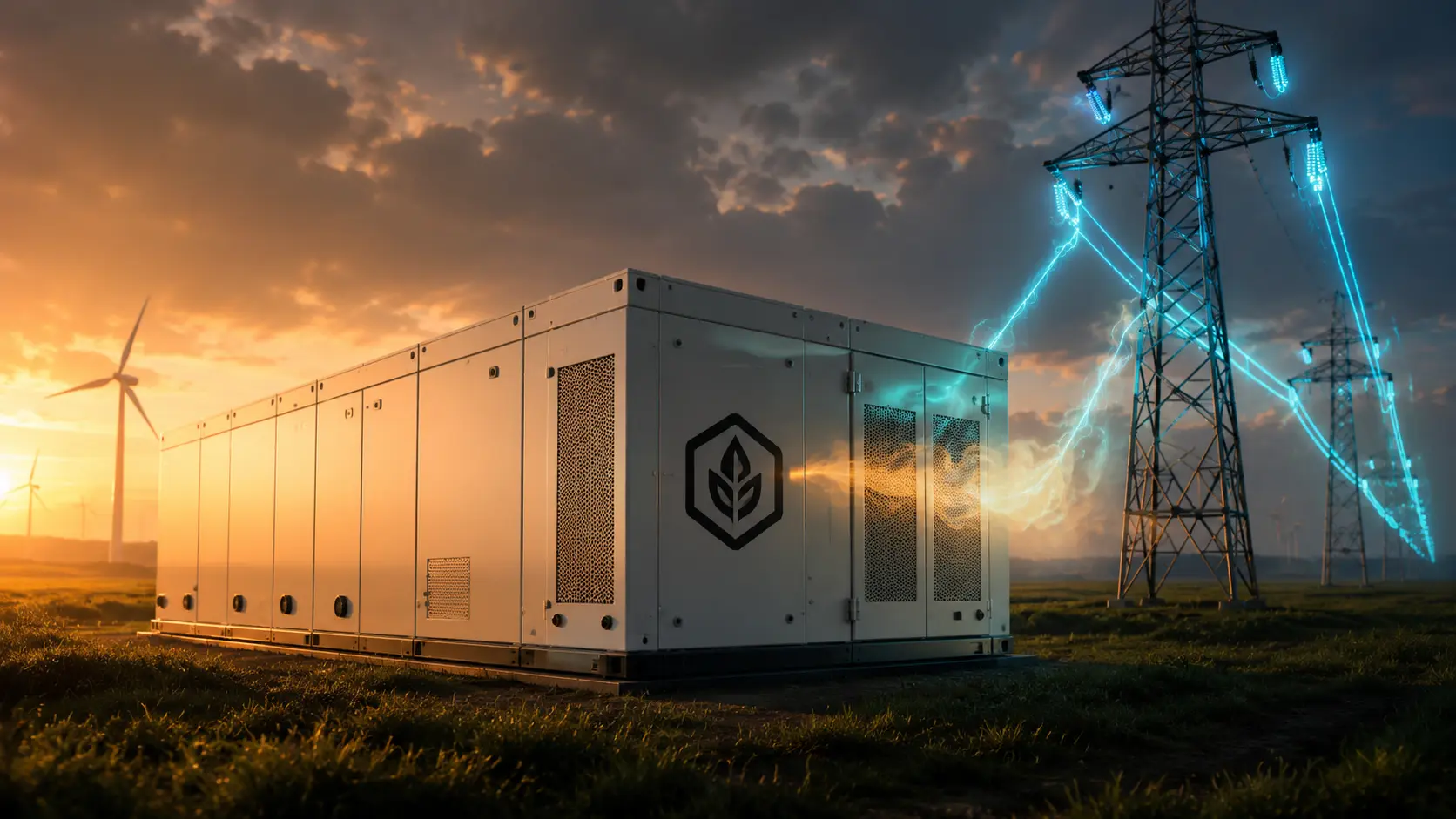

At a Glance
- Concept: Utilizing earth-abundant materials (iron, water, and air) to perform reversible electrochemical oxidation, acting as a massive, slow-release battery.
- Why it matters: A 100% renewable energy grid cannot survive a multi-day winter storm or a prolonged lull in wind without massive storage. Lithium-ion batteries only hold power economically for about 4 to 6 hours. Iron-air batteries bridge the “multi-day” gap, keeping the lights on when the sun doesn’t shine for a week.
- Who uses it: Mega-utilities (Xcel Energy, Georgia Power, Great River Energy) and national grids (like Ireland’s FuturEnergy project) partnering with pioneering hardware manufacturers like Form Energy.
- Biggest takeaway: Iron-air batteries trade efficiency for capacity. They are heavy, large, and lose a significant amount of power during the charging cycle. However, because iron is so incredibly cheap, the total cost of storing energy for 100 hours is an order of magnitude lower than any competing technology.
In Simple Words
If you leave a bicycle out in the rain, it rusts. That rusting process is actually a chemical reaction where the iron in the bicycle binds with oxygen from the air. When that binding happens, tiny amounts of energy (electrons) are released.
Scientists realized that if you can control this rusting process inside a box, you can capture those electrons and use them to power a city.
An iron-air battery is essentially a large, high-tech box full of iron pellets sitting in a water-based liquid.
When the power grid needs electricity, the box opens valves to let in ordinary air. The oxygen hits the iron, it instantly begins to rust, and it releases a massive flow of electricity to the grid.
When the sun comes out and solar panels are generating extra electricity, the grid sends that power back into the box. This electrical shock chemically rips the oxygen out of the rust, turning it back into pure iron. The battery is now “charged” and ready to rust again. Because iron and air are essentially free, you can build batteries the size of football fields that power a city for days.
Why This Matters
The global energy transition is facing a terrifying mathematical wall known as “multi-day grid stress.”
As we retire coal and natural gas plants, we rely more on wind and solar. But what happens during a “dunkelflaute”—the German term for a dark, windless period that can blanket an entire continent for days?
Currently, grid operators use lithium-ion mega-batteries (like Tesla Megapacks). Lithium is fantastic for short sprints; it charges quickly and releases massive power instantly to get the grid through the evening peak when the sun goes down. However, lithium-ion costs between USD 125 and USD 200 per kilowatt-hour (kWh). Buying enough lithium batteries to power a city for 100 hours would bankrupt the utility.
Iron-air batteries target a capital cost of under USD 20 per kWh. This drastic cost collapse unlocks the Holy Grail of the energy transition: Multi-Day Storage. It allows utilities to confidently shut down their polluting natural gas “peaker” plants, knowing they have a cheap, localized iron reserve ready to sustain the grid through the worst winter storms.
The Big Picture
The emergence of iron-air batteries represents the bifurcation of the global battery market into two distinct lanes: Gravimetric vs. Stationary.
For electric vehicles (EVs) and smartphones, you need high gravimetric and volumetric energy density. You must pack the maximum amount of energy into the lightest, smallest possible space. Lithium, being the lightest metal on the periodic table, is the undisputed king of this domain.
For the power grid, weight and size do not matter. A utility company has hundreds of acres of empty land next to a substation. The grid does not need the battery to be light; it needs the battery to be cheap. By explicitly abandoning the quest for miniaturization, iron-air engineers unlocked an entirely different branch of electrochemistry, prioritizing cost-per-megawatt-hour over size-per-kilogram.
HOW IRON-AIR BATTERIES WORK
Turning a fundamentally destructive process (rust) into a highly reliable, 20-year grid asset requires precise electrochemical control. Here is the first-principles breakdown.
1. The Fundamental Problem: The Cost of Duration
In a lithium-ion battery, the chemicals that store the energy (the active materials) and the structures that deliver the power are housed in the same expensive cell. To get more hours of storage, you must buy more of the expensive active materials (lithium, cobalt, nickel). Therefore, the cost of the battery scales linearly with the duration required.
2. The Insufficiency of Pumped Hydro
Historically, the only cheap way to store multi-day power was Pumped Hydroelectric Storage (pumping water up a mountain and letting it flow down through turbines). While cheap, pumped hydro is geographically constrained. You cannot build a mountain in the flat plains of Texas or the industrial zones of Germany. The grid requires a multi-day storage solution that can be deployed anywhere.
3. The Core Mechanism: Reversible Oxidation
An iron-air battery uses an anode made of millions of tiny iron pellets, a liquid alkaline electrolyte (like potassium hydroxide), and an air-breathing cathode.
- Discharging: The battery “breathes in” oxygen from the ambient air. The oxygen reacts with the iron anode through the electrolyte, forming iron oxide (rust) and releasing electrons to the grid.
- Charging: To charge, the grid applies an electrical current to the cell. This current forces the reverse reaction, stripping the oxygen atoms off the iron oxide, venting the oxygen back into the atmosphere, and leaving pure iron ready to discharge again.
4. Technical Depth: The Round-Trip Efficiency (RTE) Penalty
The most critical engineering trade-off of iron-air is the Round-Trip Efficiency (RTE). Lithium-ion batteries have an RTE of over 90% (you get 90% of the energy out that you put in). The reversible rusting process is chemically sluggish. Iron-air batteries currently operate at roughly 50% to 60% RTE. This means for every 10 megawatt-hours (MWh) of solar power you push into the battery, you only get 5 or 6 MWh back out.
5. Real-World Consequences: Levelized Cost of Storage (LCOS)
Because of the heavy 50% RTE penalty, developers must buy twice as much charging energy to fill the battery. However, because the capital cost of the iron hardware is an order of magnitude cheaper than lithium ($20/kWh vs. $150/kWh), and the battery is designed to cycle over 100-hour durations, the math still wins. The total Levelized Cost of Storage (LCOS) targets USD 20 to 40 per MWh. This places multi-day iron-air storage financially below the cost of running a natural gas peaker plant, making it economically viable to deploy gigawatt-scale installations across the globe.
Real-World Applications
Iron-air technology has graduated from venture-capital science projects to massive, grid-scale infrastructure deployments.
The Form Energy Mega-Projects: American manufacturer Form Energy is leading the commercialization of iron-air. They converted an old steel mill in Weirton, West Virginia (Form Factory 1) into a massive manufacturing hub. They are actively deploying gigawatt-scale projects. In 2026, they finalized an agreement to deploy an 8.5 GWh system in Maine (breaking ground in 2027) capable of powering 65,000 homes for four days straight, relieving major regional transmission congestion.
International Grid Resilience: Island nations with aggressive renewable targets are prime candidates. In 2026, FuturEnergy Ireland partnered with Form Energy to deploy a 10 MW / 1,000 MWh iron-air system. Because Ireland’s grid is isolated from mainland Europe, it cannot easily import power if the wind stops blowing across the Irish Sea. The 100-hour battery serves as a critical strategic reserve, strengthening national energy independence without burning imported natural gas.
Data Center Power Balancing: The explosion of Artificial Intelligence data centers requires continuous, 24/7 firm power. Tech giants like Google (who signed a 30 GWh multi-day storage deal with Xcel Energy) are utilizing iron-air to bridge the gap between their “100% renewable” pledges and the reality that AI servers cannot shut off at night. Iron-air provides the cheap, continuous baseload power required to keep hyperscale data centers running through multi-day weather anomalies.
Economic & Strategic Impact
The mass deployment of iron-air batteries drastically reshapes the global supply chain for grid infrastructure.
By utilizing iron, water, and air, the technology completely circumvents the geopolitical bottleneck of critical minerals. Iron is the most abundant and heavily mined metal on Earth. It is globally distributed, cheap, and immune to the supply chain volatility, human rights concerns, and pricing spikes associated with cobalt, nickel, and lithium mining.
For utility regulators, iron-air alters capital planning. Historically, utilities spent billions building new high-voltage transmission wires to handle peak loads. Iron-air acts as “transmission as a service.” By placing a massive 100-hour battery near a congested city, the utility can slowly trickle power into the battery over a week when the transmission wires are empty, and then dump the power locally during peak demand, completely bypassing the need to permit and build expensive new copper transmission lines.
Advantages
- Extreme Cost Efficiency: At scale, targets capital costs below USD 20/kWh, less than 1/10th the cost of equivalent lithium-ion storage, allowing for massive 100-hour durations.
- Geopolitical Security: Built using iron, water, and air—abundant, domestic materials that entirely bypass the volatile lithium and rare-earth mineral supply chains.
- Fire Safety: Unlike lithium-ion batteries, which are prone to violent, self-sustaining thermal runaway fires, iron-air batteries use a water-based electrolyte and are fundamentally non-flammable.
- No Degradation from Deep Cycling: Iron-air batteries can be fully discharged to 0% continuously without permanently damaging the cell chemistry, a process that severely degrades lithium batteries.
Limitations
- Low Round-Trip Efficiency (RTE): Returning only 50% to 60% of the energy put into them means utilities must over-build wind and solar generation just to account for the energy lost during the charging cycle.
- Massive Physical Footprint: They have very low energy density. A 1-megawatt iron-air system takes up roughly half an acre of land. They are strictly limited to utility-scale, rural, or industrial environments where land is cheap.
- Slow Discharge Rate: They cannot release power quickly. If the grid experiences a sudden, millisecond voltage drop, iron-air cannot respond fast enough. They are slow, steady baseload providers, requiring utilities to pair them with fast-acting lithium batteries or flywheels to handle sudden grid shocks.
Common Misconceptions
Misconception: Iron-air batteries will eventually be used in electric vehicles (EVs).
Reality: They are physically impossible to use in cars. The battery is incredibly heavy and massive due to the iron and liquid volume required, and it discharges power far too slowly to accelerate a vehicle.
Misconception: The battery slowly rusts away and falls apart over time.
Reality: The rusting is a controlled, contained electrochemical process. The iron isn’t exposed to the elements to flake away; it oxidizes and reduces within a sealed alkaline electrolyte. The systems are designed for a 20-year operational lifespan without requiring the iron pellets to be replaced.
Misconception: Iron-air replaces lithium-ion on the grid.
Reality: They serve entirely different purposes and operate symbiotically. Lithium-ion acts as the “sprinter,” providing 2 to 4 hours of intense, fast-reacting power to balance the grid every evening. Iron-air acts as the “marathon runner,” stepping in to provide low-and-slow power when the lithium runs out during a multi-day storm.
What Most People Miss
The impact of Cycle Count on the Levelized Cost of Storage (LCOS).
A lithium-ion grid battery makes its money by cycling quickly—charging during the day and discharging during the evening peak, up to 365 times a year. Iron-air batteries are designed for 100-hour events. Because it takes days to charge and days to discharge, an iron-air battery might only cycle 20 to 50 times an entire year.
This drastically changes the project financing. The revenue per cycle must be significantly higher to pay back the investor. Therefore, iron-air batteries are largely treated as “capacity assets” (like a fire insurance policy for the grid). Utilities pay the battery operator a fixed fee simply to exist and be ready for a catastrophic winter storm, rather than relying solely on day-to-day energy arbitrage trading.
Comparison Table
| Feature | Lithium-Ion (LFP) Grid Storage | Pumped Hydroelectric Storage | Iron-Air Battery |
| Economical Duration | 2 to 6 Hours | 10 to 24 Hours | 100+ Hours |
| Capital Cost per kWh | ~$125 to $200 | Site dependent (High upfront civil costs) | ~$20 |
| Round-Trip Efficiency | High (85%–95%) | Moderate (70%–80%) | Low (50%–60%) |
| Geographic Flexibility | High (Can be placed anywhere) | Extremely Low (Requires specific mountains) | High (Can be placed anywhere land is cheap) |
| Primary Grid Role | Daily peak shaving, frequency regulation | Overnight baseload, massive capacity | Multi-day weather resilience, seasonal bridging |
Case Study
Situation: The state of Maine and the broader New England electric grid face severe constraints. They are aggressively building onshore and offshore wind, but the transmission lines are bottlenecked. During multi-day winter storms (Nor’easters), solar drops to zero, and if the wind lulls, the region is forced to turn on highly expensive, polluting oil and natural gas peaker plants to keep the population from freezing.
Challenge: Expanding the physical transmission wires to import more power from Canada or New York would take over a decade of environmental permitting and billions of dollars. They needed a localized solution to store massive amounts of excess wind power generated during the fall to be released slowly during winter lulls.
Solution (The Maine 8.5 GWh Project): Form Energy partnered with the U.S. Department of Energy and the state to build an 8,500 MWh iron-air energy storage system at the site of a former paper mill in rural Maine.
Outcome: Scheduled for construction in 2027, the massive battery array acts as an immense grid shock absorber. Because it can discharge for 100 continuous hours, it is capable of powering roughly 65,000 homes for four days straight through a winter weather event.
Lessons Learned: The deployment validated that long-duration energy storage (LDES) is not just an environmental tool; it is a critical transmission deferral asset. By placing the massive, cheap iron-air battery at a strategic grid node (a former paper mill with existing heavy electrical infrastructure), the state bypassed the need to build new power lines, solving a multi-billion dollar infrastructure bottleneck with modular chemistry.
Future Outlook
Next 12–24 Months
The industry will eagerly monitor the operational data from Form Energy’s first wave of live utility deployments (with Xcel Energy and Great River Energy). The primary focus will be validating the software integration. Grid operators must learn how to “dispatch” a 100-hour battery. Because it charges and discharges so slowly, automated energy trading software must be rewritten to predict weather patterns days in advance to ensure the iron is fully “un-rusted” before a major storm hits.
Next 3–5 Years
We will witness the standardization of the “Hybrid Storage Power Plant.” Utilities will stop building standalone lithium or standalone iron-air sites. Instead, they will deploy mixed sites: 100 MW of lithium-ion sharing the same substation as 500 MW of iron-air. A single AI control system will manage both, using the lithium to instantly stabilize millisecond voltage drops, and triggering the iron-air array to provide the heavy, long-term power required when the sun sets for the weekend.
Next 10 Years
Iron-air will facilitate the full retirement of the natural gas peaker plant. Currently, natural gas is the only reliable safety net for a renewable grid. As iron-air battery manufacturing scales globally (replicating the cost-curve collapse seen in solar panels a decade earlier), the Levelized Cost of Storage will permanently undercut the cost of purchasing, storing, and burning natural gas. Iron-air will become the baseline “firming” technology for global renewable megaprojects, completely decoupling grid reliability from fossil fuel markets.
Most Likely Scenario
Iron-air technology will monopolize the 100-hour multi-day storage market. While other technologies (like flow batteries or compressed air) compete in the 10-to-24 hour range, nothing can mathematically compete with the cost of raw iron for multi-day duration. It will fundamentally change utility planning, proving that building massive, low-efficiency, ultra-cheap “rust boxes” is the ultimate key to finalizing the transition to a 100% renewable electrical grid.
Key Takeaways
- Iron-air batteries store energy by reacting iron pellets with oxygen to create rust, and release energy by using electricity to remove the oxygen.
- The technology is designed specifically for “multi-day” storage, providing continuous power for up to 100 hours to cover prolonged weather events (like winter storms or wind lulls).
- By using earth-abundant iron, water, and air, capital costs target under USD 20 per kWh, fundamentally cheaper than lithium-ion solutions.
- The primary trade-off is Round-Trip Efficiency (RTE). Iron-air returns only 50% to 60% of the energy used to charge it, compared to lithium’s 90%+ efficiency.
- Iron-air is strictly for utility-scale stationary grids. Its massive weight, large physical footprint (half an acre per megawatt), and slow discharge rate make it useless for consumer electronics or vehicles.
- Form Energy, backed by billions in investments, is leading the global rollout, building high-volume factories in the American Rust Belt and securing gigawatt-scale contracts globally.
Glossary
Anode / Cathode: The two main terminals of a battery. In an iron-air battery, the anode is made of iron pellets, and the cathode “breathes” in oxygen from the ambient air.
CapEx (Capital Expenditure): The upfront cost to buy and install the physical battery hardware, usually measured in dollars per kilowatt-hour ($/kWh).
Dunkelflaute: A German term used in the energy sector describing a prolonged period of cold, cloudy, and windless weather when renewable energy generation drops near zero.
Levelized Cost of Storage (LCOS): The single most important financial metric. It calculates the total lifetime cost of the battery (upfront cost, operating expenses, charging electricity costs, and efficiency losses) divided by the total megawatt-hours of energy it will discharge over its lifespan.
Pumped Hydroelectric Storage: A legacy method of long-duration storage that involves pumping water to a higher elevation reservoir and releasing it through turbines.
Round-Trip Efficiency (RTE): The percentage of electricity put into a battery that can actually be retrieved later. A lower RTE means more power is lost as heat during the chemical reaction.
Frequently Asked Questions
Why not just use lithium-ion batteries for everything?
Cost. A lithium-ion system is perfect for 4 hours of storage. If you want 100 hours of storage, you have to buy 25 times more expensive lithium cells. At roughly $150/kWh for lithium versus $20/kWh for iron-air, it is mathematically impossible to scale lithium for multi-day resilience without bankrupting the utility grid.
Do iron-air batteries run out of air?
No. They use ambient oxygen from the atmosphere. When discharging, they pull oxygen in. When charging, they vent that exact same oxygen back out into the air. It is a completely closed loop regarding the iron, and an open, harmless loop regarding the air.
Are they dangerous or prone to exploding?
They are fundamentally safer than lithium-ion. They use a non-flammable, water-based alkaline electrolyte. They are not prone to “thermal runaway” (the chemical chain reaction that causes difficult-to-extinguish fires in lithium EVs or storage arrays).
If they lose 40% of their power during charging, isn’t that a huge waste?
Yes, the 50-60% round-trip efficiency is a massive penalty. However, they are charged using “excess” wind and solar power—electricity generated in the middle of a sunny/windy day when the grid has too much power and prices often drop to zero or go negative. Wasting 40% of “free” energy is an acceptable economic trade-off to secure reliable power during a winter storm when prices skyrocket.
When will we see these powering cities?
They are already entering the grid. Form Factory 1 in West Virginia is actively producing modules, with major multi-gigawatt utility projects (like the 8.5 GWh Maine project and the Irish 1,000 MWh deployment) slated for construction and activation between 2027 and 2029.
Sources
- Form Energy: Corporate Strategy, Battery Technology, and Form Factory 1 Operations (2026)
- SunLith Energy: Iron Air Battery LCOS: The Cost of 100-Hour Storage (June 2026)
- Utility Dive: Form Energy’s $20/kWh, 100-hour iron-air battery could be a ‘substantial breakthrough’
- The Earthshot Prize: Form Energy 2025 Finalist Overview – Global Multi-Day Storage Deployment
- Form Energy / FuturEnergy Ireland: Joint Deployment of 10 MW / 1,000 MWh Iron-Air System (March 2026)