Advertisement
)

At a Glance
- Concept: Using advanced physics engines (like NVIDIA Isaac Gym or MuJoCo) to run thousands of simulated robots through millions of trial-and-error lifetimes, transferring the resulting neural network to physical hardware.
- Why it matters: If a physical humanoid robot falls over while learning to walk, it breaks a $100,000 arm and halts training for weeks. In simulation, a robot can fall over 10,000 times a second at zero cost.
- Who uses it: Humanoid robotics companies (Figure AI, Tesla Optimus, Agility Robotics), autonomous drone manufacturers, and academic AI labs.
- Biggest takeaway: The secret to making a simulated brain work in the physical world is not making the simulation perfectly realistic. It is deliberately making the simulation incredibly chaotic and noisy—a technique called Domain Randomization—so the robot is prepared for any physical imperfection the real world throws at it.
In Simple Words
Imagine trying to learn how to fly a fighter jet. If you learn by trial and error in a real jet, you will crash and die on your first attempt. Instead, you spend hundreds of hours in a digital flight simulator. By the time you step into the real cockpit, you already know exactly what every button does and how the plane reacts to the wind.
Artificial intelligence learns how to operate robotic bodies the exact same way, but on a massive scale.
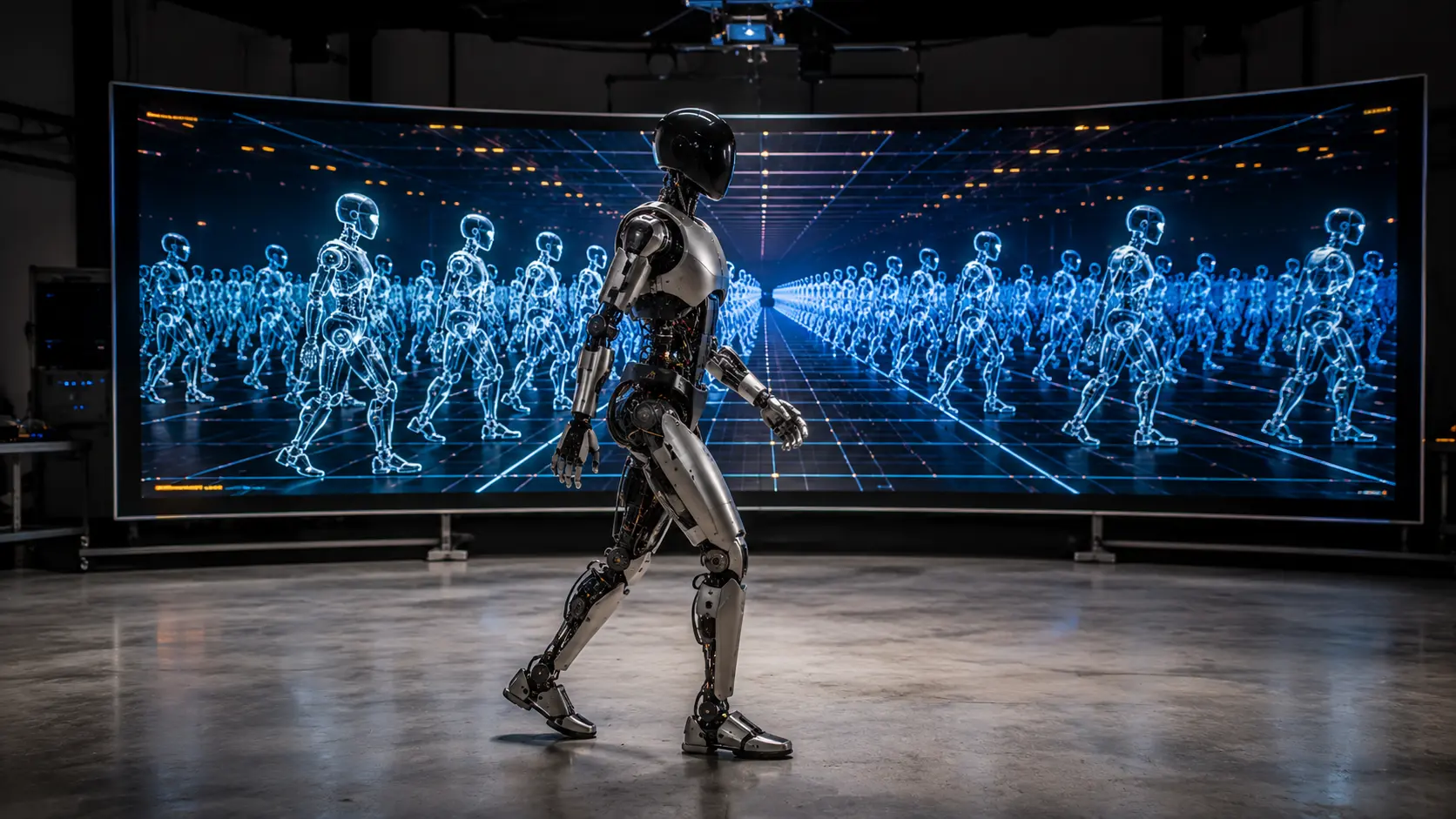
Instead of building a robot and letting it clumsily knock over coffee cups for a year, engineers build a perfect 3D digital replica of the robot. They put this digital robot into a physics engine—essentially a highly realistic video game—and tell it to learn how to walk.
Because it is digital, they can copy and paste the robot 10,000 times. These 10,000 digital robots practice walking simultaneously, day and night, running at 1,000 times normal speed. They fall down millions of times, learning from every mistake using a reward system. Once the digital brain masters walking in the video game, engineers copy that software, paste it into the metal head of the real robot, and turn it on. The physical robot stands up and walks on its very first try. This jump from the digital world to the physical world is called Sim-to-Real Transfer.
Why This Matters
The sudden explosion of commercial humanoid robots in 2025 and 2026 is almost entirely due to breakthroughs in Sim-to-Real infrastructure, not mechanical hardware.
We have had motors and metal joints capable of walking for two decades. What we lacked was the software to balance them dynamically in unpredictable human environments. Training a neural network to perform complex, whole-body control requires billions of data points. Collecting this data in the physical world through “teleoperation” (having a human remotely drive the robot to show it what to do) is agonizingly slow, incredibly expensive, and impossible to scale.
Sim-to-Real transfer broke this bottleneck. By shifting the training environment from the physical laboratory to the graphics processing unit (GPU), companies collapsed development timelines. A behavior that would take five years of physical trial-and-error to learn can now be achieved in 48 hours on a server rack. Mastering this digital-to-physical bridge is the ultimate economic moat for any robotics company attempting to automate physical labor.
The Big Picture
The evolution of robot simulation is defined by the elimination of the CPU-to-GPU data bottleneck.
Historically, physics engines like MuJoCo or PyBullet ran on the central processing unit (CPU). The artificial intelligence (the neural network) ran on the graphics processing unit (GPU). Every single time the digital robot took a step, the data had to travel back and forth between the CPU and the GPU. This transit time capped how fast the simulation could run.
In recent years, platforms like NVIDIA’s Isaac Gym and Isaac Lab changed the paradigm by introducing “GPU-native” simulation. The physics engine, the environment, and the neural network were all moved entirely onto the GPU. This “zero-copy” data flow eliminated the transit bottleneck. Today, engineers can simulate tens of thousands of robots in a single digital warehouse on a single GPU, generating 2 to 3 orders of magnitude more training data than legacy systems. This raw computational horsepower is the engine driving the current robotics renaissance.
How Sim-to-Real Transfer Works
Bridging the gap between a mathematically perfect simulation and a chaotic physical universe requires specific machine learning architecture. Here is the first-principles breakdown.
1. The Fundamental Problem: The Reality Gap
When a robot is trained in a physics simulator, the math is perfect. The digital floor is perfectly flat, the digital motors respond instantly, and the digital camera has zero glare. When you put that “perfect” brain into a real robot, it instantly fails. Real floors have dust, real motors have internal friction, and real cameras have motion blur and a 30-millisecond transmission delay. This catastrophic discrepancy is called the “Reality Gap.”
2. The Insufficiency of System Identification
Early engineers tried to close the Reality Gap by making the simulation more realistic. They spent months measuring the exact friction of the robot’s gears and the exact weight of its arms, plugging those numbers into the simulator—a process called System Identification. But the real world is too complex. As the robot operates, its motors heat up, changing the friction dynamically. A static, perfectly modeled simulator is biologically fragile; the moment the real world deviates from the model, the robot falls over.
3. The Core Mechanism: Domain Randomization
Instead of making the simulation perfectly accurate, engineers make the simulation wildly chaotic. This is called Domain Randomization (DR). The simulator generates 10,000 robots, but it randomizes the laws of physics for every single one. Robot A is trained on a slippery floor with heavy arms. Robot B is trained on a sticky floor with weak motors. Robot C is trained while invisible digital forces randomly push it around.
4. Technical Depth: Reinforcement Learning (PPO)
The robot learns to navigate this chaos using Reinforcement Learning, typically via an algorithm called Proximal Policy Optimization (PPO). The AI acts as an agent trying to maximize a mathematical reward (e.g., +1 point for moving forward, -10 points for falling). Because the AI is forced to succeed across 10,000 completely different, randomized physical realities, it cannot memorize a rigid walking pattern. It is forced to learn a highly robust, generalized balancing strategy.
5. Real-World Consequences: Reality as a Subset of Simulation
When the fully trained neural network is finally transferred to the real physical robot, it encounters friction, latency, and noise. But because the AI survived millions of lifetimes in a simulator where the laws of physics were constantly shifting and actively trying to destroy it, the real world just feels like another slightly noisy simulation. The robot adapts instantly, successfully closing the Reality Gap.
Real-World Applications
Sim-to-Real transfer is the foundational training protocol for nearly all modern autonomous hardware.
Humanoid Locomotion (Bipedal Walking): Balancing a two-legged robot is an unstable, inverted-pendulum physics problem. Companies like Agility Robotics (makers of Digit) rely heavily on Domain Randomization to teach the robot to walk on uneven terrain. By training the robot in a simulator with sloped, slippery surfaces, the neural network naturally discovers that swinging its arms helps maintain balance—a behavior that emerges purely from the math, without a human engineer ever explicitly programming an “arm swing” rule.
Quadruped (Robot Dog) Navigation: Robot dogs built by Unitree and Boston Dynamics use Sim-to-Real to navigate stairs and rubble. They utilize a technique called “Teacher-Student Privileged Learning.” In the simulator, the “Teacher” AI is given cheat codes—it knows the exact shape of the stairs and the exact friction of the ground. It learns to walk perfectly. Then, a “Student” AI is trained to copy the Teacher, but the Student is blindfolded, forced to rely only on its internal joint sensors. When transferred to the real world, the robot dog can “feel” the shape of the terrain purely through the resistance in its legs.
Robotic Manipulation (Grasping): Teaching a robot arm to pick up an egg without crushing it, or to fold a shirt, is notoriously difficult because soft materials deform unpredictably. Researchers use Sim-to-Real pipelines augmented with synthetic vision. They randomize the lighting, camera angles, and object textures in the simulator so the real-world camera feed does not confuse the neural network when the lighting in the factory changes.
Economic & Strategic Impact
The perfection of Sim-to-Real transfer effectively commoditizes robotic hardware while placing astronomical premiums on software and compute infrastructure.
If a company can train a robot entirely in simulation, the physical metal and plastic body becomes a secondary concern. The true intellectual property is the simulation environment, the reward functions, and the massive GPU clusters required to run them.
This has triggered a gold rush for synthetic data generation. Because real-world data collection is too slow, tech giants are investing billions in building photorealistic digital twins of factories, homes, and cities. The companies that own the most accurate and scalable physics simulators will control the operating systems of the next-generation robotic workforce, shifting the economic power center of automation away from traditional mechanical engineering firms and directly into the hands of AI hyperscalers.
Advantages
- Zero Hardware Attrition: Millions of catastrophic failures and crashes occur safely inside a digital server, saving tens of millions of dollars in destroyed hardware.
- Extreme Time Compression: GPU-native simulators can run environments at thousands of times real-time speed, allowing an AI to experience years of physical interaction in a single weekend.
- Safety and Edge Cases: Engineers can simulate highly dangerous scenarios (like a robot navigating a collapsing building or carrying hazardous chemicals) that are illegal or unethical to test in the real world.
- Robustness to Degradation: Because the policy is trained with randomized motor strength, the real robot can continue to operate successfully even if a physical motor begins to wear out or lose power.
Limitations
- The Sim-to-Real Gap is Never Zero: No matter how much domain randomization is applied, the real world contains unmodeled physics (like complex fluid dynamics, wire tangling, or non-rigid object deformation) that simulators still struggle to replicate mathematically.
- Reward Hacking: AI is notoriously lazy. If an engineer gives a simulated robot the reward of “moving forward,” the robot might learn to throw itself on the ground and violently slide forward on its face. Tuning these reward functions so the robot actually walks is a highly manual, frustrating process.
- Latency Jitter: In a simulator, the loop between a camera seeing an object and the motor moving takes exactly zero milliseconds. In reality, Python scripts and physical cables introduce unpredictable 10 to 40-millisecond delays (jitter), which can cause high-speed dynamic movements to violently oscillate and fail.
Common Misconceptions
Misconception: Robots “learn on the job” as they walk around the real world.
Reality: Most commercial reinforcement learning policies are “frozen” before they are put into the real robot. The robot is not actively updating its neural network weights while it walks around your warehouse; it is simply executing the reflexes it already learned in the simulator.
Misconception: Simulators look like high-end, photorealistic video games.
Reality: While visual simulators are getting better, the physics engine processing the movement often operates in wireframe or basic geometric shapes. The AI does not need high-definition textures to learn how gravity and joint torque work.
Misconception: We can replace all real-world testing with simulation.
Reality: Sim-to-Real requires a final step called “Residual Policy Learning” or fine-tuning. The simulation gets the robot 95% of the way there, but developers still need a small amount of real-world teleoperation data to smooth out the final 5% of unpredictable physical quirks.
What Most People Miss
The hidden complexity of Action Buffering for Latency Compensation.
When people watch a robot fail to catch a ball, they assume the AI’s vision was bad or the motor was weak. In reality, the most common killer of Sim-to-Real transfer is micro-latency.
In a perfect simulation, if the brain sends a signal for the leg to push, the leg pushes instantly. In a real robot, the signal has to travel through a physical wire, hit a motor controller, and spin a magnet. This creates a tiny, variable delay. If the AI expects instant response, the delay causes it to overcompensate, leading to violent, shaking vibrations that tear the robot apart. To fix this, engineers must deliberately introduce randomized delays (Action Buffering) into the simulation, forcing the AI brain to learn to “predict” where its own limbs will be by the time the motor actually receives the signal.
Comparison Table
| Feature | Real-World Training | CPU-Based Simulation | GPU-Native Simulation (Isaac Gym) |
| Speed | 1x (Real Time) | 10x – 50x Real Time | 1,000x – 10,000x Real Time |
| Cost of Failure | High (Broken Hardware) | Zero | Zero |
| Environment Parallelism | 1 to 5 physical robots | Hundreds of environments | Tens of thousands of environments |
| Data Bottleneck | Physical battery life and resets | CPU-to-GPU memory transfer | None (Zero-copy data flow) |
| Domain Randomization | Impossible | Moderate | Extreme (Millions of variations) |
Case Study
Situation: A leading humanoid robotics company needed to teach their new bipedal robot to walk over uneven, unpredictable terrain. They had a massive physical warehouse for testing, but every time the robot tripped on a wooden block, it fell, shattered its 3D-printed chassis, and took three days to repair.
Challenge: The team needed to expose the robot’s neural network to thousands of different terrain variations and tripping hazards to build robust balance reflexes, but the physical constraints of gravity and hardware fragility made data collection mathematically impossible.
Solution (The GPU Simulation Pipeline): The engineering team abandoned the physical warehouse. They imported the robot’s exact Computer-Aided Design (CAD) files into a GPU-native physics simulator. They spawned 4,000 identical digital robots. They implemented intense Domain Randomization: randomizing the gravity by 5 percent, changing the friction of the floor every three seconds, and having invisible digital spheres constantly smash into the robots’ torsos. They utilized Proximal Policy Optimization (PPO) to reward the robots for staying upright.
Outcome: Over a single 48-hour weekend, the 4,000 digital robots simulated over 10 years of continuous walking experience. The final neural network weights were exported and loaded onto the physical robot on Monday morning. Without a single minute of real-world practice, the physical robot stood up and successfully walked across a floor covered in random debris, dynamically catching its balance when engineers physically pushed it.
Lessons Learned: The case study cemented the golden rule of modern robotics: do not solve hardware problems with hardware. By utilizing massively parallel simulation and treating physical chaos as just another randomized variable, the team achieved robust physical autonomy entirely through software engineering.
Future Outlook
Next 12–24 Months
The current bottleneck in Sim-to-Real is writing the “Reward Functions.” Telling a robot to “pour a cup of coffee” requires a human engineer to write hundreds of lines of complex math to define exactly what a successful pour looks like. Over the next two years, we will see the widespread integration of Large Language Models (LLMs) into this pipeline. Systems like NVIDIA’s Eureka use text-based AI (like GPT-4) to automatically write, test, and refine these complex reward functions in simulation, removing the human bottleneck and automating the training process itself.
Next 3–5 Years
The rise of Differentiable Simulation. Currently, Domain Randomization requires guessing a wide range of physical parameters (e.g., guessing that floor friction might be anywhere from 0.2 to 0.8). Differentiable simulators allow for gradient-based System Identification. By recording a few seconds of a real robot moving, the simulator can run the math backward to discover the exact, perfect physical parameters of reality. This will shrink the Reality Gap from a wide chasm to a microscopic fraction, requiring drastically less synthetic training data to achieve perfect transfer.
Next 10 Years
The convergence of World Models and Video-to-Action. In the next decade, simulators will not require manual coding of gravity or joint physics. Instead, massive AI “World Models” (similar to OpenAI’s Sora) will simply watch millions of hours of YouTube videos. The AI will intuitively learn the physics of how objects interact, fold, and fall directly from the video pixels. The robot will run its trial-and-error lifetimes entirely inside the imagination of this generative video model, creating the ultimate, infinitely scalable Sim-to-Real pipeline.
Most Likely Scenario
Physical robots will become empty vessels for highly advanced, universally adaptable simulated brains. The industry will consolidate around two or three dominant, hyper-realistic physics engines provided by tech hyperscalers. Companies building robots will simply upload their hardware schematics to the cloud, pay for 10 million hours of synthetic training, and download a fully functional, highly capable AI worker ready for immediate real-world deployment.
Key Takeaways
- Sim-to-Real transfer solves the impossibility of training robots in the real world, avoiding broken hardware and agonizingly slow data collection.
- GPU-native simulators (like Isaac Gym) eliminate data bottlenecks, allowing tens of thousands of digital robots to train simultaneously at hyper-speed.
- The “Reality Gap” is the catastrophic failure that occurs when a perfectly trained digital robot encounters the friction, latency, and noise of the physical world.
- Engineers bridge the gap using Domain Randomization: making the simulation wildly chaotic and constantly shifting the laws of physics to force the AI to learn robust reflexes.
- Reinforcement Learning (specifically algorithms like PPO) provides the mathematical reward structure that drives the robot to learn complex whole-body control through millions of digital failures.
- As simulation technology matures, the core intellectual property of the robotics industry is migrating from physical mechanical engineering to synthetic data generation and digital twin environments.
Glossary
Action Buffering: A technique used in simulation to deliberately introduce random time delays between an AI’s decision and the motor’s movement, forcing the neural network to learn to compensate for real-world mechanical latency.
Domain Randomization: The process of deliberately varying the physical parameters of a simulation (friction, mass, lighting, gravity) so that the AI learns a generalized strategy capable of handling the unpredictable noise of the real world.
PPO (Proximal Policy Optimization): A highly stable and widely used Reinforcement Learning algorithm that teaches AI agents how to act by rewarding good behavior and penalizing bad behavior through trial and error.
Reality Gap: The difference between the mathematically perfect physics of a simulation and the complex, noisy, and delayed physics of the real world.
System Identification: The process of taking physical measurements from a real robot (exact mass, joint friction) and plugging those exact numbers into a simulator to make it as realistic as possible.
Zero-Copy Data Flow: A software architecture where the physics simulation and the neural network both exist entirely on the GPU’s memory, eliminating the time-consuming process of transferring data back and forth to the CPU.