Advertisement
)

At a Glance
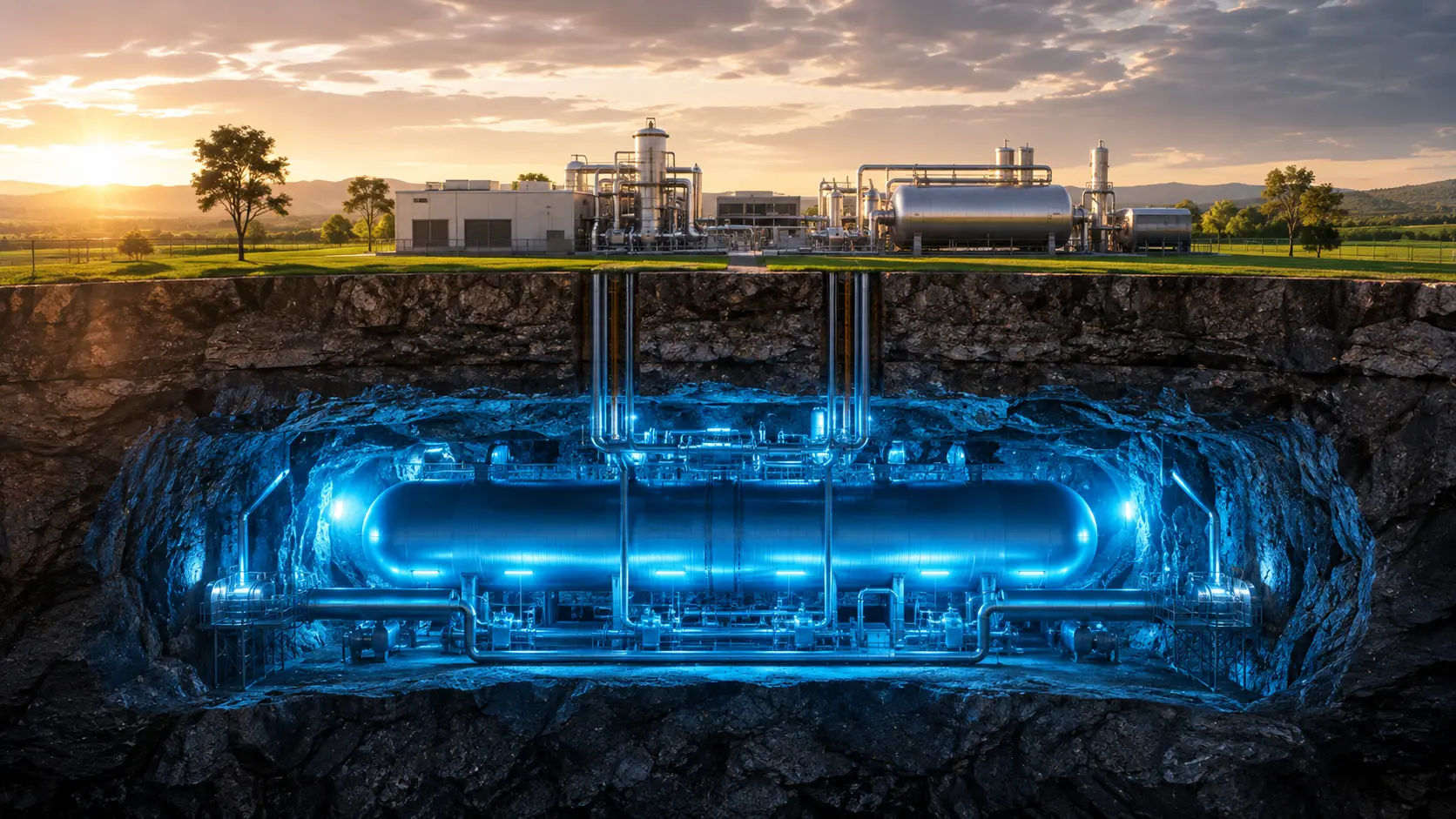
- Concept: Utilizing excess grid energy to power massive industrial air compressors, pushing air into subterranean salt caverns or depleted mines. When energy is needed, the pressurized air is released to drive a turbine generator.
- Why it matters: Lithium-ion batteries become economically unviable past 4 to 6 hours of duration. To run a modern civilization on 100 percent wind and solar, the grid requires Long-Duration Energy Storage (LDES) capable of dispatching gigawatts of power for days or weeks.
- Who uses it: Utility-scale developers like Hydrostor (Canada/Australia), independent power producers, and massive state-owned grid operators in China expanding salt cavern clusters.
- Biggest takeaway: The technology has evolved from “Diabatic” (which required burning natural gas to reheat the air) to “Adiabatic” (which captures the heat of compression and reuses it). This shift makes modern A-CAES a 100 percent emissions-free, highly efficient grid asset.
In Simple Words
Imagine blowing up a balloon. When you force air into the balloon, you are storing your physical energy. If you let go of the opening, the pressurized air rushes out, and you can use that rushing air to spin a small pinwheel.
Compressed Air Energy Storage (CAES) is this exact process, but scaled to the size of a city.
When a massive solar farm produces too much electricity at noon, the grid operators cannot just throw that power away. Instead, they use that electricity to run giant fans (compressors). These compressors shove millions of cubic feet of air deep underground into an empty salt cave or an abandoned mine, trapping it under immense pressure.
Three days later, when a massive storm blocks the sun and the wind dies down, the grid operators simply open the valve on the cave. The highly pressurized air rushes back to the surface, spins a massive turbine, and generates clean electricity for thousands of homes. It turns the Earth’s crust into an invisible, rechargeable battery.
Why This Matters
The global energy transition is facing a multi-day duration crisis.
While mega-battery packs (like Tesla Megapacks) are excellent for short-term “peak shaving”—absorbing solar power at noon and discharging it at 7:00 PM—they are mathematically incapable of backing up the grid for a week-long winter storm. Buying enough lithium-ion batteries to power a city for 100 hours would bankrupt a sovereign nation.
CAES provides the missing link for deep grid decarbonization. Because the “storage medium” is just empty underground space and ambient air, the marginal cost of adding another hour of storage is nearly zero. As capacities scale from 10 MW to 500 MW, the Levelized Cost of Storage (LCOS) for CAES drops precipitously. For utility planners striving to meet 2035 and 2050 net-zero mandates, CAES offers the physical inertia and multi-day dispatchability of a traditional coal plant, without the carbon footprint.
The Big Picture
The CAES market is crossing a critical inflection point in the mid-2020s, transitioning from scattered legacy pilot plants to a globally contracted, multi-billion-dollar asset class.
Industry analysts forecast the CAES market to expand rapidly, with revenue projections scaling from roughly USD 1.7 billion in 2025 toward USD 3.6 billion by 2035, driven by aggressive LDES procurement targets in California, Ontario, and Australia.
This acceleration is structurally enabled by a shift in geology. Historically, CAES was restricted to regions with perfect, watertight salt domes (like the legacy Huntorf plant in Germany or the McIntosh plant in Alabama). Today, companies like Hydrostor have pioneered hard-rock cavern techniques utilizing hydrostatic compensation. By digging a shaft into standard bedrock and using a column of water to maintain constant pressure, modern CAES can be built almost anywhere on Earth, radically expanding the total addressable market.
HOW COMPRESSED AIR ENERGY STORAGE WORKS
Compressing massive volumes of air introduces complex thermodynamic challenges. Controlling the heat generated by this process dictates the efficiency of the entire system. Here is the first-principles breakdown.
1. The Fundamental Problem: Multi-Day Storage
The electrical grid must balance supply and demand in real-time. To fully replace baseload fossil fuels, the grid requires a mechanical battery capable of discharging hundreds of megawatts continuously for 8, 24, or 100 hours.
2. The Insufficiency of Pumped Hydro and Lithium
Pumped Hydroelectric storage (pumping water up a mountain) is excellent, but we have largely run out of ecologically acceptable mountains to dam. Lithium-ion batteries degrade over thousands of cycles and carry steep capital costs for long durations. A new mechanical solution was required that minimized surface footprint and relied on abundant materials.
3. The Core Mechanism: The CAES Cycle
The architecture relies on three distinct phases:
- Charge Phase: Surplus grid electricity powers a rotary compressor. This machine pulls in ambient air, compresses it to extreme pressures (often 70 to 100 times atmospheric pressure), and forces it underground into a geological cavern.
- Storage Phase: The highly pressurized air sits in the cavern, sealed by impermeable rock or salt, indefinitely holding the potential energy.
- Discharge Phase: When the grid requires power, a valve is opened. The high-pressure air rushes up a pipe, expands rapidly, and drives a turbo-expander (a specialized turbine) connected to a generator, creating electricity.
4. Technical Depth: The Thermodynamics of Compression
When you compress a gas, it gets incredibly hot (Gay-Lussac’s Law). When it expands, it gets freezing cold. This temperature swing dictates the three types of CAES:
- Diabatic CAES (Legacy): The heat from compression is vented into the atmosphere and wasted. When the air expands later, it gets so cold it would freeze the turbine, so operators must burn natural gas to reheat the air before it hits the turbine. This results in a poor efficiency of roughly 45 to 55 percent and produces carbon emissions.
- Adiabatic CAES (A-CAES): The modern standard. The heat generated during compression is captured using heat exchangers and stored in a thermal battery (usually a packed bed of crushed rock, molten salt, or specialized thermal oil). During discharge, the cold expanding air is run back through this stored heat, warming it up without burning fossil fuels. This pushes round-trip efficiency to roughly 65 to 70 percent.
- Isothermal CAES: An experimental ideal where heat is continuously removed during compression so the temperature never changes, maximizing absolute physical efficiency. It remains highly complex to execute at utility scale.
5. Real-World Consequences: Hydrostatic Compensation
As a cavern empties during discharge, the air pressure naturally drops, causing the turbine’s power output to fade over time. Modern A-CAES solves this using hydrostatic pressure. An above-ground water reservoir is connected to the underground air cavern. As air is pumped in, it pushes the water up to the surface. As air is released, the heavy column of water flows back down, acting like a giant physical piston that keeps the underground air pressure perfectly constant until the very last cubic foot is used.
Real-World Applications
Advanced Adiabatic CAES (A-CAES) has officially graduated from pilot testing to utility-scale execution.
Hydrostor’s Quinte Energy Storage Centre (Ontario): In May 2026, Hydrostor announced a massive A-CAES project in Greater Napanee, Ontario. Backed by capital from the Canada Growth Fund, the facility is designed to provide long-duration peaking capacity. It operates completely emissions-free, utilizing the province’s surplus baseload nuclear and hydro power to charge the cavern, and then discharging during grid peaks, injecting CAD 1.4 billion into the regional economy over its 50-year lifespan.
China’s Salt Cavern Clusters: China is rapidly expanding its CAES infrastructure to balance its massive solar and wind deployments. Moving beyond initial 10 MW and 100 MW pilot systems, Chinese state-owned enterprises are developing 300 MW adiabatic CAES facilities utilizing the country’s vast underground salt formations. These projects monetize ancillary services and energy arbitrage, proving that localized turbomachinery supply chains can dramatically lower engineering, procurement, and construction (EPC) costs.
Repurposing Mining Infrastructure (Australia): In regions like New South Wales (e.g., Broken Hill), developers are targeting abandoned hard-rock mines. Instead of digging a new multi-million-dollar shaft, engineers seal existing mine workings to create the pressure vessel. This not only slashes capital expenditure but also provides a direct economic transition for legacy mining towns facing the phase-out of coal extraction.
Economic & Strategic Impact
The deployment of CAES provides a geopolitical and economic off-ramp for the traditional fossil fuel industry.
The workforce and supply chain required to build an A-CAES facility—subsurface geological modeling, deep-shaft drilling, high-pressure piping, and large-scale turbomachinery maintenance—is identical to the oil and gas sector. Unlike solar panel manufacturing (which is heavily concentrated in Asia), CAES relies on heavy civil engineering and domestic labor. This allows governments to greenlight CAES projects as a mechanism for a “Just Transition,” keeping thousands of roughnecks and pipeline engineers employed in the clean energy economy.
Furthermore, CAES fundamentally alters the economics of resource adequacy. While short-duration batteries generate revenue through daily price arbitrage, CAES generates revenue through long-term capacity payments. Utilities pay CAES operators simply for the guarantee that they can dispatch 500 MW of firm power for 12 straight hours during extreme weather events, effectively replacing the grid stability traditionally provided by combined-cycle natural gas peaker plants.
Advantages
- Lowest Cost for Long Duration: Because expanding the storage capacity simply requires carving a larger hole underground (rather than buying expensive lithium-ion cells), the Levelized Cost of Storage (LCOS) for CAES plummets at durations of 8, 12, or 24 hours.
- Extreme Lifespan: A physical cavern and a steel turbine do not suffer from chemical degradation. A CAES facility boasts a 50+ year operational lifespan with unlimited cycling, drastically outlasting chemical batteries that require replacement every 10 to 15 years.
- Emissions-Free Integration: Modern Advanced Adiabatic systems capture and recycle their own thermal energy, completely eliminating the need for natural gas reheating.
- Small Surface Footprint: While pumped hydro requires flooding entire valleys, a gigawatt-scale CAES facility only requires a small plot of land for the compressor building and thermal storage tanks; the actual “battery” is entirely invisible underground.
Limitations
- Geological Dependence: Even with hydrostatic compensation allowing for hard-rock caverns, you cannot build CAES in unstable soils, earthquake fault zones, or highly fractured bedrock.
- Lengthy Development Timelines: Permitting, drilling, and excavating deep underground caverns is a massive civil engineering undertaking. Projects typically require 4 to 6 years from initial site screening to commercial operation, making it too slow to solve immediate year-over-year capacity shortages.
- Lower Round-Trip Efficiency: While lithium-ion batteries boast round-trip efficiencies of 90 to 95 percent, even the best Adiabatic CAES systems peak around 65 to 70 percent. A significant portion of the initial electrical energy is permanently lost as low-grade heat and mechanical friction.
Common Misconceptions
Misconception: CAES burns natural gas, so it is not clean energy.
Reality: This is only true for the two oldest legacy plants in the world (Huntorf built in 1978, and McIntosh built in 1991), which use “Diabatic” technology. Modern “Adiabatic” A-CAES facilities are 100 percent emissions-free and rely entirely on recycled thermal energy.
Misconception: The compressed air could explode like a bomb.
Reality: Air is not flammable. If a cavern were to breach, it would not detonate; the air would simply leak through the microscopic fissures in the rock back to the surface over a long period, resulting in a loss of pressure, not a catastrophic explosion.
Misconception: You need natural salt caves to make it work.
Reality: While salt domes are excellent because they are naturally airtight, modern technology allows developers to bore shafts into standard igneous or metamorphic hard rock. By keeping the rock under constant hydrostatic water pressure, the system remains perfectly sealed.
What Most People Miss
The critical importance of the Thermal Management System.
When people think of CAES, they focus entirely on the giant hole in the ground. In reality, the underground cavern is the easy part. The true engineering marvel—and the intellectual property that separates successful CAES companies from failures—is the thermal battery on the surface.
During compression, the air reaches temperatures exceeding 400°C. Capturing that extreme heat quickly, storing it in an insulated medium (like crushed rock or pressurized hot water) with minimal thermal leakage over several days, and then perfectly reintegrating it into the discharging air flow without causing the turbine blades to fracture from thermal shock is an incredibly complex thermodynamic balancing act. The “air” stores the mechanical energy, but the “heat” dictates the financial profitability of the plant.
Comparison Table
| Feature | Lithium-Ion Megapack | Pumped Hydroelectric | Advanced Adiabatic CAES (A-CAES) |
| Optimal Duration | 2 to 4 Hours | 8 to 24 Hours | 8 to 100+ Hours |
| Round-Trip Efficiency | 90 – 95% | 75 – 80% | 65 – 70% |
| Operational Lifespan | 10 to 15 Years (Degrades) | 50 to 100 Years | 50+ Years (Zero chemical degradation) |
| Surface Land Footprint | Small (Modular pads) | Massive (Floods entire valleys) | Minimal (Battery is underground) |
| Siting Flexibility | High (Anywhere with a grid tie) | Extremely Low (Needs two mountains) | Moderate (Needs suitable deep bedrock or salt) |
| Primary Use Case | Peak shaving, frequency regulation | Grid baseload, bulk shifting | Firming variable renewables, winter backup |
Case Study
Situation: The Independent Electricity System Operator (IESO) in Ontario, Canada, faced a looming capacity shortfall. With rising electricity demand, the impending retirement of nuclear assets, and strict mandates to decarbonize the grid, they required reliable, multi-hour peaking capacity that could not be fulfilled by short-duration lithium-ion batteries.
Challenge: Expanding traditional pumped hydro was geographically impossible in the targeted regions, and deploying combined-cycle natural gas plants conflicted with the province’s aggressive clean energy targets. They needed gigawatt-scale storage with a microscopic surface footprint.
Solution (The Goderich Validation & Quinte Expansion): Hydrostor initially validated their Advanced Adiabatic Compressed Air Energy Storage (A-CAES) technology at the Goderich Energy Storage Centre—the world’s first commercially contracted A-CAES facility, operating fully in the merchant energy market. Building on this operational proof, Hydrostor announced the massive Quinte Energy Storage Centre in Greater Napanee in May 2026.
Outcome: By partnering with local municipalities and the Mohawks of the Bay of Quinte (as an Indigenous equity partner), the project secured critical stakeholder support. The facility will utilize surplus provincial electricity to compress air into deep, hard-rock caverns, storing it for days. When discharged, it acts as a zero-emissions baseload provider. The project avoids the massive land destruction of pumped hydro while driving massive economic revitalization—contributing an estimated CAD 1.4 billion to the GDP and supporting hundreds of construction jobs.
Lessons Learned: The Ontario execution proved that A-CAES is highly bankable when tied to long-term capacity contracts. By proving the thermodynamic safety and grid reliability of the technology at Goderich, developers were able to unlock massive institutional capital (like the Canada Growth Fund) to scale up to massive, 500-MW class infrastructure projects that rival the output of small nuclear reactors.
Future Outlook
Next 12–24 Months
The era of aggressive interconnection queuing. As LDES mandates become law in critical markets like California (CAISO), New York (NYISO), and Australia (AEMO), utility-scale CAES developers will lock in early-stage development sites. We will see a flurry of engineering announcements as companies finalize their turbomachinery supply chains—partnering with legacy industrial giants like Siemens and Baker Hughes to adapt standard natural gas turbines to run exclusively on pure, heated compressed air.
Next 3–5 Years
The commissioning of the flagship 500 MW global pipeline. Projects like Hydrostor’s Willow Rock in California and the Silver City project in Australia will transition from civil engineering construction sites into operational grid assets. These massive facilities will serve as the definitive real-world proof of concept for Adiabatic round-trip efficiency. If these plants successfully achieve their target 65 percent efficiency metrics while providing flawless 12-hour dispatch, the perceived technology risk will evaporate, triggering a flood of sovereign wealth and pension fund capital into the sector.
Next 10 Years
The integration of Isothermal technology and Hydrogen hybrids. As the hardware matures, CAES will converge with the hydrogen economy. Subterranean salt caverns are uniquely capable of storing both compressed air and pure hydrogen gas. Future hybrid facilities will use surplus solar to generate green hydrogen, store it underground, and combust it in the expansion turbine alongside compressed air. This will create multi-week, ultra-high-efficiency seasonal storage plants capable of powering entire metropolitan areas through the deepest, darkest weeks of winter without a single drop of fossil fuel.
Most Likely Scenario
Lithium-ion will maintain absolute dominance for 2-to-4 hour daily cycling, but Compressed Air Energy Storage will emerge as the undisputed heavy-weight champion for deep grid resilience. As global grids push past 80 percent renewable penetration, the physical inertia and multi-day storage capabilities of A-CAES will become the foundational bedrock of the global energy transition, quietly running civilization from a thousand feet underground.
Key Takeaways
- Compressed Air Energy Storage (CAES) operates by pumping highly pressurized air into underground caverns using surplus grid energy, and releasing it later to spin a turbine.
- The market is shifting from “Diabatic” (which burns natural gas to reheat the air) to Advanced “Adiabatic” (A-CAES), which captures the heat of compression and is 100 percent emissions-free.
- CAES solves the multi-day storage crisis; unlike lithium-ion batteries, expanding CAES capacity is extremely cheap because the storage medium is simply empty underground space.
- Modern engineering uses hydrostatic compensation (a column of water) to maintain constant air pressure in the cavern, allowing CAES to be built in standard hard bedrock, not just natural salt domes.
- Major deployments are accelerating globally in 2026, highlighted by Hydrostor’s utility-scale projects in Ontario, California, and Australia, alongside massive salt cavern developments in China.
- Because CAES relies on drilling, pipelines, and heavy turbomachinery, it provides a seamless economic transition for the legacy oil, gas, and mining workforce.
Glossary
A-CAES (Advanced Adiabatic Compressed Air Energy Storage): A modern CAES system that captures the heat generated during the air compression phase, stores it in a thermal battery, and reuses it during expansion, eliminating the need to burn fossil fuels.
Baseload Power: The minimum level of demand on an electrical grid over a span of time. CAES is one of the few clean technologies capable of providing continuous, multi-day baseload power when renewables fail.
Diabatic CAES: The legacy method of compressed air storage that vents compression heat into the atmosphere and burns natural gas to reheat the air during the discharge phase to prevent the turbines from freezing.
Hydrostatic Compensation: An engineering technique where an above-ground water reservoir is connected to the underground air cavern. As air is released, water flows down to maintain constant pressure, ensuring the turbine runs at maximum efficiency.
LCOS (Levelized Cost of Storage): A financial metric calculating the total lifetime cost of building and operating an energy storage facility, divided by the total amount of energy it discharges.
LDES (Long-Duration Energy Storage): Any technology capable of dispatching electricity to the grid continuously for 8 hours, 24 hours, or several days, bridging the gaps in intermittent wind and solar generation.
Frequently Asked Questions
Is a CAES plant loud?
The underground cavern is completely silent. Above ground, the compressor and turbine building generate noise comparable to a standard light industrial facility or a natural gas power plant. They are heavily insulated and typically located away from dense residential zoning.
What happens if the underground cavern leaks?
Before a project is commissioned, geologists conduct extensive seismic and pressure testing to ensure the rock formation is completely impermeable. If a micro-fracture were to develop, the compressed air would slowly dissipate into the surrounding rock strata. It is harmless, non-toxic ambient air, posing zero environmental contamination risk.
Why haven’t we built these everywhere already?
Historically, natural gas was so cheap that it was financially easier for utilities to simply build fossil-fuel peaker plants. The current explosion in CAES development is driven strictly by aggressive government mandates to decarbonize the grid, forcing utilities to finally adopt utility-scale, non-fossil solutions.
How deep are these caverns?
To achieve the immense pressures required (often 70 to 100 times atmospheric pressure), the caverns are typically excavated between 1,500 and 3,000 feet (450 to 900 meters) below the Earth’s surface, keeping them safely isolated from shallow drinking water aquifers.
Can you use abandoned coal mines?
Generally, no. Coal is a soft, highly fractured sedimentary rock that cannot hold high-pressure gas, and coal mines often contain dangerous methane. CAES requires deep, non-porous hard rock (like granite or limestone) or self-healing salt domes to maintain structural integrity under pressure.
Sources
- Hydrostor: Goderich Energy Storage Centre Operations and Performance Data
- Hydrostor: Announcement of Advanced Compressed Air Energy Storage Project in Greater Napanee, Ontario (May 2026)
- Future Market Insights: Compressed Air Energy Storage (CAES) Market Global Industry Analysis 2025-2035 (September 2025)
- IMARC Group: Compressed Air Energy Storage (CAES) Market Share and Forecast 2026-2034
- ResearchGate: Techno-economic analysis of advanced adiabatic compressed air energy storage systems