Advertisement
)

For years, the race to build a practical quantum computer has been trapped inside an expensive, hyper-complex cryogenic freezer. Superconducting platforms—the early darlings of the quantum industry—require massive dilution refrigerators cooling their chips to fractions of a degree above absolute zero, just to keep manufactured metal circuits from melting under thermal noise. Worse, every single qubit must be physically wired to control electronics, creating an insurmountable wiring nightmare as processors scale toward thousands of qubits.
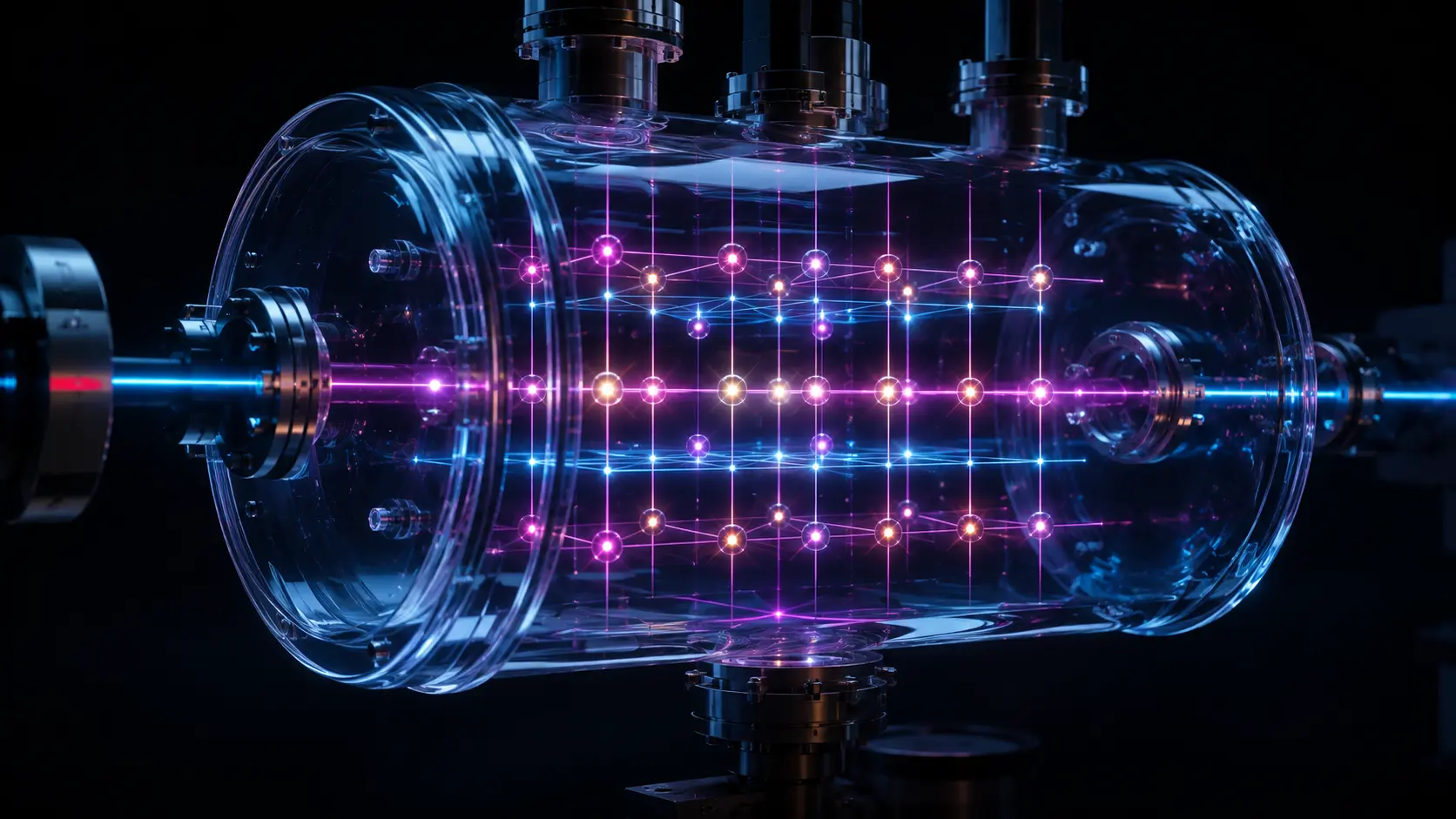
Enter nature’s ultimate pre-fabricated qubits: individual atoms. By stripping away the need for bulky metal circuits and billion-dollar dilution refrigerators, physicists have unlocked a radically cleaner architecture. Using tightly focused laser beams as microscopic tweezers, researchers can catch, move, and arrange thousands of neutral atoms inside a simple glass vacuum cell operating at room temperature. Why should you care right now? Because neutral atoms have rapidly eclipsed older paradigms, crossing the threshold into thousands of physical qubits and demonstrating fault-tolerant, logical error correction. Understanding how optical tweezers and quantum mechanics manipulate these atomic arrays is the key to grasping the new physical foundation of modern computing.
What is Neutral Atom Quantum Computing?
Neutral atom quantum computing is an advanced quantum architecture that traps uncharged atoms (such as rubidium or cesium) using laser-driven optical tweezers or optical lattices. Qubits are encoded in the internal energy states of the atoms, and multi-qubit entanglement is achieved by temporarily exciting the atoms into high-energy Rydberg states.
At a Glance
- Concept: Suspending thousands of identical, natural atoms in a grid using microscopic laser beams, manipulating them dynamically, and entangling them via laser-induced Rydberg interactions.
- Why it matters: Unlike man-made superconducting circuits that suffer from slight physical manufacturing imperfections, every atom of a specific element in the universe is identical, providing a mathematically flawless foundation.
- Who uses it: Pioneering quantum firms (QuEra, Infleqtion, Pasqal), elite national laboratories (Sandia National Laboratories), and academic research consortia.
- Biggest takeaway: The architecture is dynamically reconfigurable. Optical tweezers can physically pick up and move atoms mid-computation, allowing the computer to change its connectivity graph on the fly and repair lost qubits in real-time.
In Simple Words
Imagine trying to build a computer using microscopic glass beads where every single bead has to be wired to a circuit board by hand. As you add more beads, the wiring becomes an unmanageable, tangled catastrophe. This has been the primary scaling bottleneck for traditional quantum computers.
Neutral Atom Quantum Computing throws out the wires entirely.
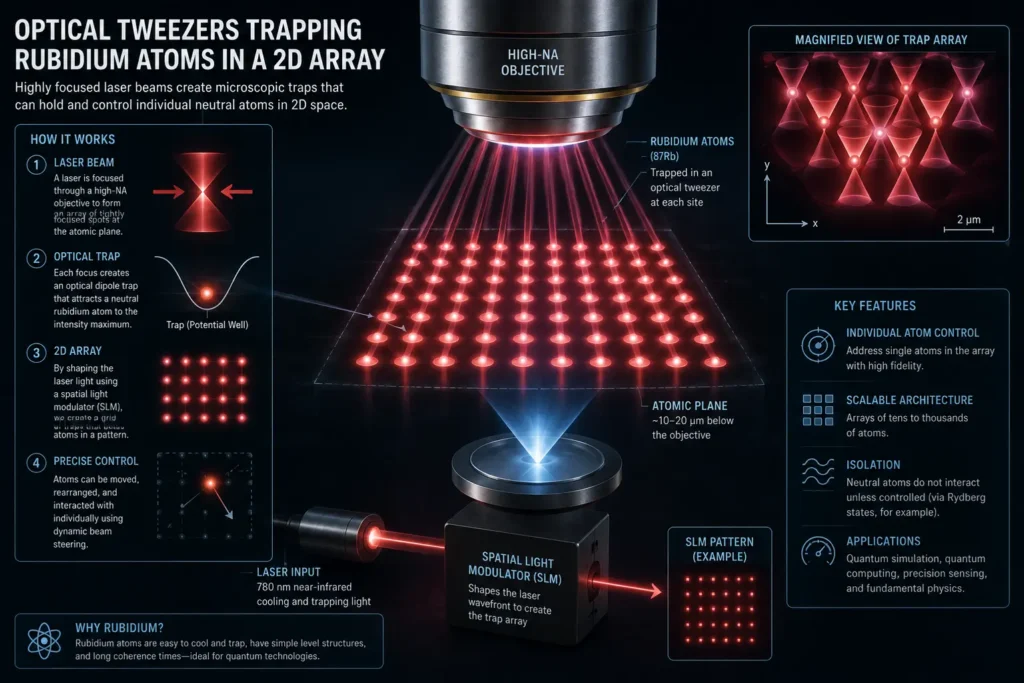
Instead of building artificial circuits on a silicon chip, scientists start with a vapor of natural atoms (like Rubidium) inside a glass vacuum chamber. Then, they shine hundreds of intersecting laser beams down into the chamber. These beams act like microscopic optical tweezers.
Each optical tweezer grabs a single, invisible atom and holds it floating in mid-air. Because the atoms are trapped by light rather than physical wires, computers can use spatial light modulators to instantly pick up, rearrange, and pack thousands of atoms into a neat, perfect grid. To make them compute, another laser flashes the atoms, causing them to interact and share quantum information across the grid without a single wire touching them.
Why This Matters
The commercialization of quantum computing has long been choked by the “Connectivity and Footprint” crisis. Superconducting processors are strictly limited by their two-dimensional nearest-neighbor wiring layout; if a qubit needs to talk to a qubit on the opposite side of the chip, it requires a complex chain of intermediary swap operations that introduces massive error rates.
Neutral atom platforms completely bypass this limitation through dynamic atomic rearrangement. Because the optical tweezers can physically move atoms across distances of several micrometers mid-computation, qubits that need to interact can simply be picked up and shoved next to each other. This reconfigurable architecture allows for arbitrary, flexible entanglement topologies. Combined with the fact that these systems operate in standard vacuum chambers without massive dilution refrigerators, neutral atoms are dramatically lowering the engineering and capital barriers required to field thousand-qubit, fault-tolerant processors.
The Race for Fault-Tolerant Quantum Computing
The neutral atom paradigm has rapidly transitioned from a university physics experiment into a dominant commercial hardware race.
Over the past few years, academic and industrial groups have systematically shattered scale milestones, pushing from dozens of qubits to dense arrays surpassing 3,000 to 6,000 active atoms. This rapid escalation is heavily supported by advancements in real-time control hardware and mid-circuit imaging. Using high-speed CMOS cameras and advanced laser drivers, systems can now image the array, detect if an atom was lost, dynamically replenish the empty site from a reservoir, and resume computation—all in a fraction of a millisecond.
However, the field is locked in a fierce engineering race to improve two-qubit gate fidelities. While single-qubit operations easily exceed 99.9% fidelity, managing the extreme sensitivity of Rydberg states to stray electric and magnetic fields remains a relentless calibration challenge as systems scale toward millions of physical qubits.
How Neutral Atom Quantum Computing Works
Controlling individual atoms requires a sophisticated synergy of laser cooling, spatial light modulation, and atomic physics. Here is the first-principles breakdown.
1. The Fundamental Problem: Thermal Chaos
At room temperature, atoms fly around at hundreds of meters per second, crashing into each other chaotically. To perform quantum calculations, the atoms must be brought to a virtual standstill so they can be trapped.
2. The Insufficiency of Magnetic Traps
Traditional magnetic traps can hold atoms, but they lack spatial precision. They cannot isolate a single atom with the nanometer-scale accuracy required to execute individual quantum logic gates or assemble complex, defect-free two-dimensional geometries.
3. The Core Mechanism: Laser Cooling and Optical Tweezers
The process begins by vaporizing a metal like Rubidium inside a vacuum chamber and bathing it in a counter-propagating laser configuration known as a Magneto-Optical Trap (MOT). The photons from the lasers exert a braking force on the atoms, chilling them to micro-kelvin temperatures—just a hair’s breadth above absolute zero. Once immobilized, an array of optical tweezers (formed by focusing a laser through an Acousto-Optic Deflector or Spatial Light Modulator) traps individual atoms into a precise grid.
4. Technical Depth: The Rydberg Blockade Gate
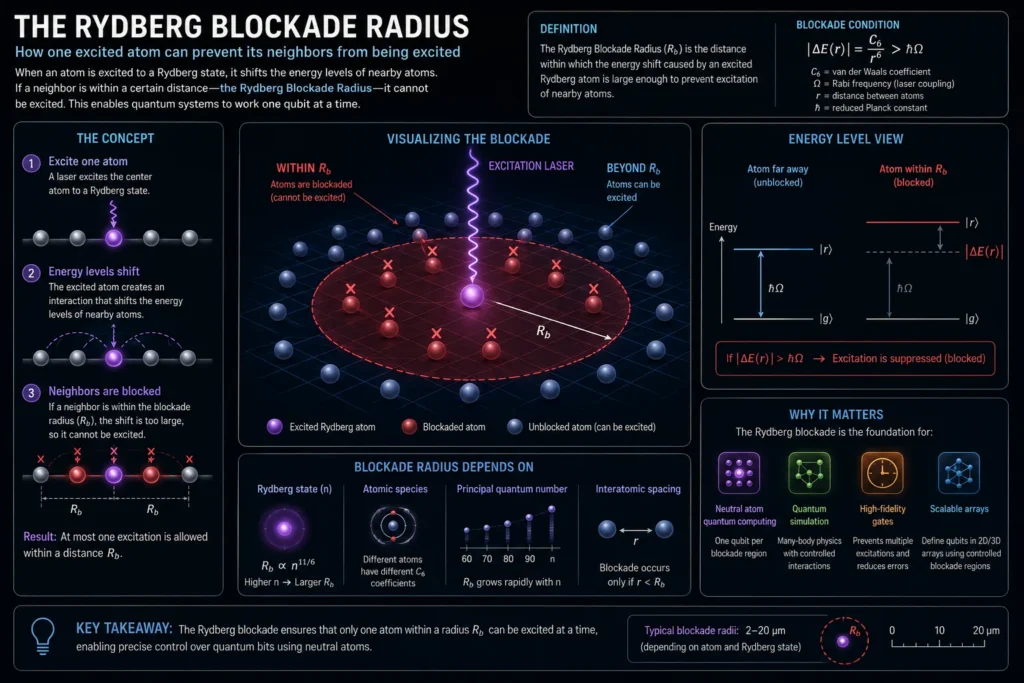
To make two distant atoms share quantum information, scientists exploit the Rydberg Blockade. Normally, two neutral atoms in their ground state ($\vert{}0\rangle$ and $\vert{}1\rangle$) are too far apart to interact with each other; their electronic fields do not overlap.
To force an interaction, a precise ultraviolet laser pulse excites one of the atoms into a high-energy Rydberg State (where the valence electron is pushed far out into a massive orbital). In this inflated state, the atom experiences immense dipole-dipole interactions with its neighbors.
This interaction creates a physical “blockade”: if the first atom is successfully excited into a Rydberg state, its electric field shifts the energy levels of the neighboring atom so drastically that the second atom cannot be excited by the laser. This conditional exclusion is the exact physical mechanism used to construct high-fidelity two-qubit quantum gates (such as the Controlled-Z or CZ gate).
5. Real-World Consequences: Logical Qubit Arrays
Because multiple atoms can be entangled simultaneously across an array using global laser pulses targeting Rydberg states, neutral atom systems can execute multi-qubit operations in parallel. This massive parallelism has allowed laboratories to demonstrate clusters of logical qubits operating under quantum error correction codes (like surface codes and color codes), proving that fault-tolerant quantum computing is not exclusive to cryogenic superconducting architectures.
Enterprise Applications of Neutral Atom Hardware
Neutral atom platforms have rapidly transitioned from academic physics papers into active, cloud-accessible enterprise hardware.
Cloud-Accessible Quantum Computing: Commercial platforms built by companies like QuEra and Pasqal are directly integrated into major enterprise cloud ecosystems (such as Amazon Braket and Microsoft Azure Quantum). Financial institutions, pharmaceutical researchers, and logistics enterprises can submit complex optimization and simulation algorithms to execute on multi-hundred-atom neutral hardware remotely.
Advanced Quantum Simulation: Many complex molecular structures and quantum materials (like the Kitaev honeycomb model or high-temperature superconductors) are impossible to simulate accurately on classical supercomputers. Because neutral atom arrays can be geometrically configured to mimic the exact physical lattice of a material, scientists use them as analog quantum simulators, arranging the atoms to directly model quantum magnetism and molecular behavior in real-time.
Fault-Tolerant Error Correction: Recent experimental milestones have demonstrated the processing of dozens of logical qubits running error-correction algorithms on neutral atom hardware. By utilizing mid-circuit measurements and real-time atom replenishment, these systems can detect and correct qubit decoherence errors on the fly, paving the way for the first commercially viable, fault-tolerant quantum computers.
Economic & Strategic Impact
The rise of neutral atoms represents a major capital diversification for institutional investors in the quantum space.
For years, venture capital was heavily concentrated in superconducting and trapped-ion hardware, both of which require immense capital expenditure for cryogenic dilution refrigerators and complex, high-vacuum microwave wiring harnesses. Neutral atom systems significantly flatten the infrastructure curve. While they still require ultra-high vacuum chambers, eliminating the multi-million-dollar dilution refrigerators drastically reduces the cost-per-qubit scaling curve.
Furthermore, because neutral atom processors can be reconfigured via software (adjusting the spatial light modulator to alter the tweezer geometry), a single physical hardware unit can seamlessly switch between completely different quantum algorithms or error-correction topologies without requiring any physical rewiring of the machine, offering unprecedented hardware versatility.
Advantages
- Identical Qubits: Nature provides the qubits. Every single atom of a given isotope is fundamentally identical, eliminating the manufacturing defects that plague man-made superconducting circuits.
- Room-Temperature Operation: The vacuum chamber operates at room temperature, entirely removing the need for complex, failure-prone cryogenic dilution refrigerators.
- Dynamic Reconfigurability: Optical tweezers can physically move atoms across the array mid-computation, enabling arbitrary connectivity and real-time defect correction.
- High Scalability: Demonstrations of thousands of trapping sites prove that scaling from dozens to thousands of physical qubits is primarily an optical engineering challenge rather than a fundamental physical barrier.
Limitations
- Rydberg State Sensitivity: Rydberg atoms are intensely sensitive to stray electric and magnetic fields in the environment, which can cause decoherence and gate errors if the vacuum chamber is not magnetically shielded with extreme precision.
- Atom Loss and Heating: Manipulating atoms with optical tweezers can inadvertently heat them, causing individual atoms to escape the trap and resulting in operational “atom loss” that requires active mid-circuit replenishment.
- Gate Speed Constraints: While extremely precise, Rydberg-mediated gate operations operate on microsecond timescales, which are fundamentally slower than the nanosecond clock speeds of traditional classical silicon processors.
Common Misconceptions
Misconception: Neutral atom computers use actual lasers to “cut” or physically alter the atoms.
Reality: The lasers are purely optical tools used as “tweezers” to push, pull, and hold the atoms in place using electromagnetic field gradients, or to gently nudge their electron energy levels. The atoms are never physically damaged or altered.
Misconception: Because they don’t use dilution refrigerators, the entire computer operates at blistering hot temperatures.
Reality: While the exterior chamber is at room temperature, the atoms inside the center of the vacuum must still be laser-cooled to micro-kelvin temperatures (nearly absolute zero) so they sit completely still; otherwise, thermal motion would knock them out of the optical tweezers.
Misconception: Neutral atom computing is a completely unproven, theoretical technology.
Reality: It is fully operational at enterprise scale. Commercial quantum processors containing thousands of physical qubits are actively running algorithms via cloud access platforms today.
What Most People Miss
The strategic advantage of Mid-Circuit Real-Time Replenishment.
In almost all other quantum computing architectures, if a single component degrades or drops out during a calculation, the entire algorithm is corrupted, and the run must be aborted.
What most industry observers miss about neutral atom platforms is the unique ability to execute mid-circuit replenishment. Because the array is continuously imaged by a high-speed camera during computation, if an optical tweezer accidentally drops an atom, the control system instantly detects the empty site. It commands an auxiliary reservoir of cold atoms to slide over via optical tweezers, drop a fresh atom into the vacant spot, laser-cool it, and seamlessly resume the calculation—all in real-time, without halting the quantum circuit.
Comparison Table
| Feature | Superconducting Qubits | Trapped Ion Qubits | Neutral Atom Qubits |
| Qubit Medium | Man-made aluminum/niobium circuits | Charged ions (e.g., Ytterbium) | Uncharged natural atoms (Rubidium/Cesium) |
| Operating Temperature | Cryogenic (~15 milliKelvin) | Room temp (Chamber) / Cryo (Surface) | Room Temperature (Laser-cooled micro-kelvin core) |
| Connectivity | Fixed (Nearest-neighbor wiring) | All-to-all (Ion chain motion) | Dynamic & Reconfigurable (Movable optical tweezers) |
| Qubit Uniformity | Variable (Prone to fabrication defects) | Perfect (All ions identical) | Perfect (All natural atoms identical) |
| Scale Limit (2026) | Hundreds to low thousands | Hundreds | Thousands to over 6,000 physical qubits |
Case Study
Situation: A leading financial institution wanted to run massive, highly complex portfolio optimization models that exceeded the memory and calculation limits of traditional classical supercomputers, but existing superconducting quantum computers lacked the qubit count and connectivity to handle the problem without massive error accumulation.
Challenge: The financial algorithms required complex multi-qubit entanglement across non-adjacent variables. On a fixed-wiring superconducting chip, this required thousands of wasteful swap gates that destroyed the quantum state before the answer could be computed.
Solution (The Neutral Atom Pivot): The institution partnered with a commercial neutral atom quantum provider, submitting their optimization problem to a cloud-accessible, 256-qubit reconfigurable optical tweezer array.
Outcome: Because the neutral atom platform utilized dynamic optical tweezers, the system bypassed the swap gate bottleneck entirely. When two non-adjacent qubits needed to interact, the optical tweezers physically picked up the atoms and slid them next to each other in milliseconds, executed the Rydberg gate, and returned them to their grid positions. The algorithm executed with a fraction of the error rate of competing hardware architectures.
Lessons Learned: The case study proved that architectural flexibility is just as important as raw qubit count. By leveraging dynamic atom rearrangement and optical connectivity, neutral atom processors can execute complex optimization graphs with radically fewer gate operations, cementing their status as a premier hardware modality for real-world computational problem-solving.
Future Outlook
Next 12–24 Months
The race for Logical Qubit Supremacy. Over the next two years, the focus will shift entirely from scaling physical qubits to stabilizing logical qubits. Companies will race to demonstrate continuous, error-corrected execution of complex quantum circuits exceeding 100 logical qubits, utilizing real-time mid-circuit measurements and dynamic atom replenishment to suppress error accumulation below fault-tolerant thresholds.
Next 3–5 Years
The integration of Hybrid Photonic Interconnects. While optical tweezers allow local arrays to scale internally to thousands of atoms, connecting multiple distinct vacuum chambers into a massive, multi-module supercomputer requires optical fiber links. By the late 2020s, entanglement distribution via photons will link separate neutral atom arrays, creating massive, distributed quantum data centers.
Next 10 Years
The Commercialization of Industrial Optimization. By the mid-2030s, neutral atom computers will transition from scientific testbeds into standardized enterprise accelerators. Housed in sleek, room-temperature server racks (requiring only laser systems and vacuum pumps rather than massive cryogenic plants), they will be deployed directly inside corporate data centers to solve complex logistics, pharmaceutical discovery, and cryptographic challenges at industrial scale.
Most Likely Scenario
Neutral atom quantum computing will capture a dominant market share in large-scale simulation and combinatorial optimization. While superconducting systems may hold advantages in raw gate speed for specific niche algorithms, the unmatched scalability, room-temperature operation, and dynamic reconfigurability of optical tweezer arrays will make neutral atoms the premier platform for massive, fault-tolerant quantum computing.
Key Takeaways
- Neutral atom quantum computing traps uncharged atoms using focused laser beams called optical tweezers, operating inside room-temperature vacuum chambers.
- Qubits are encoded in the internal energy states of natural elements like Rubidium and Cesium, ensuring every qubit in the processor is fundamentally identical.
- Entanglement is achieved by exciting atoms into high-energy Rydberg states, creating a “Rydberg blockade” that forces atomic interactions when atoms are pushed close together.
- Unlike fixed-wiring architectures, optical tweezers can physically move atoms mid-computation, enabling dynamic reconfigurability and arbitrary connectivity.
- Systems have scaled rapidly to thousands of physical qubits, successfully running error-corrected logical circuits and real-time atom replenishment.
- The primary engineering challenges involve protecting the delicate Rydberg states from stray magnetic/electric fields and managing atom loss through active thermal control.
Glossary
Acousto-Optic Deflector (AOD): An electronic device that uses sound waves to dynamically steer laser beams, allowing optical tweezers to rapidly shift atom positions across a 2D plane.
Entanglement: A fundamental quantum phenomenon where two or more particles become deeply interconnected such that the state of one instantly dictates the state of the other, regardless of distance.
Magneto-Optical Trap (MOT): An experimental apparatus that combines magnetic field gradients and laser cooling to immobilize and trap a cloud of atoms near absolute zero.
Optical Tweezers: Highly focused laser beams capable of trapping and manipulating microscopic dielectric objects, including individual neutral atoms, using light pressure and gradient forces.
Rydberg Blockade: A quantum phenomenon where exciting one atom to a high-energy Rydberg state shifts its electronic field so drastically that nearby atoms are blocked from entering the same state, enabling controlled multi-qubit logic gates.
Spatial Light Modulator (SLM): An advanced optical device used to modulate the phase and amplitude of a laser beam, projecting complex, multi-spot patterns to form massive arrays of optical tweezers.
Frequently Asked Questions
Do neutral atom computers need to be kept in a freezer?
No. Unlike superconducting quantum computers that require multi-million-dollar dilution refrigerators to reach near absolute zero, the main vacuum chamber of a neutral atom computer operates at room temperature. However, the atoms inside the chamber must still be laser-cooled to micro-kelvin temperatures so they sit completely still.
How do you read the results of a neutral atom computer?
At the end of the calculation, a specialized camera shines a fluorescence laser onto the atom array. If the atom is in a specific quantum state, it glows brightly; if it is in another state, it remains dark. The camera takes a picture, and software instantly decodes the final binary answer from the image.
Why are Rubidium and Cesium used as qubits?
They are alkali metals with a single valence electron in their outer shell. This simplified electronic structure makes them exceptionally clean to laser-cool, trap, and excite into Rydberg states compared to multi-electron atoms.
Can optical tweezers crush an atom?
No. Optical tweezers do not apply mechanical pressure. They use electromagnetic field gradients generated by light to create a microscopic “potential well” (an energy trap) that gently holds the atom in place using light forces.
Are neutral atom computers commercially available today?
Yes. Companies like QuEra and Pasqal offer cloud-based access to multi-hundred-atom neutral quantum processors, allowing developers to run algorithms remotely over the internet today.
Sources
[1] arXiv: Neutral Atom Quantum Computing: Principles, Routes, Progress, and Challenges (August 2026)
[2] Wikipedia: Neutral atom quantum computer (2026 Technical Overview)
[3] Sandia National Laboratories: Neutral Atoms and Rydberg Computing Research Brief
[4] QuEra Computing: Building Quantum Computers with Neutral Atoms and Optical Tweezers
[5] Quantum Machines: Quantum Control Solutions for Neutral Atom Architectures (2026)