Advertisement
)
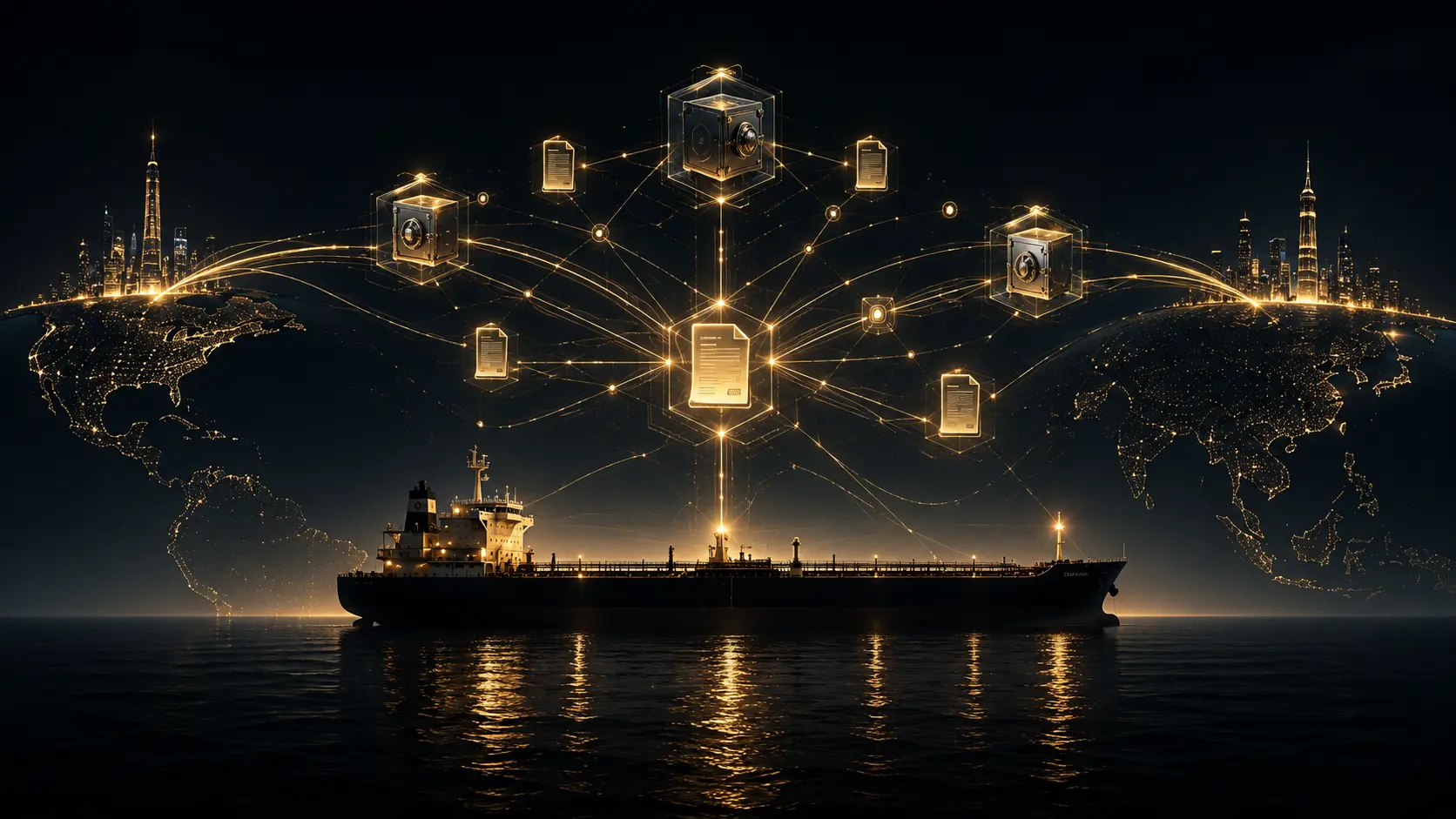

When a geopolitical crisis shuts down a major shipping lane or a sudden freeze paralyzes natural gas production, the global economy panics. But in the ultra-secretive offices of Geneva and Singapore, the world’s largest commodity trading houses do not panic—they profit. Companies like Trafigura, Vitol, and Glencore control the physical flow of the planet’s oil, copper, and wheat. Yet, despite moving trillions of dollars of raw materials annually, they operate almost entirely on borrowed money. They use massive syndicates of bank debt to purchase crude oil, load it onto Very Large Crude Carriers (VLCCs), and literally park the ships in the middle of the ocean.
Why should you care right now? Because these trading cartels have mastered a financial cheat code known as “synthetic storage arbitrage.” By exploiting the spread between today’s spot price and tomorrow’s futures contract, they lock in guaranteed, risk-free profits funded entirely by short-term bank lines. Understanding the obscure plumbing of physical commodity trade finance reveals who truly controls the levers of global inflation, and why the “shadow banking” debt fueling these massive cargo ships is the most critical, yet least understood, systemic risk in the global financial system.
What is Physical Commodity Trade Finance?
Physical commodity trade finance is the specialized provision of short-term credit and liquidity used by trading houses to purchase, store, and transport physical raw materials. It relies heavily on Letters of Credit (LCs), uncommitted bilateral credit lines, and inventory repurchase agreements to fund massive maritime cargoes while simultaneously managing severe price volatility and counterparty risk.
At a Glance
- Concept: Utilizing specialized short-term bank debt to finance the movement and storage of physical raw materials across the globe.
- Why it matters: The global economy runs on physical commodities, but moving a single ship of LNG or copper costs hundreds of millions of dollars. Without trade finance acting as the grease, global supply chains would instantly freeze.
- Who uses it: The “ABC” of agriculture (ADM, Bunge, Cargill) and the energy/metals giants (Vitol, Trafigura, Glencore, Mercuria), backed by major trade finance banks like ING, Rabobank, and BNP Paribas.
- Biggest takeaway: Commodity trading houses are fundamentally highly leveraged arbitrageurs. They do not gamble on the directional price of oil; they hedge every physical cargo with a paper futures contract, locking in a margin and borrowing against the hedged inventory.
In Simple Words
Imagine you want to buy $100 million worth of oil from a driller in the Middle East and sell it to a refinery in Europe for $102 million.
You don’t have $100 million in cash. So, you go to a bank. The bank says, “We will lend you the money, but we need a guarantee.” You ask the European refinery’s bank to write a Letter of Credit—a legally binding promise that they will pay you the $102 million the exact moment the oil arrives at their port.
With that letter in hand, your bank lends you the $100 million. You buy the oil, put it on a ship, and sail it to Europe. When it arrives, the letter is triggered, the refinery pays $102 million, you pay back your bank the $100 million plus a small interest fee, and you keep the profit.
Now, scale this up to thousands of ships, trains, and pipelines moving simultaneously around the globe every single day. That is the multi-trillion-dollar machine of Physical Commodity Trade Finance.
Why This Matters
Commodity trading houses are the ultimate shadow banks of the real economy.
Because they are predominantly privately held partnerships, they operate outside the strict capital requirements of Basel III that constrain traditional Wall Street banks. Yet, their balance sheets are astronomical. When global supply chains break—such as during the 2022 energy crisis or the Red Sea shipping blockades—the volatility causes the price of commodities to spike violently.
For Macro Analysts and Supply Chain Executives, understanding the capital structure of these firms is vital. When commodity prices double, the amount of credit a trading house needs to finance the exact same cargo also doubles. If the banks refuse to extend more credit, the trading houses cannot buy the cargo, leading to immediate, physical shortages of food, metal, and fuel globally. Trade finance is the invisible tether connecting central bank interest rates directly to the price of a gallon of gasoline.
The Geopolitics of Commodity Trade Finance
The geopolitical fragmentation of the 2020s has turned trade finance into a weapon.
Historically, global trade finance was a smooth, boring, low-margin business dominated by European banks. However, as sanctions isolated massive commodity producers like Russia, the standard flow of Letters of Credit broke down. Western banks refused to clear transactions involving sanctioned entities.
This created a massive premium for the trading houses willing to navigate the legal and geopolitical minefield. Firms that can source “dark fleet” tankers, route payments through non-dollar clearing systems, and secure alternative credit lines in the Middle East or Asia are capturing unprecedented arbitrage margins. The ability to finance a controversial cargo is now vastly more profitable than the physical extraction of the commodity itself.
How Synthetic Storage Arbitrage Works
Extracting risk-free profit from volatile physical markets requires executing a flawless combination of physical logistics and paper derivatives. Here is the first-principles breakdown.
1. The Fundamental Problem: Capital Intensity of Cargoes
A single Very Large Crude Carrier (VLCC) holds 2 million barrels of oil. At $80 a barrel, that is a $160 million cargo. A trading house might have 200 ships on the water at any given time. No company on Earth has $32 billion in idle cash sitting around just to float their daily inventory. They absolutely must borrow the money.
2. The Insufficiency of Traditional Corporate Debt
Traditional corporate bonds or term loans take months to negotiate and carry strict covenants that limit how much a company can borrow. Commodity markets move in minutes. A trader needs to be able to borrow $160 million on a Tuesday morning, buy a cargo, sell it on Thursday, and instantly repay the loan. Traditional corporate debt is too slow and too rigid.
3. The Core Mechanism: Uncommitted Bilateral Lines
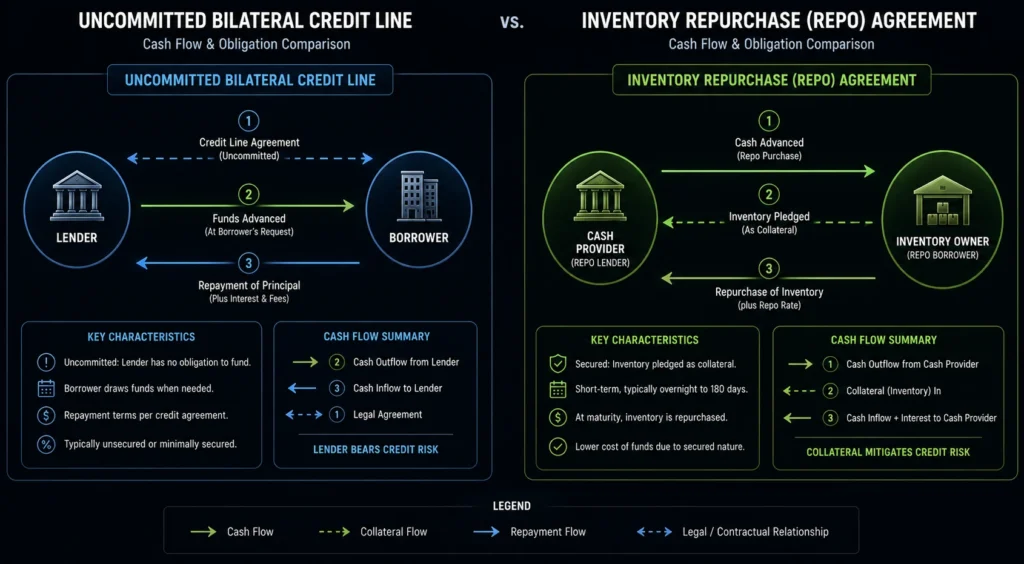
To achieve maximum flexibility, trading houses use “Uncommitted Bilateral Credit Lines.” A syndicate of banks agrees to provide a massive pool of capital (e.g., $5 billion) to the trader. Crucially, the facility is “uncommitted,” meaning the bank reviews every single cargo the trader wants to buy before approving the specific loan. The bank lends the cash specifically against the physical value of that exact cargo, using the oil inside the ship as collateral.
4. Technical Depth: Contango and The Paper Hedge
Banks will not lend $160 million against oil unless the trader removes the price risk. The trader does this by hedging. The moment they buy the physical oil, they sell a paper “Futures Contract” on a financial exchange to lock in the future sale price.
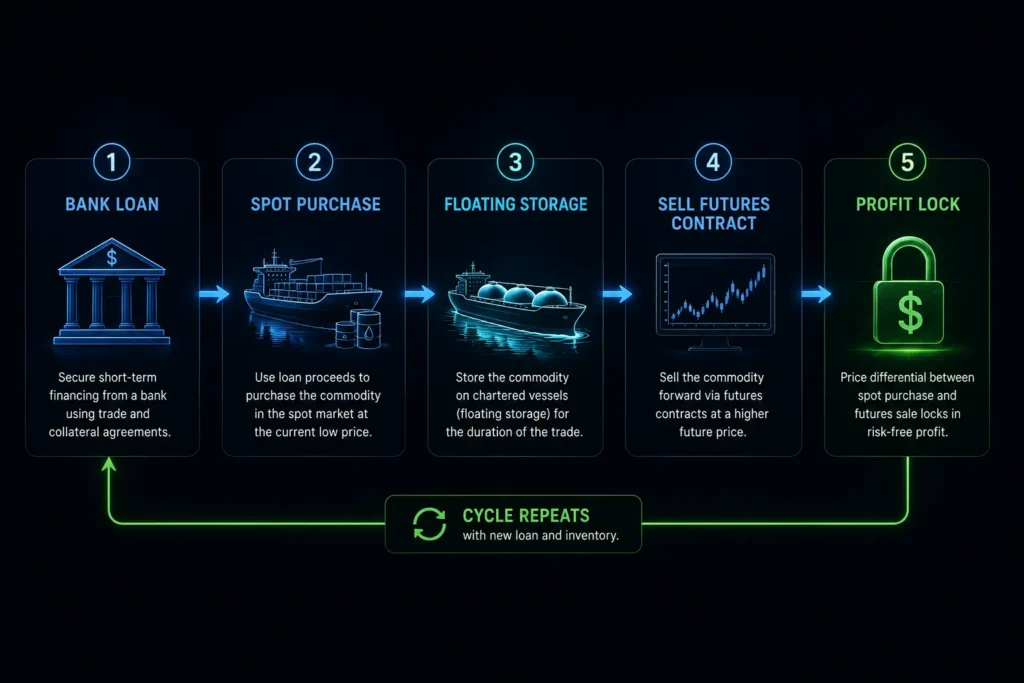
If the market is in Contango (meaning the future price is higher than today’s spot price), the trader executes a “Synthetic Storage Arbitrage.” They borrow cheap bank money, buy the cheap physical oil today, put it on a rented ship (floating storage), sell the expensive futures contract for 6 months from now, and physically wait. The profit is mathematically locked in on day one.
5. Real-World Consequences: Inventory Repurchase Agreements (Repos)
To avoid overloading their balance sheets with debt, modern trading houses utilize structural inventory financing, or “Commodity Repos.” Instead of taking a loan to buy the oil, the trading house legally sells the oil in their storage tanks to the bank today, and signs a contract to buy it back from the bank in 30 days. The bank technically owns the physical oil for a month, freeing up massive amounts of working capital for the trader while keeping the debt off their official balance sheet.
Real-World Applications of Trade Finance
The plumbing of trade finance dictates the physical movement of the modern world.
The Floating Oil Armadas: During the peak of the 2020 pandemic lockdowns, oil demand collapsed, and spot prices went negative. However, future prices remained positive (super-contango). Trading houses chartered every available VLCC on Earth, bought the worthless physical oil, stored it at sea, sold the futures, and generated billions in guaranteed profit simply by floating the ships in circles for six months, funded entirely by their massive uncommitted bank lines.
Metals Warehousing and Repos: Copper and aluminum are critical for the energy transition. Trading giants own massive physical warehouse networks (like LME-approved sheds). They utilize Repo structures, selling the physical metal sitting in their own warehouses to financing banks to unlock cash, while simultaneously charging the market premium storage fees. This dual-sided grip allows them to control the physical availability of the metal that automakers and grid developers desperately need.
Agricultural Letters of Credit: Moving wheat from Brazil to Egypt is fraught with counterparty risk; the seller does not trust the buyer to actually pay when the ship arrives. Trade finance banks issue complex, tiered Letters of Credit (LCs) that guarantee payment. By acting as the trusted, highly capitalized middleman, the bank absorbs the geopolitical default risk, allowing the physical food supply to reach emerging markets.
Economic & Strategic Impact
The greatest vulnerability in physical commodity trading is The Margin Call.
When a trader buys physical oil and hedges it by selling short a paper futures contract, they are economically perfectly neutral. However, the financial plumbing is deeply flawed. The physical oil is sitting on a ship, illiquid. The paper futures contract is sitting on a digital exchange, marked-to-market every day.
If geopolitical chaos causes the price of oil to suddenly spike by 50%, the value of the physical oil on the ship goes up, but the paper futures contract loses massive amounts of money. The financial exchange demands an immediate cash “margin call” to cover the paper loss. Even though the trader is fully hedged overall, they must come up with billions of dollars in liquid cash by 3:00 PM to satisfy the exchange, or face immediate liquidation. This “liquidity mismatch” is the single greatest systemic risk generated by the commodity trading sector.
Advantages
- Massive Leverage with Low Default Risk: Because the loans are backed directly by highly liquid, physical collateral (oil, gold, wheat) and hedged on exchanges, banks are willing to lend trading houses tens of billions of dollars at extremely low interest rates.
- Off-Balance Sheet Agility: Using Repurchase Agreements (Repos) allows traders to legally transfer ownership of inventory to the bank, acquiring immediate cash without triggering traditional debt-to-equity covenant limits.
- Geopolitical Arbitrage: The complexity of the financing acts as a massive barrier to entry. Only the elite cartels have the banking relationships required to finance and move a cargo out of a sanctioned or conflict-heavy zone, allowing them to charge astronomical premiums.
Limitations
- The Liquidity Mismatch (Margin Risk): The devastating vulnerability of having illiquid physical assets backing highly liquid, volatile paper hedges, requiring the trading house to maintain massive, idle cash reserves just to survive sudden price spikes.
- Bank Retreat and Consolidation: As global banking regulations (Basel III and IV) increase capital requirements, many traditional European trade finance banks are exiting the sector, shrinking the pool of available credit and concentrating systemic risk among a few remaining mega-banks.
- Fraud and Paper Tracking: Trade finance relies heavily on physical paper documents like Bills of Lading. The industry is notoriously susceptible to fraud, where criminals use forged paperwork to sell the exact same cargo of metal to multiple different banks simultaneously.
Common Misconceptions
Misconception: Commodity traders are speculators betting on the price of oil to go up or down.
Reality: They are hyper-conservative arbitrageurs. They almost never take a naked directional bet on the price of a commodity. The instant they buy a physical asset, they hedge it with a paper derivative. They profit from the logistics, the storage, and the financing spread, not the absolute price.
Misconception: If a trading house goes bankrupt, the bank loses all its money.
Reality: The loans are heavily collateralized. Because the bank extended credit against a specific, physical cargo on a specific ship, if the trader defaults, the bank legally seizes the ship, sails it to a refinery, sells the oil on the open market, and recovers its capital.
Misconception: Backwardation is bad for commodity traders.
Reality: While contango is great for “storage arbitrage,” backwardation (when spot prices are higher than future prices) is highly lucrative for logistics. In a backwardated market, physical commodities are in massive deficit today. Traders make fortunes by utilizing their superior shipping networks to deliver physical cargoes instantly to desperate buyers at massive premiums.
What Most People Miss
The strategic weaponization of Pre-Export Finance (PXF).
While standard LCs and uncommitted lines finance the ships on the water, the true geopolitical power of trading houses is wielded through Pre-Export Finance.
What most people miss is that trading cartels effectively act as sovereign lenders. A struggling, resource-rich nation (or a mid-tier mining company) often cannot secure loans from traditional Western banks or the IMF. A trading house like Glencore will step in and lend the country $2 billion in cash upfront. In exchange, the country agrees to pay back the loan by exclusively giving the trading house millions of barrels of oil over the next five years at a steep discount. By acting as the bank, the trading cartel permanently locks up the physical supply of critical national resources, guaranteeing their own monopoly over the global flow of the commodity.
Comparison Table
| Feature | Corporate Revolving Credit | Uncommitted Bilateral Line | Inventory Repurchase (Repo) |
| Commitment | Guaranteed by the bank | Discretionary (Bank approves per-cargo) | Legal sale of asset, not a loan |
| Collateral | Broad corporate assets | The specific physical cargo being shipped | The physical inventory in the tank |
| Balance Sheet Impact | Appears as standard debt | Appears as short-term debt | Off-balance sheet (Inventory sold) |
| Primary Use Case | Long-term CapEx / Operations | Funding ships on the water (Transit) | Freeing cash from stored materials |
| Flexibility | Rigid, requires covenants | High, scales instantly with cargo value | Extreme, liquidates idle storage |
Case Study
Situation: In early 2022, following the geopolitical shock of the invasion of Ukraine, global commodity markets experienced unprecedented, violent volatility. The London Metal Exchange (LME) nickel market broke completely, with prices spiking over 250% in a matter of hours due to a massive short squeeze.
Challenge: Major commodity trading houses held massive physical inventories of metals and energy. As per standard practice, they had shorted paper futures contracts to hedge the price of their physical inventory. When the prices spiked vertically, the exchanges demanded billions of dollars in immediate cash margin calls to cover the paper losses, even though the physical metal the traders held had gained equal value.
Solution (The Liquidity Scramble): Trafigura, one of the world’s largest traders, faced immense margin pressure. They could not liquidate their physical ships fast enough to generate the cash required by the exchange. They had to frantically tap their massive network of uncommitted bilateral credit lines and secure an emergency $3 billion syndicated revolving credit facility from a consortium of private banks to cover the margin calls and prevent a default.
Outcome: The traders survived, and once the contracts settled and the physical goods were delivered, the massive paper losses were canceled out by the massive physical gains. However, the sheer scale of the emergency borrowing exposed a terrifying systemic fragility.
Lessons Learned: The 2022 liquidity crisis proved that the greatest threat to physical commodity traders is not the price of the commodity, but the architecture of the financial plumbing. It forced trading houses to permanently increase their liquid cash buffers and rely more heavily on bespoke bilateral derivatives (where banks are more forgiving with margin requirements) rather than rigid, cash-hungry public exchanges.
Future Outlook
Next 12–24 Months
The era of Working Capital Squeeze. As global interest rates remain structurally higher than the 2010s baseline, the cost of financing a $150 million cargo has skyrocketed. Smaller, Tier-2 and Tier-3 trading boutiques simply will not be able to afford the interest expense required to float their cargoes. We will witness an aggressive wave of consolidation, as the mega-traders (who can secure the cheapest bank debt) buy up the distressed physical assets and logistics networks of their smaller, undercapitalized competitors.
Next 3–5 Years
The integration of Blockchain Bills of Lading. The physical commodity sector still relies on couriers literally flying paper documents across the globe to trigger multi-million dollar bank payments. The friction and fraud in this system cost billions. By the late 2020s, major banking consortiums will force the transition to digitized, blockchain-based Electronic Bills of Lading (eBL). This will allow smart contracts to instantly verify cargo ownership and release letters of credit in seconds, drastically reducing the required duration of uncommitted loans.
Next 10 Years
The shift to Critical Mineral Hegemony. The golden era of crude oil arbitrage will slowly plateau. The trading cartels will redirect their massive credit syndicates toward the physical control of the energy transition: copper, lithium, cobalt, and rare earth elements. Because these markets are smaller, less transparent, and highly concentrated geographically, the trading houses will leverage massive Pre-Export Finance (PXF) facilities to aggressively lock up mining output in Africa and South America, effectively controlling the physical supply chain of the global electrification movement.
Most Likely Scenario
Physical commodity trade finance will remain an opaque, essential shadow banking layer. As commercial banks retreat due to tightening capital regulations, the trading cartels will increasingly source their debt from private credit funds and sovereign wealth entities. By mastering the alchemy of synthetic storage and uncommitted credit, these secretive giants will maintain their absolute monopoly over the physical movement of the global economy.
Key Takeaways
- Commodity trading houses move trillions of dollars of raw materials using almost entirely borrowed money, relying heavily on uncommitted bilateral credit lines and Letters of Credit.
- Traders are not directional speculators; they hedge every physical purchase by selling a paper futures contract, mathematically neutralizing their exposure to the absolute price of the commodity.
- In a “Contango” market (future prices > spot prices), traders buy cheap physical oil, store it on ships, sell the expensive future, and lock in a risk-free “synthetic storage arbitrage” profit.
- To avoid overloading their balance sheets, traders use Inventory Repurchase Agreements (Repos), legally selling their stored commodities to a bank for cash today and buying it back later.
- The primary systemic risk is the “Margin Call”: when prices spike, traders must produce billions in liquid cash to cover their paper hedges, creating a massive, highly dangerous liquidity mismatch.
- Trading cartels act as shadow banks through Pre-Export Finance (PXF), lending billions to resource-rich nations in exchange for exclusive, long-term control over their physical mining or drilling output.
Glossary
Backwardation: A market condition where the current (spot) price of a physical commodity is higher than prices trading in the futures market, indicating a severe, immediate shortage of supply.
Contango: A market condition where the future price of a commodity is higher than the current spot price, allowing traders to profit by buying the physical asset today, storing it, and selling the future.
Letter of Credit (LC): A financial document issued by a bank guaranteeing that a buyer’s payment to a seller will be received on time and for the correct amount, fundamentally eliminating counterparty risk in global trade.
Margin Call: A demand from a financial exchange or broker for an investor to deposit additional cash to cover potential losses on an open, highly leveraged derivative or futures position.
Pre-Export Finance (PXF): A funding arrangement where a trading house or bank lends cash to a commodity producer upfront, and the loan is repaid exclusively through the future delivery of the physical commodity itself.
Uncommitted Bilateral Line: A flexible banking arrangement where the bank provides a maximum credit limit, but retains the right to approve or deny every single loan request on a cargo-by-cargo basis.
Sources
[1] Trafigura: The Economics of Commodity Trading Firms (Annual Industry Whitepaper 2025/2026)
[2] Financial Stability Board (FSB): Vulnerabilities in Commodity Trade Finance and Shadow Banking (2026 Analysis)
[3] Bank for International Settlements (BIS): Margin Calls and Liquidity Mismatches in Physical Commodity Markets
[4] Bloomberg Financial: The Shadow Banks of Geneva: How Glencore and Vitol Finance the World
[5] International Chamber of Commerce (ICC): The Digitization of Trade Finance and Electronic Bills of Lading