Advertisement
)

Inside the world’s most powerful artificial intelligence data centers, a hidden energy crisis is throttling the future of computing. As tech giants wire together tens of thousands of GPUs to train massive AI models, they are discovering that the traditional internet is simply too slow and too power-hungry. To move data between servers, modern networks convert beams of light from fiber-optic cables into electricity, route the electrical signal through a silicon switch, and convert it back into light. This constant translation process consumes up to 30 percent of an entire data center’s electricity, generating massive heat and injecting fatal latency into synchronized AI training runs.
To solve this, engineers are entirely eliminating the electrical middleman. Instead of translating light into electricity, they are bouncing the light directly to its destination using microscopic, robotic mirrors. This breakthrough—known as Optical Circuit Switching (OCS)—replaces power-hungry electronic switches with pure, all-optical routing. By manipulating lasers with nanometer precision, hyperscalers are achieving unprecedented data speeds while slashing energy consumption to near zero. Understanding how these mechanical mirrors are physically rewiring the cloud is the key to grasping how AI scaling will survive the electrical demands of the next decade.
What is Optical Circuit Switching (OCS)?
Optical Circuit Switching (OCS) is an advanced networking technology that routes data purely as light, using microscopic, steerable mirrors to bounce laser beams directly from an input fiber to an output fiber. By eliminating the need to convert light into electricity for routing, OCS drastically reduces power consumption and latency in AI data centers.
At a Glance
- Concept: Removing the silicon microchips from the core of the network and replacing them with a purely physical, optical reflection system to route internet traffic.
- Why it matters: AI models are distributed across thousands of chips that must constantly talk to each other. The time it takes to convert light to electricity and back again (OEO conversion) slows down the entire multi-billion-dollar supercomputer.
- Who uses it: Google (pioneering its TPU clusters), elite hyperscale cloud providers, and advanced telecommunication backbone operators.
- Biggest takeaway: OCS is “protocol agnostic.” Because the mirror doesn’t read the data—it only reflects the light—you can push 100-Gigabit, 400-Gigabit, or 800-Gigabit speeds through the exact same mirror without ever having to upgrade the OCS hardware.
In Simple Words
Normally, data travels between servers as pulses of light inside glass cables (fiber optics).
But light cannot turn corners on its own. When the data reaches a major intersection in the data center, a traditional network switch acts like a traffic cop. To read the destination address, the traffic cop has to catch the light, turn it into electricity, read the electrical data, and then turn it back into light to shoot it down the correct path. This translation process requires a piece of hardware called an optical transceiver. Transceivers are expensive, get incredibly hot, and consume massive amounts of electricity.
Optical Circuit Switching (OCS) fires the traffic cop and replaces them with a mirror.
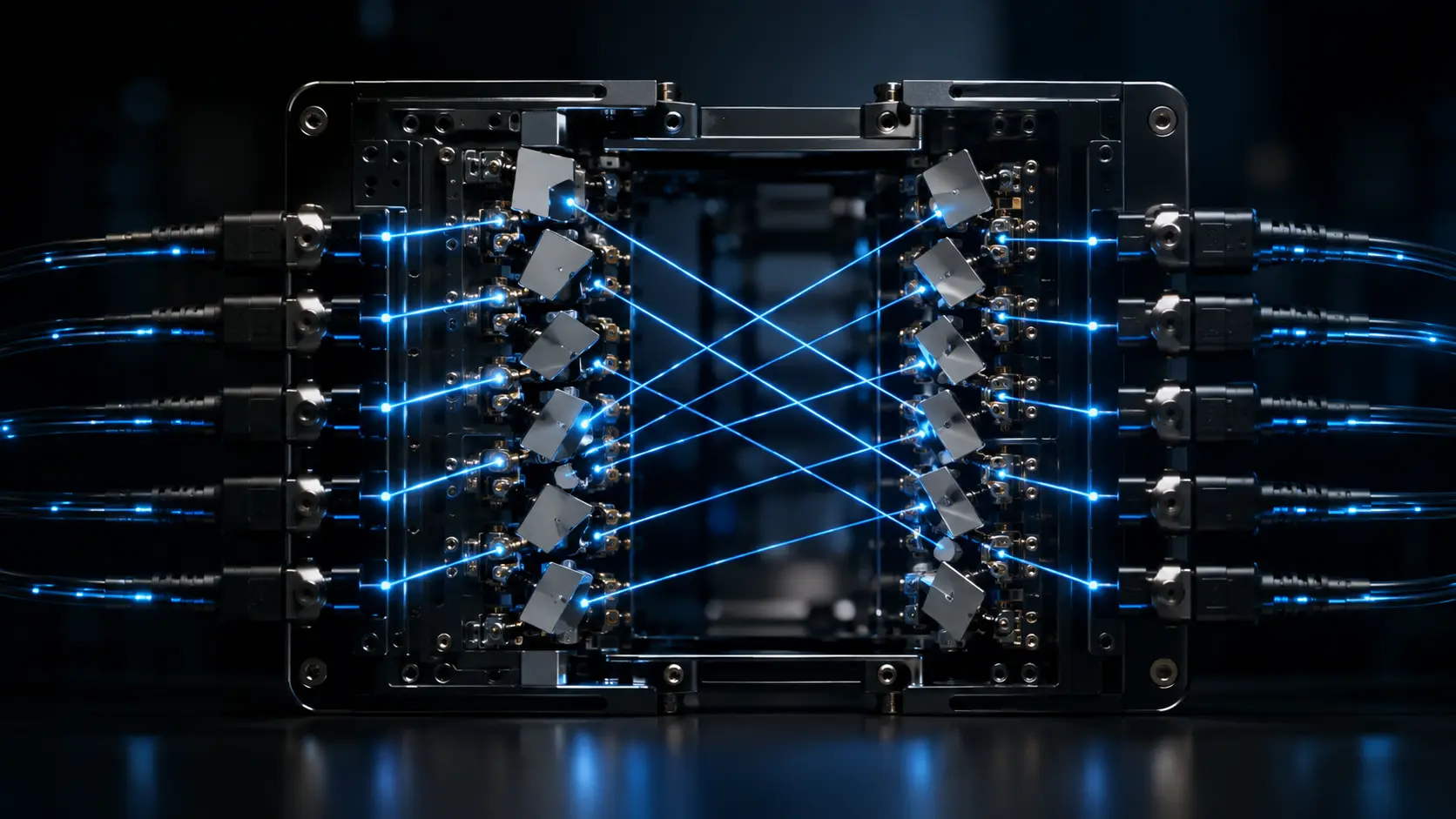
Inside an OCS box, there are hundreds of microscopic mirrors mounted on tiny robotic hinges. When the beam of light enters the intersection, a computer instantly tilts a specific mirror by a fraction of a degree. The light simply bounces off the mirror and shoots perfectly down the correct output cable. The data stays as light the entire time. There is no translation, no electricity wasted on reading the data, and zero delay.
Why This Matters
The capital expenditure (CapEx) required to build a 100,000-GPU artificial intelligence cluster is staggering, but the operational expenditure (OpEx)—specifically the electricity bill—is what ultimately limits scaling.
As cluster speeds move from 400G to 800G and beyond, the power required by traditional optical transceivers scales exponentially. In a traditional electrical spine-and-leaf network architecture, a single piece of data might have to undergo six different Optical-Electrical-Optical (OEO) conversions just to travel from one rack to another.
For Cloud Architects and Hardware Investors, OCS represents the ultimate structural shortcut. By deploying OCS at the core “spine” layer of the data center, hyperscalers completely eliminate millions of transceivers from their bill of materials. This not only slashes the power budget of the network by up to 60 percent, but it frees up that electrical capacity to be routed directly into the GPUs themselves, allowing the data center to train vastly larger AI models within the same municipal power constraints.
The Evolution of Optical Circuit Switching
Optical Circuit Switching is not a new concept—telecom companies experimented with it during the dot-com boom of the late 1990s. However, the technology failed commercially because the internet of 2001 didn’t move enough continuous data to justify the cost of the mirrors, and the MEMS (Micro-Electro-Mechanical Systems) technology was too fragile.
The AI boom fundamentally altered the math. Training a Large Language Model (LLM) involves “synchronous” workloads, meaning thousands of GPUs compute a math problem and then all try to share their answers with each other at the exact same millisecond. This creates predictable, massive, continuous waves of data that perfectly suit the static routing of an OCS. Google’s publication of their TPUv4 architecture proved that OCS had finally transitioned from a telecommunications novelty into the foundational networking layer of the modern AI supercomputer.
How Optical Circuit Switching (OCS) Works
Eliminating silicon logic chips from the routing equation requires extreme mechanical precision. Here is the first-principles breakdown.
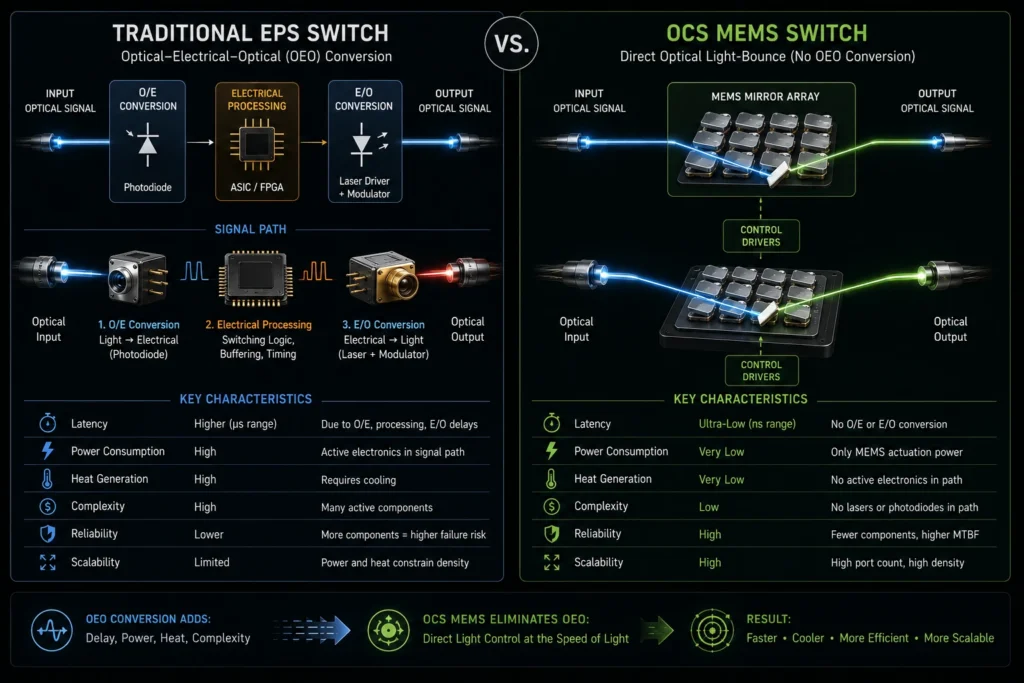
1. The Fundamental Problem: OEO Conversion
In traditional Electronic Packet Switching (EPS), fiber optic cables plug into transceivers. These transceivers use lasers and photodetectors to convert light (Optical) into electricity (Electrical) and back to light (Optical). This is the OEO Conversion. As bandwidth speeds scale up to 800 Gbps, the silicon switches get so hot they require massive liquid cooling, and the transceivers consume so much power they threaten to melt the network ports.
2. The Insufficiency of Traditional EPS for AI
Electronic switches read every individual “packet” of data to figure out where it goes. This is great for the chaotic, random traffic of the public internet. However, AI training clusters don’t have random traffic. They have highly predictable, massive, continuous data flows. Forcing this massive river of data through a packet-reading silicon tollbooth creates unnecessary latency and massive energy waste.
3. The Core Mechanism: 3D MEMS Mirror Arrays
An OCS bypasses the tollbooth entirely. The core of an OCS is the 3D MEMS (Micro-Electro-Mechanical Systems) array. Imagine two silicon chips facing each other, each covered in hundreds of microscopic mirrors. Every mirror is mounted on tiny, electrically controlled hinges that allow it to tilt in two dimensions (X and Y axes).
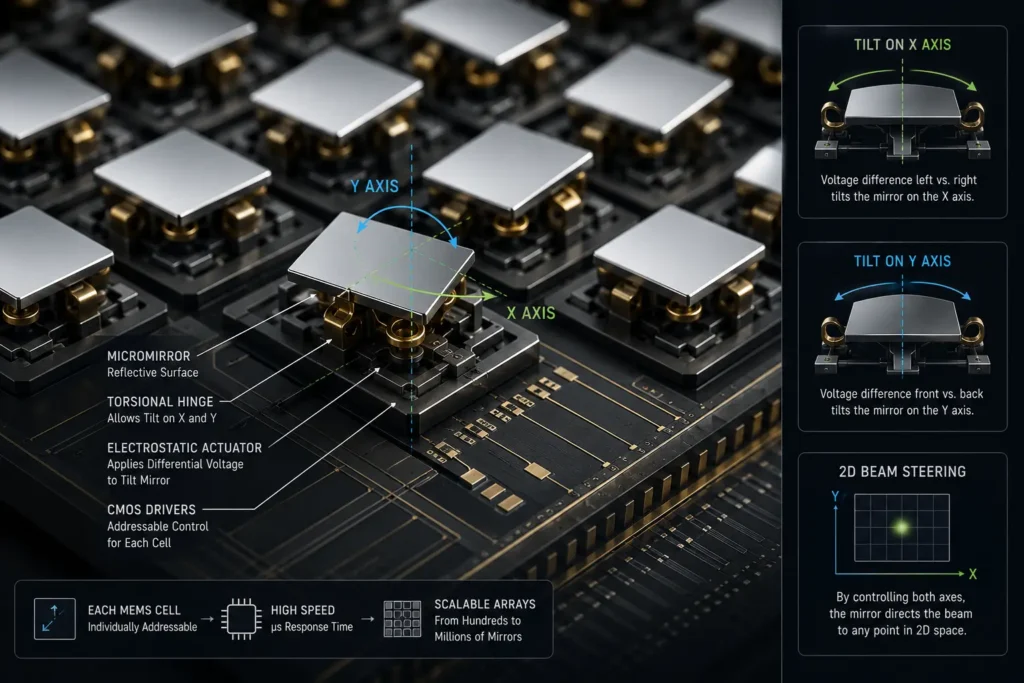
4. Technical Depth: The Optical Path
When a laser beam carrying data enters the OCS from an input fiber, a microscopic lens focuses the beam. It hits a specific mirror on the first MEMS array. That mirror is precisely tilted to bounce the beam across the empty space inside the switch to hit a specific mirror on the second MEMS array. The second mirror then bounces the beam perfectly into the exact center of the desired output fiber. The data never leaves the optical domain.
5. Real-World Consequences: Bit-Rate Independence
Because the mirror is just reflecting light, it has no idea what the data actually is. It doesn’t care if the laser is pulsing at 100 Gigabits per second or 1.6 Terabits per second. This creates Bit-Rate Independence. When a cloud provider decides to upgrade their GPUs from 400G to 800G speeds, they only have to upgrade the endpoints. The OCS in the middle of the room does not need to be replaced—it simply continues reflecting the faster light, effectively future-proofing the core network architecture for decades.
Real-World OCS Deployment: Google TPUv4
The integration of OCS is strictly reserved for the highest echelons of data center engineering.
Google TPU Supercomputers: Google’s TPUv4 architecture is the undisputed flagship of commercial OCS deployment. Traditional supercomputers use static, hard-wired topologies (like a 3D Torus). Google used OCS to make their topology dynamic. By constantly adjusting the microscopic mirrors, the Google network can physically rewire itself on the fly. If one specific TPU rack fails during a multi-week training run, the OCS simply adjusts a mirror, bounces the light around the dead rack, and connects to a backup rack instantly, saving the AI training run from a catastrophic crash.
Submarine Cable and Telecom Backbones: While hyperscalers are using OCS inside the data center, tier-1 telecommunications companies are deploying Reconfigurable Optical Add-Drop Multiplexers (ROADMs)—a close cousin to OCS—at the landing stations of intercontinental submarine cables. By switching light at the wavelength level, telecoms can instantly route a massive fiber trunk from London to New York toward a different city if a deep-sea cable is accidentally severed, without ever converting the multi-terabit data stream to electricity.
Disaggregated Compute Clusters: The future of data centers relies on “disaggregation”—separating CPUs, GPUs, and Memory into their own distinct racks to cool them more efficiently. Because OCS introduces virtually zero latency, it allows engineers to place the GPU rack 100 meters away from the memory rack, using the speed of light to make the two components act as if they are sitting on the exact same motherboard.
Economic & Strategic Impact
The deployment of OCS triggers a massive Transceiver CapEx Avoidance.
In a standard 10,000-GPU cluster using traditional Fat-Tree electronic networking, the data must hop through multiple layers of switches (Leaf, Spine, Super-Spine). Every single hop requires two optical transceivers (one to receive, one to send). At $1,000 to $2,000 per high-speed transceiver, the cost of the optical components alone often exceeds the cost of the actual silicon switches.
By inserting an OCS layer at the spine, the data travels optically end-to-end. This entirely deletes the need for transceivers at the core layer. In their published research, Google explicitly noted that replacing traditional electrical switches with OCS reduced their network cost by nearly 30 percent and reduced power consumption by over 40 percent. For a hyperscaler building a $5 billion data center, this translates to hundreds of millions of dollars in immediate hardware savings.
Advantages
- Near-Zero Power Consumption: OCS switches use less than 100 watts of power to simply hold the tiny mirrors in place, compared to the thousands of watts required to power the ASIC and cooling fans of an electronic switch.
- Protocol and Speed Agnostic: The mirrors do not care what language or speed the light is transmitting. A single OCS deployment will perfectly route 400G Ethernet today, and 1.6T InfiniBand tomorrow, without any hardware upgrades.
- Dynamic Restriping (Fault Tolerance): Because the mirrors can be physically retargeted in milliseconds, the network can instantly route around broken hardware, isolating faulty GPUs without stopping the broader AI training calculation.
Limitations
- Slow Switching Speed: This is the primary flaw of OCS. Electronic switches can route an individual data packet in nanoseconds. An OCS has to physically move a microscopic mechanical mirror, which takes several milliseconds. Therefore, OCS is useless for standard, rapid-fire internet traffic; it is only useful for establishing a long-term, high-volume “circuit” connection (like a massive AI data transfer).
- Mechanical Fragility: The MEMS array is a physical, moving machine. It is highly susceptible to extreme physical vibrations and microscopic dust. Manufacturing an array of hundreds of perfect, steerable mirrors requires astronomical clean-room tolerances.
- No Data Buffering or Inspection: Because an OCS does not read the data, it cannot perform standard network security checks, firewall filtering, or data buffering. If the destination server is busy, the OCS cannot “hold” the data; it just bounces it, requiring the endpoint servers to handle all traffic congestion logic.
Common Misconceptions
Misconception: OCS will replace all standard network switches (like Cisco or Arista boxes).
Reality: OCS replaces the core (the spine layer) of specific, high-performance data centers. Electronic switches are still absolutely mandatory at the “Top-of-Rack” (Leaf layer) to handle the fast, chaotic sorting of individual data packets before they are sent up to the optical spine.
Misconception: Fiber optic networks are already “all-optical.”
Reality: The cables are optical, but the intersections are electrical. In almost all global networks, light is violently converted back into electricity every time it hits a router or switch. True “all-optical” routing (where data never touches silicon logic) is still exceedingly rare and restricted to OCS and ROADM architectures.
Misconception: OCS requires quantum computing to work.
Reality: OCS relies on classical physics (optics and micro-mechanics), not quantum mechanics. However, OCS will be critical for future quantum computers, as routing delicate quantum photons without destroying their state requires the exact touchless, mirror-based routing that OCS provides.
What Most People Miss
The strategic shift to Silicon Photonics.
Currently, the MEMS mirrors in an OCS are physical, moving parts. What most hardware analysts miss is that the industry is aggressively trying to replace these physical mirrors with solid-state Silicon Photonics.
By using advanced materials (like Mach-Zehnder interferometers or ring resonators etched directly into a silicon wafer), scientists can bend and route light using heat or electrical fields, without any moving parts at all. When OCS transitions from mechanical MEMS mirrors to solid-state silicon photonics, the switching time will drop from milliseconds to nanoseconds, finally allowing all-optical networking to conquer standard, high-speed commercial internet traffic.
Comparison Table
| Feature | Electronic Packet Switching (EPS) | Optical Circuit Switching (OCS) |
| Routing Mechanism | Silicon logic reads electrical packets | MEMS mirrors reflect optical beams |
| Power Consumption | Extremely High (Requires massive cooling) | Near-Zero (Mirrors use milliwatts) |
| Switching Speed | Nanoseconds (Ultra-fast) | Milliseconds (Slow, mechanical movement) |
| OEO Conversion | Mandatory at every switch | Completely Eliminated |
| Upgrade Requirement | Must replace switch for faster speeds | Protocol Agnostic (No upgrade needed) |
| Primary Use Case | Standard public internet, web servers | AI Training clusters, Telecom backbones |
Case Study
Situation: When Google designed its TPUv4 supercomputer, they recognized that the sheer volume of data required to train next-generation Large Language Models (LLMs) would overwhelm traditional electronic networking. Training an LLM requires thousands of chips to constantly synchronize their parameters. If Google used standard electrical switches, the power required for the network alone would throttle the power available for actual AI computation.
Challenge: How to connect 4,096 TPU chips together so any chip can talk to any other chip at maximum bandwidth, without blowing the municipal power budget or buying millions of dollars worth of optical transceivers.
Solution (Project Palomar): Google deployed its proprietary OCS architecture (internally dubbed Palomar). They removed the electronic switches at the core of the cluster and installed custom 3D MEMS mirror arrays. The TPUs were connected directly to the OCS using pure optical fibers.
Outcome: The results fundamentally altered cloud economics. By bouncing the light instead of translating it, Google bypassed the need for intermediate transceivers. They published data confirming that the OCS architecture consumed a fraction of the power of an equivalent Infiniband electrical network, slashed latency, and allowed the cluster to dynamically rewire itself to isolate broken TPU chips without halting the massive AI training runs.
Lessons Learned: The Google TPUv4 deployment proved that OCS was no longer a lab experiment. It validated that for massive, synchronous workloads (like AI), static optical routing is vastly superior to dynamic electrical routing. This forced competing hyperscalers (like Microsoft and Meta) to aggressively accelerate their own internal all-optical networking research to remain competitive in the AI hardware arms race.
Future Outlook
Next 12–24 Months
The era of Commercial OCS Democratization. Until recently, OCS was locked behind the proprietary walled gardens of giants like Google. Over the next two years, independent hardware vendors will commercialize “off-the-shelf” OCS appliances. We will see specialized AI cloud providers (like CoreWeave or Lambda Labs) integrating commercial OCS units into their NVIDIA H100 and B200 clusters, utilizing all-optical fabrics as a massive competitive differentiator to lower power costs and offer cheaper AI training to their clients.
Next 3–5 Years
The integration of Co-Packaged Optics (CPO). OCS currently routes light between server racks. The next leap is routing light directly onto the silicon chip. By physically bonding the optical laser directly onto the GPU processor (Co-Packaged Optics), the data leaves the GPU as light, travels through the data center, bounces off an OCS mirror, and lands directly on the processor of a different GPU entirely. This will completely eliminate copper traces from the data center, creating a unified, building-scale optical super-chip.
Next 10 Years
The transition to Solid-State Optical Switching. By the mid-2030s, the physical, moving MEMS mirrors will be replaced by solid-state silicon photonics. Without any physical hinges to slow them down, these next-generation optical switches will route light at nanosecond speeds. This will allow OCS to expand beyond dedicated AI clusters and take over the entire global internet infrastructure, permanently retiring the energy-draining era of Optical-Electrical-Optical (OEO) conversion across the entirety of human telecommunications.
Most Likely Scenario
As the power demands of artificial intelligence trigger a global energy crisis, the inefficiency of traditional electronic switches will become unacceptable. OCS will become the mandatory foundational layer for any cluster exceeding 10,000 GPUs. The companies that master the microscopic mechanics of bouncing light—and the software algorithms required to manage them—will control the physical infrastructure of the AI century.
Key Takeaways
- Optical Circuit Switching (OCS) routes data by bouncing laser beams off microscopic, robotic mirrors (MEMS arrays) directly from one fiber to another.
- Traditional Electronic Packet Switching (EPS) must convert light into electricity to route it (OEO conversion), which consumes up to 30% of a data center’s power.
- By entirely bypassing OEO conversion, OCS slashes networking power consumption to near zero, freeing up electricity to power more AI GPUs.
- OCS is “Protocol Agnostic.” Because it just bounces light, a data center can upgrade its server speeds (e.g., from 400G to 800G) without ever having to replace the OCS hardware.
- The primary limitation of OCS is speed; physically moving a mirror takes milliseconds, making it perfect for long, massive AI data flows, but too slow for random internet traffic.
- Google’s TPUv4 supercomputer proved the commercial viability of OCS, using it to dynamically bypass broken hardware and drastically lower the CapEx of AI training.
Glossary
Co-Packaged Optics (CPO): An advanced manufacturing technique where the optical transceiver (laser) is built directly onto the same silicon package as the processor (GPU/CPU), minimizing the use of copper wiring entirely.
Electronic Packet Switching (EPS): The traditional method of routing internet traffic, where data is chopped into small packets, converted into electricity, and actively sorted by a silicon logic chip.
MEMS (Micro-Electro-Mechanical Systems): Microscopic machines fabricated using semiconductor technology. In OCS, MEMS refers to the tiny, steerable mirrors mounted on electronic hinges.
OEO Conversion (Optical-Electrical-Optical): The incredibly power-hungry process of catching a light signal from a fiber optic cable, translating it into electricity so a computer can read it, and translating it back into light.
Spine-and-Leaf Topology: The standard architectural layout of a modern data center network. “Leaf” switches sit at the top of a server rack, while massive “Spine” switches connect all the leaf switches together.
Transceiver: The physical piece of hardware plugged into the end of a fiber optic cable that executes the translation between light and electricity.
Frequently Asked Questions
Why don’t we use OCS in our home internet routers?
Home internet traffic is incredibly chaotic. You request a tiny packet of data from Netflix, then a tiny packet from a video game. An OCS has to physically move a mirror to route data. Moving a mirror takes milliseconds, which is vastly too slow to sort millions of tiny, random internet packets. OCS is only useful for huge, continuous data streams like AI training.
How big are the mirrors in an OCS?
They are microscopic. A typical MEMS mirror is smaller than a grain of sand. Hundreds of these mirrors are packed onto a single silicon chip that is no larger than a standard computer processor.
If the mirror moves, doesn’t it break eventually?
This is a major engineering challenge. However, because the mirrors are so incredibly small and lightweight, they experience very little mechanical stress. High-end telecom MEMS arrays are rated to move billions of times over decades without suffering mechanical failure.
Does OCS make the data travel faster than light?
No, nothing travels faster than light. However, it removes the delay (latency) caused by the electronic tollbooth. Because the light never stops to be translated into electricity, the data arrives at its destination much faster than in a traditional network.
Why does Google use this but others don’t?
Google designs both its hardware (TPUs) and its network infrastructure, allowing them to perfectly synchronize the two. Traditionally, companies bought servers from one company (Dell) and switches from another (Cisco). Mixing and matching proprietary optical hardware is incredibly difficult without standard, open-market OCS integration protocols, which are only now being developed.
Sources
[1] Google Research: TPU v4: An Optically Reconfigurable Supercomputer for Machine Learning with Hardware Support for Embeddings (2023/2026 Analysis)
[2] IEEE Communications Magazine: Optical Circuit Switching for Data Center Networks
[3] Optica: MEMS-based optical circuit switches for hyperscale data centers (2025)
[4] Next Platform: The Photonic Networking Evolution of AI Clusters (2026)
[5] Lightwave: Co-Packaged Optics and the Elimination of OEO Conversions