Advertisement
)


For decades, if a mid-sized manufacturing company in Ohio or a regional software firm in Texas needed $50 million to expand, they went to a traditional commercial bank. Today, the bank’s door is often locked. Burdened by strict regulations following the 2008 financial crisis, regional banks have systematically retreated from middle-market lending. Into this vacuum stepped Wall Street’s “Shadow Banks”—private credit and direct lending funds. These funds now lend over a trillion dollars directly to regular, mid-sized businesses, becoming the hidden financial engine of the real economy.
But private credit funds face a massive scaling problem: how do you keep lending billions of dollars when your money is locked up in 5-year illiquid loans? The solution is one of the most powerful financial mechanisms ever engineered. By gathering hundreds of these bespoke loans, dumping them into a legal vault, and slicing them into new, tradable bonds, Wall Street has created the Middle Market Collateralized Loan Obligation (MM CLO). Why should you care right now? Because as traditional banking recedes, the MM CLO is the critical plumbing that connects the retirement savings of global billionaires and pension funds directly to the payrolls of mid-sized regional businesses.
What is a Middle Market CLO?
A Middle Market Collateralized Loan Obligation (MM CLO) is a securitized debt vehicle that purchases a diversified pool of direct, senior-secured loans issued to mid-sized corporations. The vehicle finances this portfolio by issuing tranches of varying risk and return—ranging from AAA-rated senior bonds to unrated equity—to institutional investors.
At a Glance
- Concept: Taking illiquid, private loans made to medium-sized businesses and transforming them into liquid, high-yield bonds through financial engineering and tranching.
- Why it matters: It provides the ultimate recycling mechanism for private credit. Direct lenders use MM CLOs to get their cash back early, allowing them to turn around and lend to even more companies, fueling the boom of the shadow banking sector.
- Who uses it: Elite alternative asset managers (Ares, Golub Capital, Churchill, Owl Rock), global life insurance companies, and institutional pension funds searching for yield.
- Biggest takeaway: MM CLOs generally pay a higher yield (a “premium”) compared to standard Broadly Syndicated Loan (BSL) CLOs. Investors are paid this extra yield to compensate for the fact that the underlying mid-sized loans are highly bespoke and extremely difficult to sell in a panic.
In Simple Words
Imagine you are a wealthy investor who lends $10 million to 100 different medium-sized local businesses—plumbers, tech startups, and trucking companies.
You now have $1 billion tied up in loans. You are collecting great interest, but you have no cash left to make new loans. You can’t just sell one of these loans easily, because no one knows anything about these private, obscure businesses.
To get your cash back, you build a Middle Market CLO.
You create a legal vault and place all 100 loans inside it. Then, you print your own “bonds” backed by the cash coming into the vault from those 100 businesses. You slice these bonds into different levels of risk:
- The Safe Slice: You tell conservative investors (like insurance companies), “You get paid first. Even if 20 of these businesses go bankrupt, you are guaranteed your 6% interest.”
- The Risky Slice: You tell aggressive investors (like hedge funds), “You get paid last. If businesses default, you lose your money first. But if everyone pays, you get a massive 15% return.”
You sell these slices, instantly getting your $1 billion back to make more loans, while global investors get a steady stream of interest from 100 local businesses they never had to research themselves.
Why This Matters
The explosive growth of the MM CLO market is the direct result of the golden era of Private Credit.
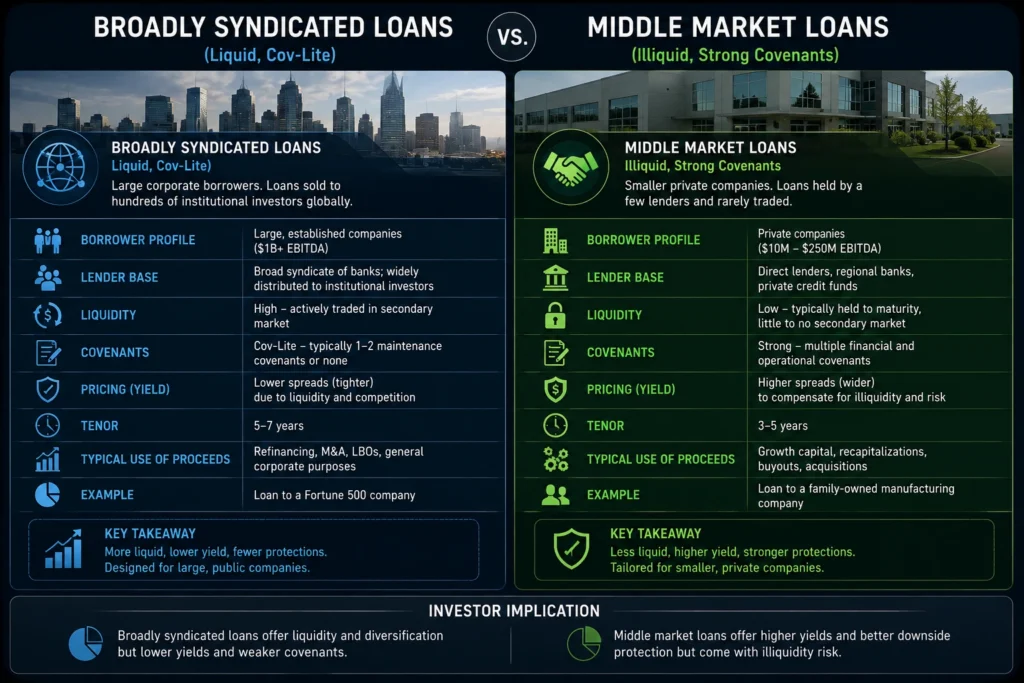
Historically, CLOs only purchased Broadly Syndicated Loans (BSLs)—massive, $1 billion+ loans made to giant public companies like Delta Airlines or Hilton Hotels. Because BSLs are traded openly between banks, they are highly liquid. Middle Market loans are the exact opposite. A $40 million loan to a regional logistics company has no public rating and no secondary trading desk.
For Macro Economists and LPs, the securitization of these illiquid assets is a structural triumph. By using MM CLOs, private credit managers introduce institutional-grade leverage into the middle market. It allows life insurance companies (who are legally restricted from buying illiquid, unrated loans) to buy the AAA-rated senior debt slices of the CLO, safely funneling trillions of dollars of global capital into the arteries of the domestic economy.
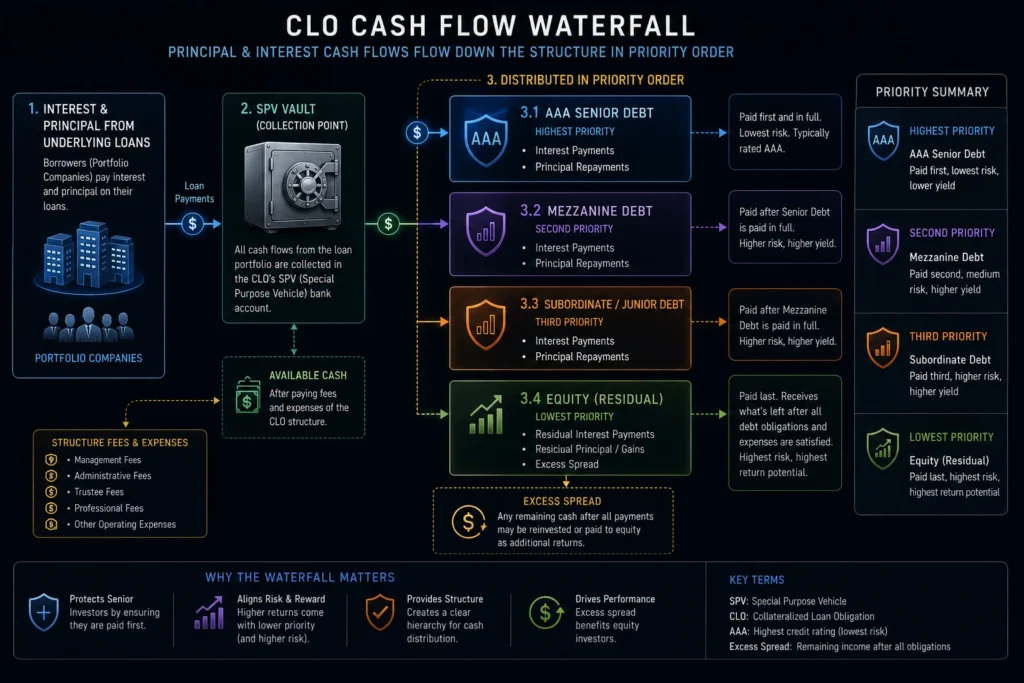
The CLO Cash Flow Waterfall Structure
The structural integrity of a CLO relies entirely on the mathematical separation of risk, known as the “Cash Flow Waterfall.”
When the mid-sized businesses pay their monthly interest on the underlying loans, the cash flows into the CLO vault. The legal code of the CLO dictates a strict hierarchy. The AAA-rated senior tranches receive their coupon payments first. The cash then cascades down to the AA, A, BBB, and BB tranches.
The bottom layer is the Equity Tranche (often held by the private credit manager who originated the loans). The equity tranche has no guaranteed interest rate; it simply catches whatever cash is left over at the bottom of the waterfall. If underlying businesses default and stop paying, the cash flow shrinks. The equity tranche absorbs these losses first, acting as a massive shock absorber protecting the senior debt at the top of the waterfall.
How Middle Market CLOs Execute Securitization
Securitizing illiquid assets without terrifying rating agencies requires strict, mathematically enforced safety mechanisms. Here is the first-principles breakdown of CLO architecture.
1. The Fundamental Problem: Default Correlation
If you pool 100 loans from 100 oil companies, and the price of oil crashes, all 100 companies will default simultaneously. The shock absorber (the equity tranche) will be instantly wiped out, and the AAA-rated senior debt will take catastrophic losses. This is high default correlation.
2. The Insufficiency of Simple Pooling
To achieve a AAA rating from agencies like Moody’s or S&P, the pool must be brutally diversified. The CLO manager is legally bound by strict concentration limits. They cannot allow more than 2% of the loans to come from a single company, and no more than 10% can come from a single industry (e.g., healthcare or software).
3. The Core Mechanism: The Overcollateralization (OC) Test
The ultimate defense mechanism of the MM CLO is the Overcollateralization (OC) test. The total value of the loans in the vault must always be mathematically higher than the total value of the debt tranches issued. For example, $500 million in underlying loans backing $400 million in CLO debt.
4. Technical Depth: Fixing a Failing OC Test
If an economic recession hits and 10 of the mid-sized companies go bankrupt, the value of the underlying loan pool drops to $450 million. The OC test is suddenly dangerously close to failing.
When an OC test fails, the CLO executes an automatic, ruthless correction: it shuts off the waterfall.
5. Real-World Consequences: Cash Flow Diversion
The moment the test fails, cash is entirely blocked from reaching the Equity and Mezzanine (lower-rated) tranches. All cash coming into the vault is legally diverted to aggressively pay down the principal of the AAA Senior Debt. By paying off the senior debt, the ratio of assets to debt is forcefully stabilized. Once the math is cured and the OC test passes again, the waterfall turns back on, and the lower tranches resume receiving their cash.
Real-World Private Credit & MM CLO Strategies
The MM CLO structure is the primary leverage tool for the titans of alternative asset management.
Private Credit Fundraising (The Spin-Out): A direct lending fund originates $1 billion in loans. To maximize their return on equity (ROE), they package these loans into an MM CLO. They sell the AAA, AA, and A tranches to Japanese banks and American insurance companies for $800 million. The private credit fund keeps the $200 million Equity tranche. They use the $800 million in fresh cash to go out and make new loans, effectively turning their initial $1 billion pool into an infinite recycling engine of management fees and equity upside.
Navigating High Interest Rates: MM CLOs are predominantly backed by floating-rate loans (e.g., SOFR + 500 basis points). When central banks raise interest rates to fight inflation, the interest paid by the mid-sized businesses automatically goes up. Consequently, the yield paid to the CLO bondholders goes up. During the 2022-2023 rate hiking cycle, while fixed-rate corporate bonds suffered devastating losses, floating-rate MM CLOs provided a massive, lucrative hedge against inflation for institutional investors.
The “Captive” Insurance Strategy: Mega-funds like Apollo and KKR have acquired their own life insurance companies (like Athene and Global Atlantic). These insurers take in billions of dollars in consumer premiums every month and must invest it safely. The private equity parent creates an MM CLO and explicitly sells the safe, AAA-rated senior tranches directly to their own captive insurance subsidiary. This vertically integrated loop captures the origination fee, the management fee, and the insurance yield, completely bypassing commercial banks.
Economic & Strategic Impact
MM CLOs carry a distinct “Illiquidity Premium” that fundamentally alters their risk-reward profile compared to standard BSL CLOs.
Because Broadly Syndicated Loans are made to massive public companies, they have public credit ratings (e.g., B+ or BB-) and a highly active secondary trading desk. If a BSL CLO manager sees a company struggling, they can instantly sell the loan on the open market and buy a healthier one to protect the portfolio.
Middle Market loans have no secondary market. If a direct lender makes a $40 million loan to a regional HVAC supplier and the supplier struggles, the CLO manager cannot sell the loan; they are trapped in the asset. To compensate for this severe lack of trading liquidity, MM CLOs must inherently pay a wider spread (higher interest rate) to their debt investors. This premium forces the direct lender to deeply underwrite the original loan, focusing heavily on strict financial covenants, because they know they must “hold to maturity or default.”
Advantages
- Yield Premium: MM CLO debt tranches consistently offer higher yields (often 50 to 150 basis points more) than equivalently rated BSL CLOs or standard corporate bonds.
- Stronger Covenants: Unlike modern BSLs, which are mostly “cov-lite” (lacking strict financial check-ins), middle-market loans generally retain strict maintenance covenants. If a company’s earnings slip, the lender can intervene months before an actual bankruptcy occurs.
- Superior Recovery Rates: Because private credit funds lend directly to the company (acting as the sole lender), resolving a bankruptcy is much faster and cleaner. There is no messy syndicate of 50 angry banks fighting in bankruptcy court. The direct lender simply takes the keys to the company, leading to historically higher recovery rates on defaulted assets.
Limitations
- Valuation Opacity: Middle-market loans are not traded publicly; they are “marked-to-model” by accountants. In a severe recession, the true underlying value of the CLO’s collateral pool is heavily subjective and extremely opaque to the outside bondholders.
- The Illiquidity Trap: The inability of the CLO manager to sell deteriorating assets forces the portfolio to absorb the full impact of any distressed corporate situations.
- Sponsor Concentration Risk: In a BSL CLO, the loans come from dozens of different bank syndicates. In an MM CLO, a massive percentage of the loans might be originated by the exact same private equity sponsor. If that sponsor’s specific underwriting strategy proves flawed, the entire CLO suffers correlated damage.
Common Misconceptions
Misconception: CLOs caused the 2008 Financial Crisis.
Reality: Collateralized Debt Obligations (CDOs) caused the crisis by pooling subprime, unverified consumer mortgages. CLOs pool senior-secured, first-lien corporate loans made to cash-flow-positive businesses. During the 2008 crisis, while CDOs defaulted en masse, the vast majority of highly rated CLO tranches never missed a single interest payment.
Misconception: Middle Market companies are all risky, failing startups.
Reality: The “Middle Market” encompasses stable, highly mature businesses generating $10 million to $100+ million in annual earnings (EBITDA). They are regional healthcare providers, specialized software firms, and industrial manufacturers that simply don’t need the $1 billion loans required to access public bond markets.
Misconception: If the CLO fails the OC test, the investors lose their money.
Reality: Failing an OC test is an active defense mechanism, not a default. It simply means cash is diverted away from the manager’s equity tranche to aggressively pay off the senior debt. It actually makes the senior bondholders safer during a crisis.
What Most People Miss
The strategic weaponization of the Reinvestment Period.
When an investor buys a CLO bond, the bond usually has a “Reinvestment Period” of 3 to 5 years. During this time, if an underlying mid-sized company pays off its loan early, the CLO manager does not return the cash to the bondholders. Instead, the manager is allowed to use that cash to buy new loans and add them to the vault.
What most people miss is that the true skill of a top-tier private credit manager is displayed entirely during this window. If a recession hits in Year 3, a brilliant manager uses the cash from early payoffs to buy highly discounted, distressed loans on the cheap, vastly increasing the overall yield and mathematical strength of the CLO before the Reinvestment Period ends and the vault permanently locks.
Comparison Table
| Feature | Broadly Syndicated Loan (BSL) CLO | Middle Market (MM) CLO |
| Borrower Profile | Large public/private corporations (EBITDA > $100M) | Mid-sized businesses (EBITDA $10M – $100M) |
| Loan Liquidity | Highly liquid (Active secondary market) | Illiquid (Hold-to-maturity or default) |
| Financial Covenants | Weak (“Cov-Lite” is standard) | Strong (Strict maintenance covenants) |
| Yield Premium | Baseline corporate spread | High (Illiquidity and complexity premium) |
| Origination Sourcing | Major investment bank syndicates | Directly originated by Private Credit funds |
Case Study
Situation: A top-tier direct lending fund successfully originated $800 million in senior-secured loans to 60 specialized healthcare and software companies. To continue scaling their fund and providing distributions to their LPs, the manager needed to extract liquidity from this static portfolio without selling the loans at a discount to competitors.
Challenge: The middle-market loans lacked public credit ratings and could not be sold on public exchanges. Life insurance companies expressed extreme interest in the 9% floating-rate yield the portfolio generated, but NAIC regulations legally barred them from taking the concentrated risk of holding unrated, illiquid private debt.
Solution (The MM CLO Issuance): The fund manager established an MM CLO SPV and transferred the $800 million loan portfolio into it. They worked with Kroll Bond Rating Agency (KBRA) to stress-test the pool. Due to strict industry diversification and overcollateralization ratios, KBRA awarded a AAA rating to the top $450 million senior debt tranche.
Outcome: A consortium of global life insurers eagerly purchased the AAA and AA tranches, accepting a slightly lower yield in exchange for absolute structural seniority. The private credit fund retained the $80 million Equity tranche, capturing the massive excess spread (arbitrage) between the 9% the loans paid and the ~6.5% cost of the issued debt.
Lessons Learned: The transaction flawlessly executed regulatory capital arbitrage. It proved that by wrapping opaque, bespoke middle-market loans in the highly structured, mathematically rigorous architecture of a CLO, private credit funds can legally unlock the deepest, most conservative pools of institutional capital on Earth.
Future Outlook
Next 12–24 Months
The era of Private Credit Refinancing Pressure. As higher-for-longer interest rates squeeze the cash flows of highly leveraged middle-market businesses, default rates within the private credit sector will incrementally rise. Over the next two years, the market will closely monitor the Overcollateralization (OC) buffers of 2021-vintage MM CLOs. We will see a spike in “amend-and-extend” modifications, where direct lenders quietly restructure struggling loans to prevent formal defaults, keeping the OC tests mathematically intact and shielding the AAA tranches from cash flow diversions.
Next 3–5 Years
The rise of Retail CLO Access (Interval Funds). The immense, steady yield generated by the mezzanine and equity tranches of MM CLOs is historically locked behind institutional barriers. By the late 2020s, mega-managers will aggressively expand into the retail wealth channel. They will package slices of MM CLOs into registered Interval Funds and Business Development Companies (BDCs), allowing high-net-worth individual investors to gain direct exposure to the securitized middle market via standard brokerage accounts.
Next 10 Years
The Tokenization of the Capital Stack. By the mid-2030s, the clunky, paper-heavy legal structuring of the CLO SPV will transition entirely to distributed ledger technology (DLT). Individual middle-market loans will be tokenized upon origination. The entire cash flow waterfall, OC testing, and monthly distributions will be governed seamlessly by self-executing smart contracts. This will eliminate the massive administrative fees charged by trustee banks and dramatically increase the real-time transparency of the underlying corporate collateral for global bondholders.
Most Likely Scenario
Middle Market CLOs will permanently eclipse Broadly Syndicated CLOs as the primary growth engine of structured finance. As commercial banks are structurally restricted from corporate lending by Basel III Endgame capital rules, private credit will become the undisputed financier of the real economy, with MM CLOs serving as the essential, unbreakable conveyor belt converting regional business debt into global fixed income.
Key Takeaways
- Middle Market CLOs (MM CLOs) pool private, illiquid loans made to mid-sized businesses and slice them into tradable, rated bonds for institutional investors.
- They differ from traditional BSL CLOs because the underlying loans cannot be easily sold on a secondary market; the manager is largely locked into the asset until it pays off or defaults.
- To compensate for this illiquidity, MM CLOs offer a significant yield premium and enforce much stricter financial covenants on the borrowing companies.
- The “Waterfall” structure legally guarantees that Senior (AAA) bondholders are paid first, while the Equity tranche absorbs the first losses if any companies go bankrupt.
- Overcollateralization (OC) tests actively protect the structure: if too many loans default, the CLO automatically shuts off cash to the equity owners and aggressively pays down the senior debt to restore the balance.
- By converting unrated private loans into AAA-rated bonds, MM CLOs allow private equity firms to extract billions of dollars from highly regulated life insurance companies.
Glossary
Broadly Syndicated Loan (BSL): A massive loan provided by a group of lenders (a syndicate) to a large public or private corporation, heavily traded on a highly liquid secondary market.
Business Development Company (BDC): An organization that invests in small- and medium-sized companies as well as distressed companies, often utilizing MM CLOs to leverage their loan portfolios.
Cash Flow Waterfall: The strict, legally binding hierarchy within a CLO that dictates the exact order in which interest and principal payments are distributed to the various debt and equity tranches.
Direct Lending: The business of non-bank lenders (like private credit funds) providing loans directly to middle-market companies without utilizing an investment bank intermediary.
Overcollateralization (OC) Test: A mathematical safety check ensuring the total value of the loans in the CLO vault exceeds the total value of the debt issued. Failing this test instantly reroutes cash flows to protect senior bondholders.
Reinvestment Period: A designated time frame (usually 3 to 5 years) during the life of a CLO when the manager is allowed to use cash from paid-off loans to purchase new loans for the portfolio, rather than returning the principal to investors.
Frequently Asked Questions
Are Middle Market CLOs riskier than traditional CLOs?
They carry different risks. Traditional BSL CLOs have higher trading liquidity, meaning managers can sell bad loans quickly. MM CLOs are highly illiquid, but the underlying loans usually have much stronger legal covenants and higher recovery rates if the company defaults.
Who owns the “Equity” tranche of the CLO?
Usually, the private credit fund manager who originated the loans keeps the equity tranche (a regulatory concept called “risk retention” or “skin in the game”). This ensures the manager is highly motivated to make good loans, because if the loans fail, their money is wiped out first.
How do CLOs get AAA ratings if the underlying companies are mid-sized and unrated?
Through mathematical diversification and structural subordination. Rating agencies grant AAA ratings because the pool contains hundreds of distinct companies across different industries, and the thick layers of equity and mezzanine debt below the AAA tranche act as massive shock absorbers against defaults.
What happens if a company inside the CLO goes bankrupt?
Because it is a direct loan, the private credit manager usually takes over the bankrupt company, restructures its debt, and eventually sells it to recover the cash. The loss is absorbed by the CLO’s equity tranche, leaving the senior bondholders completely untouched.
Why are insurance companies the biggest buyers of these?
Life insurers hold trillions of dollars and need high-yielding, safe investments. Buying direct private equity or unrated loans triggers massive regulatory penalties that crush their balance sheets. Buying the AAA-rated slice of a CLO provides excellent yield while satisfying all regulatory capital requirements.
Sources
[1] PitchBook: Private Credit & Middle Market CLO Quarterly Update (Q1 2026 Analysis)
[2] Kroll Bond Rating Agency (KBRA): Middle Market CLOs: Structural Protections and Default Correlation Modeling
[3] S&P Global Ratings: CLO Market Insights and the Shift Toward Direct Lending Securitization (2025/2026 Briefs)
[4] Ares Management: Understanding the Evolution and Resiliency of Middle Market CLOs
[5] Federal Reserve Board: Financial Stability Implications of the Private Credit and CLO Ecosystem