Advertisement
)
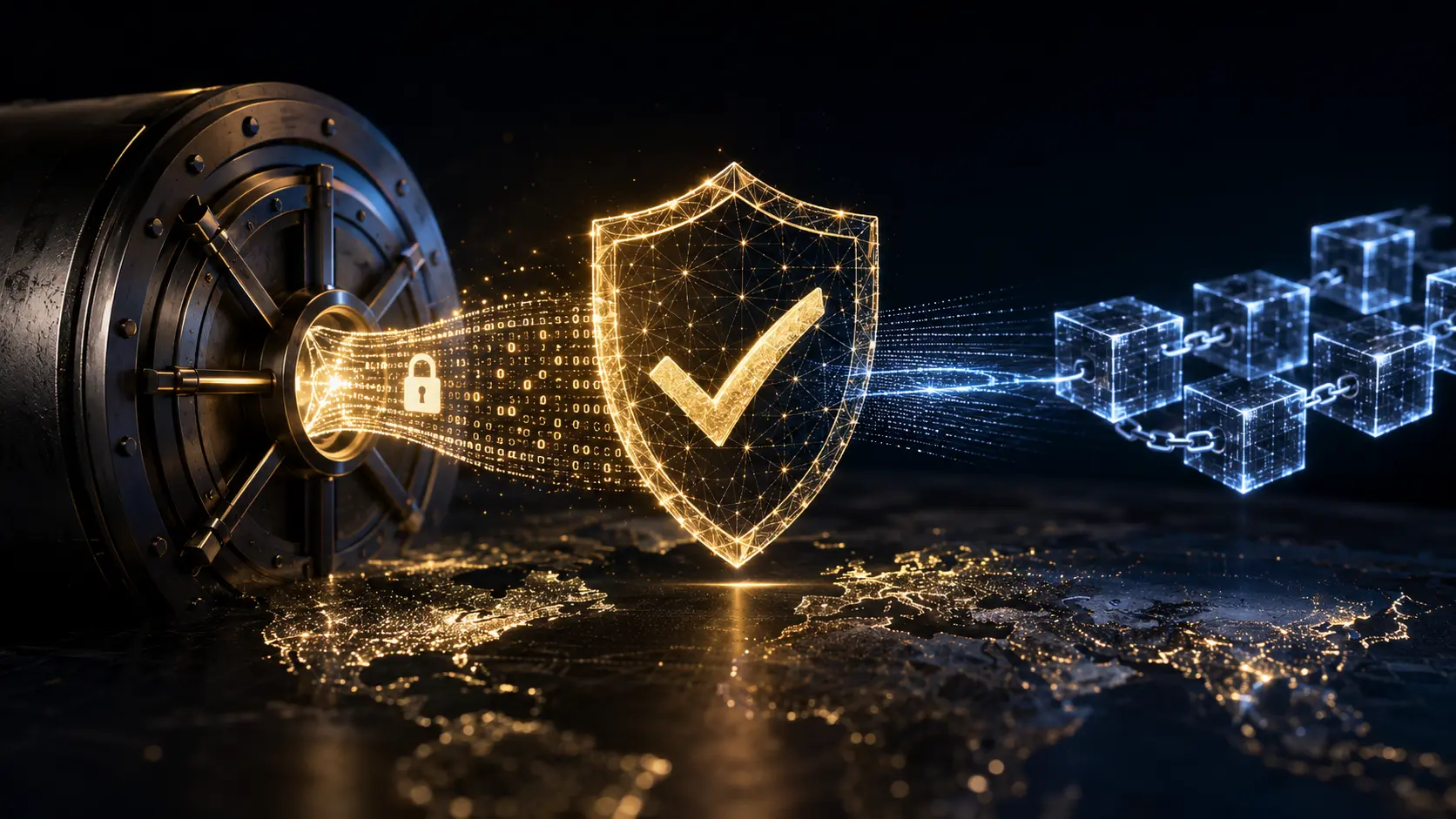

Imagine a tier-one investment bank attempting to execute a $500 million block trade on a public blockchain like Ethereum. In traditional finance, this trade is shielded by dark pools and prime brokers to prevent high-frequency traders from front-running the order. On a public blockchain, every transaction is broadcast to thousands of global validators in plain text. The moment the bank submits the trade, predatory MEV (Maximal Extractable Value) bots see the exposed data, jump ahead in the execution queue, and manipulate the price, costing the bank millions of dollars in a matter of milliseconds. Because of this default transparency, Wall Street was legally and mathematically barred from deploying institutional capital onto decentralized rails.
Why should you care right now? Because cryptographers have solved the transparency trap. Through a mathematical breakthrough known as Zero-Knowledge Proofs (zk-SNARKs), banks can now execute complex trades on public networks while keeping the entire transaction completely invisible. Instead of broadcasting the trade data, the bank broadcasts a cryptographic proof that the trade is mathematically valid. The blockchain verifies and settles the transaction without ever actually seeing it. This “blind validation” is unlocking trillions of dollars in institutional liquidity, transforming public blockchains from radically transparent ledgers into encrypted, enterprise-grade financial settlement rails.
What are Zero-Knowledge Proofs (zk-SNARKs)?
Zero-Knowledge Proofs (zk-SNARKs) are advanced cryptographic protocols that allow one party to mathematically prove to another that a specific statement is true, without revealing any underlying data about the statement itself. In blockchain networks, they enable the validation of private transactions and smart contracts while maintaining absolute data confidentiality.
At a Glance
- Concept: A mathematical magic trick where you can prove to someone that you know a secret, without actually telling them what the secret is.
- Why it matters: Blockchains are completely public. ZKPs allow banks to use these public networks for global finance without violating strict data privacy laws (like GDPR) or exposing their trade strategies to competitors.
- Who uses it:Mega-banks (JPMorgan, BNY Mellon), scaling networks (zkSync, Starknet, Polygon zkEVM), and decentralized identity providers.
- Biggest takeaway: A zk-SNARK creates a proof that is so small and easy to verify that it completely bypasses the computational limits of the blockchain, allowing thousands of private transactions to be settled in a fraction of a second.
In Simple Words
Imagine you are trying to get into an exclusive, 21-and-over nightclub.
In the Traditional Model, you hand the bouncer your driver’s license. To prove you are 21, you are forced to reveal your exact birth date, your full name, your home address, and your organ donor status. You over-shared sensitive data just to answer a simple “Yes or No” question.
In a Zero-Knowledge Proof Model, you do not hand over your ID. Instead, a trusted cryptographic app on your phone scans your ID and generates a simple green checkmark. You show the bouncer the green checkmark. The math powering the app is so structurally perfect that the bouncer knows, with 100% certainty, that you are over 21. You proved the statement was true without revealing your birthday, name, or address.
In decentralized finance (DeFi), banks use this exact mechanism. They prove to the network that they have enough money to cover a trade without ever showing the network their actual bank balance.
Why This Matters
For Cryptographers, Institutional Traders, and FinTech Developers, zk-SNARKs solve the Validator Visibility Problem.
On standard public blockchains, the node operators validating the network can see the details of every trade in the mempool. This visibility makes institutional DeFi fundamentally non-compliant with Anti-Money Laundering (AML) privacy standards and commercial confidentiality requirements.
Historically, banks tried to solve this by building “Private Blockchains.” However, private blockchains fragment liquidity and isolate assets in walled gardens. zk-SNARKs allow institutions to have the best of both worlds. They can deploy capital onto the highly liquid, interconnected public mainnets (like Ethereum or Solana) while retaining the absolute data secrecy of a private server. It bridges the gap between decentralized consensus and institutional privacy.
The Transition to ZK-Rollups and Off-Chain Scaling
Zero-Knowledge Proofs are shifting the architecture of Web3 from a “reveal-and-store” model to a “prove-and-verify” model.
For the first decade of blockchain technology, security was achieved through radical transparency—everyone audited everyone else’s transactions to prevent fraud. zk-SNARKs introduce encrypted discretion. The network no longer audits the data; it audits the math. This has triggered an explosion in Layer-2 scaling solutions (ZK-Rollups), which bundle thousands of private transactions off-chain and submit a single, tiny cryptographic proof to the main blockchain, drastically lowering gas fees while preserving perfect privacy.
How zk-SNARKs Work: Provers, Verifiers, and Arithmetic Circuits
Proving a statement is true without revealing the underlying data requires transforming standard computer code into polynomials. Here is the first-principles breakdown of the architecture.
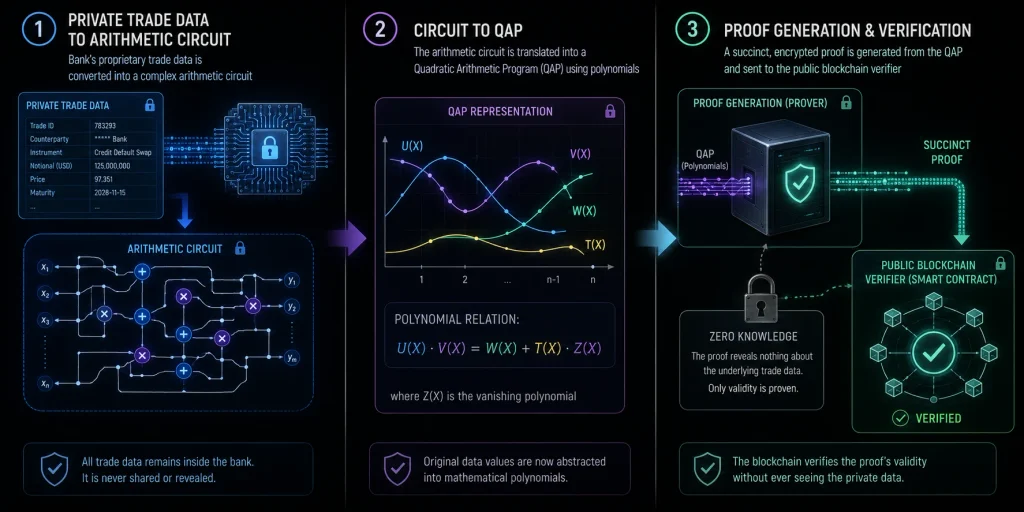
1. The Fundamental Problem: Executing Code Publicly
If a bank wants to execute a smart contract (e.g., transferring $10 million if certain conditions are met), the blockchain must run the code to verify it. If the blockchain runs the code, every node sees the variables. If the data is encrypted, the nodes cannot compute it.
2. The Core Mechanism: The Prover and Verifier
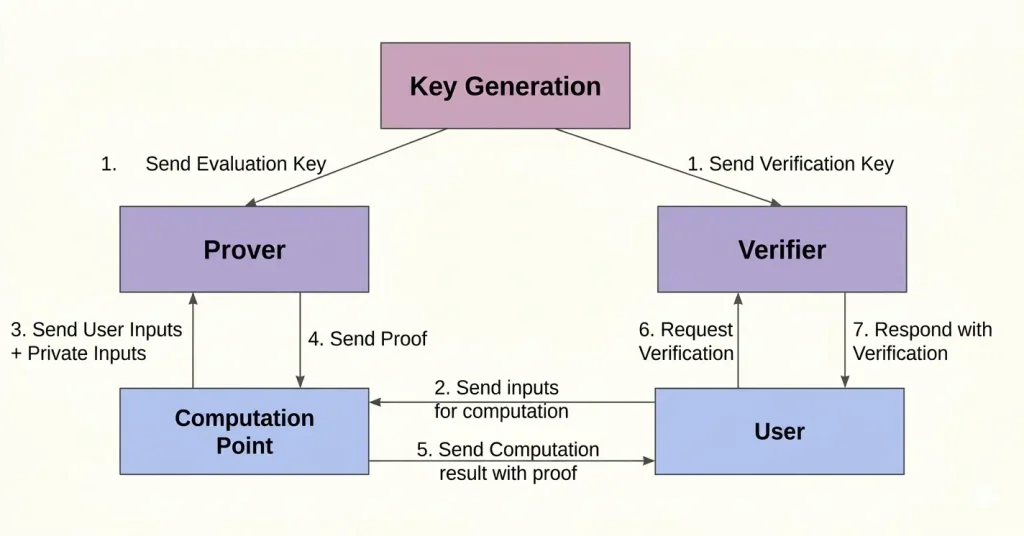
The system relies on two entities. The Prover (the bank executing the trade) has the secret data. The Verifier (the blockchain smart contract) needs to confirm the trade is valid. The Prover executes the computation locally on their own private servers. They then generate a cryptographic “Proof” and send only the Proof to the Verifier.
3. Technical Depth: Arithmetic Circuits and Polynomials
How does the Prover make a Proof? They cannot just send a hash of the data.
First, the entire smart contract program is converted into an Arithmetic Circuit (a web of addition and multiplication gates).
Next, this circuit is translated into a complex mathematical equation called a Quadratic Arithmetic Program (QAP), which is represented by polynomials.
The core rule of polynomial math is that two different polynomials will almost never intersect at the exact same random points unless they are the exact same polynomial.
The Prover evaluates the polynomial using their secret data. If the data is valid according to the rules of the smart contract, the math works out perfectly:
P(x) = T(x) · H(x)
(Where (P(x)) represents the program’s constraints, (T(x)) is the target polynomial, and (H(x)) proves the correct inputs were used).
4. Technical Depth: SNARKs (Succinct Non-Interactive)
The acronym SNARK stands for Succinct Non-Interactive Arguments of Knowledge.
- Succinct: The proof is tiny (often just a few hundred bytes), and the Verifier can check it in milliseconds, even if the original computation took hours.
- Non-Interactive: The Prover sends one single message to the Verifier. They do not need to pass data back and forth to complete the proof.
5. Real-World Consequences: The Trusted Setup
To make the math work, zk-SNARKs historically require a “Trusted Setup.” The creators of the protocol must generate a master cryptographic key to initiate the polynomial parameters. If the creators keep this key, they can forge fake proofs. To secure the system, the creators execute a “ceremony” to generate the key, and then permanently destroy the underlying data (toxic waste). Once destroyed, the zk-SNARK is mathematically unbreakable.
Institutional Use Cases: ZK-KYC and Dark Pools
The deployment of ZKPs has moved rapidly from privacy coins into the foundational infrastructure of global capital markets.
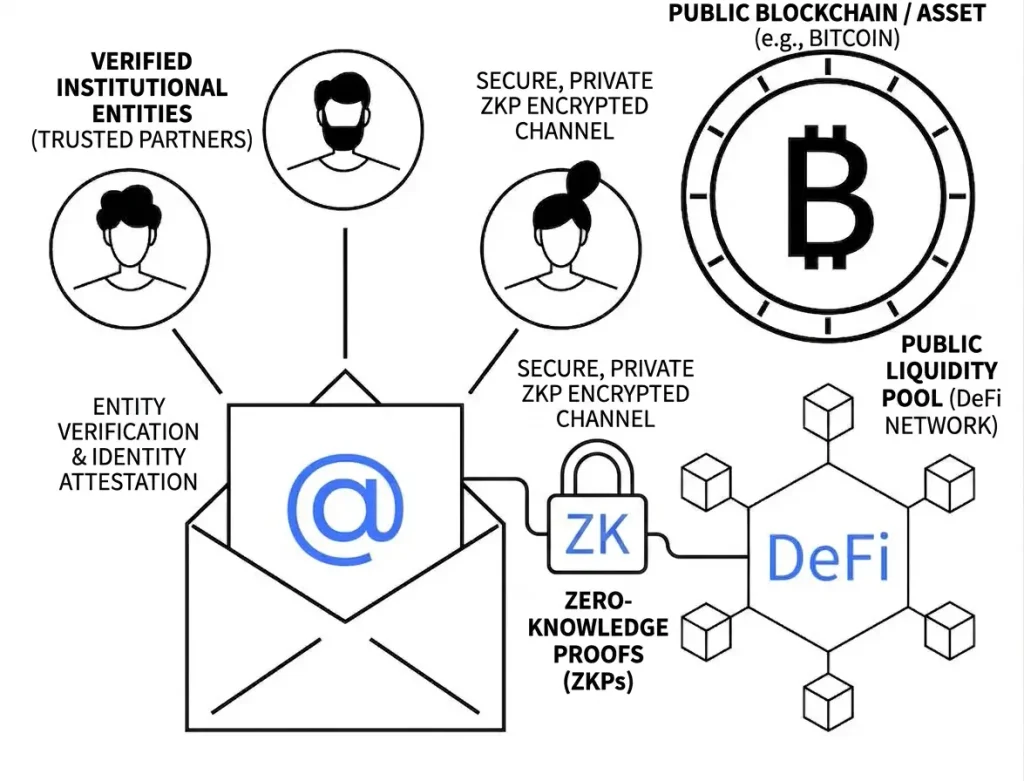
Zero-Knowledge KYC (ZK-KYC): To comply with the Financial Action Task Force (FATF) Travel Rule, institutions must verify the identity of the entities they trade with. Using protocols like Chainlink DECO, banks utilize ZK-KYC. A user can cryptographically prove they are an accredited investor, not located in a sanctioned country, and have passed AML checks without ever uploading their passport or tax returns to the blockchain. The smart contract simply verifies the proof and grants access to the liquidity pool.
Solvency Verification (Proof of Reserves): Following the collapse of centralized exchanges, institutions demanded transparency. ZKPs allow an exchange or a stablecoin issuer to generate a cryptographic proof that their total fiat reserves in a traditional bank account mathematically exceed their total on-chain liabilities. They can prove “Reserves > $10 Billion” to the public daily, without revealing the exact composition of their treasury or their proprietary banking relationships.
On-Chain Dark Pools: Institutional traders execute massive block trades that would instantly crash or spike the market if broadcast publicly. ZKPs enable the creation of decentralized dark pools. A trader can submit an encrypted order to buy $50 million of an asset. The ZK circuit matches buyers and sellers and settles the trade at the optimal price, only revealing the final transfer of assets, protecting the institutions from predatory arbitrage.
Economic & Strategic Impact
The core strategic consequence of zk-SNARKs is the Resolution of the Blockchain Scalability Trilemma.
The traditional trilemma states that a blockchain cannot be highly secure, completely decentralized, and vastly scalable all at once. zk-SNARKs fundamentally break this rule through ZK-Rollups.
If a Layer-2 network processes 10,000 trades off-chain, it does not need to send the data for all 10,000 trades back to the Layer-1 Ethereum mainnet. It only needs to send one succinct zk-SNARK proof verifying that all 10,000 trades were executed correctly. The Ethereum mainnet verifies the tiny proof in milliseconds. By mathematically compressing thousands of transactions into a single cryptographic receipt, ZKPs have increased the throughput of public blockchains by several orders of magnitude, making institutional volume economically viable.
Advantages
- Absolute Data Privacy: Cryptographically guarantees that sensitive trade data, counterparty identities, and proprietary strategies remain entirely invisible to the public ledger and node validators.
- Hyper-Scalability: Proofs are “succinct” (tiny in data size). Verifying a zk-SNARK takes milliseconds, regardless of how massive or complex the underlying computation was, radically lowering gas fees.
- Regulatory Compliance: Allows institutions to adhere to stringent data protection laws (like GDPR) by relying on “data minimization.” By verifying proofs instead of holding raw data, institutions reduce their liability for database breaches.
- Trustless Verification: The mathematics are absolute. The Verifier does not need to trust the Prover; if the proof returns “TRUE,” the statement is an undeniable mathematical fact.
Limitations
- The Trusted Setup Vulnerability: zk-SNARKs require an initial ceremony to generate a master key. If this key is not properly destroyed, bad actors can mint fake proofs indefinitely. (Note: Newer protocols are finding ways around this, but it remains a historical vulnerability of the SNARK architecture).
- Computational Proving Cost: While verifying a proof takes milliseconds, generating the proof is incredibly computationally expensive. Creating a proof for a complex smart contract can take minutes of heavy GPU processing, introducing latency for the Prover.
- Smart Contract Complexity: Writing ZK circuits is notoriously difficult. Developers cannot write standard software code; they must translate their logic into polynomial arithmetic circuits. While ZK-EVMs (Ethereum Virtual Machines) have automated much of this, the underlying code remains brittle and highly vulnerable to implementation bugs.
Common Misconceptions
Misconception: Zero-Knowledge Proofs encrypt the blockchain.
Reality: ZKPs are not encryption (like AES or RSA). Encryption scrambles data so it can be decrypted later with a key. ZKPs mathematically prove a statement is true without sending the data at all. There is nothing to decrypt.
Misconception: ZKPs hide the fact that a transaction occurred.
Reality: On a public blockchain, the movement of the actual token is still visible to ensure the ledger balances. ZKPs hide the context—the identity of the sender, the specific smart contract conditions, and the underlying collateral logic.
Misconception: TEEs (Trusted Execution Environments) do the exact same thing.
Reality: TEEs (like Intel SGX) process private data inside a physical, secure hardware chip. You must trust the hardware manufacturer not to build in backdoors. ZKPs use pure math, requiring zero trust in the physical hardware processing the data.
What Most People Miss
The disruptive capability of ZK-STARKs and Post-Quantum Resilience.
When institutions deploy capital, they look decades into the future. Cryptographers know that when quantum computers arrive, they will instantly break the elliptic curve cryptography that currently secures zk-SNARKs.
What the market is quietly pivoting toward are zk-STARKs (Scalable Transparent Arguments of Knowledge). STARKs perform the same privacy magic but rely on collision-resistant hash functions rather than elliptic curves. This makes them natively quantum-resistant. Furthermore, STARKs are “Transparent”—they do not require the controversial “Trusted Setup” ceremony. While STARK proofs are currently larger in data size than SNARKs, the institutional migration toward STARK-based architecture is the definitive preparation for the post-quantum financial era.
Comparison Table
| Feature | Standard Public Blockchain | Trusted Execution Environment (TEE) | zk-SNARKs | zk-STARKs |
| Data Privacy | Zero (Publicly broadcast) | High (Hardware encrypted) | Absolute (Math encrypted) | Absolute (Math encrypted) |
| Verification Speed | Slow (Every node verifies) | Fast | Instant (Succinct) | Fast |
| Trusted Setup Required? | No | No (Trusts hardware vendor) | Yes | No (Transparent) |
| Quantum Resistant? | No | Hardware dependent | No | Yes |
| Primary Use Case | Transparent Ledger | Low-latency private pools | High-scale private DeFi | Future-proof scaling |
Case Study
Situation: As decentralized finance expanded, tier-one banks faced an operational impasse. They wanted to participate in the tokenization of real-world assets (RWAs) and execute cross-border settlements on public blockchains like Ethereum. However, Basel IV regulations and GDPR mandated “privacy-by-design,” explicitly prohibiting the broadcast of collateral movements and client identities to decentralized node validators.
Challenge: Develop a technical framework that allowed a bank to prove to a public liquidity pool that it met all regulatory, accreditation, and solvency requirements to execute a trade, without allowing predatory MEV bots or rival banks to view the trade’s metadata.
Solution (Institutional ZK-Rollups): Leading financial institutions partnered with scaling networks like Polygon zkEVM and Matter Labs (zkSync). The banks deployed hybrid architectures where trade execution occurred off-chain in private environments. They utilized zk-SNARKs to compress thousands of these institutional trades into a single cryptographic proof.
Outcome: The proof was submitted to the Ethereum mainnet. The mainnet mathematically verified that every private trade adhered perfectly to the rules of the smart contract, updating the global ledger states without ever parsing the plaintext data. This architecture allowed banks like BNY Mellon and Goldman Sachs to participate in tokenized bond issuances, maintaining absolute trade secrecy while leveraging the liquidity of public, permissionless infrastructure.
Lessons Learned: The deployment validated that privacy and transparency are not mutually exclusive. By separating the execution of a trade from the verification of a trade, ZKPs proved that institutions can engage with trustless networks while completely shielding their proprietary financial health metrics and strategies.
Future Outlook
Next 12–24 Months
The era of Hardware Prover Acceleration. The immediate bottleneck for zk-SNARKs is the computational time it takes the Prover to generate the mathematical polynomial proof. Over the next two years, the industry will see the rapid deployment of Zero-Knowledge ASICs (Application-Specific Integrated Circuits) and highly optimized FPGAs. These specialized hardware rigs will drop the proof generation time from minutes to milliseconds, matching the speed of traditional algorithmic trading servers and enabling high-frequency ZK-trading.
Next 3–5 Years
The scaling of ZK-FHE Hybrid Models. While ZKPs are perfect for verifying data, they struggle when multiple parties need to compute on data together without seeing it. The industry will merge zk-SNARKs with Fully Homomorphic Encryption (FHE). In this hybrid architecture, an FHE smart contract will process an encrypted block trade, and a zk-SNARK will generate a tiny proof verifying that the FHE computation was executed perfectly. This combination will yield fully confidential, highly auditable on-chain order books.
Next 10 Years
The Verifiable Web and Identity Abstraction. By the mid-2030s, the concept of handing over a driver’s license or a social security number will be viewed as an archaic security hazard. zk-SNARKs will become the default operating system for digital identity. Citizens will hold cryptographically verified credentials on their local devices and navigate global banking, healthcare, and government infrastructure by submitting instantaneous, zero-knowledge proofs. The internet will transition from a web of exposed databases into a localized, verifiable trust network.
Most Likely Scenario
Zero-Knowledge Proofs are the ultimate commercial enabler for Web3. They dissolve the false dichotomy between public transparency and corporate secrecy. As regulatory bodies aggressively enforce data minimization laws globally, zk-SNARKs (and eventually STARKs) will become the mandatory compliance layer for all digital asset transfers, establishing a programmable financial system that is mathematically impenetrable to unauthorized surveillance.
Key Takeaways
- Public blockchains broadcast every trade detail to the world, which allows predatory bots to manipulate prices and makes the technology illegal for banks to use due to privacy laws.
- Zero-Knowledge Proofs (zk-SNARKs) solve this by allowing a bank to mathematically prove a transaction is perfectly valid without ever showing the network the underlying data.
- Instead of sending the raw data, the bank’s computer turns the trade into a massive polynomial equation and sends a tiny cryptographic receipt (the “Proof”).
- The blockchain verifies the tiny Proof in milliseconds. If it checks out, the trade is approved with 100% certainty, yet the network remains entirely blind to the buyer, seller, and trade amount.
- This technology is driving the explosion of “ZK-Rollups,” which bundle thousands of private trades together into one Proof, making the blockchain infinitely faster and cheaper.
- While zk-SNARKs are the current standard, the industry is preparing to shift toward zk-STARKs, which perform the same magic but are natively immune to attacks from future quantum computers.
Glossary
Arithmetic Circuit: The process of taking standard computer code (like a smart contract) and turning it into a complex web of addition and multiplication math gates so a ZKP can be generated.
Maximal Extractable Value (MEV): The profit that predatory trading bots make on public blockchains by looking at exposed, pending trades and jumping ahead of them in line to manipulate the price.
Prover: The entity (like a bank) that holds the secret data and executes the heavy math to generate the cryptographic proof.
Trusted Setup: A historical vulnerability in zk-SNARKs where the creators must generate a master key to start the system, and then permanently destroy the key to ensure no one can forge fake proofs.
Verifier: The entity (like the Ethereum blockchain) that receives the tiny proof and uses basic math to confirm it is completely valid without seeing the secret data.
ZK-Rollup: A scaling solution that executes thousands of trades privately off-chain, and then submits a single zk-SNARK proof to the main blockchain, drastically reducing fees.
Sources
Chainlink: Zero-Knowledge Proof KYC: Privacy-Preserving Compliance
BlockEden: The Privacy Trilemma: ZK, FHE, and TEE Battle for Blockchain’s Future
Journal of Ballistics (ResearchGate): Zero-Knowledge Proofs in Blockchain Systems Enhancing Privacy
Chainlink: Data Privacy in Banking: The 2026 Institutional Standard
Dataintelo: Zero-Knowledge Proof Market Research Report 2034