Advertisement
)

If you give a brilliant, highly educated executive a massive, 50-step corporate project and lock them in a room alone, they will eventually make a catastrophic mistake. Fatigue sets in, context is lost, and blind spots are ignored. For the past few years, the tech industry has treated Artificial Intelligence the exact same way. We have relied on single, monolithic “chatbots” to solve incredibly complex problems, and we have been continually frustrated when these models hallucinate, forget their instructions, or crash halfway through the task. The prevailing solution was simply to spend billions of dollars building a bigger, slightly smarter executive.
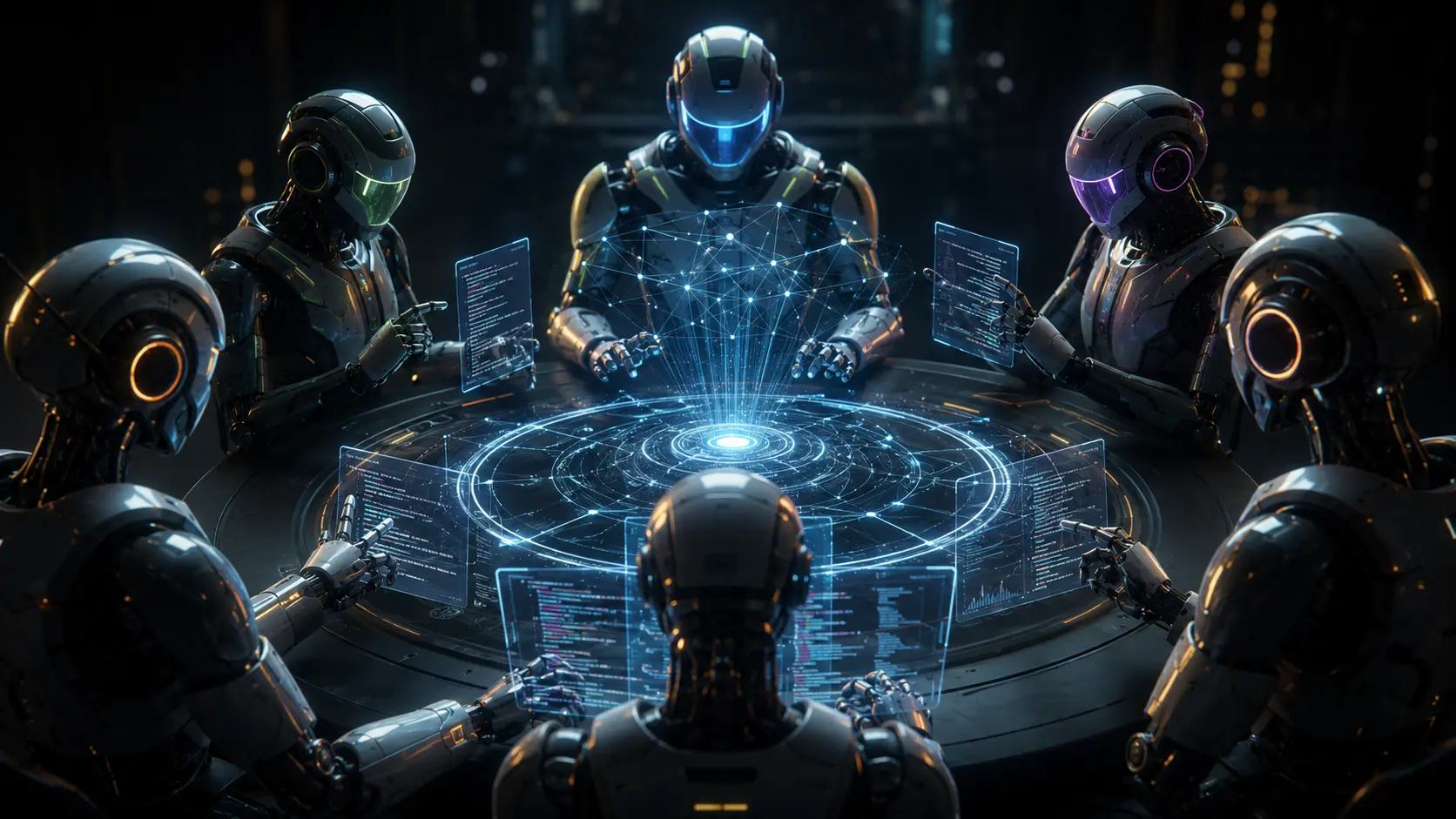
That brute-force era is over. Computer scientists have realized that intelligence does not scale linearly; it scales collaboratively. Instead of asking one massive AI to run an entire company, developers are putting hundreds of small, highly specialized AIs into a digital room together. One AI writes the code, another AI acts as the QA tester to find the bugs, and a third AI acts as the manager to negotiate disputes between the first two. Why should you care right now? Because this architecture—the Multi-Agent System (MAS)—is the blueprint for the next generation of the global economy. By allowing artificial intelligences to swarm, communicate, and correct each other, software is shifting from a tool that assists human workers into an autonomous digital workforce that operates entirely on its own.
What are Multi-Agent Systems (MAS)?
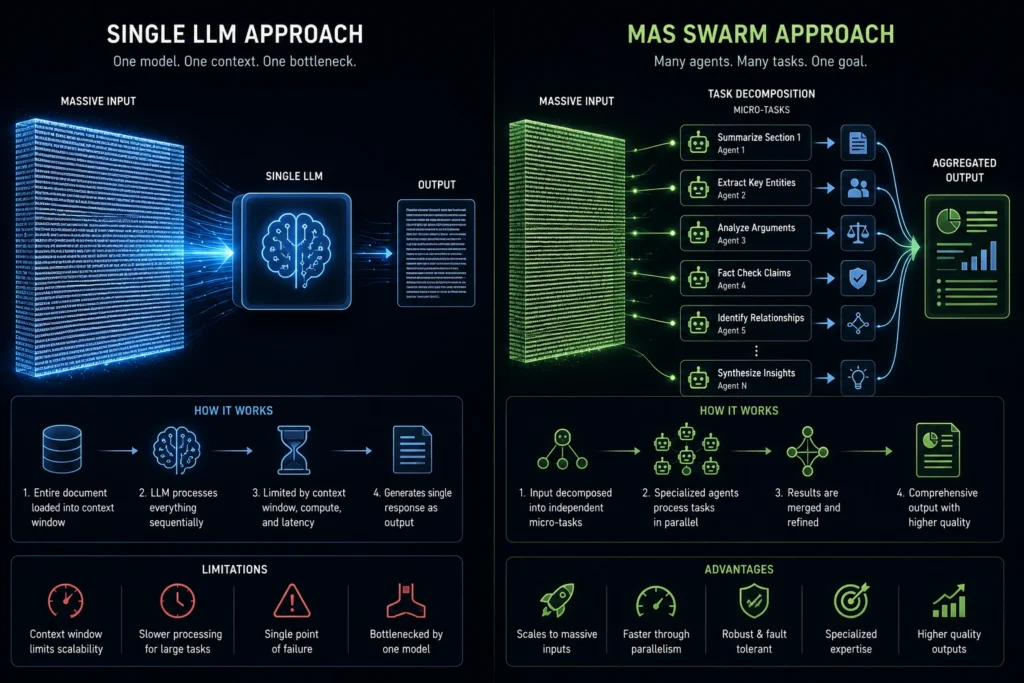
Multi-Agent Systems (MAS) are decentralized networks of autonomous artificial intelligence programs that collaborate, negotiate, and resolve conflicts to solve complex problems. Instead of relying on a single monolithic model, MAS distributes tasks across specialized agents that communicate using standardized protocols to achieve a shared objective.
At a Glance
- Concept: Dividing a massive problem into micro-tasks and assigning each task to an independent AI “agent” equipped with specific tools and a unique persona.
- Why it matters: It solves the hallucination and logic-collapse problems of standard LLMs. In a MAS, agents actively double-check and critique each other’s work, creating a self-correcting loop that produces vastly superior, deterministic results.
- Who uses it: MLOps engineers, quantitative hedge funds, and enterprise software giants (Microsoft AutoGen, CrewAI, LangGraph).
- Biggest takeaway: The secret to MAS is not the intelligence of the individual agent; it is the orchestration protocol. How the agents speak to each other, bid on tasks, and resolve disagreements is what dictates the success or failure of the swarm.
In Simple Words
Imagine a restaurant kitchen.
If you use a Single AI Model, it is like having one incredibly smart chef trying to do everything. They are taking the orders, chopping the vegetables, cooking the steaks, washing the dishes, and ringing up the bills all at the same time. Eventually, the chef gets overwhelmed, forgets an order, and burns the steak.
A Multi-Agent System (MAS) turns the AI into a fully staffed kitchen.
You create one AI and tell it: “You are the Sous-Chef. Your only tool is a knife. Your only job is chopping.” You create another AI and tell it: “You are the Grill Master. You only use the stove.” You create a third AI to act as the Expediter, whose only job is to read the tickets and shout orders to the other two. Because each AI has a tiny, hyper-focused job and a strict set of rules for talking to the others, they can cook a 100-person banquet flawlessly without a single human stepping foot in the kitchen.
Why This Matters
The enterprise software industry is facing a massive integration wall. Corporations want to automate their workflows, but traditional automation (like Robotic Process Automation, or RPA) is highly brittle. If a website changes a single button, the RPA bot breaks and the workflow collapses.
For Enterprise CIOs and Tech Investors, MAS represents the holy grail of “resilient automation.” Because agents possess semantic reasoning, they don’t just blindly click buttons; they understand the goal. If a data-gathering agent encounters a broken API, it can dynamically message a coding agent, ask for a Python script to scrape the data via a different route, execute the script, and continue the workflow without human intervention. This shift from “instruction-based” software to “intent-based” swarms threatens to entirely wipe out the legacy $100 billion business process outsourcing (BPO) industry.
The Shift to Small Models in Multi-Agent Systems
The evolution of MAS is triggering a fundamental shift in how the semiconductor and cloud computing industries allocate capital.
When everyone was focused on massive, single-model AGI (Artificial General Intelligence), the entire industry demanded massive, centralized supercomputers (clusters of 100,000 GPUs wired together).
However, MAS relies on dozens or hundreds of much smaller, highly specialized models (like 8-billion parameter models). These small models do not need to run on massive supercomputers. They can run on edge devices, local servers, or standard laptops. As MAS architecture becomes the dominant paradigm for enterprise AI, we are seeing a geopolitical and economic shift away from monopolized, centralized hyperscale data centers, toward decentralized, edge-compute inference networks that are vastly cheaper and faster to operate.
How Multi-Agent Systems (MAS) Work
Coordinating a swarm of independent artificial intelligences without descending into an infinite, recursive loop requires strict mathematical and linguistic boundaries. Here is the first-principles breakdown of MAS architecture.
1. The Fundamental Problem: Multi-Step Degradation
Large Language Models (LLMs) are autoregressive—they predict the next word. When executing a long, 50-step task, a single error at Step 4 poisons the context window. By Step 20, the model is hallucinating wildly because it is building upon its own corrupted logic. A single model cannot easily stop, critique its own past work, and reverse course while simultaneously holding the entire goal in its memory.
2. The Insufficiency of Linear Pipelines
Engineers initially tried to fix this with “Prompt Chaining” (e.g., basic LangChain). You hardcode a pipeline: Output of Prompt A feeds into Prompt B. However, this is rigid. If Prompt A fails to find the necessary data, Prompt B still blindly executes and returns garbage. There is no dynamic problem-solving.
3. The Core Mechanism: Decentralized Agency and Tools
In a MAS, the system is populated with independent “Agents.” Each agent is initialized with a specific System Prompt (its persona/rules) and access to specific external Tools (e.g., a web browser, a Python interpreter, a SQL database). The agents are not forced into a rigid pipeline; they are placed into a shared environment and given a high-level goal.
4. Technical Depth: Communication Protocols and POMDPs
How do the agents know what to do? They rely on formal communication standards, heavily inspired by the Foundation for Intelligent Physical Agents (FIPA) Agent Communication Language (ACL). Agents broadcast their state and capabilities.
Because no single agent can see the entire system perfectly, they operate using Partially Observable Markov Decision Processes (POMDPs). An agent mathematically calculates the probability of success for its next action based only on its local, limited observation. If an agent hits a dead end, it broadcasts a “Request for Assistance” to the swarm.
5. Real-World Consequences: Negotiation and Conflict Resolution
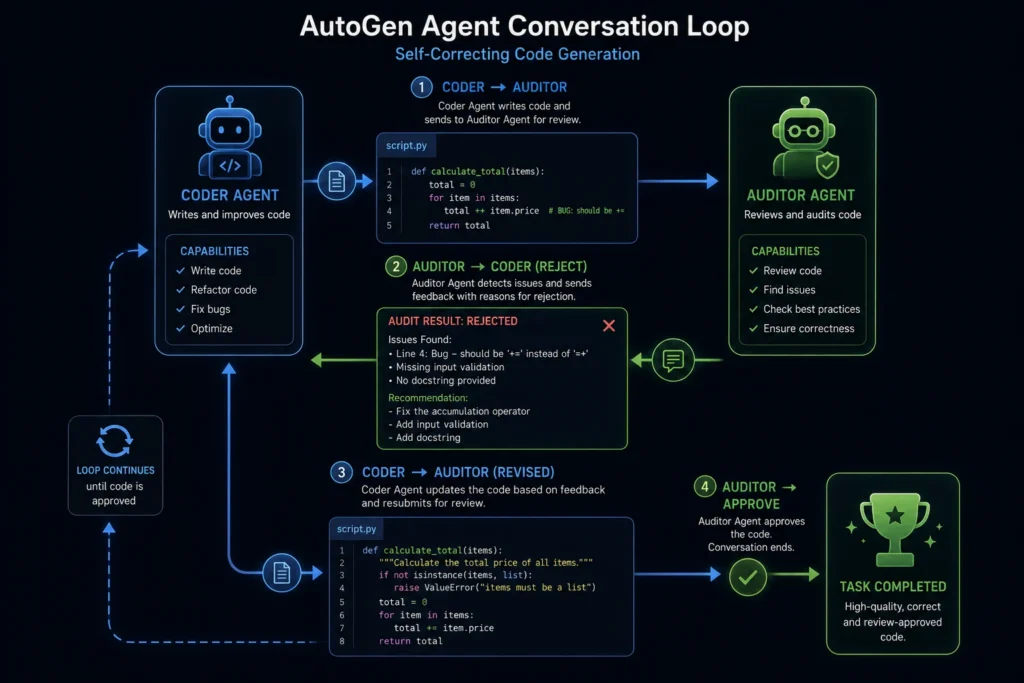
The most critical feature of a MAS is the “Debate.” If a Coding Agent writes a script, it passes it to the QA Agent. If the QA Agent finds a bug, it does not just crash; it sends the code back with an error log. The two agents argue. The system relies on “Contract Net Protocols”—a bidding system where agents negotiate who is best equipped to fix the bug. This multi-agent debate acts as a ruthless filter, ensuring that only highly refined, mathematically sound outputs survive the swarm to be presented to the human user.
Real-World MAS Frameworks: AutoGen and CrewAI
MAS frameworks have transitioned from academic theory into robust, production-grade enterprise deployments.
Autonomous Software Engineering (ChatDev / AutoGen): The most validated use case for MAS. Instead of using GitHub Copilot to help a human code, an enterprise spins up a digital software company. The user inputs a prompt: “Build a 2D ping-pong game.” The “CEO Agent” drafts the requirements and passes them to the “CTO Agent.” The “Programmer Agent” writes the code, the “Reviewer Agent” tests it, and the “Designer Agent” creates the UI. They run in a continuous loop for minutes, arguing over bugs and refining the code, eventually spitting out a perfectly compiled, executable software package.
Algorithmic Trading Swarms: Quantitative hedge funds use MAS to manage the chaos of global markets. A “Sentiment Agent” constantly scrapes Twitter and news sites. A “Macro Agent” monitors interest rate data. A “Technical Agent” reads chart patterns. They all feed their independent conclusions into a central “Risk Manager Agent.” By forcing these distinct AIs to debate the market state before executing a trade, the fund dramatically reduces the risk of a single AI hallucinating a false pattern and losing billions.
Supply Chain Resilience: Global logistics companies use MAS to model physical supply chains. Every ship, port, and warehouse is assigned its own digital agent. If a hurricane shuts down a port in Asia, the “Port Agent” broadcasts the failure. The “Ship Agents” on the water instantly communicate with “Warehouse Agents” in Europe to negotiate new arrival times, reroute logistics, and bid on alternative docking space automatically, re-optimizing the entire global supply chain in seconds.
Economic & Strategic Impact
The proliferation of MAS introduces a massive, unresolved legal crisis: Algorithmic Liability.
When a single human uses an AI chatbot to write a bad contract, the human is liable. But what happens when an autonomous swarm of 50 AI agents negotiates a supply chain contract with another company’s swarm of 50 AI agents, and a multi-million-dollar error is made?
Because the negotiation happened via high-speed machine-to-machine bidding protocols (with no human-in-the-loop), assigning legal liability becomes a jurisdictional nightmare. Corporate legal departments are currently scrambling to draft “Agentic Boundaries”—strict, hardcoded spending limits and legal guardrails that prevent a rogue MAS from accidentally executing a binding corporate acquisition or dumping a company’s entire stock portfolio during an unsupervised digital debate.
Advantages
- Self-Correction (Reduced Hallucinations): By forcing agents to review and critique each other’s work, the system naturally filters out the logical errors and hallucinations common in standalone LLMs.
- Decoupled Scaling: You do not need a massive, expensive frontier model. You can use dozens of cheap, highly optimized, open-source 8B parameter models, saving massive amounts of API inference costs.
- Dynamic Resilience: If a traditional software script hits a broken link, it crashes. If an agent hits a broken link, it autonomously searches the internet for a workaround, ensuring the workflow completes successfully.
Limitations
- Infinite Loops: The greatest technical risk in MAS. If two agents are poorly prompted, they can get stuck in a recursive argument (e.g., Agent A says the code is wrong, Agent B says it is right, and they argue forever), burning thousands of dollars in API compute credits in minutes.
- Latency: Because every step requires agents to generate tokens, read responses, and formulate counter-arguments, MAS is inherently slow. A task that takes a standard script 2 seconds to execute might take a MAS swarm 45 seconds to debate and finalize.
- Context Window Saturation: The “Memory” or “Manager” agent responsible for summarizing the debate must constantly read everything the sub-agents are saying. In complex tasks, this massive transcript quickly overflows the central agent’s context window, causing the system to forget the original goal.
Common Misconceptions
Misconception: A Multi-Agent System is just a bunch of ChatGPT windows open at the same time.
Reality: A true MAS operates via strict programmatic architecture. The agents have restricted tools, specific network topologies (like hierarchical, peer-to-peer, or supervisor-worker), and communicate via backend API calls, not human chat interfaces.
Misconception: The agents are actually “thinking” and “arguing” like humans.
Reality: They are executing probabilistic token generation based on their system prompts. When an agent “argues,” it is simply fulfilling the statistical mandate of its prompt (e.g., “Always find a flaw in the provided text”), which computationally forces the next agent to regenerate a better response.
Misconception: MAS will instantly replace all human workers.
Reality: Currently, MAS is highly effective at executing deterministic, well-defined tasks (like writing code or sorting data). However, they lack the true lateral reasoning required for high-level, creative corporate strategy. For the foreseeable future, they will act as massive leverage multipliers for human managers, not wholesale replacements.
What Most People Miss
The shift from Orchestration to Choreography.
In early multi-agent systems, developers used strict Orchestration. There was a central “Boss” agent that told every other agent exactly when to speak and what to do. This is a centralized bottleneck.
What the industry is moving toward is Choreography. In choreography, there is no boss. Every agent simply observes the digital environment. If a task appears on the message board that fits an agent’s specific toolset, it autonomously claims the task, does the work, and posts the result back to the board. This decentralized, emergent behavior mimics natural biological swarms (like ants or bees), allowing the AI network to scale infinitely without a central controller crashing under the processing weight.
Comparison Table
| Feature | Monolithic LLM (e.g., ChatGPT) | Orchestrated Pipeline (e.g., LangChain) | Multi-Agent System (e.g., AutoGen/CrewAI) |
| Architecture | Single, isolated model | Linear, hardcoded steps | Decentralized, autonomous swarm |
| Error Handling | Hallucinates or fails silently | Pipeline crashes upon error | Dynamic self-correction and debate |
| Tool Usage | Basic (e.g., simple web search) | Pre-defined, rigid integration | Agent-specific, autonomous tool discovery |
| Latency / Cost | Fast / Low | Moderate / Moderate | Slow / High (Due to recursive prompting) |
| Optimal Use Case | Brainstorming, drafting text | Predictable, static data routing | Complex, multi-step problem solving |
Case Study
Situation: A leading quantitative finance firm relied on a team of human analysts to read hundreds of daily SEC 10-K filings, extract specific financial metrics, cross-reference them against macro-economic news, and generate daily risk reports. The process was slow, highly prone to human error, and completely unscalable during earning seasons.
Challenge: The firm attempted to use a massive, single LLM to automate the process by feeding it the 10-K documents. The single model repeatedly hallucinated numbers, skipped crucial footnotes, and failed to adequately verify its own math, rendering the outputs useless for live trading.
Solution (The Swarm Integration): The firm deployed a hierarchical Multi-Agent System using the Microsoft AutoGen framework. They created:
- The Retriever Agent: Specialized in RAG (Retrieval-Augmented Generation) to extract exact text blocks from the 10-Ks.
- The Quant Agent: Equipped with a Python execution environment to take the text, extract the numbers, and run verified mathematical calculations.
- The Auditor Agent: Tasked exclusively with comparing the Quant Agent’s math against the original text provided by the Retriever.
Outcome: When the Retriever found a number, the Quant ran the math. If the Auditor found a discrepancy, it rejected the report and forced the Quant to rewrite the code. The system operated in an autonomous loop until the Auditor achieved 100% verification. The firm successfully automated the extraction process, achieving a 99.8% accuracy rate that far surpassed the single-model baseline, completely eliminating the human bottleneck.
Lessons Learned: The deployment proved that for enterprise-grade reliability, verification cannot be an afterthought; it must be structurally embedded into the workflow. By assigning a distinct agent the sole persona of an “Auditor,” the system leveraged adversarial AI dynamics to mathematically guarantee the integrity of its own outputs.
Future Outlook
Next 12–24 Months
The era of Standardized Agentic Protocols. Currently, an agent built on Microsoft AutoGen cannot easily communicate with an agent built on an open-source framework like CrewAI. Over the next two years, the industry will establish universal communication standards (the HTTP of the AI world). This will allow an enterprise’s internal supply-chain swarm to seamlessly open a secure API channel and negotiate directly with a vendor’s external pricing swarm, unlocking true machine-to-machine (M2M) digital commerce.
Next 3–5 Years
The explosion of Micro-Specialized Edge Swarms. The reliance on trillion-parameter models will fade. Companies will train thousands of microscopic, hyper-specialized models (e.g., a 2-billion parameter model whose only job in the universe is translating SQL database queries). These tiny models will live directly on laptops and smartphones. When a user asks a complex question, the device will instantly network these tiny, local models together into a spontaneous swarm, solving the problem with zero latency and absolute data privacy, completely bypassing the cloud.
Next 10 Years
The Autonomous Corporate Entity. By the mid-2030s, we will see the incorporation of the first company where the entire C-suite, middle management, and execution layer are entirely composed of a Multi-Agent System. Human founders will simply set the initial capital allocation and high-level directives. The MAS will autonomously execute marketing, negotiate vendor contracts, write software, and balance the corporate treasury, ushering in the era of hyper-scalable, zero-employee mega-corporations.
Most Likely Scenario
Multi-Agent Systems are the definitive bridge between current generative AI and future Artificial General Intelligence (AGI). While the latency and API costs of having AIs talk to each other are currently high, the rapid decline in inference costs will soon make swarm architecture economically trivial. The transition from monolithic chatbots to specialized, argumentative AI swarms is the most critical software paradigm shift of the decade.
Key Takeaways
- Multi-Agent Systems (MAS) abandon the idea of a single, massive AI and instead use a network of specialized, independent AIs that collaborate to solve complex problems.
- By giving different agents distinct personas (e.g., a Coder, an Auditor, a Manager), the swarm naturally checks its own work, drastically reducing hallucinations and logical errors.
- Agents operate autonomously by using specific tools (like web browsers or Python interpreters) and communicating via structured negotiation protocols (like bidding for tasks).
- The primary risk of MAS is the “Infinite Loop,” where agents get trapped in a recursive argument, burning massive amounts of computational power without reaching a conclusion.
- The industry is shifting from strict “Orchestration” (a boss telling everyone what to do) to fluid “Choreography” (agents autonomously picking up tasks from a shared environment).
- MAS architecture favors deploying dozens of cheap, small, specialized open-source models rather than relying entirely on expensive, massive frontier models.
Glossary
Agent: An autonomous AI program equipped with a specific persona, a set of instructions (system prompt), and access to external tools, capable of independent decision-making.
Autoregressive: The underlying mechanism of LLMs where the model generates text by predicting the next word based on the previous words. Prone to compounding errors in long tasks.
Choreography: A decentralized MAS architecture where there is no central controller. Agents observe the environment and autonomously claim tasks they are equipped to handle.
FIPA-ACL: Foundation for Intelligent Physical Agents – Agent Communication Language. A historical standard for how software agents format messages, requests, and negotiations.
Hallucination: When an AI confidently generates false, mathematically incorrect, or entirely fabricated information. MAS actively suppresses this through adversarial agent auditing.
Partially Observable Markov Decision Process (POMDP): A mathematical framework used by agents to make decisions when they cannot perfectly see or know the entire state of the environment or the swarm.
Frequently Asked Questions
Why not just write a better prompt for ChatGPT?
A single prompt, no matter how good, forces the AI to process the entire complex problem in one linear pass. It cannot easily stop, critique its own work, and pivot if it hits a roadblock. MAS breaks the problem into chunks and forces distinct agents to debate the logic, achieving a level of dynamic reasoning a single prompt cannot reach.
Do the agents actually talk to each other in English?
Usually, yes. In modern LLM-based MAS, the agents pass text strings back and forth (often formatted as JSON) inside the backend of the software. The “debate” is literally one LLM generating a paragraph of text, which is fed directly into the context window of the second LLM as its prompt.
How do you stop them from arguing forever?
Developers hardcode “circuit breakers” into the system. For example, you can set a “Max Turns” limit, dictating that if the Coder and the Auditor agents debate back and forth more than 10 times without resolving the bug, the workflow is aborted and flagged for a human to review.
Is it expensive to run?
It can be. If you have 5 agents debating a problem for 20 turns, you are paying for API inference costs on every single turn. This is why enterprise MAS deployments rely heavily on smaller, much cheaper models (like Llama 3 8B) rather than using premium models (like GPT-4) for every agent.
Are there open-source frameworks I can use to build this?
Yes. Microsoft’s AutoGen, CrewAI, and LangChain’s LangGraph are currently the most popular, accessible, and heavily documented frameworks for building customized multi-agent swarms.
Sources
[1] Microsoft Research: AutoGen: Enabling Next-Gen LLM Applications (2025/2026 Updates)
[2] arXiv (Computer Science): Communicative Agents for Software Development (ChatDev)
[3] IEEE Transactions on Artificial Intelligence: From Orchestration to Choreography in LLM-based Multi-Agent Systems (March 2026)
[4] Sequoia Capital: The Multi-Agent Future: Enterprise Application Shifts in Generative AI
[5] DeepLearning.AI: Partially Observable Markov Decision Processes in Autonomous AI Swarms