Advertisement
)
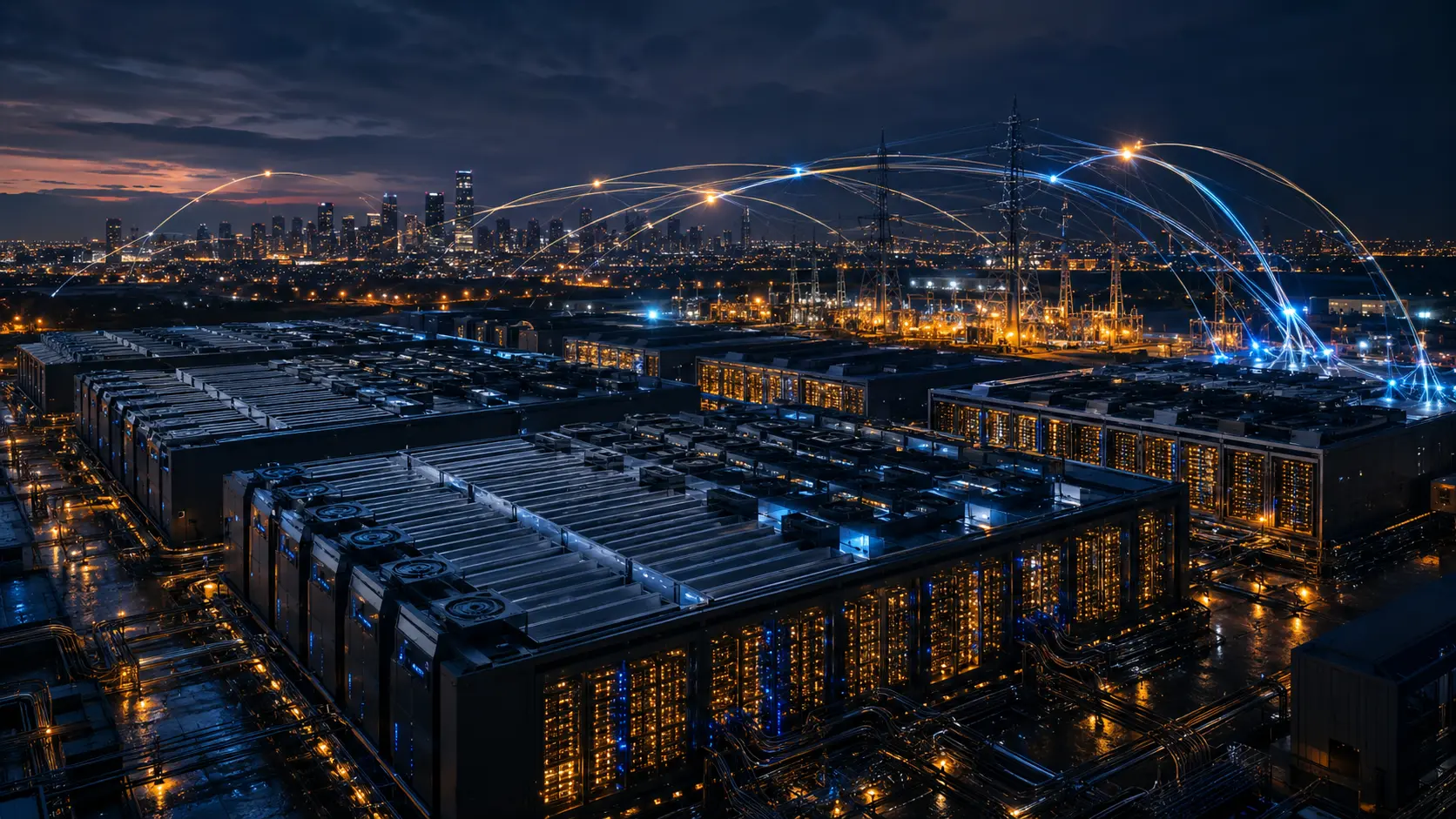

For the past two decades, private equity’s playbook was remarkably consistent: acquire a mature software or manufacturing company, load it with debt, optimize its operations, and sell it for a massive premium. But as interest rates rose and traditional corporate buyout math broke down, the titans of Wall Street found themselves sitting on over $12 trillion in total assets under management (AUM) with nowhere to deploy it. Concurrently, Silicon Valley ran into a brick wall of its own. Companies like Microsoft, Google, and Nvidia needed to spend trillions on data centers and electricity to train their artificial intelligence models, a sum that outstripped even their colossal corporate balance sheets.
The solution was the most significant financial convergence in modern history. Private equity firms are no longer just buying companies; they are financing the physical infrastructure of the internet itself. Why should you care right now? Because alternative asset managers have officially become the landlords of the AI era. By partnering directly with semiconductor monopolies and energy providers, private credit and infrastructure funds are underwriting the compute capacity that powers the modern economy, shifting the balance of power from Silicon Valley directly to Wall Street.
What is the Private Equity Pivot to AI Infrastructure?
The Private Equity Pivot to AI Infrastructure is the strategic reallocation of trillions in alternative asset capital away from traditional corporate buyouts toward the physical foundation of artificial intelligence. Private equity firms are financing data centers, power grids, and chip procurement, effectively acting as the foundational landlords of the global AI economy.
At a Glance
- Concept: Utilizing private market capital—specifically infrastructure and credit funds—to absorb the massive upfront costs of building AI data centers, power generation, and GPU clusters.
- Why it matters: The capital expenditure (CapEx) required for the AI transition is projected to be the largest infrastructure buildout since the interstate highway system. Big Tech cannot fund this solely off its own balance sheets.
- Who uses it: Mega-cap alternative asset managers including Blackstone, Apollo, KKR, and Brookfield, entering into unprecedented partnerships with tech giants like Nvidia, Broadcom, and Google.
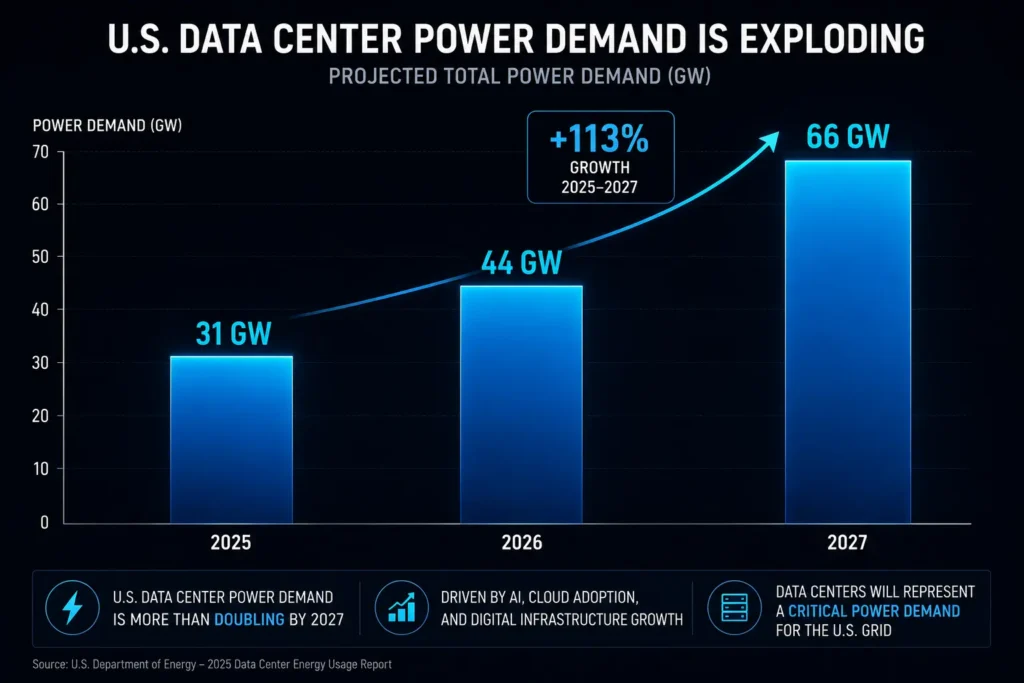
- Biggest takeaway: Power is the ultimate bottleneck. U.S. data center power demand is projected to jump from 31 GW in 2025 to 66 GW by 2027. Private equity is aggressively acquiring energy grids and natural gas pipelines simply to guarantee that their data centers can turn on.
In Simple Words
Imagine you want to build the world’s most advanced digital train network. You have designed the perfect train (the AI model), but you need millions of miles of steel tracks (data centers) and massive coal reserves (electricity) to make it run.
Even if you are the richest train engineer in the world, buying all that steel and coal at the exact same time will bankrupt you.
Instead, you go to a Wall Street bank. The bank says, “We will pay to build the tracks and buy the coal. In exchange, you sign a 15-year legal contract promising to pay us a toll every single time one of your trains uses our tracks.”
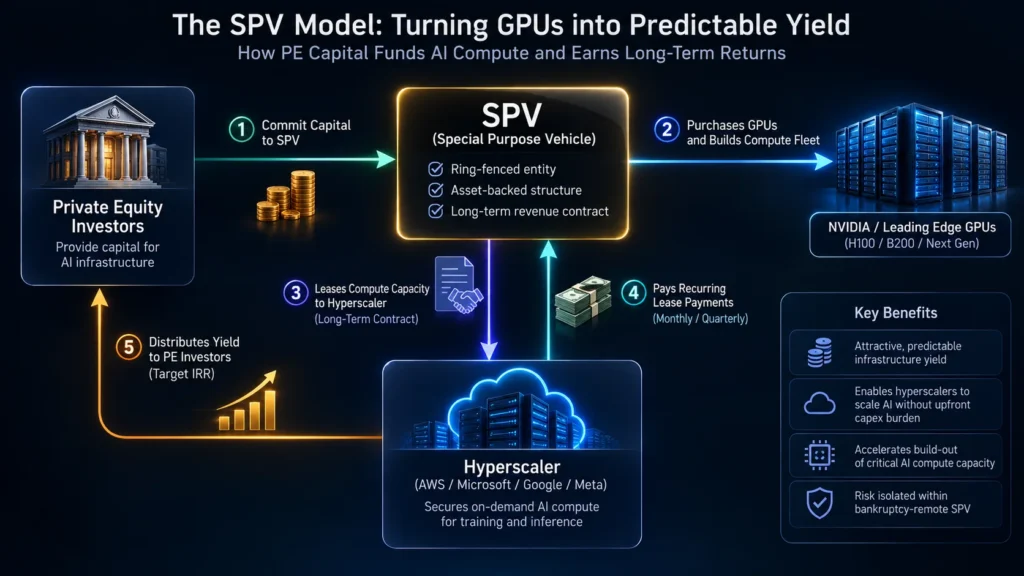
This is the private equity pivot. Tech companies design the AI, but private equity firms are putting up the billions of dollars required to buy the microchips, pour the concrete for the data centers, and secure the power plants. The tech companies rent the infrastructure back, and Wall Street collects a guaranteed, risk-free toll for the next decade.
Why This Matters
The sheer scale of the global AI opportunity requires a collaborative capital model. Hyperscalers (Amazon, Google, Microsoft, Meta) are engaged in a vicious arms race to train the smartest models, which requires hoarding hundreds of thousands of high-end GPUs.
For Institutional LPs and Infrastructure Analysts, this pivot changes the risk profile of alternative investments. Traditional private equity buyouts rely heavily on exit strategies—selling the company to another buyer or taking it public via an IPO. Infrastructure investing relies on yield. By building a data center and signing a 15-year Power Purchase Agreement (PPA) with an investment-grade tenant like Microsoft, private equity firms create a bond-like, highly predictable cash flow stream that perfectly matches the long-term liability needs of the pension funds and life insurance companies providing their capital.
The Geopolitics of AI Infrastructure Investment
The mid-2020s marked the permanent transition of AI from a software problem to an infrastructure problem.
In August 2026, it was reported that an unprecedented consortium including Apollo, Blackstone, BlackRock, Brookfield, Goldman Sachs, and KKR entered into partnerships with Nvidia to finance the global AI build-out. The entire private equity industry recognized that holding traditional, mid-market corporate software companies was a losing battle against rising interest rates. In response, these firms mobilized their infrastructure and private credit vehicles to become the marginal financiers of the energy and compute era.
This is a geopolitical restructuring of capital. By securing physical hard assets—gigawatts of compute, acres of real estate, and massive energy grids—private equity is shielding its $12 trillion empire against the volatility of the stock market and inflation.
How Asset-Backed Finance Funds AI Infrastructure
Extracting steady yield from volatile technology markets requires flawless financial engineering. Here is the first-principles breakdown of an AI infrastructure transaction.
1. The Fundamental Problem: Capital Intensity of Compute
An advanced AI data center is no longer just a building with air conditioning. A single 1-gigawatt facility filled with the latest silicon requires specialized liquid cooling, reinforced concrete flooring to support massive racks, and dedicated electrical substations. The cost to build these facilities can exceed billions of dollars, draining the liquidity of even the largest tech conglomerates.
2. The Insufficiency of Corporate Balance Sheets
Historically, companies funded their own growth. But suppliers extending capital to the customers buying their output is a recurring pattern late in massive capacity build-outs. Tech companies need their cash to pay engineers and acquire data; they do not want to tie up their balance sheets owning depreciating real estate and physical servers.
3. The Core Mechanism: Infrastructure Asset-Backed Finance
To bridge the gap, private equity steps in using Asset-Backed Finance (ABF). A firm like Blackstone will spin up a Special Purpose Vehicle (SPV) and pour billions of dollars into it. The SPV uses this cash to legally purchase the actual, physical GPUs from the manufacturer (e.g., Nvidia or Broadcom). The loan is physically secured against the chips themselves.
4. Technical Depth: PPA Off-Takers and Debt Facilities
With the hardware secured, the private equity firm strikes a deal with the hyperscaler or cloud provider (the “Off-Taker”). They sign a rigid, take-or-pay capacity contract. The hyperscaler agrees to lease the compute power for years at a fixed rate, regardless of whether they fully use it. Because the tenant is typically an AAA-rated tech giant, the private equity firm can then take this guaranteed contract to commercial banks and borrow even more money against it at incredibly low interest rates, drastically amplifying their internal rate of return (IRR).
5. Real-World Consequences: PE as the New Utility
The final piece of the puzzle is energy. AI processors are useless without electricity. Consequently, private equity firms are expanding aggressively into the power sector. In July 2026, a Blackstone-led consortium (including Apollo and KKR) committed $5.34 billion to energy provider Williams Companies to develop power projects specifically aimed at supporting the soaring power demands for data centers. Private equity is vertically integrating the entire AI stack: they own the chips, the buildings, and the power plants.
Real-World Examples of Private Equity AI Infrastructure
The largest transactions in Wall Street history are currently being drafted exclusively to support artificial intelligence.
The Broadcom & Apollo / Blackstone Mega-Deal: In June 2026, Broadcom launched the “AI XPV Platform” with an initial tranche of $35 billion, anchored by Apollo and Blackstone. This platform was explicitly designed to enable more than 20 gigawatts of compute capacity customized for leading frontier AI labs like Anthropic and OpenAI through 2028. The massive loan was secured directly against Broadcom chips, funneling capital into sites starting in mid-2026.
Google’s TPU Joint Venture: In May 2026, Blackstone announced a staggering $5 billion equity investment into a new AI infrastructure joint venture formed directly with Google. The purpose of the entity is to sell Google’s proprietary Tensor Processing Unit (TPU) capacity to the broader market, utilizing Blackstone’s capital to dramatically scale up the physical deployment of Google’s custom silicon without taxing Google’s internal balance sheet.
Brookfield’s $100 Billion Global Plan: Brookfield is executing a $100 billion global AI infrastructure spending plan, backed by the Kuwait Investment Authority, the Qatar Investment Authority, and Nvidia. As part of this sweeping mandate, Brookfield significantly expanded its partnership with Bloom Energy in June 2026, targeting $25 billion toward specialized power projects (like fuel cells) exclusively designed to supply off-grid electricity to hyperscale infrastructure.
Economic & Strategic Impact
The core risk of this $12 trillion pivot lies in the Depreciation and Utilization Curve.
Microchips degrade in value violently. An Nvidia H100 GPU might be the most valuable commodity on Earth today, but in four years, newer, faster architectures will render it obsolete.
The open question for financial analysts is who actually bears the depreciation and utilization risk on the underlying compute. If a private equity firm buys $5 billion worth of GPUs and leases them out, they must ensure the lease contract strictly guarantees a full financial return before the chips become worthless. If the AI bubble slows down and end-user demand drops, the private equity firm could be left holding massive data centers full of rapidly depreciating, obsolete silicon that no one wants to rent.
Advantages
- Stable, Bond-Like Yields: PPA agreements and take-or-pay contracts transform highly volatile tech assets into predictable, decade-long cash flows perfectly suited for institutional LPs.
- Off-Balance Sheet Scaling: Allows hyperscalers (like Amazon and Google) to build massive infrastructure rapidly without taking on toxic levels of corporate debt.
- Inflation Hedging: Physical hard assets (land, concrete, power generation, and specialized cooling infrastructure) historically provide excellent protection against macroeconomic inflation.
Limitations
- Technological Obsolescence: Unlike toll roads or airports which last 50 years, the hardware inside a data center becomes technologically obsolete in less than 5 years, requiring constant, massive recapitalization.
- The Power Bottleneck: A data center is completely useless without electricity. Securing gigawatt-level grid connections takes years due to extreme utility backlogs and transmission constraints, delaying PE revenue generation.
- Circular Demand Risks: A recurring pattern in capacity build-outs is suppliers extending capital to their own customers. Economists warn that some of this AI demand may not be genuinely third-party, but rather a “circular” financing loop inflating the true market size.
Common Misconceptions
Misconception: Private Equity firms are building their own AI models to compete with OpenAI.
Reality: Wall Street has zero interest in competing on software. They are explicitly building the physical “picks and shovels” (data centers and power plants) required by the software developers, capturing guaranteed rent regardless of which tech company wins the AI war.
Misconception: These are standard real estate transactions.
Reality: A modern AI data center is closer to an advanced power plant than an office building. The capital is primarily deployed into complex thermal management (liquid cooling), specialized transformers, and heavy electrical engineering, rather than the physical structure itself.
Misconception: AI infrastructure runs completely on green energy.
Reality: While tech companies advertise heavy investments in solar and wind, the 24/7 “baseload” power required to run a 1-gigawatt AI cluster cannot rely on intermittent renewables. PE firms are aggressively partnering with natural gas giants (like the $5.34 billion Williams Companies deal) to guarantee stable, uninterrupted fossil-fuel power.
What Most People Miss
The strategic weaponization of Captive Insurance Capital.
The largest private equity firms on Earth do not just manage pension fund money; they directly own massive life insurance companies (e.g., Apollo owns Athene, KKR owns Global Atlantic).
What most observers miss is the vertical integration of this capital. When a PE firm originates a highly secure, $10 billion debt facility backed by a Microsoft data center contract, they do not sell that safe debt to commercial banks. They sell it directly to their own captive life insurance subsidiaries. The insurer gets a safe, high-yielding asset to back its policyholder payouts, and the PE parent firm captures the origination and management fees. This closed-loop shadow banking system is the true engine aggressively financing the global AI supply chain.
Comparison Table
| Feature | Traditional Corporate Buyout (LBO) | AI Infrastructure Investment (ABF) |
| Primary Asset | Software, Manufacturing, Services | Physical Data Centers, Power Grids, GPUs |
| Risk Profile | High (Relies on business execution/growth) | Low to Moderate (Backed by hard assets & contracts) |
| Return Mechanism | Selling the company (Exit Strategy) | Long-term yield via PPAs and lease contracts |
| Duration | 3 to 7 years | 10 to 20+ years |
| Technological Risk | Disruption of the business model | Rapid physical hardware obsolescence |
| Financing Source | High-yield bank debt / Private Credit | Private Credit / Captive Insurance Capital |
Case Study
Situation: The global race for artificial intelligence supremacy reached a tipping point. Leading frontier AI labs, including Anthropic and OpenAI, required massive, multi-gigawatt compute expansions to train their next-generation models by the end of the decade. However, acquiring the sheer volume of advanced networking hardware and XPUs outstripped the immediate liquidity available through standard venture capital channels.
Challenge: How to finance a monumental hardware deployment without diluting the equity of the AI labs or overloading the balance sheets of the semiconductor suppliers producing the chips.
Solution (The AI XPV Platform): In June 2026, Broadcom partnered with Apollo and Blackstone to establish a landmark strategic platform. This entity, named “AI XPV”, was launched with an initial tranche of $35 billion, anchored by the two private equity giants. The capital was specifically deployed to fund the deployment of next-generation AI compute and networking technology developed by Broadcom.
Outcome: The consortium successfully established a scalable framework designed to enable more than 20 gigawatts of compute capacity through 2028. This immediately facilitated Anthropic’s previously-announced capacity expansion of more than 1 gigawatt of compute infrastructure, allowing the AI lab to execute its frontier roadmap with speed and certainty.
Lessons Learned: The transaction cemented a new financial template for the tech industry. It proved that the sheer scale of the global AI opportunity requires a collaborative model synchronizing the world’s most sophisticated capital with advanced technological roadmaps. By stepping in as the marginal financiers of compute, Wall Street officially solved the primary physical bottleneck threatening the AI revolution.
Future Outlook
Next 12–24 Months
The era of Energy Grid Acquisitions. The limiting factor for AI data centers is no longer buying the microchips; it is securing the electricity to turn them on. The U.S. power demand for data centers is escalating violently from 31 GW in 2025 to a projected 66 GW by 2027. Over the next two years, private equity firms will aggressively pivot toward direct investments in natural gas pipelines, local utility providers, and nuclear facilities. We will see an influx of joint ventures specifically aimed at upgrading legacy transmission lines and building private substations to bypass the multi-year public utility backlogs.
Next 3–5 Years
The rise of Sovereign Co-Investments. As the capital requirements push into the hundreds of billions, even mega-cap private equity firms will require backup. By the late 2020s, we will see deep integration with Middle Eastern and Asian sovereign wealth funds. Following the blueprint of Brookfield’s 2025 partnerships with the Kuwait and Qatar Investment Authorities, state-backed capital will become the dominant co-investor in global AI infrastructure, treating compute power as a critical geopolitical resource akin to oil reserves in the 20th century.
Next 10 Years
The Commoditization of Compute. By the mid-2030s, the current gold rush to own physical GPUs will stabilize. As the initial infrastructure build-out completes, raw compute power will become deeply commoditized—priced, traded, and regulated exactly like electricity or water. The private equity funds that successfully built the initial data centers will lock in their status as the ultimate toll-collectors of the digital age, generating trillions in stable, low-risk yield by acting as the heavily regulated public utilities of the artificial intelligence era.
Most Likely Scenario
The traditional private equity leveraged buyout is officially taking a backseat to structured infrastructure finance. The tech giants will continue to write the algorithms, but alternative asset managers have established themselves as the unavoidable financial gateway to the physical world. If a company wants to build the future of AI, they must inevitably pay rent to Wall Street.
Key Takeaways
- Private equity is pivoting away from corporate buyouts and into AI infrastructure, becoming the primary financiers of the data centers, microchips, and energy grids required to power artificial intelligence.
- Data centers are incredibly capital intensive; U.S. data center power demand is projected to soar from 31 GW in 2025 to 66 GW by 2027.
- In 2026, Apollo and Blackstone anchored a massive $35 billion transaction with Broadcom to facilitate over 20 gigawatts of compute capacity for frontier labs like Anthropic and OpenAI.
- Firms like Blackstone are investing heavily in the energy sector (e.g., a $5.34 billion commitment to Williams Companies) because a data center is useless without a guaranteed, massive power supply.
- Private equity firms secure these investments by signing long-term Power Purchase Agreements (PPAs) and lease contracts with tech giants, turning volatile tech assets into highly predictable, bond-like yields.
- The primary risk for investors is hardware depreciation; AI chips become obsolete quickly, and PE firms must ensure their lease contracts cover the cost before the hardware becomes worthless.
Glossary
Asset-Backed Finance (ABF): A specialized form of lending where the loan is heavily secured against physical, hard assets (like data centers or microchips) rather than the overall creditworthiness of the borrowing company.
Capital Expenditure (CapEx): The massive, upfront funds used by a company to acquire, upgrade, and maintain physical assets such as property, industrial buildings, or equipment.
Gigawatt (GW): A unit of power equal to one billion watts. Modern AI data centers are scaling to require gigawatt-level power supplies, matching the output of a standard nuclear reactor.
Hyperscaler: Massive technology companies—such as Amazon (AWS), Google, and Microsoft—that provide cloud, networking, and internet services at scale across hundreds of global data centers.
Power Purchase Agreement (PPA): A long-term legal contract between an electricity generator and a buyer (the off-taker). It guarantees that the buyer will purchase the energy at a set price, providing financial certainty to the infrastructure builder.
Special Purpose Vehicle (SPV): A subsidiary company formed for a specific, narrow objective (like financing a massive AI cluster) to isolate financial risk from the parent company.
Sources
The Economic Times: Blackstone and partners invest $5.34 billion in Williams power projects (July 17, 2026)
Newsquawk: Apollo, Blackstone, BlackRock, Brookfield, Goldman and KKR enter partnership with Nvidia to invest in the AI build-out (August 10, 2026)
PitchBook: Chart: PE consortium weighs $500B in AI infrastructure financing for Nvidia (August 11, 2026)
Apollo Press Release: Broadcom, Apollo, and Blackstone Establish Landmark Strategic Platform to Accelerate More Than 20 Gigawatts of Global AI Deployments (June 9, 2026)
Apollo Press Release: Broadcom, Apollo, and Blackstone Establish Landmark Strategic Platform… (Additional Disclosures, June 9, 2026)
Newsquawk: Apollo (APO), Blackstone (BX)… Newsquawk Daily Market Analysis (August 10, 2026)
PitchBook: Major private capital commitments to AI in 2026 (August 11, 2026)