Advertisement
)

If you have ever strapped a virtual reality headset to your face, you are intimately familiar with its physical compromises. The device feels like a heavy brick pulling your neck forward, the image looks like you are staring through a screen door, and turning your head too quickly induces a wave of motion sickness. For years, the tech industry promised that spatial computing would replace our monitors, phones, and televisions. Yet, that revolution stalled precisely because putting a standard glass television screen two inches from the human eyeball breaks the laws of human ergonomics and optical physics.
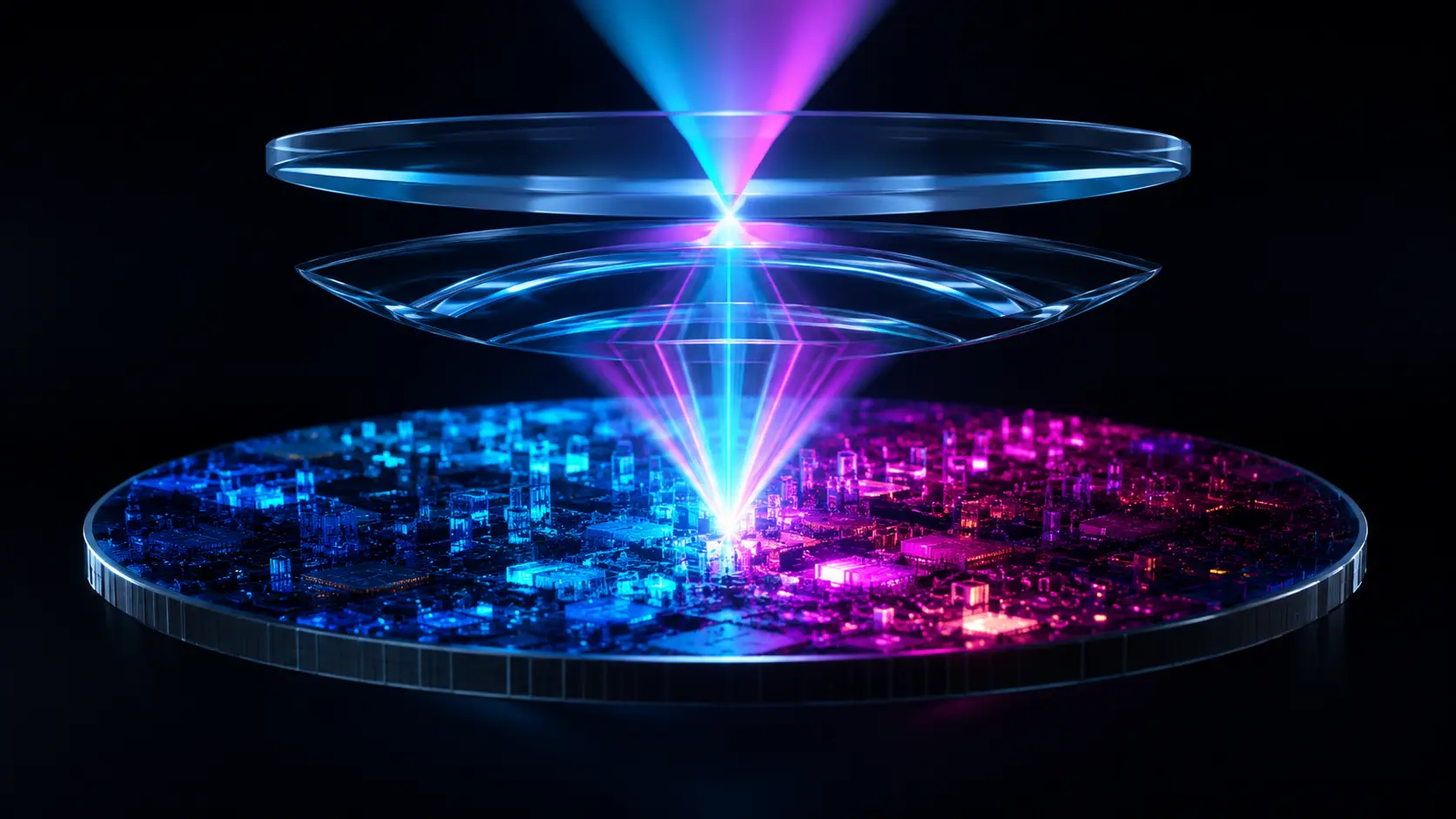
To make smart glasses truly wearable, engineers had to stop treating displays like glass screens and start treating them like microchips. They took the organic light-emitting diodes (OLED) that power your smartphone and printed them directly onto monocrystalline silicon wafers—the exact same materials used to build computer processors. This breakthrough creates screens smaller than a postage stamp, packing thousands of pixels into a single millimeter. Why should you care right now? Because combining these microscopic silicon screens with radically thin folded lenses is finally shrinking the bulky VR headset into a pair of sleek, lightweight glasses, triggering a massive boom in the multi-billion-dollar spatial computing hardware market.
What is Micro-OLED?
Micro-OLED, frequently referred to as OLED-on-Silicon (OLEDoS), is an advanced display technology that integrates organic light-emitting diodes directly onto a monocrystalline silicon CMOS wafer instead of a traditional glass substrate. This architecture enables microscopic pixel pitches and ultra-high pixel densities exceeding 3,000 PPI, eliminating the visual grid effect in near-eye spatial computing headsets.
At a Glance
- Concept: Shrinking a high-definition 4K television down to the size of a quarter by utilizing silicon microchip manufacturing plants instead of traditional glass display factories.
- Why it matters: Human eyes are incredibly sensitive to jagged pixels when a screen is placed an inch away. By crossing the 3,000 PPI threshold, Micro-OLED achieves “retina-level” clarity, completely tricking the brain into perceiving digital objects as solid physical reality.
- Who uses it: Elite spatial computing hardware manufacturers (Apple, Sony, Meta), military defense contractors for helmet-mounted displays, and professional camera manufacturers for electronic viewfinders.
- Biggest takeaway: The display is only half the equation. To make the headset thin, these microscopic screens must be paired with “Pancake Optics”—a complex lens system that bounces light back and forth to drastically shorten the physical depth of the headset.
In Simple Words
Look at the screen of your smartphone or television very closely. You will see that the picture is made of a massive grid of tiny, colored squares called pixels. On a standard TV, these pixels are printed onto a large sheet of glass.
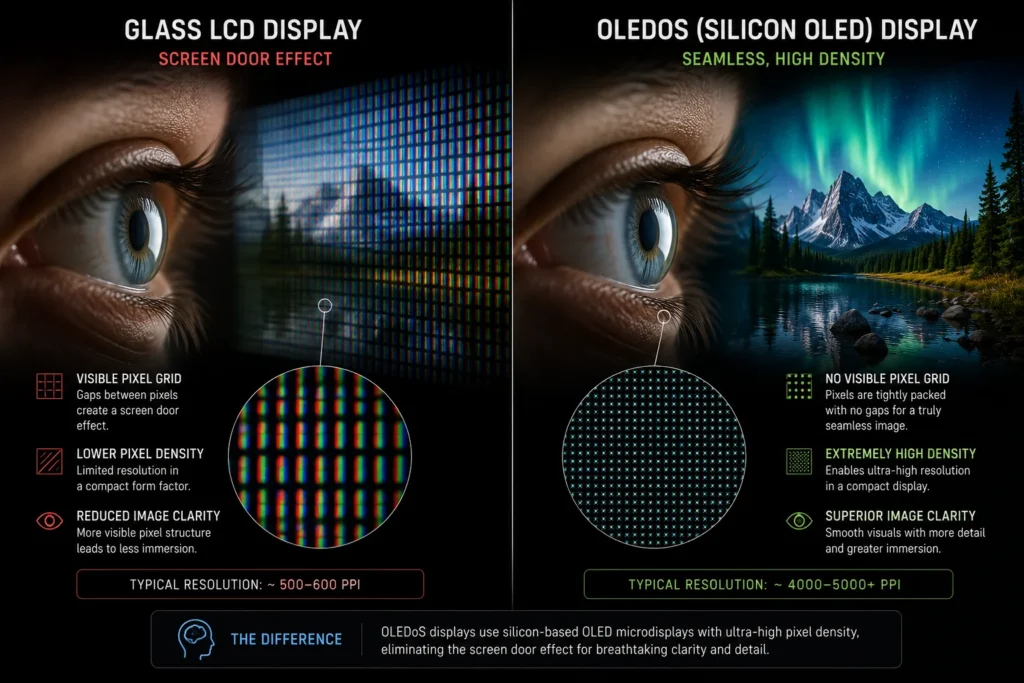
When you put a glass screen inside a VR headset, you have to use a magnifying glass to make the screen fill your entire field of view. Because the pixels are on glass, they are relatively large. When you magnify them, the black gaps between the pixels get magnified too. To the human eye, it looks like you are looking at the virtual world through a physical screen door.
Micro-OLED solves this by abandoning the glass entirely.
Instead, engineers use a silicon computer chip. Because computer chips are printed using advanced lasers, the wiring can be insanely small. Engineers print pixels directly onto the silicon chip that are only 4 microns wide—less than a tenth of the width of a human hair. When you put a magnifying lens over a Micro-OLED chip, the pixels are so densely packed that your eye physically cannot see the gaps between them. The grid vanishes, and the digital world looks flawlessly smooth.
Why This Matters
The spatial computing industry is currently undergoing a violent hardware pivot. First-generation VR was characterized by bulky, front-heavy headsets. This bulk severely limited adoption; enterprise workers could not wear them for an eight-hour shift without severe neck strain, and consumers abandoned them in closets.
For Hardware Investors and Supply Chain Execs, the Micro-OLED market is the primary bottleneck and the most lucrative growth vector in augmented and virtual reality (AR/VR). Growing at an estimated 38% CAGR to hit a projected USD 8.85 billion by 2031, the entire form-factor of the next decade of computing relies heavily on securing these silicon-based displays. If an original equipment manufacturer (OEM) cannot secure an allotment of high-resolution OLEDoS panels, they simply cannot build a competitive, lightweight mixed-reality headset.
The Global Micro-OLED Supply Chain
The integration of OLEDoS fundamentally alters the global electronics supply chain.
Traditionally, the display industry was dominated by massive, city-sized glass fabrication plants in South Korea and China (Samsung Display, LG Display, BOE). However, Micro-OLED requires semiconductor cleanrooms. This has forced traditional display makers to partner tightly with pure-play semiconductor foundries (like TSMC or specialized Chinese fabs).
Companies like Sony Semiconductor Solutions, SeeYA Technology, and BOE have spent the mid-2020s aggressively ramping up 300mm (12-inch) monocrystalline silicon wafer production lines specifically dedicated to printing these micro-displays. This blurs the line between a “display manufacturer” and a “microchip foundry,” turning spatial computing screens into highly complex, semiconductor-constrained commodities.
How Micro-OLED Spatial Computing Works
Eliminating the screen door effect and shrinking a headset requires hacking the fundamental physics of optics and electron mobility. Here is the first-principles breakdown.
1. The Fundamental Problem: Low Electron Mobility on Glass
In standard displays, the transistors that turn pixels on and off are made of Low-Temperature Polycrystalline Silicon (LTPS) sprayed onto a glass substrate. Glass is an insulator; the electron mobility (how fast electricity moves through it) is low. Because the electricity moves slowly, the wires and transistors must be physically large to handle the current. This physically prevents the pixels from shrinking below 40 microns.
2. The Insufficiency of Traditional Fresnel Lenses
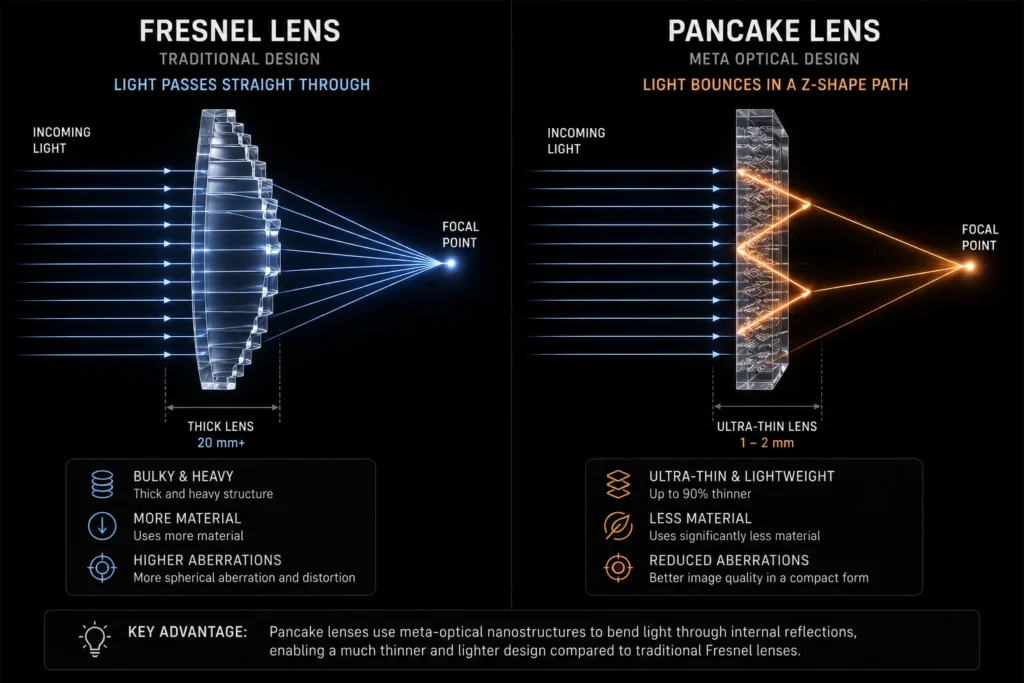
Legacy VR headsets used Fresnel lenses (concentric ridged plastic lenses) to magnify the glass screens. Because light travels in straight lines, a Fresnel lens requires 2 to 3 inches of empty physical space between the screen and the lens to focus the image. This empty space is what makes VR headsets stick out so far from your face, causing immense neck strain.
3. The Core Mechanism: The CMOS Silicon Backplane
To shrink the pixels, engineers abandoned glass and utilized monocrystalline silicon wafers—the exact same highly conductive substrate used to make CPUs. This is the CMOS (Complementary Metal-Oxide-Semiconductor) backplane. The electron mobility on a silicon wafer is nearly 10 times higher than on glass. This extreme efficiency allows the wiring to be microscopically thin, shrinking the pixel pitch down to a staggering 3.5 to 9 microns. The organic light-emitting diodes (OLEDs) are then deposited directly on top of this highly integrated silicon circuit.
4. Technical Depth: Pancake Optics
Because the Micro-OLED screen is now the size of a postage stamp, it must be radically magnified. But to fix the bulky headset problem, engineers introduced Pancake Optics (folded optical paths).
Instead of letting light travel in a straight line across 3 inches of empty space, a pancake lens uses half-mirrors and polarization filters to forcefully bounce the light back and forth internally within the lens itself. By “folding” the light path into a Z-shape, the lens achieves the exact same focal distance while physically sitting mere millimeters away from the Micro-OLED screen, instantly cutting the physical depth of the headset by 50%.
5. Real-World Consequences: The Brightness Penalty
Folding light comes with a severe physics penalty. Every time the light bounces inside the pancake lens, it loses energy. In fact, pancake lenses block roughly 85% to 90% of the light emitted by the screen. If you put a normal smartphone screen behind a pancake lens, it would be pitch black. Therefore, Micro-OLEDs must be driven to blinding, extreme peak brightness levels (exceeding 5,000 to 10,000 nits at the source) just so 500 nits of comfortable light ultimately reaches the user’s eye.
Commercial Applications of OLEDoS Displays
The deployment of OLEDoS is aggressively dividing the consumer electronics market into high-end spatial computing and legacy VR.
Premium Mixed Reality (Apple Vision Pro & Sony): The benchmark for Micro-OLED deployment is high-end mixed reality (MR). Devices like the Apple Vision Pro rely on dual Micro-OLED displays (manufactured by Sony) boasting 23 million pixels across two postage-stamp-sized panels. This extreme density (roughly 3,400 PPI) allows professionals to read 8-point text on floating virtual monitors with zero eye strain, officially elevating the headset from a gaming toy into a viable enterprise productivity machine.
Military and Tactical Aviation: Long before consumer VR, Micro-OLEDs were heavily funded by defense contractors. Modern fighter pilots (like those flying the F-35) use augmented reality Helmet-Mounted Displays (HMDs). These viewfinders project targeting data, thermal imaging, and radar directly into the pilot’s retinas. Micro-OLED is mandatory here because it offers an infinite contrast ratio (true blacks), ensuring that the pilot’s night vision is not blinded by the gray backlight bleed associated with traditional LCDs.
Professional Photography (EVFs): Electronic Viewfinders (EVFs) in high-end mirrorless cameras (like the Nikon Z8 or Sony Alpha series) are entirely reliant on sub-1-inch Micro-OLED displays. Because OLEDoS panels offer sub-millisecond response times (<0.01 ms), sports and wildlife photographers can track fast-moving subjects with zero motion blur or ghosting inside the viewfinder.
Economic & Strategic Impact
The core vulnerability of the Micro-OLED revolution is the Manufacturing Yield Crisis.
Printing 4K resolution onto a 1-inch silicon wafer is a metallurgical high-wire act. If a single microscopic dust particle falls onto a 65-inch television screen during manufacturing, one pixel dies, and the customer never notices. If that exact same dust particle falls onto a Micro-OLED wafer, it wipes out a massive cluster of microscopic pixels, ruining the entire display.
Currently, mass-production yields for high-end OLEDoS panels hover around 80% to 85%, compared to 95%+ for traditional smartphone OLEDs. This low yield means the manufacturer has to throw away 20% of what they produce, keeping the cost of a single Micro-OLED display module astronomically high (often exceeding $300 to $400 per eye). For tech investors, the holy grail is the foundry that can successfully stabilize OLEDoS yield rates, which will immediately drop the Bill of Materials (BOM) cost and allow sub-$1,000 spatial computing glasses to hit the mainstream market.
Advantages
- Extreme Pixel Density: Packs 3,000 to 4,000+ Pixels Per Inch (PPI), completely erasing the “screen door effect” and delivering retina-level visual fidelity.
- True Black Contrast: Because it is an OLED, every microscopic pixel emits its own light. To show black, the pixel simply turns off, achieving contrast ratios of 100,000:1 and producing perfect depth in virtual environments.
- Form Factor Compression: The monocrystalline silicon backplane prevents the panel from physically warping, maintaining the exact, rigid optical alignment necessary to pair with ultra-thin pancake lenses.
- Zero Motion Blur: Achieves pixel response times of less than 0.01 milliseconds, eliminating the nauseating visual smearing common in older VR headsets during rapid head movements.
Limitations
- Thermal Constraints: Driving 5,000 nits of brightness out of a 1-inch silicon chip generates immense, concentrated heat. Because pancake headsets are thin, there is very little internal volume for fans or heat sinks, requiring advanced thermal throttling software to prevent the display from burning the user’s face.
- Astronomical Costs: The requirement to use advanced semiconductor lithography on 300mm silicon wafers makes OLEDoS exponentially more expensive to manufacture than traditional glass displays.
- Color Shift: At extreme viewing angles, the light passing through the dense color filters of a Micro-OLED can shift slightly in color or lose brightness, requiring complex software calibration to correct chromatic aberration at the edges of the lens.
Common Misconceptions
Misconception: Micro-OLED and MicroLED are the exact same thing.
Reality: They are entirely different chemical technologies. Micro-OLED uses organic (carbon-based) materials that degrade over time but are easier to print at ultra-high resolutions today. MicroLED uses inorganic materials (gallium nitride), which are vastly brighter and never degrade, but printing them at a microscopic scale is currently a massive, unsolved manufacturing nightmare.
Misconception: You can just use a smartphone screen for VR.
Reality: Smartphone screens max out around 400 to 500 PPI. When placed two inches from your eye and magnified by a lens, a smartphone screen looks like an unreadable, pixelated mosaic. True spatial computing requires a minimum of 3,000 PPI.
Misconception: The headset is heavy because of the Micro-OLED screen.
Reality: The Micro-OLED screen itself weighs less than 3 grams. The heavy, front-loaded weight of a mixed reality headset is caused by the thick glass optical lenses, the metal heat sinks, and the massive battery required to power the processors.
What Most People Miss
The absolute necessity of Foveated Rendering and Eye-Tracking Latency.
A dual-4K Micro-OLED headset requires the computer processor to render 23 million pixels 90 times a second. Even the most powerful desktop GPU on Earth struggles to do this, let alone a mobile chip strapped to your head.
What most observers miss is that Micro-OLED technology is completely useless without eye-tracking. Human eyes only see high resolution in the very center of their vision (the fovea); everything in the periphery is blurry. By using infrared cameras to track exactly where the pupil is looking, the headset executes Foveated Rendering. It only renders the 10% of the Micro-OLED screen you are staring at in 4K resolution, and drops the surrounding pixels to low resolution. If the eye-tracking is even a millisecond too slow, you will catch the screen looking blurry, breaking the illusion entirely. The success of the optics relies entirely on the speed of the biometric sensors.
Comparison Table
| Feature | LCD on Glass (Legacy VR) | OLED on Glass (Mobile VR) | Micro-OLED / OLEDoS (Spatial Computing) |
| Substrate Material | Glass | Glass | Monocrystalline Silicon Wafer |
| Pixel Pitch | 40 – 60 microns | 20 – 40 microns | 3.5 – 9 microns |
| Pixel Density (PPI) | 400 – 800 | 500 – 1,200 | 3,000 – 4,000+ |
| Lens Compatibility | Fresnel (Thick) | Fresnel / Aspheric | Pancake (Ultra-Thin Folded Optics) |
| Screen Door Effect | Severe | Moderate | Completely Eliminated |
| Contrast Ratio | 1,000:1 (Backlit) | 100,000:1 | 100,000:1 (True Black) |
Case Study
Situation: When Apple engineers began designing the Vision Pro spatial computer, their mandate was to create a device capable of fully replacing a MacBook Pro for enterprise productivity. This meant the headset had to render tiny, 8-point text with absolute, monitor-level clarity, a feat no existing VR headset could achieve without causing severe eye strain.
Challenge: Utilizing standard glass-based OLED displays limited the pixel density to roughly 1,000 PPI. When magnified through the lenses, text appeared jagged and unreadable. Furthermore, using traditional lenses required a focal distance that made the headset too physically deep and ergonomically unbalanced.
Solution (The Silicon Pivot): Apple abandoned glass displays entirely and partnered with Sony Semiconductor Solutions to secure custom Micro-OLED (OLEDoS) panels. By printing the pixels on a silicon CMOS backplane, they achieved a pixel pitch small enough to cram 23 million pixels into two panels the size of a postage stamp. They paired these dense screens with custom-engineered, three-element pancake lenses to fold the light path and compress the hardware.
Outcome: The integration delivered an effective 3,400 PPI. The physical grid between the pixels vanished completely. Users could effortlessly read fine text, engage in professional photo editing, and manipulate 3D CAD models with zero visual degradation.
Lessons Learned: The Vision Pro effectively set the new baseline standard for the industry. It proved that achieving true spatial computing presence is an exercise in semiconductor lithography, not standard display manufacturing. The case study confirmed that the integration of OLEDoS and pancake optics is the only mathematically viable pathway to enterprise-grade mixed reality.
Future Outlook
Next 12–24 Months
The era of Chinese Foundry Expansion. Throughout late 2026 and 2027, the monopoly held by early pioneers like Sony will break. Chinese semiconductor display manufacturers, specifically BOE and SeeYA Technology, are bringing massive new 300mm OLEDoS production lines online. This massive injection of manufacturing capacity will trigger a price war. As the cost of Micro-OLED modules drops by 30% to 40%, we will see a flood of lighter, sub-$1,000 “Smart Glasses” enter the market, aimed directly at consumers rather than enterprise users.
Next 3–5 Years
The optimization of White OLED + Color Filter (WOLED+CF) vs RGB. Currently, most Micro-OLEDs use a white OLED backlight passed through a color filter to create RGB colors. This is easy to manufacture but wastes brightness. By the late 2020s, the industry will pivot aggressively toward Direct-Emission RGB Micro-OLEDs. By using semiconductor lithography to precisely deposit red, green, and blue organic materials directly next to each other (without a light-blocking filter), the screens will instantly double their peak brightness to over 10,000 nits, completely overwhelming the light loss of pancake lenses.
Next 10 Years
The transition to Inorganic MicroLED. While Micro-OLED dominates today, organic materials inevitably degrade and suffer from “burn-in” at extreme brightness levels. By the mid-2030s, the ultimate frontier of spatial computing will commercialize: MicroLED. This technology replaces the organic carbon compounds with microscopic, inorganic crystals (gallium nitride). MicroLEDs will offer the exact same 4,000 PPI resolution but will be 100 times brighter and virtually indestructible, allowing for transparent, augmented reality glasses that look exactly like Ray-Bans and function perfectly in blinding, direct sunlight.
Most Likely Scenario
Micro-OLED has successfully crossed the commercial chasm, transitioning spatial computing from a nauseating novelty into a legitimate computing platform. For the remainder of this decade, the combination of OLEDoS and pancake optics will serve as the undisputed architectural standard for all premium mixed-reality headsets.
Key Takeaways
- Micro-OLED (OLEDoS) prints display pixels directly onto a silicon microchip (CMOS backplane) instead of a standard sheet of glass, vastly increasing electrical efficiency.
- This silicon foundation shrinks the pixel pitch to 4 microns, achieving pixel densities of 3,000 to 4,000+ PPI.
- Because the pixels are packed so densely, the human eye cannot see the black gaps between them, permanently eliminating the nauseating “screen door effect” of legacy VR.
- To shrink the bulky headset, these microscopic screens must be paired with “Pancake Optics,” which fold the light back and forth to reduce physical headset depth by 50%.
- Pancake lenses block up to 90% of the light, meaning the Micro-OLED screen must output blinding, extreme brightness (5,000+ nits) to compensate, creating massive thermal engineering challenges.
- The industry is shifting from traditional display factories in South Korea to semiconductor foundries in China and Japan, sparking a $8.8 billion supply chain race by 2031.
Glossary
CMOS (Complementary Metal-Oxide-Semiconductor): The standard technology used for constructing integrated circuits and microprocessors. In Micro-OLED, it serves as the highly conductive backplane that drives the pixels.
Electronic Viewfinder (EVF): A small, ultra-high-resolution Micro-OLED screen inside a digital camera that shows the photographer exactly what the camera sensor sees in real-time.
Foveated Rendering: A rendering technique that uses eye-tracking to heavily concentrate graphics processing power exactly where the user is looking, blurring the peripheral vision to save computer battery life.
Micro-OLED (OLEDoS): OLED-on-Silicon. A display technology that merges organic light-emitting diodes with a semiconductor silicon wafer to achieve microscopic pixel density.
Pancake Optics: A lens architecture used in modern headsets that utilizes polarization filters to fold the path of light back on itself, drastically shortening the physical distance required to focus the image.
Screen Door Effect (SDE): A visual artifact in older VR headsets where the user can clearly see the unlit, black physical gaps between the pixels, making it look like they are viewing the world through a mesh screen.
Sources
[1] Research and Markets: Micro-OLED Display Market Size, Share & Forecast to 2032 (January 2026)
[2] Strategic Market Research: OLED Microdisplay Market Report Updated Version 2026 (August 2026)
[3] Mordor Intelligence: OLED Microdisplay Market Size, Trends, Share & Competitive Landscape 2031 (July 2026)
[4] DisplayModule: Micro OLED for Smart Glasses | Resolution, Contrast and Pixel Density (February 2026)
[5] ARWD: Comparing Pancake And Micro OLED Display Tradeoffs For Next Gen VR Headsets (June 2026)