Advertisement
)

We know exactly how artificial intelligence writes poetry, generates code, and solves mathematical equations. It relies on the tokenization of language—breaking human thought into discrete mathematical integers that a transformer neural network can predict. But intelligence trapped inside a digital chat window cannot clean a hospital room, operate a factory assembly line, or wash dishes. For an AI to perform useful labor in the physical world, it must command a body. It must translate the chaotic, continuous geometry of a live video feed into the exact mechanical torque required to reach out, grasp a fragile coffee cup, and lift it without shattering the porcelain or crashing into a table.
For decades, the robotics industry treated this as an insurmountable engineering problem, relying on rigid, hand-coded pipelines that failed the moment an object was moved an inch out of place.
That brittle era has ended. Researchers have discovered that if you can teach an AI to predict the next word in a sentence, you can teach it to predict the next physical movement of a robotic arm. By casting physical coordinates as text tokens—a framework known as Vision-Language-Action (VLA) modeling—engineers have created a universal brain for Physical AI. Why should you care right now? Because VLA tokenization is the bedrock technology enabling the deployment of autonomous humanoid robots into the commercial workforce. Understanding how an AI translates pixels into kinetic force is the key to mapping the next multi-trillion-dollar phase of global automation.
What is Vision-Language-Action (VLA) Tokenization?
Vision-Language-Action (VLA) tokenization is a machine learning mechanism that unifies visual perception, text processing, and robotic motor control. It translates continuous physical actions (such as joint angles and motor velocity) into discrete numerical tokens, allowing a single multimodal foundation model to autoregressively predict a robot’s physical trajectory identically to how it generates text.
At a Glance
- Concept: Teaching a Large Language Model (LLM) to speak a new language: the language of physical movement. The model ingests a video feed and a text command, and outputs a string of numbers that correspond to robotic joint coordinates.
- Why it matters: It eliminates the need to program robots with rigid rules. A VLA model can transfer the “common sense” it learned from reading the internet directly into physical tasks, allowing a robot to reason through novel situations it has never encountered.
- Who uses it: Cutting-edge robotics labs and hyperscalers including Google DeepMind (RT-2), Figure AI (Helix), Physical Intelligence π0, and open-source consortiums (OpenVLA).
- Biggest takeaway: VLA models allow robots to perform “Chain-of-Thought” reasoning. Before the robot moves, the AI explains its logical plan in text, and then executes the corresponding action tokens to complete the physical task.
In Simple Words
If you ask a standard AI chatbot to “pick up the red apple,” it will reply with a text response: “I am an AI, I cannot pick up apples.” The AI understands what an apple is, but it has no physical body to command.
If you tell a classic, factory-floor robot to “pick up the red apple,” the robot will freeze. It doesn’t know what “red” or “apple” means. It only understands exact mathematical coordinates, like “Move Joint A 45 degrees, close Gripper B by 2 inches.”
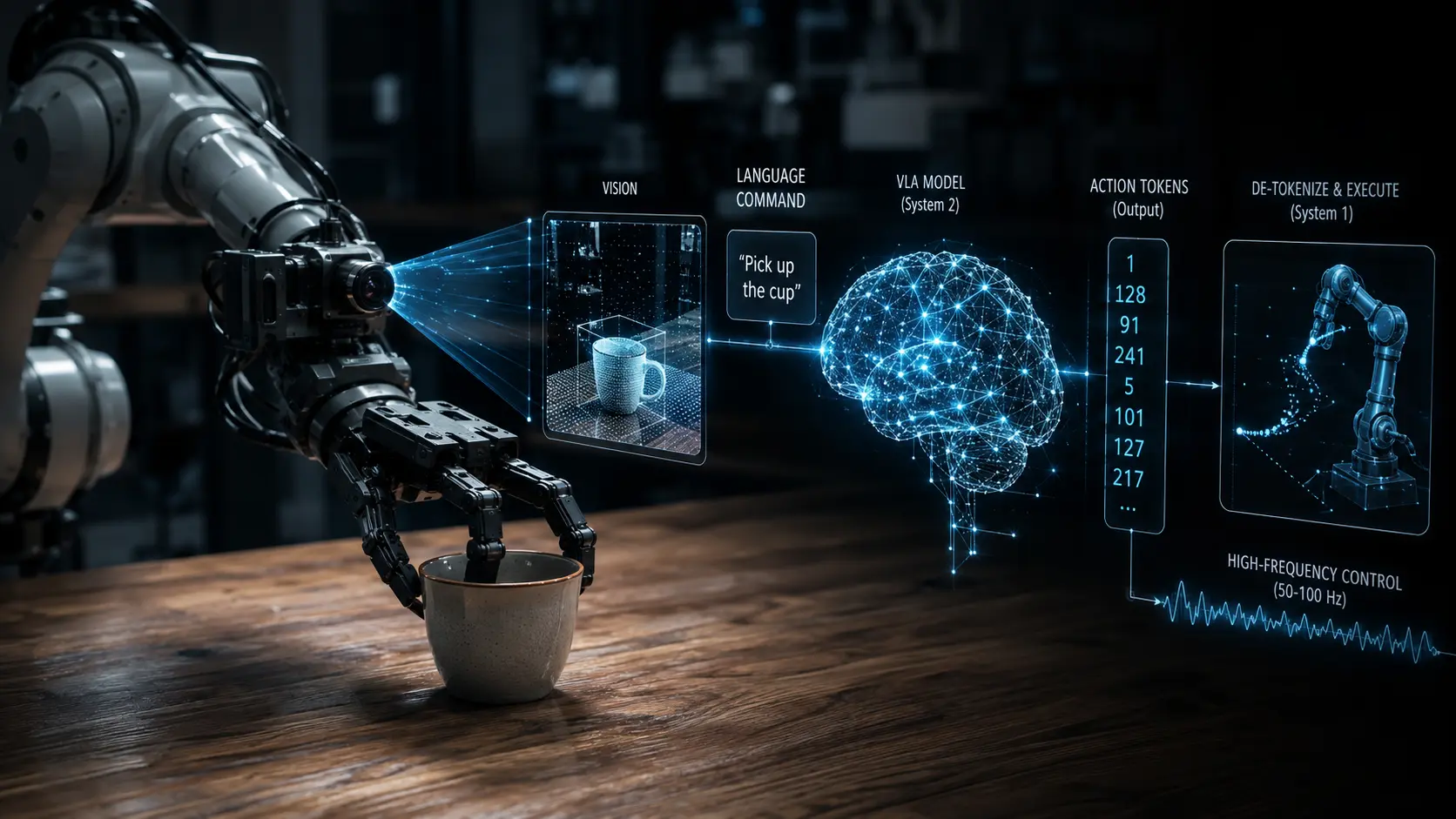
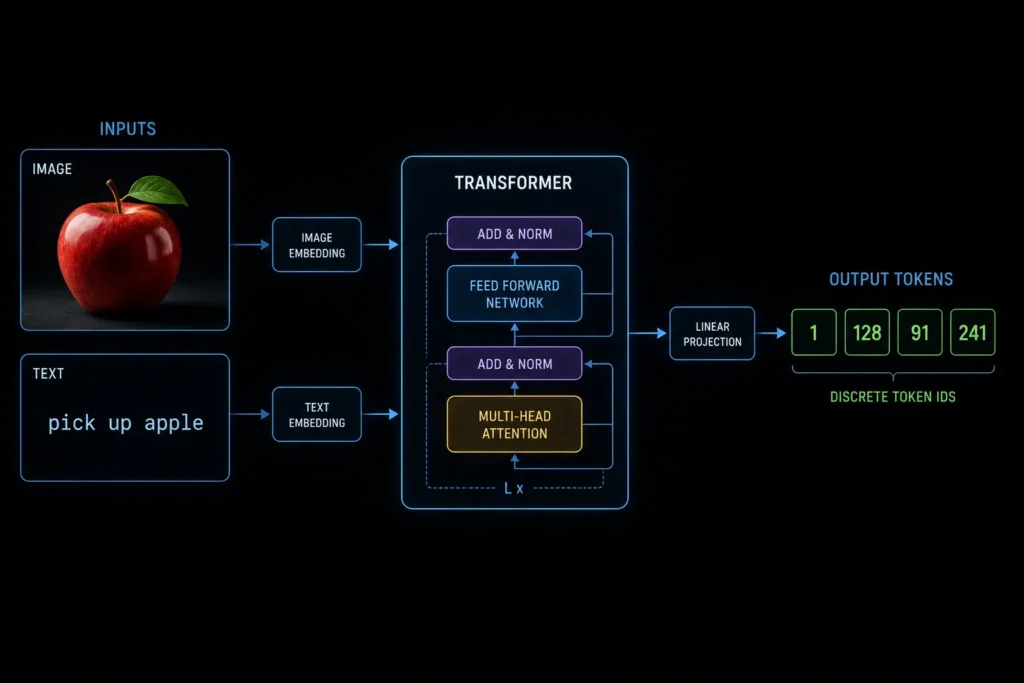
VLA Tokenization builds a bridge between these two systems. It takes a massive AI that has read the entire internet (so it deeply understands what a red apple is) and adds a new vocabulary to its brain. Along with standard words, the AI is taught a dictionary of “Action Tokens.” Now, when the robot’s camera sees the apple, the AI processes the image and outputs a sentence that looks like this: “1 128 91 241 5 101 127 217”.
To a human, that is a string of random numbers. To the robot’s motors, those numbers are exact physical coordinates. The AI is literally “speaking” the robot’s limbs into motion, transferring its vast digital intelligence directly into physical dexterity.
Why This Matters
The capital expenditure (CapEx) currently deployed to scale humanoid robotics is entirely dependent on the success of VLA architectures.
For Automation Investors and Robotics Engineers, the historical bottleneck of robotics was the “Sim-to-Real” gap. Engineers had to write custom, highly specific code for every single robot to perform every single task. If you wanted a robot to fold shirts instead of sorting boxes, you had to rewrite the entire software stack. VLA tokenization enables the “Generalist Robot.” Because the VLA relies on an end-to-end neural network, you simply fine-tune the model on video demonstrations of folding shirts. The model inherently associates its high-level semantic understanding of clothing with the newly learned low-level motor tokens. This unified framework drastically accelerates the time-to-market for commercial robotic labor.
The Breakthrough of Robotic Transformer 2 (RT-2)
The paradigm shift occurred in mid-2023 when Google DeepMind unveiled the Robotic Transformer 2 (RT-2).
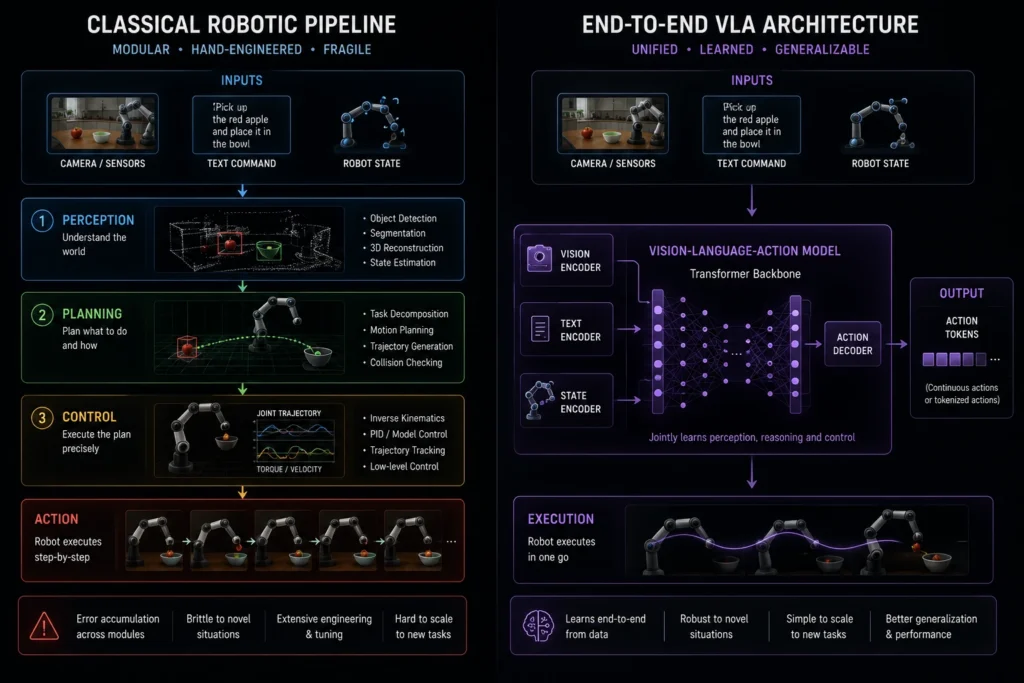
RT-2 was revolutionary because it bypassed the traditional, highly compartmentalized robotics architecture—where perception, planning, and control were handled by entirely separate software systems. Instead, DeepMind co-fine-tuned an existing 55-billion parameter Vision-Language Model (PaLI-X) on a massive dataset of robotic trajectories. The breakthrough was representing the continuous, fluid motions of a robotic arm as discrete text strings. By proving that a foundational AI model could digest web-scale knowledge and directly excrete valid robotic control instructions, the industry permanently abandoned classical control theory in favor of deep-learning-driven embodied agents.
How Vision-Language-Action (VLA) Models Work
Bridging the gap between the chaotic physical world and the discrete mathematics of a neural network requires aggressive data transformation. Here is the first-principles breakdown of VLA architecture.
1. The Fundamental Problem: The Embodiment Gap
Language models predict discrete tokens (words) from a fixed vocabulary. The physical world is continuous; a robotic arm has infinite potential positions in 3D space, varying velocities, and complex frictional dynamics. You cannot natively feed a continuous physical state into an architecture designed to predict discrete words.
2. The Insufficiency of Classical Robotics
Traditional systems relied on “cascaded” pipelines: an object detection algorithm would spot a cup, pass the 3D coordinates to a motion-planning algorithm, which calculated a path, and passed it to a motor controller. If the object detection algorithm misidentified a shadow as a solid object, the entire pipeline collapsed and the robot crashed.
3. The Core Mechanism: End-to-End Multimodal Encoding
A VLA model replaces the entire pipeline with a single Transformer network. The model ingests a natural language command (e.g., “stack the green blocks”) using a text encoder, and processes a live camera feed (RGB-D) using a Vision Transformer (ViT). These inputs are mapped into a shared latent space as “Prefix Tokens” and “State Tokens,” establishing the model’s foundational understanding of the environment and its own physical posture.
4. Technical Depth: Action Tokenization and Discretization
To generate movement, the continuous physical actions of the robot must be digitized. In discrete token output models (like RT-2), the continuous dimensions of the robot’s movement are sliced into 256 uniform “bins”.
If a robotic arm needs to move to coordinate (X, Y, Z) with a specific pitch and yaw, the VLA calculates the trajectory τ_1:N and outputs a string of discrete integers representing the bins. The network autoregressively generates these action tokens just as it would generate text.
5. Real-World Consequences: De-tokenization and Execution
During inference, the model rapidly outputs these numbers (e.g., “1 128 91 241…”). A lightweight deterministic script at the edge of the robot “de-tokenizes” the sequence, converting the bins back into continuous electrical signals that physically drive the actuators and servos, completing the closed-loop control.
Commercial Applications of Physical AI and VLA Models
VLA tokenization is moving artificial intelligence out of the server rack and into the physical environment.
Humanoid Factory Automation: Companies developing general-purpose humanoids (such as Figure AI and Tesla’s Optimus) rely heavily on VLA architectures to perform unstructured tasks. If a humanoid is instructed to “install the weather stripping,” the VLA model processes the unpredictable lighting, the slight misalignments of the car door, and the tactile feedback of the stripping material, generating adaptive action tokens in real-time to complete the insertion without requiring rigid, pre-programmed waypoints.
Improvised Reasoning and Tool Use: Because VLAs inherit the semantic understanding of internet-scale language models, they can improvise. In tests, when RT-2 was instructed to find an “improvised hammer,” it successfully scanned the physical environment, identified a rock, picked it up, and used it to strike an object. This zero-shot transfer of web knowledge into physical logic is fundamentally impossible under classical robotic programming.
Surgical and Precision Robotics: In environments requiring extreme dexterity, such as robotic surgery or microscopic electronics assembly, developers are replacing discrete action tokens with “Continuous Output” models (like diffusion or flow-matching architectures). Models like Physical Intelligence’s π0 generate continuous, high-frequency actions up to 50 Hz, achieving the fluid, highly sensitive motor control necessary to manipulate fragile tissues or microscopic wiring.
Economic & Strategic Impact
The mass adoption of VLA models introduces a massive Compute Latency Bottleneck at the edge.
Generating a sequence of tokens from a 55-billion parameter model requires immense processing power. If the robot takes 2 seconds to generate the next batch of action tokens, the robot will move with a severe, stuttering lag. To achieve the 50 to 100 Hz control frequencies necessary for smooth, human-like movement, the robotics industry is being forced to radically redesign on-board silicon.
This creates a massive economic opportunity for semiconductor companies. The market is aggressively pivoting to develop specialized edge-inference chips (like NVIDIA’s Jetson Thor) that are purpose-built to accelerate VLA transformer architectures directly inside the robot’s torso, untethering the robot from high-latency cloud servers.
Advantages
- Zero-Shot Generalization: The model can accurately execute physical tasks involving objects, semantic instructions, or visual environments it has never seen in its specific robotics training data, purely by relying on its vast internet pre-training.
- Unified Architecture: Eliminates the need for highly specialized, fragmented engineering teams. A single neural network handles the visual perception, the language translation, and the physical execution.
- Chain-of-Thought Execution: The VLA can be prompted to output its logical reasoning steps in text (e.g., “The user is sleepy, so I will choose the energy drink”) before generating the action tokens, allowing developers to audit the robot’s physical intentions in plain English.
Limitations
- Inference Latency: Running massive VLM backbones for motor control is inherently slow. The largest iteration of RT-2 (55B parameters) operated at a sluggish 1 to 3 Hz frequency, which is vastly too slow to catch a falling object or react to sudden dynamic hazards.
- Irreversible Actions: If an LLM hallucinates a bad paragraph of text, the user simply regenerates it. If a 300-pound humanoid robot hallucinates a bad action token, it crushes a valuable piece of equipment or injures a human. The physical risk calculus of VLA deployment is orders of magnitude higher than digital agents.
- Data Scarcity: While we have trillions of words of text on the internet to train language models, high-quality, teleoperated robotic trajectory data paired with language instructions is incredibly scarce and intensely expensive to gather.
Common Misconceptions
Misconception: VLA models are just ChatGPT plugged into a robot.
Reality: While VLAs share the transformer backbone of models like ChatGPT, they possess entirely different output structures. A standard LLM outputs semantic text; a VLA has a specialized “action head” trained specifically to output discrete robotic motor trajectories or continuous spatial flows.
Misconception: Robots learn to move purely by watching YouTube videos.
Reality: While video data helps with semantic scene understanding, learning how to physically move a joint requires paired kinematic data. The models must be fine-tuned on hundreds of hours of actual robot teleoperation data, mapping exact joint angles and gripper force to the visual feed.
Misconception: Tokenization is always discrete numbers.
Reality: The industry is heavily exploring continuous outputs. To avoid the jerky motion caused by slicing actions into 256 discrete bins, newer generalist models (like π0 and Helix) use diffusion policies to directly output continuous, fluid actions.
What Most People Miss
The architectural transition to the Dual-System (System 1 / System 2) Paradigm.
Early models like RT-2 forced the massive, sluggish 55B parameter brain to calculate every single millimeter of movement. This was inefficient and slow.
What most people miss is that the industry has shifted to a “Dual-System” architecture, mimicking the human brain (as popularized by Daniel Kahneman’s Thinking, Fast and Slow). Models like Figure AI’s Helix decouple the workload. An internet-scale VLM acts as System 2: it runs slowly (e.g., 5 Hz), looks at the room, understands the context, and formulates a high-level plan. It passes this plan to a much smaller, lightning-fast visuomotor policy, System 1. System 1 operates at 100 Hz, instantly translating the plan into high-frequency continuous action tokens to maintain precise physical balance and dexterity.
Comparison Table
| Feature | Classical Robotics (Heuristics) | Pure Vision-Language Models (VLMs) | Vision-Language-Action (VLAs) |
| Primary Input | Sensor data, rigid coordinate maps | Images, Video, Text | RGB-D Video, Text, Proprioception |
| Primary Output | Executable motor signals | Descriptive Text | Executable Action Tokens & Text |
| Generalization | None (Fails if environment changes) | Excellent (Semantic understanding only) | Excellent (Transfers logic to physical movement) |
| System Architecture | Cascaded, multi-software pipelines | End-to-end foundation model | End-to-end foundation model |
| Response to Novelty | Crashes or stalls | Describes the novelty | Adapts physical execution via inference |
Case Study
Situation: The robotics industry struggled for decades with the “Semantic Grounding” problem. If a human told a robot to “pick up the extinct animal,” classical robots failed entirely because they lacked the vast historical and cultural knowledge required to identify a dinosaur toy among a pile of modern animal toys.
Challenge: How to embed internet-scale semantic knowledge into a robotic control policy so the robot could accurately navigate novel, abstract human instructions without requiring developers to manually label millions of specific objects in the robot’s database.
Solution (The RT-2 Paradigm): In mid-2023, Google DeepMind launched Robotic Transformer 2 (RT-2). DeepMind researchers bypassed traditional programming and co-fine-tuned massive existing VLMs (PaLI-X and PaLM-E) directly on robotic teleoperation data. They cast the robot’s joint trajectories into sequences of action tokens (e.g., “1 128 91 241…”) and embedded them into the training set identically to natural language.
Outcome: During real-world evaluations, RT-2 successfully executed highly abstract, untrained commands. It was able to pick up an improvised hammer (a rock) or select the best drink for a tired person (an energy drink). The model demonstrated a 2x improvement in generalization to novel, unseen objects and semantic categories compared to prior state-of-the-art architectures.
Lessons Learned: The deployment of RT-2 proved that the tokenization of physical space is the definitive key to general-purpose robotics. It validated that transferring the semantic reasoning and “chain-of-thought” capabilities of a massive foundation model directly into low-level robotic control transforms a machine from a blind tool into an adaptive, reasoning agent.
Future Outlook
Next 12–24 Months
The era of Open-Source Embodiment Platforms. Just as Llama democratized the LLM space, initiatives like OpenVLA and Hugging Face’s LeRobot are aggressively democratizing physical AI. Over the next two years, the barrier to entry for training robotic brains will collapse. Smaller manufacturing firms and academic labs will utilize highly efficient, parameter-efficient fine-tuning (like LoRA) to quickly adapt compact VLA architectures (like SmolVLA) for specialized industrial tasks, eroding the monopoly of well-funded hyperscalers.
Next 3–5 Years
The scaling of Frequency-Space Tokenization and Diffusion. The jerky, discretized motion of early VLA models will be entirely eliminated. The industry will widely adopt models that leverage Flow-Matching and Diffusion policies to generate high-frequency (50-100 Hz) continuous control. Innovations like Frequency-space Action Sequence Tokenization (FAST), which compresses continuous tokens using discrete cosine transforms, will allow robots to execute highly dynamic, fluid movements (like catching a thrown object or performing acrobatics) with minimal compute latency.
Next 10 Years
The Universal Embodiment Standard. By the mid-2030s, the concept of writing specific software for a specific robot chassis will be obsolete. Massive VLA models will be completely “cross-embodied”. A single foundational AI will be trained to understand the universal physics of manipulation. When a user purchases a new drone, a robotic arm, or a bipedal humanoid, they will simply download the same universal VLA brain. The model will automatically read the robot’s specific joint configurations (URDF files) and instantly calibrate its action tokens to command the new body perfectly on the first try.
Most Likely Scenario
Vision-Language-Action tokenization is the final algorithmic hurdle to unlocking the commercial humanoid market. As edge-inference silicon improves and dual-system architectures master high-frequency motor control, VLAs will transition from heavily funded lab experiments into the ubiquitous operating systems of the global physical economy.
Key Takeaways
- Vision-Language-Action (VLA) models convert continuous physical robotic movements into discrete strings of text tokens, allowing AI to predict physical actions just like it predicts language.
- By fine-tuning existing Vision-Language Models on robotic trajectory data, VLAs eliminate brittle, hand-coded robotics pipelines, creating highly adaptive, end-to-end controllers.
- The architecture allows robots to execute “Chain-of-Thought” reasoning, enabling them to comprehend abstract commands (e.g., “pick up the smallest object”) without prior specific programming.
- Modern VLAs utilize a “Dual-System” architecture: a massive, slow internet-trained brain (System 2) handles high-level logic, while a fast, localized policy (System 1) executes the rapid, continuous motor control required for physical dexterity.
- A major limitation of VLA deployment is inference latency; predicting complex action tokens requires immense compute power, necessitating highly specialized, onboard edge-AI silicon.
- Unlike digital AI models, VLAs operate in the physical world where “hallucinations” or incorrect token generations can cause irreversible, dangerous damage to machinery or human operators.
Glossary
Action Token: A numerical or symbolic representation of a robot’s specific motor command (e.g., joint angle or gripper state) that allows an AI model to read and output physical movement like text.
Autoregressive Prediction: A mathematical process where a model predicts the next element in a sequence (the next word, or the next physical coordinate) based strictly on all the preceding elements.
Chain-of-Thought (CoT) Reasoning: A prompting technique where an AI model explicitly generates the intermediate logical steps in plain text before outputting the final answer or physical action token.
Dual-System Architecture: A robotic control framework consisting of a slow, highly intelligent model (System 2) for semantic planning, paired with a fast, continuous policy (System 1) for real-time motor execution.
Prefix Tokens: The initial contextual embeddings generated by a VLA model that compress the visual scene (the camera feed) and the natural language command into the model’s internal representations.
Vision-Language-Action (VLA) Model: A multimodal foundation model that jointly ingests visual data and text instructions, and directly outputs low-level, executable robotic actions.
Frequently Asked Questions
How does an AI model know how heavy an object is?
Current VLAs process visual and language data, but they increasingly rely on “State Tokens” (proprioception). These tokens feed real-time sensor data—like the electrical current draw from the robot’s finger motors—back into the model. If the motor draws heavy current, the VLA dynamically updates its tokens to account for the object’s weight and adjusts its grip force accordingly.
Do VLAs require an internet connection to work?
High-level “System 2” reasoning models are often massive (50B+ parameters) and may require a low-latency cloud or local server connection. However, the “System 1” visuomotor policy handling the rapid, localized physical movement runs entirely on-device to prevent fatal lag, ensuring the robot doesn’t drop an object if the Wi-Fi drops.
Why did Google use text tokens instead of just outputting continuous electrical voltages?
Casting physical actions as discrete text tokens allowed Google engineers to use their existing, incredibly powerful language models (like PaLM-E) without fundamentally changing the underlying architecture. By treating physical movement simply as “another language,” they seamlessly injected robotic control into internet-scale AI.
What happens if the AI hallucinates an action token?
This is the primary safety constraint of Physical AI. If the VLA outputs a token that tells a robotic arm to swing backwards through a solid wall, it could cause catastrophic damage. To mitigate this, engineers place hard-coded safety constraints (guardrails) downstream of the VLA, ensuring that if a mathematically dangerous trajectory is generated, the robot ignores it and halts.
Can one VLA control different types of robots?
Yes. Advanced generalist models (like Physical Intelligence’s π0 are trained on “cross-embodiment” datasets—meaning they ingest data from single arms, dual arms, and quadrupeds. The model learns the general physics of movement and applies it across vastly different robotic chassis.
Sources
[1] arXiv: Vision-Language-Action Models: Concepts, Progress, Applications and Challenges (May 2025)
[2] Google DeepMind: RT-2: New model translates vision and language into action (July 2023)
[3] CS391R (UT Austin): RT-2: Vision-Language-Action Models Transfer Web Knowledge to Robotic Control (October 2023)
[4] Wikipedia: Vision–language–action model
[5] Google DeepMind / GitHub: RT-2: Vision-Language-Action Models